
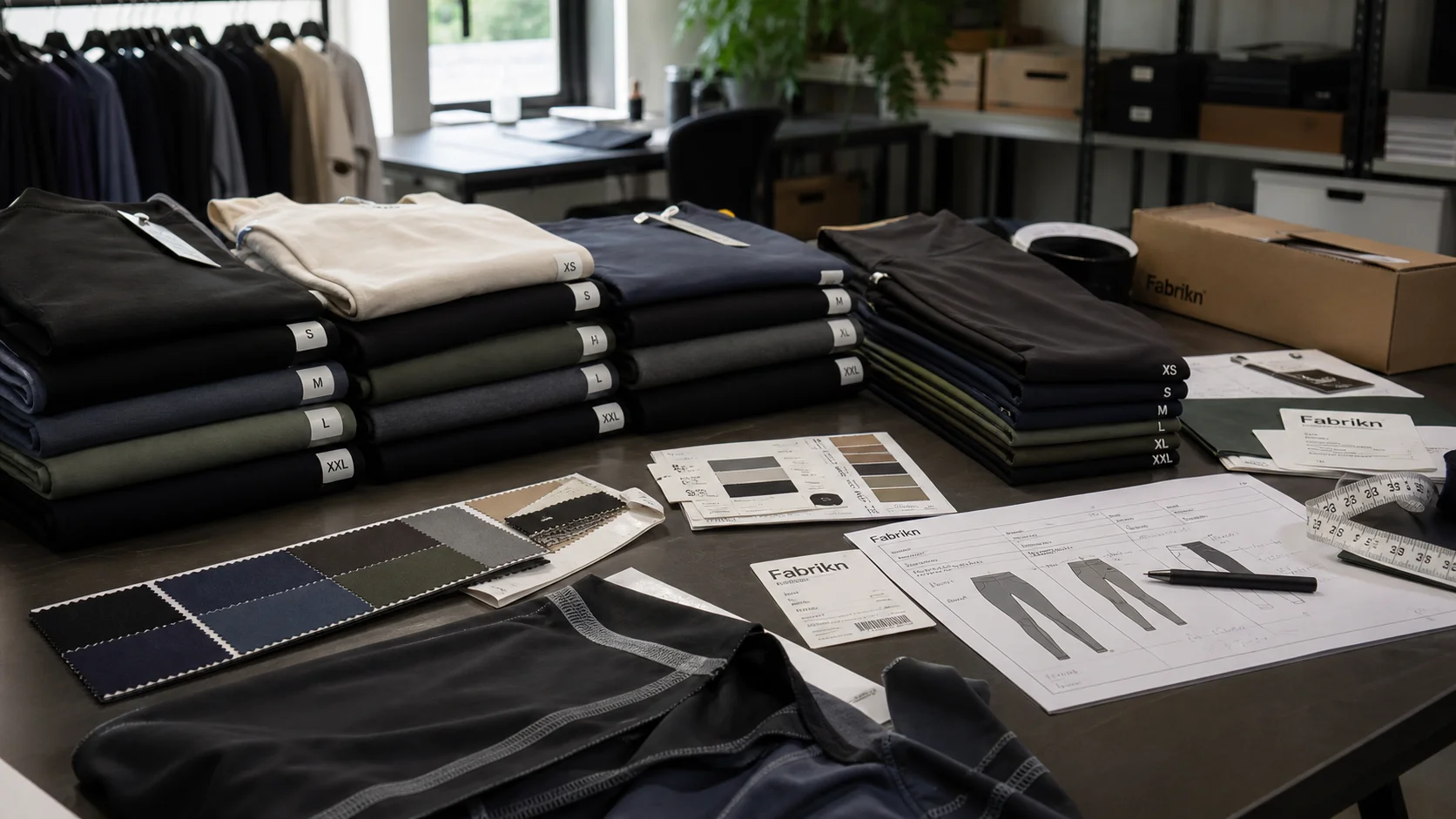
Ecommerce Clothing Box Supplier with checks for samples, fit, MOQ, QC evidence, pricing terms, and delivery risk.
Fast answer: Ecommerce Clothing Box Supplier: Board, Inserts, Print, and Freight should be judged by production evidence, not by a generic sourcing promise. The buyer needs sample proof, cost breakdowns, QC checkpoints, and delivery buffers in writing.
Ask for recent sample photos, measurement tolerances, fabric or print test assumptions, decoration test notes, packing examples, and a named inspection checkpoint. These details show whether the team can repeat an approved sample at bulk volume.
Separate garment cost, decoration, labels, packaging, sampling, testing, freight, and rush charges. When every cost line is visible, it becomes easier to reduce colorways, adjust size depth, or reserve more time for sampling.
Most apparel brands lose money in packaging long before they notice the leak. Damage, freight, and oversized cartons can quietly shave 2% to 7% off revenue, which is why choosing a clothing box packaging supplier for ecommerce brands is not a back-office errand. It affects conversion, returns, repeat orders, and the mood of your warehouse team on a Monday morning.
The box is part of the product.
I say that after visiting more than 200 factories across 8 countries. The same T-shirt can arrive in a slim 18pt mailer, a heavy rigid set-up box, or a corrugated carton that somehow seems to expand in transit. The pretty option on a mood board is often the one that turns into a freight headache.
One brand I audited shipped 40,000 units a month in rigid packaging and paid 22% more in freight than a competitor using a thinner 2.5 mm corrugated mailer with tighter tolerances. In China and Vietnam, thinner board, cleaner die cutting, and accurate folding usually beat glossy specs. A plant in Guangzhou held ±1.5 mm tolerance on a six-panel fold, while a boutique European vendor missed crease alignment by 4 mm on one side and called it “artisan.”
North American suppliers were strongest on communication and sampling speed, but many relied on outsourced board cutting, which added variation. The box that survives 3,000 miles in a courier network wins. For premium denim, basics, and even price-sensitive DTC tees, packaging changes perceived value more than most founders expect.
A $28 shirt can do fine in a simple kraft mailer with one-color print. A $140 knit sweater may deserve a rigid box with a magnetic closure, but only if it ships flat or nests efficiently. This is not luxury for its own sake. The job is to match presentation to contribution margin.
I have seen brands pay for foil stamping, soft-touch lamination, and foam inserts when a well-printed board with a 24-hour scuff test would have done the job. A clothing box packaging supplier for ecommerce brands should raise cart confidence without pushing shipping weight into the next bracket. A 350 g increase per parcel sounds tiny until it crosses a carrier threshold on 12,000 monthly orders.
A supplier scorecard should begin with measurable facts, not sales language. I grade board strength, dieline accuracy, print registration, coating performance, compression strength, and damage rates in transit. Data from ASTM matters because packaging failures are physical events, not branding opinions. A box that looks refined in a showroom can still collapse at 35 lbs compression if the flute profile is wrong.
Before sampling, I ask for substrate specs, finishing options, ink systems, MOQ, tolerance ranges, and packing method. That means thickness in mm or points, recycled content percentage, whether inks are soy-based or solvent-based, and how the boxes will be packed for export. I also want the carton count per master case and the case weight, because a supplier that ships 200 flat-packed boxes per carton is easier to warehouse than one that splits the same volume into 20 awkward bundles.
Certifications should be checked, not admired. FSC chain-of-custody records, recycled content verification, audited labor standards, and environmental audits are the proof points I trust. According to FSC, chain-of-custody certification tracks wood and paper materials through every stage of production, which helps reduce vague claims. If a vendor cannot produce certificates that match the factory name and address, I treat the claim as unverified.
Mid-priced suppliers often beat luxury-positioned vendors because they run simpler production lines. I visited a factory outside Porto that used fewer coating variants and one primary board grade, yet achieved better color consistency than a premium house with 11 finishing options. Fewer variables usually mean fewer defects. A supplier charging $0.78 per box can be safer than one charging $1.60 if the latter changes paper mills every month.
For brands expanding into categories like clothing packaging solutions, the same scorecard should be reused across tees, knits, and bundles. I would rather see a clothing box packaging supplier for ecommerce brands hit 98.5% on-time delivery, 0.8% damage in transit, and a 2-week sampling window than hear about prestige materials. Consistency pays the rent.
Unit price is the trap. Landed cost is the truth. I build packaging budgets by adding unit price, tooling, print plates, freight, duties, warehouse handling, carton loss, and replacement shipments. A box quoted at $0.62 can land at $1.14 once you include $180 in plates, $620 in ocean freight, 7% duty, and 1.5% damage replacement. That extra 52 cents can wipe out more margin than the print upgrade ever added.
Low-tier apparel boxes for basics usually run $0.35 to $0.85 each at 5,000 units, depending on board grade and one- to two-color print. Mid-tier custom mailer boxes tend to fall between $0.90 and $1.80, especially with matte aqueous coating or inside print. Premium rigid gift boxes can range from $2.50 to $6.50, and once you add magnetic closures or specialty paper wraps, the number climbs fast. I have seen brands spend $7.20 landed on a box for a $42 order. That ratio is painful.
Order volume changes pricing more than founders expect. A 1,000-unit run often carries a 20% to 35% premium over a 5,000-unit run because tooling is spread across fewer boxes and setup labor is fixed. On the other hand, 10,000 units can lower unit price again, but storage risk rises. If your sell-through is 1,200 boxes a month and you order 15,000, you are financing 12 months of cardboard. That cash sits on a pallet, not in marketing.
When I compare quotes, I use a simple framework:
This is where many apparel brands get caught. A supplier offering free samples and a low unit price may charge higher freight or require a larger master carton, which raises handling costs. A second supplier with a slightly higher unit price can still win if they palletize efficiently, ship 1,500 boxes per pallet instead of 1,000, and reduce warehouse touches. For custom bra manufacturing clients I advise, the packaging math is even tighter because the product value is high but the item itself is small, which makes wasted volume especially expensive.
Tees and basics rarely need rigid construction. A recycled corrugated mailer or kraft paperboard folder with a 24pt to 32pt feel is usually enough, especially for orders under $60. Premium knitwear can justify a set-up box if the product value is high and the box becomes part of the gifting ritual. Subscription drops need speed and flat-pack efficiency. Fragile accessories, such as delicate embellishments or boxed gifts, often need an inner insert to stop movement during transit.
I compare recycled corrugated, virgin paperboard, rigid set-up boxes, and hybrids on three measures: protection, perceived value, and shipping weight. Recycled corrugated at 2.5 mm to 3 mm flute depth wins on protection and cost. Virgin board is smoother for print but does not automatically improve sustainability unless the mill is certified and the sourcing is transparent. Rigid boxes look expensive, yet they add dead weight and take more warehouse space. Hybrid constructions can be smart for capsule drops, especially if the outer shell is paper-based and the inner tray is lightweight.
Recycled content helps brand trust when the visual system supports it. A natural kraft box with black ink looks honest. A dark navy box with 100% recycled content can be harder to print consistently, especially when large solid areas show banding or scuffing. In those cases, I have seen brands move to 60% recycled board with a better coating and fewer rejects. Purity is not the same as performance.
Factory geography matters. In Vietnam and Portugal, I have found suppliers with excellent paper-based finishes, clean folding, and careful embossing on 1,500-piece runs. Larger Chinese plants often win on speed and scale, with 25-day production windows and strong tooling libraries. North American converters are good for short runs and faster domestic replenishment, usually 7 to 12 days, though their per-unit cost can run 15% to 30% higher. For baby lines, where sensitivity to odors and inks is real, I have also seen brands pair packaging with custom baby clothing manufacturing partners that require cleaner board and lower-migration inks.
Lead time needs to be separated into three clocks: sampling, production, and transit. Stock packaging can ship in 7 to 10 days. Semi-custom work, where you change print or size but keep the structure, usually takes 15 to 20 days. Fully custom packaging often runs 25 to 45 days, with another 3 to 6 weeks for ocean freight depending on origin and destination. Air freight can cut transit to 3 to 7 days, but it often multiplies cost by 4 to 8 times.
Rushing creates expensive problems. Shortened curing times can cause ink transfer, soft-touch coatings can scuff, and rushed die lines can throw off flap alignment by 2 mm or more. I have seen brands accept speed and then pay again for rework because the lids bowed under compression. A 10-day emergency order can become a 30-day cash drain if 8% of the shipment needs replacement.
MOQ is not just a number. It determines your cash exposure and your ability to test. I prefer suppliers willing to discuss pilot runs of 300 to 500 units, even if the unit price is higher. That lets a brand test fit, customer response, and warehouse handling before committing to 5,000 or 10,000 boxes. A supplier that refuses any pilot volume may be better suited to a much larger brand.
Quality control should be staged. I insist on first article approval, pre-production samples, inline inspections, drop tests, and carton compression tests. For shipping performance, I want a 6-face drop test from 80 cm to 100 cm for retail parcels and a compression test that reflects real stacking loads. If a vendor cannot explain where those tests happen, who signs off, and how defects are recorded, I treat the relationship as risky.
Before signing, ask direct questions about capacity, backup machinery, board sourcing, print consistency, and response times. How many boxes can you produce per day, and what happens if one line goes down for 48 hours? What is the backup die cutter? How do you hold color within Delta E tolerances across 3,000 pieces? Can you provide a mill certificate for the board, and can you name the mill?
I also ask about service rhythm. How fast do they respond to revision requests? Can they turn comments in 24 hours? Will they provide photos of the first article and the pallet build? A supplier that communicates only after you chase them usually becomes a problem later, especially if you are coordinating launches across 2 warehouses and 4 SKUs.
To verify sustainability claims, I want documents, not adjectives. FSC certificates, recycled content declarations, chain-of-custody records, and test reports from recognized labs matter more than “eco-friendly” printed on a sales sheet. According to Textile Exchange, material claims should be traceable across the chain, and that principle applies just as strongly to packaging papers and recycled fibers. If the paperwork does not match the quote, the quote is not enough.
For import planning, it also helps to review market guidance from Trade.gov, especially if your supplier is in China and your freight plan crosses multiple customs checkpoints. Cross-border delays can turn a good production window into a late launch if documents are incomplete or duties are misquoted. A careful clothing box packaging supplier for ecommerce brands should be able to support that paperwork without guesswork.
Here are the red flags I watch for in the first 10 minutes:
A clean supplier brief keeps quotes comparable. Include product dimensions, target ship weight, annual volume, monthly forecast, board preference, finish, print count, destination port, warehouse location, and target landed cost. Brands moving into private label clothing services should attach style counts too, because packaging often changes by collection. If the brief is incomplete, the quote is fiction.
Start with numbers. I want product dimensions, folded thickness, target ship weight, brand colors in Pantone and CMYK, finish preferences, destination market, and a budget ceiling before any design work begins. Those inputs let a clothing box packaging supplier for ecommerce brands narrow the structure from five possible formats to one sensible option. The more precise the brief, the fewer rounds of sampling you will pay for.
Then sample with 2 to 3 contenders. Ask each one to build the same dieline, the same board grade, and the same print spec, then score them side by side for fit, print sharpness, closure strength, and scuff resistance. I like using a 100-point sheet: 30 points for fit, 25 for print, 25 for durability, 10 for cost, and 10 for communication. One supplier may win on price, but another may hold better under a 70 cm drop and a 12 kg stack test.
For reorder planning, tie triggers to sales velocity and lead time. If you sell 1,000 boxes a month and production plus transit takes 6 weeks, reorder when you have 1.5 months of inventory left. That buffer keeps you from paying air freight on a panic order. For brands with seasonal spikes, I prefer a 20% safety stock rather than a full extra month, because carrying too much packaging can lock up cash and warehouse space.
I review packaging performance every quarter: damage rates, supplier response time, landed cost per order, and defect percentages. If breakage rises above 2%, I look at board thickness first, then packing method, then carrier handling. If a supplier misses two milestones in a row, I switch volume to a second source. The system should be boring. Boring is profitable, and it keeps your boxes from becoming a hidden tax on every sale.
Basic mailer boxes usually cost $0.35 to $0.85 each at 5,000 units. Mid-tier custom boxes often land between $0.90 and $1.80, while rigid gift boxes can run $2.50 to $6.50 before freight and duties.
Stock packaging can ship in 7 to 10 days. Semi-custom orders usually take 15 to 20 days, and fully custom packaging often needs 25 to 45 days before transit, which can add 3 to 6 more weeks by sea.
Score suppliers on board strength, dieline accuracy, print consistency, compression tests, and damage rates in transit. I also check certifications, tolerance data, and whether they can produce a pilot run of 300 to 500 units before a larger commitment.
Yes, but the ink system and finish matter. Recycled board prints well for simple designs and kraft looks, while large solid dark areas may show banding or scuffing unless the coating and press control are tight.
Ask about capacity, backup machinery, board sourcing, response times, MOQ, tolerance ranges, and test results. Request mill certificates, FSC records, sample photos, and a clear landed-cost breakdown so every quote can be compared on equal terms.