
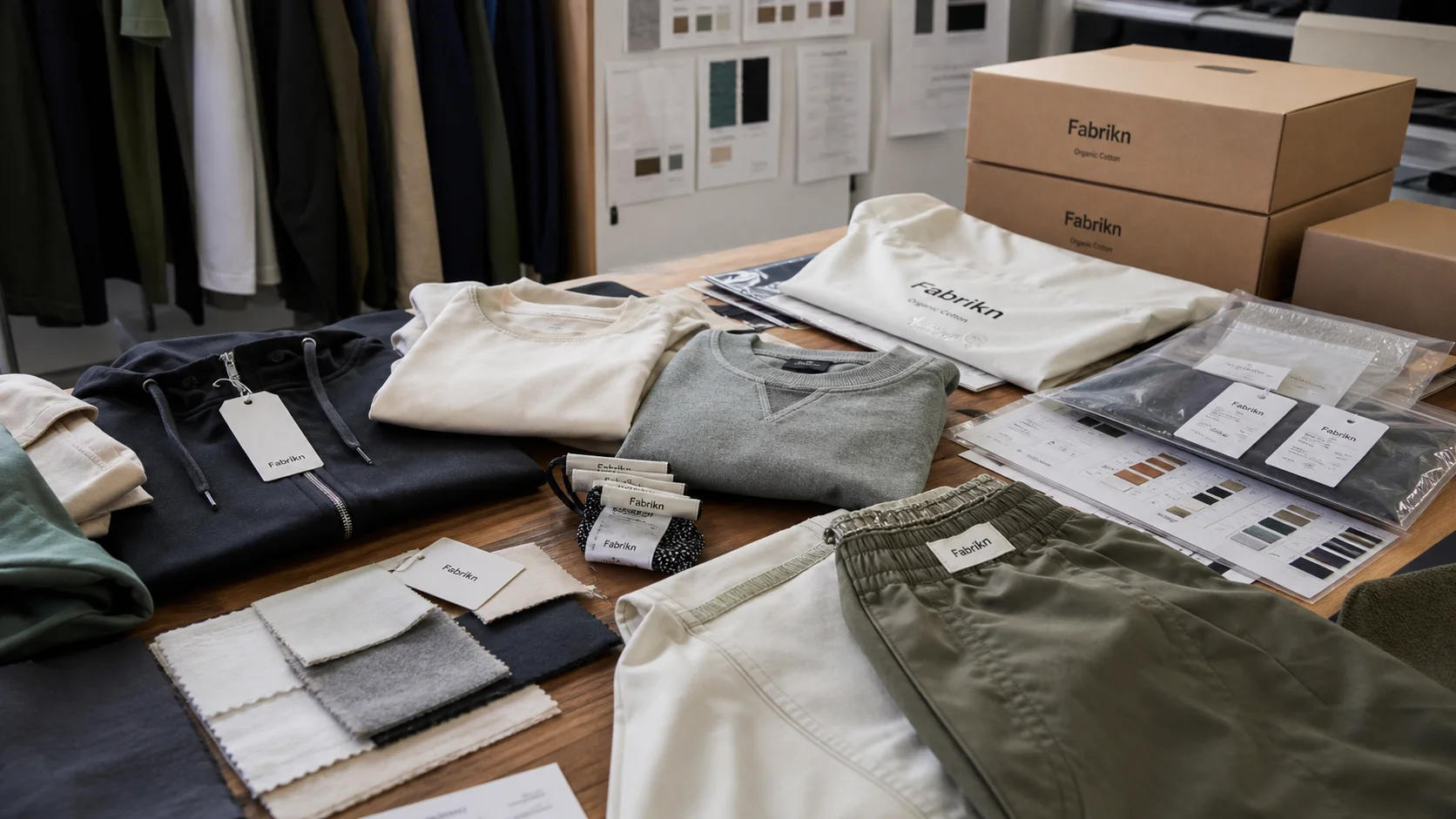
Clothing Shipment Inserts with checks for samples, fit, MOQ, QC evidence, pricing terms, and delivery risk.
Fast answer: Clothing Shipment Inserts: Cost, Message, ROI, and Packing Flow should be judged by production evidence, not by a generic sourcing promise. The buyer needs sample proof, cost breakdowns, QC checkpoints, and delivery buffers in writing.
Ask for recent sample photos, measurement tolerances, fabric or print test assumptions, decoration test notes, packing examples, and a named inspection checkpoint. These details show whether the team can repeat an approved sample at bulk volume.
Separate garment cost, decoration, labels, packaging, sampling, testing, freight, and rush charges. When every cost line is visible, it becomes easier to reduce colorways, adjust size depth, or reserve more time for sampling.
Across eight countries and a frankly absurd number of parcel openings, I kept seeing the same thing: the box gets forgotten, but the insert lingers. That is why branded inserts for clothing shipments matter far more than most teams want to admit. A plain kraft mailer can do the job. A smart insert can make a $12 tee feel considered and a $120 jacket feel worth the wait.
Inside factories from Ho Chi Minh City to Leicester, I kept seeing the same low-ticket tactic done well: a single card answering the questions that trigger returns. How do I wash this? Will it shrink? What size should I reorder? Those answers matter because online fashion return rates often sit in the 20% to 40% range, and even a small drop pays for print many times over. A $0.18 card tucked into a $12 tee order is not decoration. It is risk reduction.
Most brands lose margin in the post-purchase moment and barely notice. Someone who paid $18 for leggings does not expect luxury paper stock, but they do expect proof that somebody checked the details. Someone who paid $120 for outerwear wants reassurance: fiber content, care, fit, origin, brand values. Same insert strategy. Different job. For private label clothing, the insert often carries more weight than the outer parcel because the garment is the product and the packaging is only the frame.
Recycled uncoated stock kept winning in customer interviews because it looked less wasteful and photographed better under indoor light. Matte paper, soy or water-based ink, and restrained coverage lower impact without making the piece feel cheap. Spend on clarity, not glitter. A clean insert with one strong message can drive repeat purchase behavior, referral moments, and fewer “what size should I buy next?” emails. That is a commercial outcome, not branding fluff.
Branded inserts for clothing shipments usually fall into a tight set of formats: thank-you cards, care cards, size guides, discount cards, return instructions, authenticity cards, and QR-enabled story cards. Each has a job. Care cards can cut support tickets by 10% to 15% in some categories. Discount cards can lift second-order conversion if the incentive lands at the right time, usually within 14 to 30 days. QR story cards move shoppers from curiosity to content in one scan.
DTC brands use branded inserts for clothing shipments as a retention lever. Marketplace sellers use them more defensively, often to reduce returns, answer sizing complaints, or send shoppers to a branded site after the sale. Wholesale plays by different rules. The insert there usually sells less and explains more: fiber origin, compliance notes, a simple brand card that helps the end customer remember who made the piece.
Here’s the part many teams miss: one well-designed folded card can beat a multi-piece set when the message hierarchy is tight. In Guangdong, I watched factories produce five-piece kits with tissue wrap, coupons, and postcards that looked impressive on a bench, then got ignored because every item fought for attention. A folded card with one primary CTA, one QR code, and one utility panel often gets better engagement. Simplicity is not decoration. It is better cognition.
Finish choices matter, but only in proportion. Uncoated paper reads honest. Soft-touch lamination feels premium in hand, though it adds plastic content and can complicate recycling. Embossing and foil can work for a luxury drop, especially with a 500-piece MOQ or a seasonal capsule, but they are often wasted on entry-level basics. Spot UV can make a logo pop, yet it can also become visual noise on a card that needs to explain returns or care. In garments, usefulness usually wins.
Price point changes the brief. Budget basics need utility-first inserts because the margin cannot carry theatrical print. Premium apparel can justify more layered storytelling because the customer is paying for reassurance as much as fabric. I’ve seen a $9 tank top ship with a black-and-white size reminder and a QR care guide, while a $240 wool coat carried a folded booklet, origin story, and return policy card. Both made sense. Neither needed excess.
Region shifts the economics too. In Asia, especially China and Vietnam, paper sourcing is broad, turnaround can be 3 to 7 days for reprints, and MOQs often start at 1,000 to 3,000 pieces for simple cards. In Europe, paper availability is strong, but labor cost is higher and specialty finishes may push lead times to 10 to 15 days. In the US, domestic print shops can move fast for 500 to 2,000 units, though pricing rises once custom cutting or folding enters the order.
For a simple cost comparison, black-and-white cards often land at about $0.06 to $0.12 each in 5,000-unit runs. Full-color single cards usually sit around $0.12 to $0.28. Folded booklets can run $0.35 to $0.90. Premium multi-part kits may hit $0.80 to $2.50 depending on finish and assembly. Freight changes the picture. A 10-gram card set shipped by air across borders can cost more in logistics than in print, especially once tariffs and brokerage fees enter the math. Local sourcing often wins for low-margin apparel and seasonal launches.
Higher-cost inserts did not always perform better. In the UK, one brand spent heavily on foil, embossing, and a three-card bundle, then saw lower QR engagement than a competitor using one clean recycled card. Message fit beat decoration. For sports bras or babywear, clarity matters because sizing, fabric feel, and washing instructions drive fewer returns. That is especially true for technical items, including custom bra manufacturing and custom baby clothing manufacturing, where fit anxiety is high and the insert has to solve a practical problem in under 15 seconds.
One message per card. That rule saves more money than any finish choice. If the insert is supposed to thank, instruct, and sell at once, it usually does none of them well. A strong brand mark, a visible headline, and one clear call to action are enough for most apparel shipments. I prefer a layout that can be read in 5 to 7 seconds under warehouse lighting, because many cards are checked at packing tables under bad bulbs, not in a design studio.
Paper weight should match the job. A 250 to 300 gsm card feels substantial without becoming a wasteful object. For a booklet, 170 gsm inner pages and a 300 gsm cover can work well. Contrast matters more than color trends. Dark text on off-white stock beats pale gray on cool white every time. If the card is folded, the outer panel should carry the promise, while the inside handles the operational facts: care, sizing, returns, or a QR link to a styling page.
The content blocks I recommend most often are simple: a brief thank-you note, care instructions, one social proof line, one QR code, the return policy, and sustainability claims backed by actual numbers. If you say recycled content, state the percentage. If you say lower-impact ink, name the ink system. Vague green language burns trust faster than it builds it. I’ve seen consumers keep inserts only when they double as a mini reference sheet, especially in categories where private label clothing competes on perceived quality rather than logo recognition.
Factory-room reality is messy. Cards get trimmed by a millimeter or two. Fold lines drift. Shrinkwrap piles shift in humid rooms. Design for that. Keep margins generous, avoid tiny text near edges, and leave enough white space that small registration errors do not break the layout. In low-cost print runs, tolerances of 1 to 2 mm are normal. If your design only works at perfect alignment, it is not production-ready.
I start supplier conversations with substrate, ink, and compliance. Ask what papers they carry, whether the stock has FSC or recycled options, what inks they use, and how they control color consistency across runs of 1,000, 5,000, and 20,000 pieces. If the inserts will sit inside kidswear, ask about safety requirements, coating migration concerns, and packaging compliance checks. For technical reference points, I often cross-check claims against OEKO-TEX, Textile Exchange, and trade.gov guidance.
MOQ matters, but so does proof turnaround. A printer that offers 500-piece flexibility may still be the wrong partner if proofs take 8 to 12 days and they cannot support dielines. I want file expectations in writing: PDF, AI, or EPS; bleed requirements; font conversion rules; the acceptable error tolerance for trimming and color shift. If they cannot explain how they handle a typo caught after approval, I keep walking.
Sampling should be boring and disciplined. Request 2 or 3 paper weights, 2 finishes, and one production proof before you commit to a larger run. That lets you see how a 250 gsm recycled card compares with a 350 gsm coated stock, and whether soft-touch or uncoated paper better matches the garment. For anyone building technical apparel or performance basics, cut and sew manufacturing teams often value this proofing discipline because trim and packaging have to sync with production dates, not after them.
Warning signs show up fast. Inconsistent trimming. Vague sustainability claims. No clear reprint policy. No waste-rate numbers. I’ve visited plants where a supplier admitted 8% to 12% waste on short runs yet had never itemized how that affected pricing. That is not transparency. That is a hidden surcharge. Lead times matter too. For a seasonal drop or influencer push, I want inserts locked 21 to 28 days before ship date, not in the final week when the apparel is already in cartons.
Start with one goal. Reduce returns, grow repeat orders, or cut support volume. Not all three. Then choose the format that serves that goal, write the copy, design the layout, approve a proof, print, pack, and track the result. A brand with a 1,500-piece test can learn enough to avoid wasting 15,000 pieces on the wrong message.
I like a simple rollout sequence: define audience, choose one product category, draft one CTA, approve one visual system, then launch against a control group. Test inserts against orders that do not receive them and compare repeat purchase rate, support contacts, QR scans, review volume, and return rate over 30 to 60 days. If the insert lifts scans by 12% but does nothing for returns, it may still be worth keeping if it is a retention asset. If it does neither, cut it.
Limited budget? Start with one card, one CTA, and one measurable outcome. A thank-you card that drives to care instructions can be enough for a first test. A discount card can wait. I would rather see a small brand spend $150 on a clean 1,000-card run than $1,200 on a glossy package nobody reads. For private label or seasonal basics, the order value often does not support elaborate collateral anyway.
Test by product category or order value. A $28 tee and a $180 coat will not behave the same way. The tee may respond to a reorder offer. The coat may respond to a fit guide and warranty note. Align the production calendar with replenishment cycles, too. If your lead time is 3 weeks and your bestselling size sells through every 5 weeks, overprinting is easy. Seasonal spikes punish sloppy forecasting.
ROI starts with a simple equation: incremental revenue or savings minus insert cost, divided by insert cost. If a 10,000-piece run costs $1,500 and generates 60 repeat orders at an average margin contribution of $18 each, the lift is $1,080 in margin before you even count support reduction. Add a 5% drop in “how do I wash this?” tickets and the economics improve again. Measure revenue per order, retention lift, and ticket deflection, not just QR clicks.
I also watch returns. A care card that cuts return rate by 1 percentage point on a category with 20,000 annual orders can save more than a premium print treatment costs. That is particularly true in apparel categories where fit drives disappointment and the garment itself has a short decision cycle. For some products, the insert’s value is invisible because it prevents a problem rather than creating a headline.
On sustainability, the honest answers are usually the least glamorous ones. Recycled stock, lighter paper, soy or water-based inks, and reduced embellishment can lower footprint and freight weight. A 300 gsm multi-part kit might weigh 4 to 5 times more than a single 80 gsm card, and that matters when you ship 50,000 units. According to WTO trade data and freight norms, weight affects cost quickly once you move beyond domestic print. For a rough environmental benchmark, ISO-aligned print and material choices often beat decorative extras that exist only to be photographed.
I have a blunt view after 200-plus factory visits. Some premium finishes create more waste than value, especially in low-margin apparel. Foil, heavy lamination, and multi-piece kits can look expensive while adding almost nothing to retention. The best insert is the one customers keep because it helps, not because it glitters. If the piece answers a question, reduces friction, and respects the budget, it earns its place in the box.
They are used to thank buyers, explain care and sizing, reduce returns, and drive repeat purchases. In apparel, one good insert can also cut support tickets by 10% to 15% if it answers the most common post-purchase questions.
Simple black-and-white cards often cost $0.06 to $0.12 each in runs of 5,000. Full-color cards usually land around $0.12 to $0.28, while folded booklets and premium kits can reach $0.35 to $2.50 depending on finish, assembly, and freight.
Standard production can take 3 to 7 days in parts of Asia, 5 to 10 days in the US, and 10 to 15 days in some European print workflows. Add another 2 to 5 days for proofing and file corrections if the artwork is not final.
Yes. Inserts that explain fit, care, and return steps can lower uncertainty, especially for categories like bras, babywear, and outerwear. A 1 percentage point return-rate drop can save meaningful margin on 10,000 to 20,000 annual orders.
Start with one clear message, one CTA, and one practical detail. The strongest combinations are a thank-you note, care instructions, a QR code, and a short return or reorder prompt. Avoid cramming five different offers into one card.