
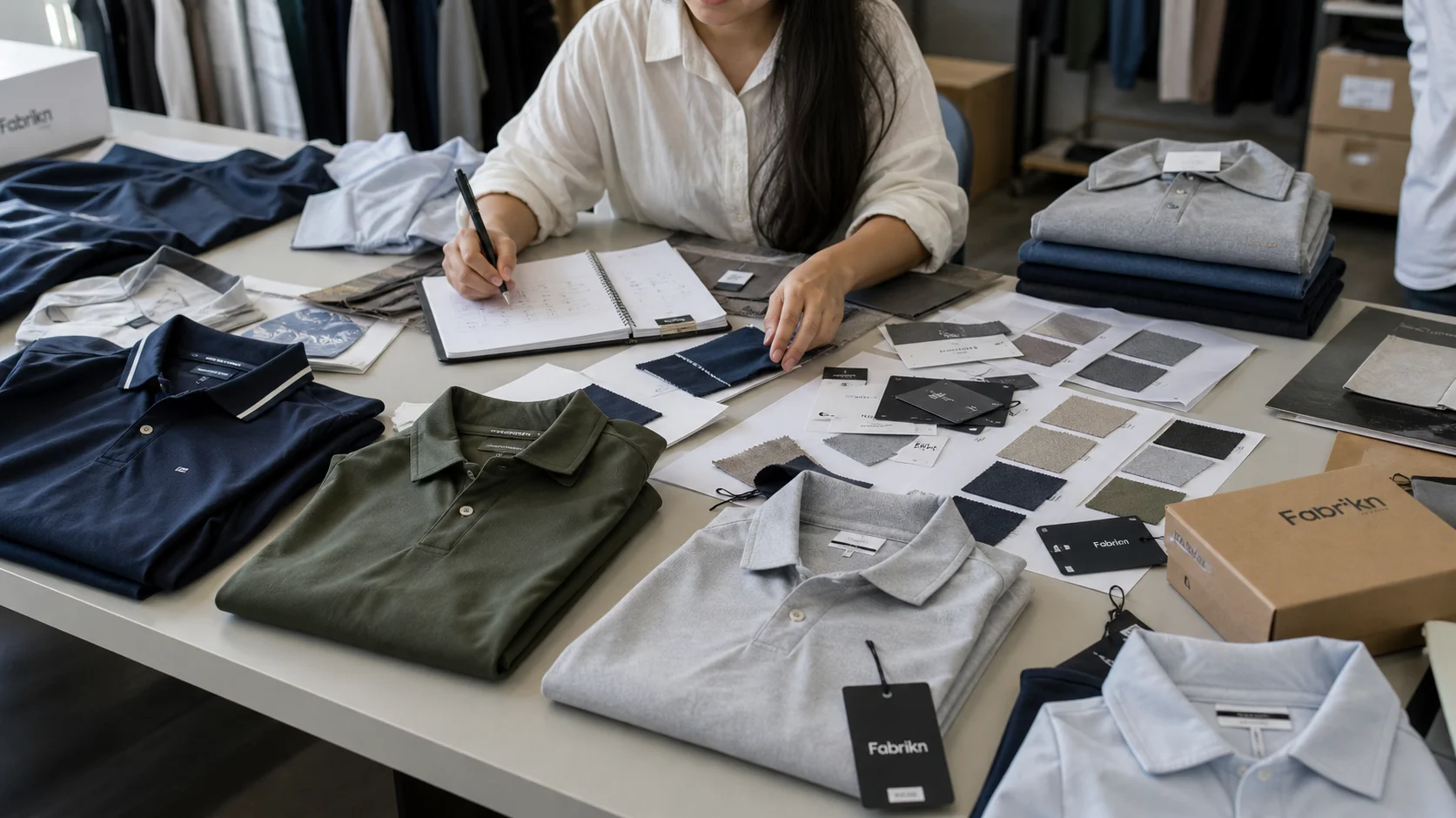
Clothing Order Thank-You Inserts with checks for samples, fit, MOQ, QC evidence, pricing terms, and delivery risk.
Fast answer: Clothing Order Thank-You Inserts: Message, Paper, Size, and Packing should be judged by production evidence, not by a generic sourcing promise. The buyer needs sample proof, cost breakdowns, QC checkpoints, and delivery buffers in writing.
Ask for recent sample photos, measurement tolerances, fabric or print test assumptions, decoration test notes, packing examples, and a named inspection checkpoint. These details show whether the team can repeat an approved sample at bulk volume.
Separate garment cost, decoration, labels, packaging, sampling, testing, freight, and rush charges. When every cost line is visible, it becomes easier to reduce colorways, adjust size depth, or reserve more time for sampling.
The parcel lands, the tape comes off, and that first glimpse decides whether the brand feels thoughtful or forgettable. That is why custom thank you inserts for clothing orders are not decorative extras. They are retention tools tucked into a box, usually for less than $0.50 to $1.20 per order, and they can do more work than a discount email sent three days later.
Brands often spend 5 to 7 times more acquiring a customer than keeping one. A clean insert with a thank-you note, care card, and return details cuts confusion and trims the “where is my order” pile. In one mid-market program I reviewed, support requests dropped by 18% after the insert was added to 12,000 units. Not branding fluff. Operational relief.
A 50-cent insert can make a $68 dress feel considered, while the same order without guidance can feel unfinished, especially if the garment needs cold wash, line dry, or a sizing exchange path. Value brands often win with a crisp thank-you card and QR code. Premium labels usually go thicker, using 350 to 600 gsm stock, minimal copy, and a restrained logo mark.
When I visited a cut-and-sew facility outside Ho Chi Minh City, the pack-out team told me they could insert a card in under 2 seconds if it was a single clean format. Folded pieces took longer. Return-slip bundles took longer still. Tiny delays matter at scale. A 4-second stall per pack becomes a real labor cost across 5,000 orders.
Packaging becomes part of the product. Brands working in cut and sew manufacturing already know how much precision lives in seam allowance and fabric trim. The same logic belongs in the box. If the order includes French terry 320 GSM, nylon activewear, or a rayon blend that shrinks, the insert should say so plainly.
A strong insert carries five jobs at once: gratitude, brand memory, care guidance, a reason to return, and a way to contact you. For custom thank you inserts for clothing orders, the winning version is usually short. Buyers spend seconds scanning packaging, not minutes. A cluttered layout loses the race before the order reaches the dresser.
Use this structure: one human thank-you line, one brand story line, one practical care note, one action line, and one contact point. That can fit on a postcard, a double-sided card, or a small folded insert. If your average order value is under $60, keep the note lean. If it is $120 or above, you can justify a stronger story element, a referral code, or a product care QR code.
Care instructions matter more than many founders think. I have seen returns fall by 8% to 14% when labels and inserts clearly explain cold wash at 30°C, no tumble dry, and how to handle enzyme wash finishes or garment-dyed fabrics. Sizing guidance helps too. A note that says “relaxed fit, size down if between sizes” can prevent a disappointing first try-on. Exchange policy details reduce anxiety, especially for first-time buyers.
Regional behavior changes the mix. Markets with return rates above 20%, such as parts of North America and the UK, usually benefit from a fuller insert with exchange steps and a QR code to a size guide. Lower-return markets, where fit feedback is more reliable and return rates sit closer to 8% to 10%, can use a slimmer format. I’ve seen brands in Germany use a two-language card for the same reason: less confusion, fewer service tickets.
Optional elements depend on business size and order value. Referral codes suit direct-to-consumer brands with repeat purchase goals. Social handles help if your visual identity is strong. A mini brand story matters more for newer labels than for established ones. If you also run private label clothing services, the insert can do double duty by reinforcing quality expectations for buyers who never speak to your team directly.
The thing nobody tells you: a QR code often replaces a second page. If the code links to care videos, size advice, and returns, you can cut paper use by 20% to 40% without losing useful information. That matters when you print 10,000 units and every gram adds freight cost.
Paper choice changes perception fast. Uncoated stock feels honest and tactile. Matte stock reads polished without glare. Soft-touch coating feels expensive, though it adds a layer that can complicate recycling. Recycled paper signals values clearly, especially for indie brands that want sustainability to feel visible rather than advertised. FSC-certified paper adds another layer of credibility, particularly for labels that want a traceable paper trail backed by FSC standards.
For luxury labels, I often see 400 to 600 gsm stock with blind embossing, foil only where necessary, and one or two lines of copy. For value brands, 250 to 350 gsm recycled card can do the job better. The key is alignment. A $28 t-shirt does not need museum-grade packaging. A $220 coat may deserve it. The finish should match the product price, not the founder’s ego.
Sustainability lives in the details. Soy-based inks and minimal lamination improve recyclability and reduce the mixed-material mess that frustrates waste facilities. Data from WRAP has repeatedly shown that simpler paper packs are easier to recover than laminated or heavily coated versions. In practical terms, that means one-sided coating instead of full wrap, and avoiding plastic windows unless they serve a real purpose.
Factory reality is less romantic. Some finishes look premium on a sample table, then slow production by 2 to 4 days once you order 500 pieces instead of 5,000. Soft-touch can scuff in transit. Heavy foil can raise spoilage if the printer’s heat calibration drifts. I’ve seen a 3% reprint rate on small runs because a matte black card dried unevenly and showed roller marks under warehouse lighting.
Test finish against volume, not moodboard fantasy. If your insert is tucked into a cotton tee pack, a recycled 300 gsm card may be enough. If it sits inside a structured outerwear box, the card can be more substantial. A QR code printed on the insert can also replace a folded leaflet and cut paper use by 20% to 40%, which is a meaningful saving when you ship 2,000 or 20,000 units.
When a brand is scaling into children’s products, I push even harder for plain language and safe materials. The same packaging discipline used in custom baby clothing manufacturing applies here: low-ink coverage, clear care icons, no confusing claims, and materials that do not shed or smudge inside the parcel.
Price moves with format, quantity, ink coverage, and finishing. A simple single card might run $0.18 to $0.45 at 5,000 pieces, while a folded insert with two panels, a QR code, and heavier stock can land at $0.42 to $0.95. A hangtag-style insert often sits in between, but die-cut shapes push setup cost higher. Multi-language cards cost more in design and proofing, not just print.
The biggest swing is volume. A 500-piece run can cost two to four times more per unit than a 5,000-piece run because setup, plates, and calibration are spread over fewer cards. If you order 500 double-sided cards, you might pay $180 to $320 total. At 5,000 units, the same design may drop closer to $650 to $1,200 total, depending on stock and coating.
Here is a useful comparison lens:
Hidden costs matter more than founders expect. Setup fees can add $40 to $120. Proofing may cost another $20 to $60 if you need physical samples. Shipping can be trivial on a local run and painful on an offshore run, where freight and customs stretch the budget by 10% to 25%. Color mismatches cause reprints, and reprints are where cheap becomes expensive.
In my experience, the cheapest option is rarely the cheapest result. A $0.22 card that creates 15 extra support emails costs more than a $0.40 card with clear sizing and returns guidance. This is especially true if your packaging also sits alongside tailored cut and sew manufacturing output, where customers expect precision from seam to slip.
For brands selling premium basics, the better choice is often a heavier stock with lower ink coverage rather than a flashy finish. The parcel feels calmer. The process feels more trustworthy. That matters more than glitter, metallics, or a crowded coupon block that nobody reads.
The first line should sound human, not scripted. “Thank you for choosing us” is fine. “We packed this order with care” is better. “Made for your everyday wear” can work if it sounds like your brand. The goal is a 3 to 5 second read window, because that is what most buyers give an insert while holding the parcel over a table or trash bin.
Build the message in three layers: one emotional line, one useful line, one action line. Emotional: gratitude. Useful: care or fit tip. Action: QR code, discount code, or social handle. Keep the action from shouting. If every line screams sell, the card starts to look like a coupon flyer, and people toss it.
Factory reviews I’ve done over the years show that large type and high contrast outperform clever layouts. Black text on off-white stock beats pale gray on glossy stock almost every time. Dense copy slows pack-out too, because workers must check the orientation of every card. Simple layouts help speed and reduce mistakes. That matters on a line moving 1,200 units a shift.
Think about hierarchy. The brand name should be visible, but not dominant. A QR code belongs in one corner, not center stage. Discount codes work best when they are modest, such as 10% or free shipping on the next order, and tied to a time limit like 30 days. The insert should invite, not nag.
If you need a broader messaging system for multiple product lines, the insert can sit alongside a longer brand story on your site. Brands that use contact us for a free quote pages well often use the same clarity in their inserts: one promise, one path, one next step.
A normal timeline runs through seven stages: artwork prep, proofing, printing, drying or curing, finishing, packing, and shipping. Standard production is usually 7 to 14 days once artwork is approved. Rush jobs can compress that to 3 to 6 days, but custom folds, coating, or foil often add 2 to 5 more days. Every extra step is a chance for delay.
Supplier checks should be boring and strict. Ask for a physical sample, a digital proof, and a color tolerance range. On press, I look for a Delta E target under 3 when brand colors matter. If the vendor cannot explain repeatability, they are not ready for a serious apparel program. A beautiful first run means nothing if the second run shifts to a warmer blue or duller red.
Lead times change by region. Domestic suppliers can move faster, but freight costs are higher per unit. Nearshore partners often balance speed and price well, especially on 1,000 to 3,000 piece runs. Offshore sourcing may cut print cost by 20% to 35%, yet ocean freight and customs can erase much of that advantage if your calendar is tight or your stock arrives in split shipments.
I have seen fast turnarounds fail because the printer matched the proof once and missed it twice. That is why repeat run checks matter. If your inserts support a larger product program, including custom baby clothing manufacturing or seasonal drops, keep one master file and one approved color profile. It saves time and protects consistency.
When you compare vendors, ask about the manufacturer, factory location, supplier capacity, and quality controls for each production run. If the order will ship from China, request photos of the press, finishing line, and packing area. Also confirm the MOQ, especially for custom wholesale and bulk orders, so your first test run does not get forced into a larger commitment than you can use. For apparel sustainability standards, it also helps to review Textile Exchange and OEKO-TEX guidance before approving materials or inks.
Start with a goal, not a design. Decide whether you want fewer returns, more repeat purchases, more reviews, or fewer support tickets. Then choose one format, approve one copy deck, and test two versions across 500 to 1,000 orders before scaling. That sample size is enough to catch obvious winners without burning through budget.
Track five numbers: repeat purchase rate, coupon redemption, review volume, support tickets, and return rate. If Version A cuts support tickets by 12% but Version B increases repeat orders by 6%, the better choice depends on margin and inventory cycle. A fashion brand with tight stock may value lower returns more than a broad discount code strategy.
Simple experiments work best. Try a thank-you note versus a care card. Try a discount offer versus a QR content hub. Try recycled paper versus coated stock if your audience cares about sustainability. The goal is not perfection on day one. The goal is proof, in 30 to 60 days, that the insert earns its place in the box.
It also helps to compare pricing from a few suppliers before you commit. A reliable supplier will explain custom options for wholesale, bulk, and low-MOQ production without forcing you into a bloated print run. For sourcing benchmarks and import planning, the U.S. International Trade Administration is a useful reference when you are evaluating cross-border production or freight risk.
Small runs of 500 pieces often cost $0.30 to $0.95 per insert depending on paper, ink, and finish. At 5,000 pieces, many brands get closer to $0.18 to $0.45 each.
Standard production is usually 7 to 14 days after proof approval. Rush orders can be 3 to 6 days, but special folds or coatings can add 2 to 5 days.
Include a thank-you message, care instructions, return or exchange details, and one clear action such as a QR code or discount code. Keep it to one side or two sides so buyers can read it in under 5 seconds.
Yes. Clear sizing notes, wash instructions, and exchange steps often reduce avoidable returns by 8% to 14% in my factory reviews. The biggest gains come from clarifying fit and fabric care.
Start with a supplier that can handle 500 to 1,000 pieces, provide a physical proof, and show color tolerance data. That gives you room to test before moving to a 5,000-piece run.