
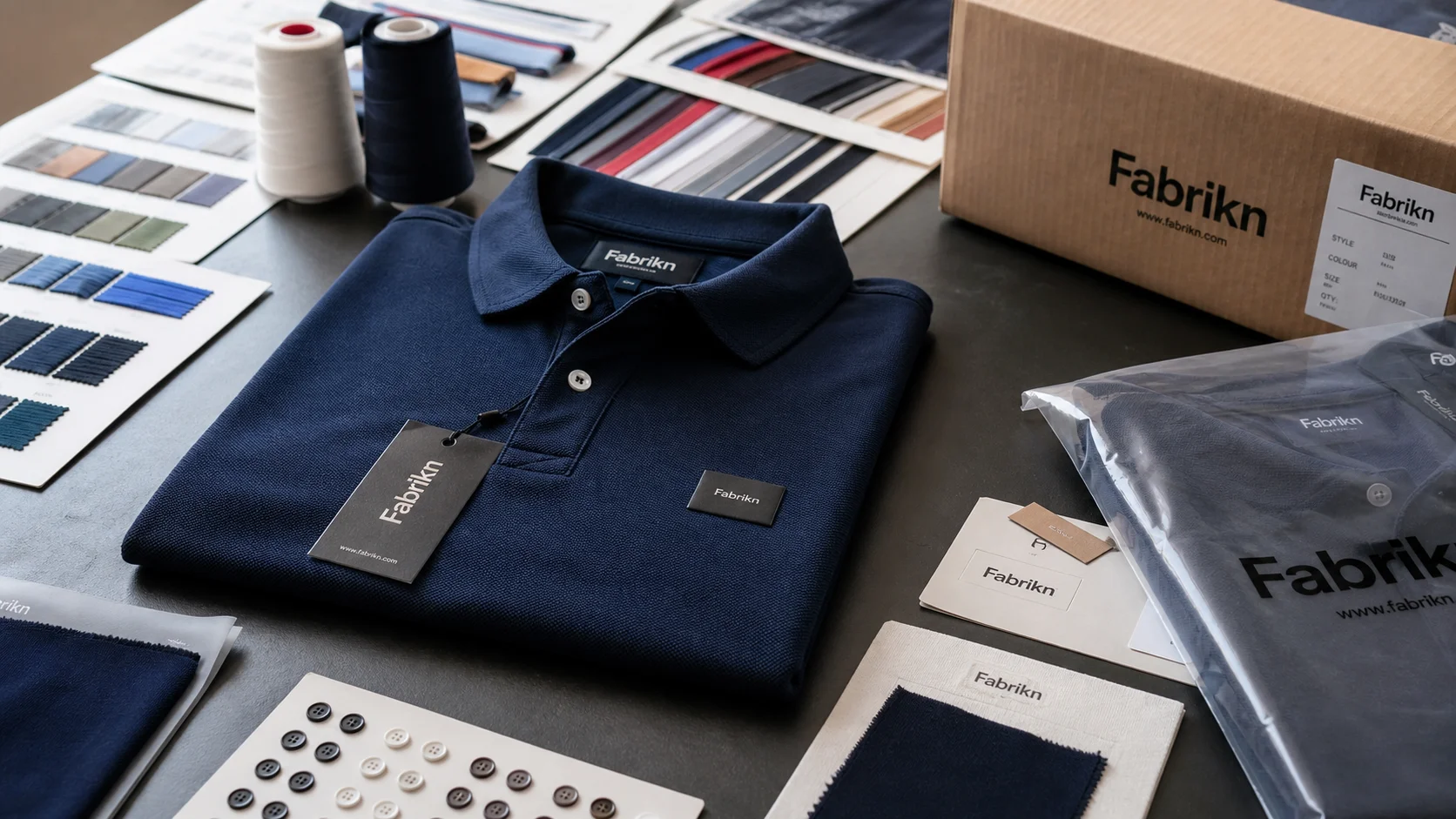
Branded Thank You Cards for Clothing Parcels compared by sample evidence, fabric or trim specs, MOQ, AQL terms, cost lines, delivery timing, and rework...
Fast answer: Branded Thank You Cards for Clothing Parcels: Tech Pack, Sample Gate, MOQ, and QC Terms should be judged by production evidence, not by a generic sourcing promise. The buyer needs sample proof, cost breakdowns, QC checkpoints, and delivery buffers in writing.
Ask for recent sample photos, measurement tolerances, fabric or print test assumptions, decoration test notes, packing examples, and a named inspection checkpoint. These details show whether the team can repeat an approved sample at bulk volume.
Separate garment cost, decoration, labels, packaging, sampling, testing, freight, and rush charges. Clear cost lines make it easier to reduce colorways, adjust size depth, or reserve more time for sampling.
The smallest thing in the parcel is often the one customers remember. Branded thank you cards for clothing parcels can turn a £48 order into something that feels considered, not transactional. I’ve watched it happen on packing lines from Leicester to Ho Chi Minh City, via Guangzhou and Istanbul fulfilment hubs: the tissue comes off, the insert lands in hand, and that’s the moment the brand actually speaks. And when that insert feels human, the face lighting up on the other end is the proof. I have seen factories where the thank-you insert is buried under the tissue like some top-secret memo; the packers just slap it in without a glance (and no, a sticker slapped on the flap doesn’t count).
But I’ve also watched brands spend £1.20 on outer packaging and nothing on inserts, then wonder why repeat orders stall. The cards that get kept tend to trigger three actions fast: a review, a social share, or a second visit to the site. According to Textile Exchange, consumer expectations around responsible materials are rising, and packaging is part of that expectation now. When a brand feels considered, the customer is more willing to believe the product inside was made with care. That perceived care is what keeps the customer from clicking next door.
Hard commercial logic is not subtle. A well-placed card can lift review generation by 10-20% in post-purchase campaigns, and I’ve seen coupon redemption rates move from 2.1% to 5.8% when the QR code sits on a clean, uncluttered insert produced on a Heidelberg Speedmaster XL 106 press with inline coating. One mid-market knitwear label I audited in Portugal spent €0.14 per parcel on branded thank you cards for clothing parcels and saw higher perceived value than a rival brand spending €0.42 on embossed mailer boxes. That rival still looked generic once the parcel opened. The card did the emotional work. Honestly, this approach works better because the card feels like a human note instead of a polished yet distant marketing push.
Premium-feel cards do not need expensive print specs. In a Guangzhou factory last year, a matte 350 GSM uncoated card with one spot-color logo and a single black text panel came in under $0.11 at 10,000 units. The manufacturer, supplier, and production process were simple; the paper stock did the heavy lifting. A £4 T-shirt and a £180 cashmere sweater do not need the same insert, but both need the same signal: someone checked this order, and someone noticed the customer. Getting that across without sounding like a script is what keeps me up on late approval calls (and, to be honest, it sometimes feels like herding cats that have all read the same style guide). The roll-fed die cutter, the folder-gluer, and the hand-silvered edges all contribute to a tactile result, but none of them cost as much as a rethink of the story itself.
The best cards carry four messages and no more: gratitude, brand memory, practical help, and one clear next step. Anything beyond that turns into clutter. I’ve seen inserts that cram in seven offers, two hashtags, a manifesto, and a return policy line. They read like a ransom note.
Luxury labels should write like they have time. A 16-word note, a restrained serif font at 9-11 pt, and one visual mark are usually enough. DTC basics brands can be slightly warmer and more direct, with 25-35 words plus a code or URL that sits inside a clean visual hierarchy. Sustainable fashion labels have a different burden. Their cards need to explain recycled stock, low-impact inks, or local print runs without sounding sanctimonious. I’ve found that 45-60 words is the upper limit before attention drops.
For a brand selling premium tailoring, I’ve seen a simple card outperform a glossy mini-brochure because it felt more honest. That same rule holds for more technical categories too, including items from custom bra manufacturing, where care notes and fit guidance matter more than marketing copy. The customer wants reassurance, not performance art. Factory teams usually spot the same error first: too much copy, too little hierarchy. A QR code needs enough negative space to scan in 0.3-0.5 seconds. Main copy should sit at 12-14 pt for easy reading under warehouse lighting and at home under warm bulbs. The brand name should be the strongest visual element, followed by the gratitude line, then the action prompt. If every line is equally loud, nothing stays in memory.
For smaller categories, including kidswear from custom baby clothing manufacturing, I’ve seen a gentler tone work better than discounts. Parents respond to reassurance and practical care notes. One label in the Netherlands moved from a 10% off message to a wash-and-wear guide and got 18% more scans on the card (and yes, the parents emailed to thank us for not giving them another promo code).
Paper choice changes perception faster than most design tweaks. A 300-350 GSM uncoated stock feels quieter and more credible than a 250 GSM gloss card, especially for sustainability-led brands. Soft-touch lamination can make a £0.18 card feel like £0.80, but it also complicates recycling in some markets. Coated stocks often show richer color and sharper photos, yet I’ve watched recyclers flag them as less straightforward to process when mixed with adhesive labels and foil.
Regional sourcing matters. In Asian print hubs such as Shenzhen and Dongguan, I’ve seen short-run flexibility down to 500-1,000 units with quick turnarounds of 5-7 days once artwork is approved. A Dhaka print house aligned with WRAP and OEKO-TEX Standard 100 standards handles foil blocking on natural pigment inks and can ship laminated packs in 18-22 business days when textiles are already in transit. Some European suppliers, particularly in Poland and the Netherlands, are stronger on FSC-certified, recycled, and uncoated options, but lead times often sit closer to 10-15 days. If your brand sells through private label clothing channels and needs frequent seasonal refreshes, that difference changes cash flow and inventory planning. In my experience, that timing mismatch is where brands trip up most—especially when the ops team is still waiting on a fresh fabric shipment.
Single-sided cards are cheaper and cleaner. Double-sided cards offer room for a note, QR code, care tip, and referral offer, but they only work if the back stays disciplined. Die cuts, foil stamping, embossing, and variable data printing all add cost. Foil can add $0.03-0.08 per unit at scale. Embossing often adds $0.05-0.12. Variable data, such as unique discount codes, can lift setup fees by $40-$150 per run because the data merge and proofing take time.
The strongest sustainability trade-off is simple. Recycled uncoated stock usually wins on footprint and cost. A 350 GSM recycled sheet can be printed with soy or vegetable-based inks, trimmed cleanly, and inserted without lamination. That combination often lands 12-18% cheaper than a coated, laminated equivalent once waste and recycling concerns are included. In one Italian factory, I saw a buyer switch from a pearlescent coated card to a natural recycled board and save €0.04 per unit while cutting complaint emails about packaging waste.
A strong brief makes the supplier's job narrower and the quote more reliable. For branded thank you cards for clothing parcels, include the target customer, sales channel, expected order quantity, size range, decoration needs, packaging requirements, and delivery market. Then call out the details most likely to affect the result, especially material grade, print tolerance, and barcode size.
The brief should also explain what cannot change. Some brands care most about hand feel, some about price, some about launch timing, and some about retail compliance. When those priorities are not written down, suppliers tend to optimize for whatever is easiest to quote. Clear priorities help the factory make better tradeoffs before the first sample is cut or printed.
Ask the supplier to respond with assumptions, not just a price. A useful reply states MOQ, sample route, production capacity, inspection plan, packing method, and freight handoff. If the answer is vague, the project may still work, but it needs a tighter pre-production stage before money and calendar pressure build up.
The best time to catch problems is before the pre-production sample is approved. Check measurements, color, placement, material behavior, shrinkage, construction, labels, and packaging in the same review instead of approving each item in isolation. Many bulk issues are not caused by one dramatic mistake; they come from several small unchecked assumptions.
For branded thank you cards for clothing parcels, pay special attention to folding method, pack-out sequence, and retail compliance. These details often look minor in an email but become expensive once cutting, printing, sewing, packing, or shipping begins. A simple checklist with owner, due date, and approval status keeps the brand team and factory aligned.
Bulk production should not start until the supplier can explain how the approved sample becomes a repeatable production standard. That means reference sample storage, line instructions, inline checks, final inspection, and defect handling. A factory that can describe this process clearly is usually safer than one that only promises speed.
Price differences are useful only when the quotes cover the same work. Compare sample cost, material source, trims, decoration, packaging, testing, inspection, and freight assumptions. A low unit price can become expensive if it excludes items the brand needs before launch.
Timeline promises deserve the same scrutiny. Ask what happens if the first sample needs revision, whether materials are in stock, when the production slot is reserved, and how export packing is handled. The most reliable supplier is often the one that gives a realistic calendar instead of the fastest optimistic answer.
Before making the final decision, write down the specification, approval owner, delivery expectation, and the one or two risks that would cause the most trouble if missed. For branded thank you cards for clothing parcels, this usually means checking material grade, print tolerance, barcode size, and the support process after the order is placed.
This last review does not need to be complicated. It simply makes the decision easier to repeat, easier to explain, and easier to verify when the finished product or jewelry arrives.
One useful way to pressure-test the decision is to ask what would happen if the order had to be repeated in six months. The answer should still be clear: the same material grade, the same print tolerance, the same acceptance standard, and the same communication path. If a second order would depend on memory or guesswork, the first order is not documented well enough yet.
Another useful check is to separate preference from requirement. Preference is the look, wording, or finish the brand likes. Requirement is the measurement, tolerance, certificate, material, or delivery condition that cannot fail. Good buying decisions keep both visible, so the final choice is not pushed around by the last email, the cheapest quote, or the prettiest sample photo.
Finally, ask who owns each approval. A project with one accountable owner for sample review, one owner for final content or artwork, and one owner for delivery sign-off usually moves faster than a project where every decision is shared loosely across a team. Clear ownership reduces delays and makes the finished result easier to judge.