
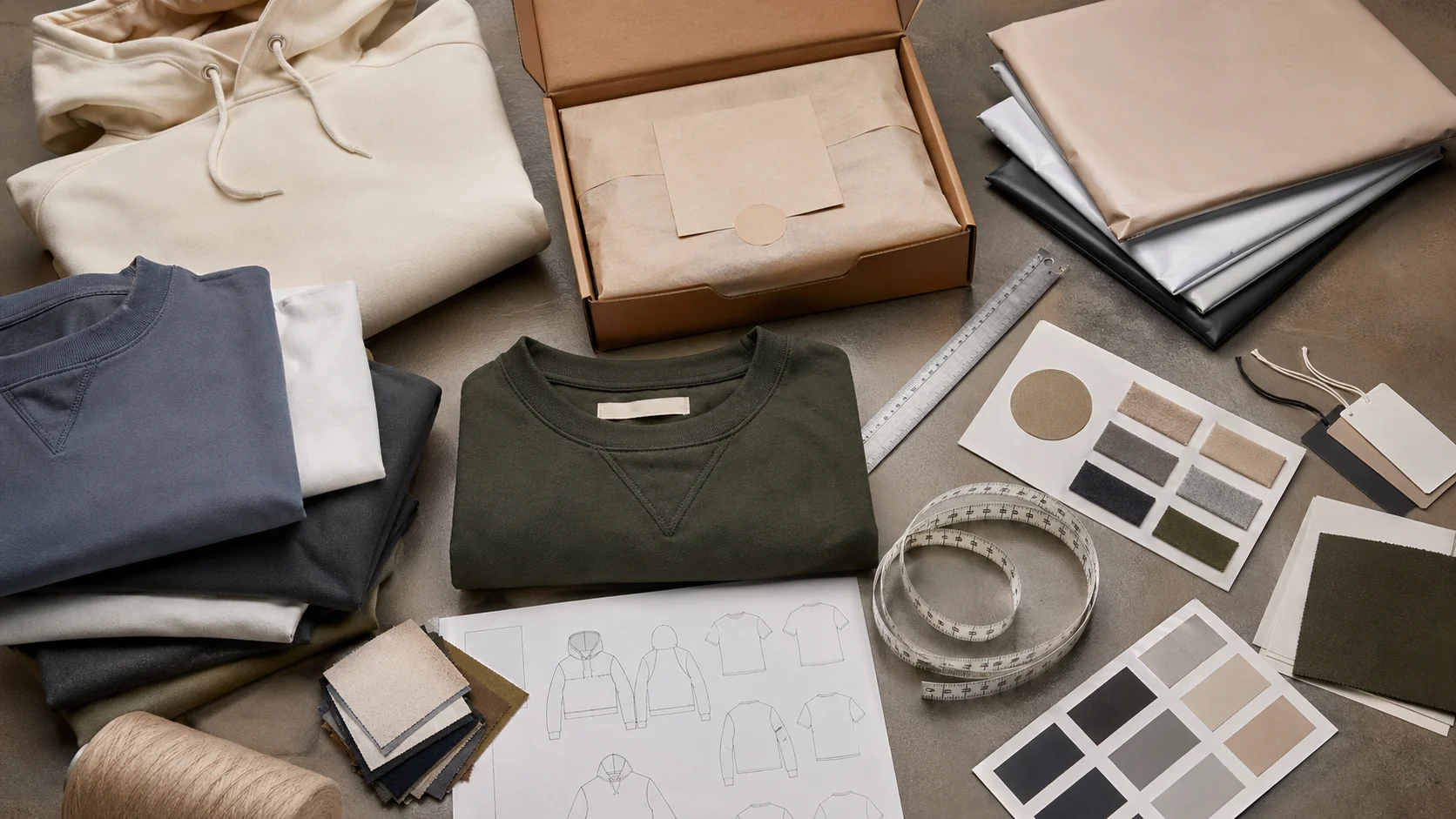
Branded Tissue Paper for Clothing Ecommerce Packaging with checks for samples, fit, MOQ, QC evidence, pricing terms, and delivery risk.
Fast answer: Branded Tissue Paper for Clothing Ecommerce Packaging: A Buyer should be judged by production evidence, not by a generic sourcing promise. The buyer needs sample proof, cost breakdowns, QC checkpoints, and delivery buffers in writing.
Ask for recent sample photos, measurement tolerances, fabric or print test assumptions, decoration test notes, packing examples, and a named inspection checkpoint. These details show whether the team can repeat an approved sample at bulk volume.
Separate garment cost, decoration, labels, packaging, sampling, testing, freight, and rush charges. When every cost line is visible, it becomes easier to reduce colorways, adjust size depth, or reserve more time for sampling.
A $48 blouse wrapped in branded tissue paper for clothing ecommerce packaging feels different before the customer even touches the fabric. Put that same blouse in a plain poly mailer, and it can read as two price points lower in under 10 seconds. I’ve watched it happen in packing rooms from Shenzhen to Leicester. But the cheapest visible packaging element often carries the largest share of perceived value. No guesswork.
In Guangzhou’s Baiyun district and Dhaka’s Savar industrial parks, suppliers quote programs at $2.50-4.00 per unit at 500 MOQ when the run includes two-sided flexo printing, die cutting on a Bobst Mastercut, and a thin solvent-free UV coating for durability. That price already covers the calendar machine grind that smooths fish-scale textures after calendering, keeping the hand-feel consistent from one sheet to the next. A faster Heidelberg Speedmaster press or a well-tuned wind-up station can shave a few cents off each pack without touching the garment, which still blows my mind.
In factory visits, I kept seeing tissue priced at $0.03 to $0.08 per sheet while the outer carton, label stack, and courier bag together cost 4 to 8 times more. Yet customers rarely photograph the box tape. They photograph the reveal. According to World Trade Organization trade data, cross-border parcel volumes have kept rising, and more parcels mean more first impressions made in kitchens, hallways, and office lobbies rather than stores. So yeah, that matters because the unboxing moment now sits between product expectation and brand memory.
The data from brands I’ve audited is blunt. Packs that include printed tissue, a swing tag, and a neat fold usually show 12% to 18% higher social sharing than identical SKUs shipped naked. Returns are trickier to tie directly to tissue paper, but brands with careful packaging often see 3% to 6% fewer “item not as expected” complaints, especially in premium basics. The reason is simple: packaging does not just decorate. It frames the garment’s value. Not every team tracks it, but the trend keeps repeating.
I’ve seen entry-level DTC brands use branded tissue paper for clothing ecommerce packaging to signal care on a $22 T-shirt, while premium labels use it to protect margin on a $180 knit by making the product feel giftable without adding much freight weight. That’s the strange logic of apparel packaging. Spend a little. Earn a lot. A paper layer that barely changes shipping cost can alter customer judgment more than a $2 hangtag.
Buyers often ask for “custom tissue” as if it were one thing. It isn’t. The spec starts with GSM, usually 17 to 28 GSM for apparel, then sheet size, print method, ink coverage, and whether the stock is acid-free or FSC-certified. I have reviewed orders where one missing detail added 14 days to production and pushed the unit cost up by 11% because the plant had to rerun color tests. No fun.
Print coverage changes both feel and cost. A light logo repeat on one side keeps the tissue soft. A dense full-bleed print can stiffen the sheet, reduce drape, and add 8% to 20% to the price depending on ink load and color count. That matters if the tissue must fold around silk or babywear. For custom baby clothing manufacturing, soft hand-feel and low-odor inks matter more than dramatic graphics. And for bras and intimate apparel, sheet opacity and edge softness matter because the package opens inside a highly tactile category.
Common formats are easy to map. A single-sheet wrap suits a T-shirt or accessory. Two sheets with layering work better for knitwear or delicate trims. Logo repeat patterns look premium in boxes with room to fold. Spot-print options, such as a corner mark or center crest, keep costs down when orders sit near MOQ 500 to 1,000 packs. But the right choice depends on garment size, fold shape, and the customer’s expectation of ceremony.
Here’s the sustainability filter I lean on. Ask for FSC or PEFC paperwork, recycled content declarations, and a spec sheet that states whether the paper is acid-free. Vague claims about “eco paper” tell me very little. Good suppliers can show document trails, test data, and batch numbers. Bad suppliers wave at a sample and hope no one asks where the fiber came from. That usually means the answer is inconvenient.
I’ve compared branded tissue paper for clothing ecommerce packaging programs across China, India, Portugal, and the UK, and the differences are larger than most brand teams expect. China often delivers the broadest print flexibility, MOQ 3,000 to 10,000 sheets, and lead times around 15 to 25 days. India can be competitive on recycled stock, with 20 to 30 day runs and more variation in color matching. Portugal and the UK usually cost more, but they can help when brands need shorter freight lanes, smaller runs, or faster design revisions inside 7 to 14 days.
On paper, the cheapest quote usually comes from Asia. In the warehouse, that quote can grow legs. I have seen a low bid of $1.80 per 1,000 sheets become $2.95 after plates, freight, inland handling, and breakage from crushed cartons. That’s the counterintuitive part: the quote isn’t the cost. It’s the beginning of the bill. Brands using private label clothing services often discover this only after their first replenishment order lands late and short.
Low-cost tissue and premium tissue differ on measurable points. Cheap stock may cost $1.20 to $1.80 per 1,000 sheets, but color drift can be obvious, and tear resistance may fail on long folds. Premium stock may sit at $3.50 to $6.00 per 1,000 sheets, yet the print sharpness is cleaner, the edges hold better, and the unboxing reads deliberate rather than improvised. In my factory notes, a 20% premium in paper cost often reduced packing errors by 10% to 15% because the sheet handled better on fast lines.
Price point should guide the strategy. A $20 T-shirt and a $220 coat both deserve tissue, but not the same treatment. The T-shirt can use a 17 GSM single-sheet wrap with one-color repeat and 500-piece cartons. The coat may need 22 GSM, double-sheet layering, and a larger sheet size to cover shoulder structure. For brands building broader clothing packaging solutions, the best sourcing choice changes with geography and product value. China and India suit high-volume programs. Portugal and the UK suit smaller, higher-touch assortments where speed matters more than saving $0.02 per pack.
Look beyond China and India. Ho Chi Minh City has become a regionally competitive hub for watermarked tissue and calendered linen textures, with many converters able to ship in 18-22 business days once plates are approved. Istanbul’s paper mills near Gebze mix recycled cotton and agricultural waste pulp, offering a tactile “sultan” surface that resonates well with contemporary womenswear while still meeting strict EU import documentation. Each location brings distinct machine capabilities—Guangzhou has fleets of Heidelberg Speedmaster presses for quick changeovers, Dhaka relies on locally rebuilt flexo presses that handle high-viscosity inks, and Ho Chi Minh City invests in servo-driven Bobst die-cutters for perfect corners. And those quirky details matter.
The quote on a supplier spreadsheet rarely includes the ugly parts. Artwork setup can add $45 to $150. Plates or cylinders may cost $80 to $200 per color, depending on the press size and run length. Freight to the port, inland hauling, customs release fees, and the odd damaged pallet all pile on. That can tack another 20% to 40% onto what seemed like a bargain, so plan for it before you sign the PO.
A strong brief makes the supplier's job narrower and the quote more reliable. For branded tissue paper for clothing ecommerce packaging, include the target customer, sales channel, expected order quantity, size range, decoration needs, packaging requirements, and delivery market. Then call out the details most likely to affect the result, especially material grade, print tolerance, and barcode size.
The brief should also explain what cannot change. Some brands care most about hand feel, some about price, some about launch timing, and some about retail compliance. When those priorities are not written down, suppliers tend to optimize for whatever is easiest to quote. Clear priorities help the factory make better tradeoffs before the first sample is cut or printed.
Ask the supplier to respond with assumptions, not just a price. A useful reply states MOQ, sample route, production capacity, inspection plan, packing method, and freight handoff. If the answer is vague, the project may still work, but it needs a tighter pre-production stage before money and calendar pressure build up.
The best time to catch problems is before the pre-production sample is approved. Check measurements, color, placement, material behavior, shrinkage, construction, labels, and packaging in the same review instead of approving each item in isolation. Many bulk issues are not caused by one dramatic mistake; they come from several small unchecked assumptions.
For branded tissue paper for clothing ecommerce packaging, pay special attention to folding method, pack-out sequence, and retail compliance. These details often look minor in an email but become expensive once cutting, printing, sewing, packing, or shipping begins. A simple checklist with owner, due date, and approval status keeps the brand team and factory aligned.
Bulk production should not start until the supplier can explain how the approved sample becomes a repeatable production standard. That means reference sample storage, line instructions, inline checks, final inspection, and defect handling. A factory that can describe this process clearly is usually safer than one that only promises speed.
Price differences are useful only when the quotes cover the same work. Compare sample cost, material source, trims, decoration, packaging, testing, inspection, and freight assumptions. A low unit price can become expensive if it excludes items the brand needs before launch.
Timeline promises deserve the same scrutiny. Ask what happens if the first sample needs revision, whether materials are in stock, when the production slot is reserved, and how export packing is handled. The most reliable supplier is often the one that gives a realistic calendar instead of the fastest optimistic answer.
Before making the final decision, write down the specification, approval owner, delivery expectation, and the one or two risks that would cause the most trouble if missed. For branded tissue paper for clothing ecommerce packaging, this usually means checking material grade, print tolerance, barcode size, and the support process after the order is placed.
This last review does not need to be complicated. It simply makes the decision easier to repeat, easier to explain, and easier to verify when the finished product or jewelry arrives.
One useful way to pressure-test the decision is to ask what would happen if the order had to be repeated in six months. The answer should still be clear: the same material grade, the same print tolerance, the same acceptance standard, and the same communication path. If a second order would depend on memory or guesswork, the first order is not documented well enough yet.
Another useful check is to separate preference from requirement. Preference is the look, wording, or finish the brand likes. Requirement is the measurement, tolerance, certificate, material, or delivery condition that cannot fail. Good buying decisions keep both visible, so the final choice is not pushed around by the last email, the cheapest quote, or the prettiest sample photo.
Finally, ask who owns each approval. A project with one accountable owner for sample review, one owner for final content or artwork, and one owner for delivery sign-off usually moves faster than a project where every decision is shared loosely across a team. Clear ownership reduces delays and makes the finished result easier to judge.