
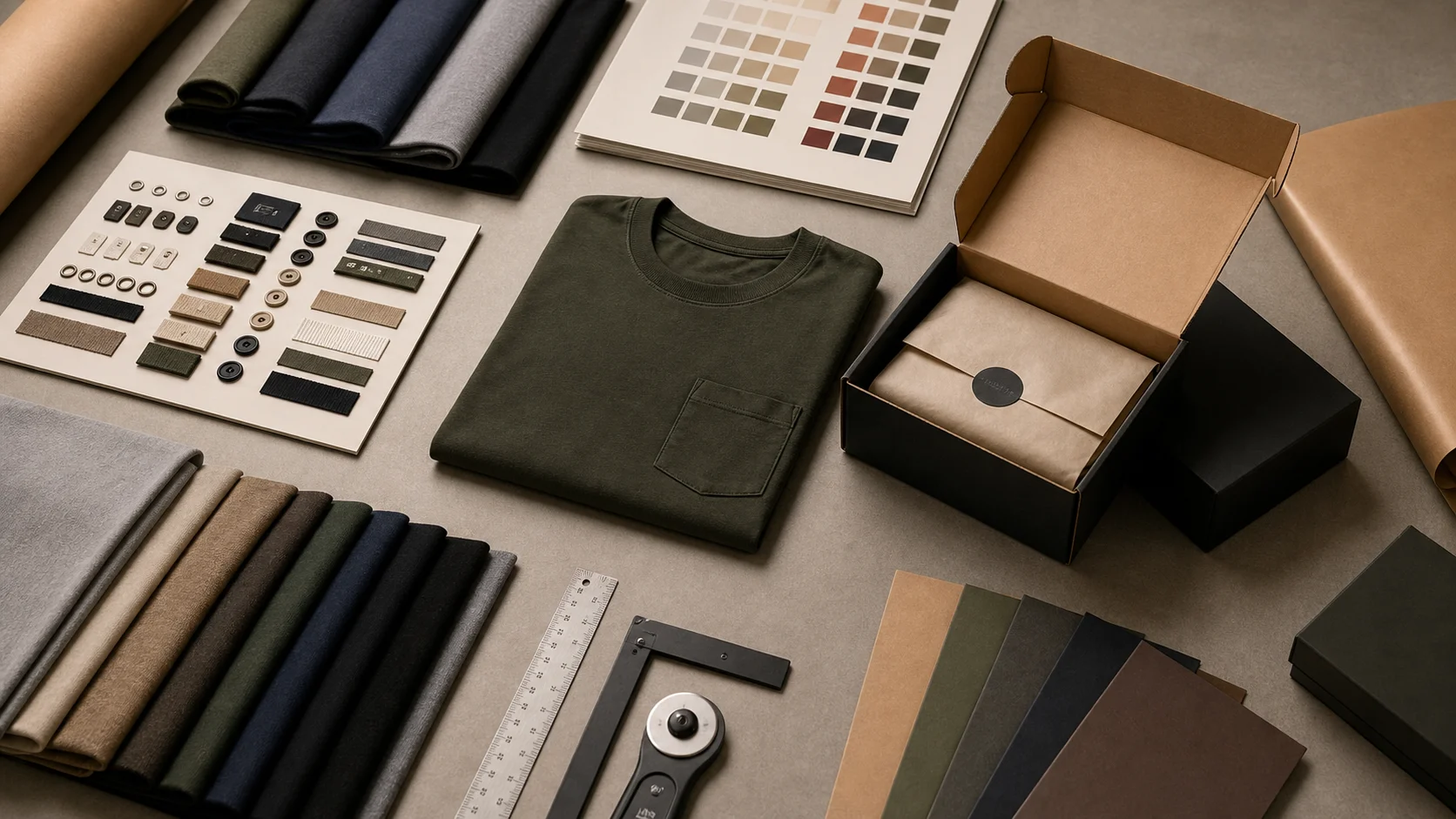
Eco-Friendly Tissue Paper Wholesale with checks for samples, fit, MOQ, QC evidence, pricing terms, and delivery risk.
Fast answer: Eco-Friendly Tissue Paper Wholesale: Paper Claims, GSM, Print, and MOQ should be judged by production evidence, not by a generic sourcing promise. The buyer needs sample proof, cost breakdowns, QC checkpoints, and delivery buffers in writing.
Ask for recent sample photos, measurement tolerances, fabric or print test assumptions, decoration test notes, packing examples, and a named inspection checkpoint. These details show whether the team can repeat an approved sample at bulk volume.
Separate garment cost, decoration, labels, packaging, sampling, testing, freight, and rush charges. When every cost line is visible, it becomes easier to reduce colorways, adjust size depth, or reserve more time for sampling.
The quickest way to make a garment feel expensive is often the quietest one: wrap it well. Eco friendly tissue paper for clothing orders wholesale has moved from branding flourish to basic operational discipline. I have watched buyers open cartons in London, Los Angeles, and Ho Chi Minh City, and the first thing they notice is not the shirt itself. It is the wrap. Clean sheets say the brand cares. Dusty, translucent ones say the opposite, before the customer even touches the garment.
In factory after factory, the same pattern kept showing up. Cheap tissue at $0.02-0.04 per sheet tore during packing, shed lint on dark knits, and arrived with inconsistent opacity. That creates rework at the line, then complaints at the customer end. On a 5,000-piece order, even a 3 percent defect rate means 150 garments repacked, re-taped, and reboxed. If a carton weighs 0.5-1.2 kg more than planned because a buyer overcompensates with extra padding, freight costs climb too. Small waste. Real money.
Luxury brands use tissue to justify $120-300 shirts and $400 dresses. Premium labels use it to defend a $60-120 price point. Budget brands use it to signal care without adding much to landed cost, usually $8-25 per thousand pieces depending on print and sheet size. That spread matters. I have seen a $14 tee in a plain polybag feel cheaper than a $22 tee wrapped in recycled white tissue and folded consistently. Presentation changes perception faster than most founders admit.
The real question is not whether tissue looks nice. It is whether packaging waste hurts margin. Freight is charged by weight or volume, and inefficient wrapping inflates both. Customer perception can drag on repeat purchase rates. In my experience, eco friendly tissue paper for clothing orders wholesale is one of the few packaging items where a $0.01 upgrade can cut $0.50 of friction later.
For brands building custom baby clothing manufacturing programs or seasonal collections with tight cash flow, that math gets sharp fast. A cleaner pack-out can mean fewer returns from scuffed prints, fewer complaints about “cheap” presentation, and less overbuying of filler material that never gets seen by the customer.
Most buyers start with the word “eco-friendly” and stop there. That is a mistake. Recycled tissue, FSC-certified virgin fiber, bamboo blends, and acid-free sheets sit under the same umbrella, but they behave very differently on a packing table. Recycled tissue usually has a softer hand and more natural flecking. Virgin fiber sheets can be whiter and stronger at 17-28 GSM. Bamboo blends are still niche, often priced 10-20 percent higher than standard recycled options, and usually appear in small runs.
The specs that matter are measurable. GSM tells you weight, but not always performance. I check opacity, sheet count, folding consistency, and dust levels. A 20 GSM sheet that looks fine in a sample can fail on a line if the die-cut is inconsistent by even 2-3 mm. On silk blouses and black jersey, dust is not cosmetic. It is a defect. In one factory in Portugal, I saw operators reject 1 out of 20 sheets because the fibers shed onto white shirts during a 400-piece packing batch.
Greenwashing is common here. “Eco-friendly” may mean recycled content, but not necessarily post-consumer fiber. It may also hide chlorine-based bleaching. Buyers should ask whether the pulp is pre-consumer or post-consumer, whether the sheet is chlorine-free processed, and whether the inks are soy-based or water-based. According to Textile Exchange, material claims need documented chain-of-custody if they are to hold up under scrutiny. I would not accept a verbal assurance from a sales rep alone.
Ask for proof, not adjectives. Request certification numbers, recycled-content percentages, and test reports for strength and colorfastness. If a mill claims FSC status, verify the code against the certificate. If it claims compostability, ask which standard and under what conditions. Acid-free sheets matter for delicate apparel, but only if the supplier can prove pH and storage stability over 6-12 months. For a brand using private label clothing services, these details protect both product quality and resale value.
Buyers love unit price because it is easy to compare. Landed cost tells the truth. A domestic supplier may quote $24-38 per thousand sheets for recycled white tissue, while an offshore mill might quote $14-22. That looks decisive until freight, duties, and lead time are added. I have seen a $17 offshore quote land at $28-31 once sea freight, customs delays, and extra cartons were counted. The domestic quote felt expensive on paper, then saved two weeks and removed tariff surprises.
Here is how the main options stack up in practice. Recycled white tissue usually lands in the $0.018-0.030 per sheet range for mid-volume orders of 10,000-50,000 sheets. Kraft tissue often costs a little less, around $0.014-0.025, but it can read less premium on a glossy brand unless the design is restrained. Printed tissue adds $0.004-0.012 per sheet depending on colors and coverage. Premium acid-free tissue can jump to $0.035-0.060 per sheet, yet it protects delicate knits, embellished dresses, and accessories that scratch easily.
Shipping density matters more than most buyers expect. A standard 50 x 75 cm tissue sheet folded flat may let you pack 8,000-12,000 sheets per carton, while a thicker acid-free version can reduce that by 20-30 percent. That affects warehouse space and pallet count. On a 1,000-box annual run, a difference of 10 cartons can change storage by 1.5-2.0 cubic meters. Small brands feel that immediately. Larger brands feel it when they scale to 50,000 units and suddenly need another racking bay.
The trade-off buyers miss is that stronger tissue can reduce overpacking. If a sheet resists tearing, packers use fewer backup layers and waste less time. I have measured a 7-12 second savings per order on busy lines, which sounds trivial until you multiply it by 20,000 orders a month. Damaged returns also fall when dark garments stay free of lint and abrasion. For a brand shipping French terry 320 GSM sweatshirts, that is not a style issue. It is a margin issue.
When a product line includes cut-and-sew knits, woven dresses, and accessories in one shipment, I often recommend cut and sew manufacturing teams align tissue specs with the heaviest-handled item, not the cheapest one. That keeps one packaging standard from failing across the whole assortment. Data from WTO trade reporting also shows freight volatility can swing within a quarter, so flexible sourcing matters more than chasing the lowest quote on a single day.
The thing nobody tells you: a slightly stronger tissue can lower total packaging cost even when the sheet price is higher, because it trims overpacking, repacking, and avoidable returns.
Supplier selection should begin with process control, not price. A manufacturer that holds grammage within ±1.0 GSM and keeps die-cuts clean will save more money than a cheaper factory that ships mixed lots and forces your packers to sort by hand. I have watched a 12-person packing team lose nearly an hour per day because one supplier’s sheets varied by only a few millimeters. That is hidden labor, and it compounds fast.
My audit questions are blunt. Where does the pulp come from? Is the fiber post-consumer, pre-consumer, or virgin FSC? What dyes are used, and are they compliant with local chemical rules? How much water is consumed per ton, and what percentage is recycled? What is the energy mix, and does the site track defect rates by batch? If a supplier cannot answer these in numbers, they are selling optimism, not production.
Regional differences matter. In Southeast Asia, I often see faster turnaround for custom print runs, 7-14 days for repeat stock and 3-5 weeks for first orders, but MOQs can be 10,000-20,000 sheets per design. European mills tend to offer tighter environmental documentation and smaller customization runs, sometimes 3,000-5,000 sheets, though prices can run 15-30 percent higher. North American suppliers usually sit in the middle: decent lead times, clear communication, and less freight risk.
Factory audits taught me a counterintuitive lesson. A smaller mill can outperform a larger one on consistency if it runs tighter quality checks. In one 60-employee facility, every fifth carton was opened and measured. In a much larger plant, inspection happened only at the end. The smaller site had fewer complaints, even though its equipment was older. That is why I look for batch records, not just glossy brochures.
For brands that need packaging aligned with private label programs, the right vendor can support seasonal changes and color matching without turning every tweak into a 5,000-sheet headache. If a supplier can quote one-color repeats within 48 hours and confirm shade tolerances before production, they are worth more than the lowest sticker price. When quality slips, the customer notices before accounting does.
Restraint usually looks more expensive than saturation. A single-color logo on recycled tissue, placed off-center with generous white space, reads premium because it feels deliberate. Dense coverage can make a sheet look busy and heavier than it is, especially when natural fibers show through. I have seen brands spend $0.006 more per sheet on full-bleed print and end up with packaging that looked cheaper than the minimal version.
Ink choice matters. Spot printing with one or two colors keeps recyclability simpler and reduces drying issues. Heavy coverage can add odor, slow production by 1-2 days, and create a waxy feel that customers associate with cheap gift wrap. Water-based inks are usually the cleanest fit for recycled stock, while soy-based inks can work well for darker logos if the printer controls density. If the design calls for foil, I would push back unless the brand is genuinely luxury and the margin can absorb it.
Sheet size should fit the product. Shirts often pack well on 50 x 70 cm or 50 x 75 cm sheets. Dresses and knitwear may need 60 x 80 cm to prevent exposed corners. Accessories can use smaller cuts, around 35 x 50 cm, to reduce waste. A refined fold does more for perceived value than adding more ink. I have seen a two-fold wrap on a simple T-shirt outperform a printed insert card because it signals care at the first touch.
For brands using get a free quote services to compare packaging and garment costs together, I recommend sampling three print styles: blank recycled, one-color logo, and a minimal border repeat. Then compare them on a black tee, a cream knit, and a structured dress. The right choice is usually the one that disappears into the garment rather than shouting over it.
Timelines depend on customization. Stock tissue can ship in 3-7 days if the supplier has cartons ready and the finish is standard. Custom size orders usually take 2-3 weeks, while custom printed runs need 3-6 weeks, sometimes 8 weeks if the paper mill is crowded or the print plates are delayed. I have seen holiday demand add 10-14 days in October and November because packaging gets pushed behind apparel production.
MOQ traps show up everywhere. A low MOQ of 1,000 sheets can look attractive, but the per-sheet price may be 25-40 percent higher than a 10,000-sheet run. On the other side, a 50,000-sheet order can bring strong pricing but forces inventory storage and cash tied up for months. For a brand testing a new collection, I usually suggest starting at 3,000-5,000 sheets across 2 sizes. That is enough to see packing behavior without burying the balance sheet.
Quality control should happen before the goods leave the factory. I check color matching against the approved proof, sheet count per carton, odor, moisture resistance, and carton-drop testing from 80-100 cm. Tissue that absorbs humidity during a 20-day sea voyage can wrinkle or stick, which ruins presentation. ISO guidance on quality management helps structure this thinking, and standards bodies like ISO give buyers a useful framework for documented inspection even when the product is simple.
For apparel brands that run tight launches, QC is not bureaucratic. It is how you avoid repacking 2,000 units because the print shifted by 5 mm or the carton arrived with a damp edge. I would rather delay one week than absorb two weeks of corrective labor.
My 30-day sourcing plan is simple. Week one: define specs, including GSM, sheet size, color, recycled-content target, and print method. Week two: request 3 sample sets from different suppliers and compare them on one shirt, one knit, and one delicate item. Week three: compare landed costs, not quote prices, and include freight, duties, and carton counts. Week four: run one packing cycle in production before scaling.
Score every supplier on five metrics: price, lead time, defect rate, certification, and print quality. I give each a 1-5 score, then weight defect rate and lead time higher than the rest. A supplier that is $1.50 cheaper per thousand but ships late twice a quarter is not cheaper. A supplier that holds a 2 percent defect rate instead of 6 percent usually pays for itself inside one season.
For the pilot order, I prefer 3,000 sheets minimum, with one stock version and one branded version. Measure customer response through returns, reviews, and unboxing feedback over 30-60 days. If customers mention “nice packaging” in 5-10 percent of reviews, that is a useful signal. If they mention wrinkled or dusty tissue even once, fix the specification before scaling.
Packaging should be treated as economics, not decoration. The strongest tissue is the one that protects margin, holds up in transit, and makes the product feel intentional. Start with two quotes, one domestic and one offshore, then test both against your current pack-out. The data will tell you which one earns its place.
It is usually made from recycled paper, FSC-certified virgin fiber, bamboo blends, or acid-free sheets for delicate apparel. Buyers should verify recycled-content percentages, bleaching method, and certification numbers before placing orders.
Most recycled white tissue lands around $0.018-0.030 per sheet at mid-volume, while printed versions often add $0.004-0.012 per sheet. Premium acid-free tissue can reach $0.035-0.060 per sheet depending on GSM, print coverage, and MOQs.
Stock tissue can ship in 3-7 days, custom sizes usually take 2-3 weeks, and custom printed runs often need 3-6 weeks. Seasonal peaks can add 10-14 days, especially before major retail periods.
Yes, and one-color spot printing is usually the cleanest option. It keeps costs lower, protects recyclability, and looks more premium than dense coverage on recycled stock in many apparel categories.
Start with a written spec sheet, then request 3 sample sets and compare landed costs from at least 2 suppliers. Run one packing cycle with 3,000-5,000 sheets before scaling to a larger order.