
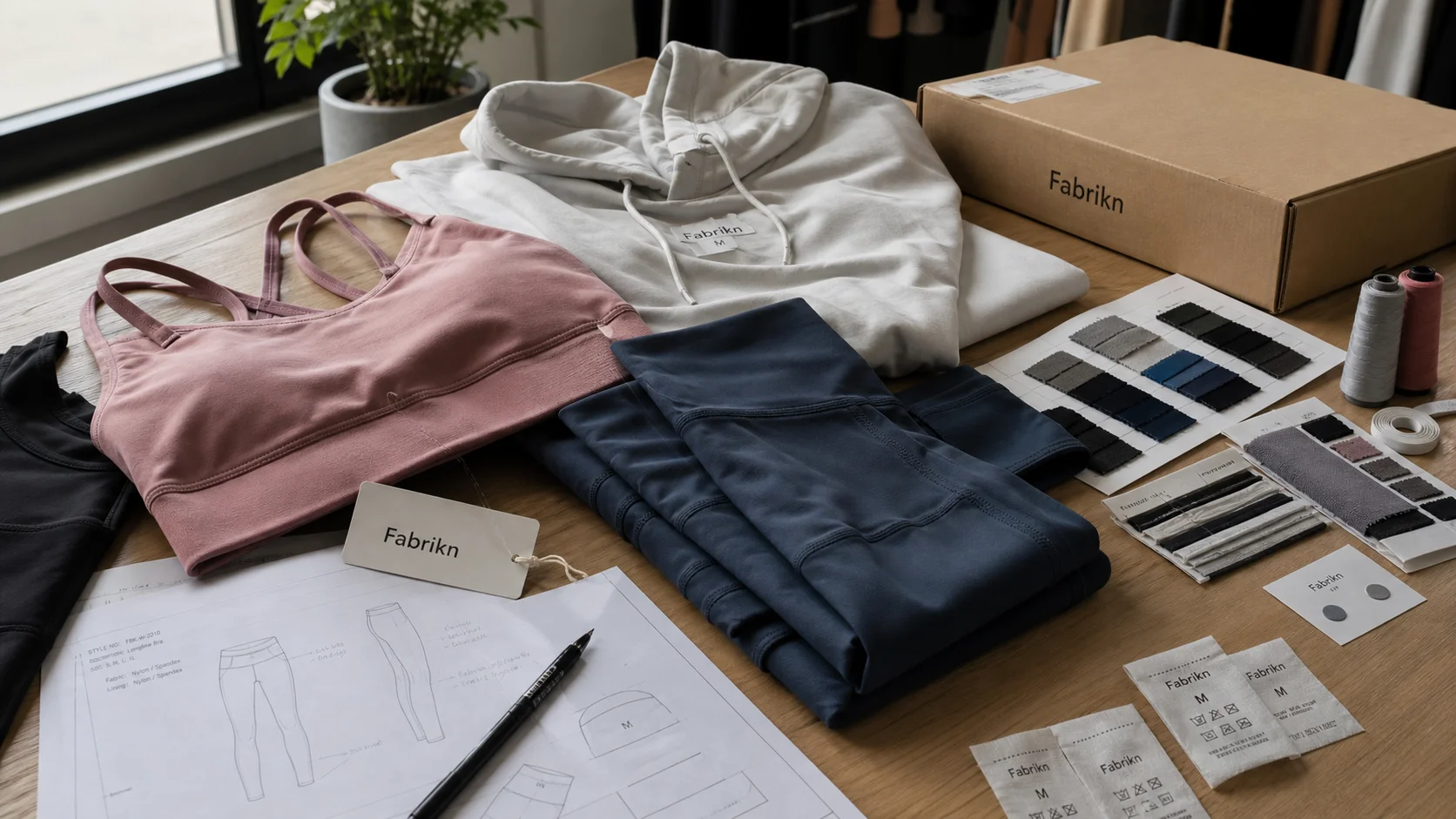
A focused outline for buyers sourcing bulk activewear sets, centered on shrinkage testing, fabric stability, fit retention, and sustainable gym apparel production decisions.
Bulk Activewear Sets With Shrinkage Testing to Buy - Fabrikn production reference
Bulk activewear sets with shrinkage testing are a smarter buy for gym apparel sourcing than low-cost sets that only look good on the first delivery. In activewear, post-wash stability is not a minor technical point. It affects size consistency, customer returns, logo distortion, seam stress, and long-term brand credibility. Buyers sourcing leggings, sports bras, bike shorts, training tops, and matching tracksuits in volume need to treat shrinkage testing as a core purchasing requirement, not an optional lab extra.
That is especially true when sourcing matching sets. A single-piece shrinkage problem can already create fit complaints. In a coordinated set, shrinkage mismatch between top and bottom creates a more visible issue. The leggings may tighten and shorten after washing while the bra band or cropped top holds its original dimensions, leaving the end customer with a set that no longer fits as intended. For gym apparel brands, this becomes a product review problem fast.
From a sourcing standpoint, the best bulk activewear sets are not simply the cheapest polyester-spandex packages on offer. They are the programs built around stable fabric construction, controlled finishing, tested colorfastness, and wash-performance approval before bulk cutting begins. That is where shrinkage testing earns its place. It gives buyers a practical indicator of whether the selected fabric, dyeing route, and finishing process can hold measurement tolerances once the garments are in use.
If your product line sits in the Sustainable Fashion category, the case is even stronger. Poor shrinkage performance leads to avoidable waste through returns, replacements, discounted stock, and short product lifespan. Better-tested garments tend to stay wearable longer, which supports a more responsible sourcing model. Buyers evaluating production options can review broader manufacturing support through services, brand background at about-us, and direct sourcing discussions via contact-us.
Not every activewear set category has the same sourcing profile. Some are easier to stabilize in wash than others. Some require tighter pattern engineering because compression fit leaves less room for measurement drift. Buyers should prioritize styles based on their customer use case, price point, and quality tolerance.
For most gym apparel programs, leggings and sports bra sets remain the anchor order. They sell across multiple training categories and allow efficient color blocking, branding, and upsell into capsule drops. They also create the highest risk if shrinkage is ignored, because tight-fit garments reveal even small changes in inseam, rise, chest, or underband measurements.
Jogger and hoodie sets tend to be more forgiving in fit, but the fabric category changes the risk. Cotton-rich fleece, organic cotton blends, recycled brushed back jersey, and French terry constructions often need stricter dimensional stability controls than synthetic compression knits. A buyer selecting sustainable loungewear-to-gym crossover sets should not assume a soft-hand fabric will remain stable after washing just because it passes initial visual review.
Seamless activewear sets deserve separate caution. They can perform well in bulk, but shrinkage review should include both length and width response, along with stretch recovery. A seamless rib waistband that pulls back too aggressively after washing can turn a good pre-production sample into a high-return retail style.
Purchasing judgment: if your brand is early-stage and budget-sensitive, it is often wiser to buy fewer colorways in a tested core set than to spread budget across too many styles with weak wash validation.
Shrinkage testing in activewear sourcing usually starts at the fabric stage, then moves into garment-level confirmation during development. Buyers should ask what standard is being followed, how many wash cycles are being used for approval, and whether results are measured in both warp and weft for woven fabrics or course and wale for knits. The goal is not just to receive a “pass” comment. The goal is to understand expected movement and build garment measurements around it.
For activewear knits, acceptable shrinkage targets often depend on fabric composition and intended fit. Many buyers aim for low single-digit shrinkage after a defined wash procedure, commonly around 3% to 5% as a general commercial threshold, though premium programs may require tighter control. Cotton-rich fabrics can show higher movement. Brushed finishes, heavy garment washes, enzyme treatments, and heat-setting inconsistency can all change the result.
A practical sourcing point gets missed here: the fabric can test acceptably in isolation and still create garment shrinkage issues after elastic application, panel joining, printing, bonding, or topstitch tension. That is why garment wash testing matters. Waistbands, armholes, neck bindings, and underbust elastics can all react differently once assembled.
Buyers should also clarify whether the factory or testing party measures shrinkage after one wash, three washes, or a brand-specific care simulation. For gym apparel, one wash may be enough for a development check, but repeat-cycle testing often gives a truer picture of real use.
Bulk activewear sourcing runs on specifications, not just mood boards. The more performance-driven the garment, the less room there is for vague fabric language. “Poly-spandex” is not a usable sourcing brief by itself. Buyers need a fabric and trim sheet detailed enough to control shrinkage, hand feel, recovery, and wear life.
For leggings and bras, common commercial fabrics include polyester-elastane or nylon-elastane blends in roughly 220 to 320 GSM, depending on compression target and opacity requirement. Lighter-weight tops may sit closer to 140 to 220 GSM. Sustainable programs often use recycled polyester or recycled nylon, but buyers should not assume recycled input automatically performs the same as a conventional benchmark. The yarn quality, knitting consistency, dye process, and finishing discipline still decide stability.
Trim selection also affects shrinkage performance. Elastic quality matters. A soft brushed underband may feel premium but can lose dimension if the elastic spec is weak. Zippers, silicone logos, heat-transfer labels, and reflective films need compatible heat application so panels do not distort. Drawcords in jogger sets should be checked for colorfastness and wash behavior. Even sewing thread tension can influence puckering after wash.
The safest buying approach is to request a full bill of materials and lock the approved fabric code and trim references before bulk. If the supplier reserves the right to substitute “equivalent” materials without written approval, shrinkage risk rises immediately.
Buyers looking for bulk activewear sets with shrinkage testing should expect some tradeoffs in MOQ and timing. Testing, sample revisions, and fabric reservation take time. In return, the sourcing process becomes more controlled and usually more scalable.
These are common market ranges, not fixed rules. Actual MOQs depend on fabric availability, number of sizes, print techniques, trim customization, and whether the supplier is working from open stock materials or custom-developed inputs.
Lead times vary widely. A stock fabric order with light branding may move faster than a custom shade matched sustainable compression set. Fabric mill lead time, dyeing capacity, lab testing schedules, and trim booking all matter. A reasonable planning view for custom gym apparel sets is often several weeks for development and several more for bulk, with longer timelines when mills need to produce custom recycled yarn fabrics or when multiple sample rounds are required.
Purchasing judgment: if a supplier promises very fast delivery on fully custom activewear sets with testing, ask what exactly is being shortened. In many cases, the compressed timeline means reduced sample iteration or limited wash validation.
In sustainable fashion, buyers often focus first on recycled fibers, organic inputs, biodegradable packaging, or lower-impact dye methods. Those matter, but durability and usable life deserve equal weight. An activewear set that tests well for shrinkage is more likely to remain in service longer. That reduces the waste built into premature replacement.
This is one of the more practical sourcing truths in sustainability: a garment does not become responsible simply because the fiber story sounds good. It needs to survive repeated wear, sweat, washing, and stretch. If it bags out, shrinks unevenly, twists, or loses fit after limited use, the environmental claim weakens in commercial reality.
For that reason, shrinkage testing supports sustainable fashion in several ways:
Buyers sourcing eco-positioned gym apparel should pair sustainability claims with measurable performance criteria. A recycled nylon legging set with poor dimensional stability is usually a worse commercial choice than a stable fabric with a clearer long-wear profile. The best outcome is not choosing sustainability over performance. It is choosing materials and production controls that deliver both.
Even when shrinkage testing is built into development, production risk remains. Bulk activewear sets have several recurring inspection issues that buyers should monitor through inline checks and final random inspection.
Top-to-bottom color matching is a recurring problem in coordinated sets, especially when components are cut from separate dye lots or different fabric structures. Shrinkage behavior can also vary lot to lot if finishing conditions shift. That makes bulk fabric continuity important. If the order is large, buyers should ask whether the factory will consolidate fabric from one production batch or manage lot segregation with shade bands and measurement control.
Inspection should include wash-tested measurement review on selected garments from production, not only pre-production samples. This is a sensible safeguard for any substantial order. If the buyer only approves the PPS and skips in-process verification, late discovery becomes much more expensive.
AQL-based final inspection remains useful, but activewear benefits from targeted performance checks beyond standard appearance review. Stretch seams, underband security, squat-proof opacity, and logo adhesion are all worth confirming on the actual production lot.
Strong sourcing decisions often come down to the quality of pre-order questions. Buyers comparing activewear suppliers should push past generic capability decks and get specific answers on testing, materials, and production controls.
The answers will quickly show whether the supplier is set up for real gym apparel sourcing or simply offering generic private-label garments. Buyers should be wary of vague replies like “no problem,” “export quality,” or “best fabric.” Those phrases do not protect a purchase order. Measurable specifications and a clear approval path do.
It is also worth checking how the supplier handles claim responsibility if bulk fails agreed shrinkage tolerance. That conversation is easier before the PO is issued than after goods are on the water.
If the objective is to buy bulk activewear sets with shrinkage testing for gym apparel sourcing, the best commercial choice is usually a controlled mid-compression core program in stable fabric, with limited initial colorways and a disciplined sample process. That gives buyers a cleaner path to repeat orders, lower return exposure, and more predictable fit retention.
For entry and mid-market brands, polyester- or nylon-based stretch sets with verified dimensional stability often offer the best balance of price, performance, and replenishment potential. Cotton-heavy sets can work for lounge or light training capsules, but they need closer wash control and more conservative tolerance planning. Seamless sets are attractive for margin and style value, yet they should only be purchased once yarn, recovery, and post-wash measurements are clearly validated.
The real advantage is not just preventing shrinkage. It is buying a product that behaves consistently across development, production, retail sale, and consumer care. In gym apparel, that consistency is what turns a one-off order into a repeatable sourcing program.
Get a free quote from Fabrikn — your trusted B2B clothing manufacturer with 10+ years of experience. MOQ as low as 200 pieces.
Get a Free Quote →Shrinkage testing checks how much the fabric or finished garment changes in size after washing and drying under a defined method. For bulk activewear sets, it helps buyers predict whether leggings, bras, tops, or joggers will stay within acceptable measurement tolerances after use.
Gym apparel is usually close-fitting and stretch-dependent, so even small dimensional changes can affect comfort and appearance. Testing helps reduce return risk, protects size consistency, and prevents mismatch between coordinated pieces in a set.
Typical MOQs often start around 100 to 300 sets for simpler programs using available fabrics, while custom cut-and-sew orders commonly run around 300 to 800 sets per style and color. Seamless and sustainable specialty programs may require higher minimums depending on yarn and mill setup.
Polyester-elastane and nylon-elastane blends are widely used because they can offer good recovery, opacity, and dimensional stability when properly processed. Recycled versions of these blends are also common in sustainable fashion, though they still need performance testing before approval.
Finished garments should be tested as well. Fabric may perform acceptably on its own, but sewing, elastic application, printing, and heat transfers can change how the final garment behaves after washing.
It supports durability and longer product life, which are practical sustainability outcomes. Better wash stability can reduce returns, replacements, and premature disposal, making the garment more responsible in actual use rather than just in sourcing claims.