
A detailed outline for buyers sourcing bulk jackets with heat transfer branding for logistics fleet uniforms, focused on garment performance, transfer application, visibility, durability, sizing, and rollout execution.
Buy Bulk Jackets With Heat Transfer Branding - Fabrikn production reference
Bulk jackets with heat transfer branding are a practical uniform category for logistics fleets because they solve two problems at the same time: weather protection and visible brand consistency. For delivery drivers, warehouse transfer crews, yard teams, dispatch support staff, and route supervisors, outerwear is often the most visible part of the uniform during peak operating hours. That matters in freight yards, loading bays, curbside delivery, and customer-facing stops where recognition, professionalism, and durability all affect the day-to-day operation.
In logistics, uniforms are not only about appearance. They must hold up against abrasion from vehicle entry and exit, friction from seat belts, repeated laundering, and exposure to rain, wind, road grime, and occasional high-visibility requirements. A jacket program that looks good on a product page but fails after a few months in the field creates replacement costs, inconsistent branding, and crew complaints. Buyers in this category usually get better results when they treat jackets as a functional procurement item rather than a simple promotional garment.
Heat transfer branding is often chosen for bulk fleet jackets because it can deliver clean logos, fast application, and flexible decoration across different fabric types. It can also support left chest branding, larger back logos, sleeve identifiers, and reflective transfer options without requiring embroidery needle penetration through waterproof or coated shell fabrics. That is a major benefit when water resistance and shell integrity matter.
For brands managing regional or national fleets, the best jacket purchase is rarely the cheapest unit price. The better purchasing decision is the one that balances garment durability, size consistency, branding adhesion, replenishment potential, and realistic production timing. Buyers comparing jacket suppliers should keep the full use case in view: daily wear, repeated washing, field mobility, and replacement cycles across changing seasons.
If the goal is to build a jacket line that fits a broader uniform sourcing strategy, it helps to review supplier capabilities across development and production services, including trim sourcing and customization support. A useful starting point is the overview at /services/.
Heat transfer branding refers to applying logos, text, numbering, or safety graphics onto a jacket using heat and pressure. The transfer itself may be a polyurethane film, vinyl-based graphic, screen printed transfer, reflective transfer, silicone-like effect transfer, or other engineered decoration layer designed for textile adhesion. For logistics uniforms, the most common commercial use cases are company logos, employee role markers, route identifiers, and reflective branding elements that support visibility.
There is a practical reason this method is popular in outerwear. Embroidery works well on many garments, but on lightweight rain jackets and softshells it can create perforation points, puckering, and distortion. A heat transfer avoids needle holes and often produces a sharper logo edge, especially for small text or modern corporate marks. This becomes important when a fleet brand guide requires precise Pantone approximation, clean edges, and repeatable placement.
Not all heat transfers perform equally. Some are designed for fashion decoration and some for industrial laundering or more demanding wear conditions. That difference matters. A transfer that looks excellent on a showroom sample may crack, peel, or lose reflectivity if the film type does not match the shell fabric, stretch behavior, and wash protocol. Procurement teams should ask direct questions about transfer composition, application temperature range, wash test expectations, and whether adhesion testing is performed on the actual jacket fabric before bulk production.
For logistics fleets, the most common transfer categories include:
The right choice depends on the jacket construction. A bonded softshell, a PU-coated rain shell, and a padded winter jacket may each require different heat application settings or different transfer formulas. That is why decoration approval should never be separated from garment approval. Buyers who review garment samples and branding samples independently often miss the real performance risk: how the two components behave together after wear and washing.
Not every logistics team needs the same jacket. Climate zone, route type, time spent indoors versus outdoors, and safety visibility rules all change the ideal specification. In bulk orders, narrowing the program to one or two core silhouettes usually improves pricing and reduces complexity. Still, the jacket category should be chosen based on real working conditions rather than generic popularity.
Softshell jackets are often the most balanced option for delivery fleets in mild to cool weather. They usually provide wind resistance, light rain protection, and better mobility than heavier insulated outerwear. A typical softshell spec might include a 2-layer or 3-layer bonded fabric with polyester face, TPU membrane, and microfleece inner backing. This structure works well for drivers who move in and out of vehicles all day.
Softshells also accept heat transfer branding reasonably well, but the buyer should confirm the transfer is compatible with fabric stretch and any DWR finish. Some low-cost softshells have inconsistent surface coatings that can affect adhesion. If the jacket is heavily stretch-oriented, a standard transfer may eventually show edge lifting unless the correct film type is used.
Rain jackets are a strong option for wet-route fleets, courier teams, and operations in humid or coastal regions. They are packable, easy to layer, and highly visible in active use. From a branding standpoint, heat transfers are often more suitable than embroidery on coated shells because they preserve water resistance more effectively.
The tradeoff is durability perception. Very lightweight rain jackets can feel economical, but they may not survive frequent abrasion at the pocket, cuff, and front placket areas. Buyers should be cautious about ultra-thin shell fabrics if the jackets are meant for hard daily use.
For colder climates, insulated jackets with quilted lining, synthetic fill, or fleece backing provide better warmth retention. These are common in linehaul support, yard operations, and early-morning or night-shift delivery work. Heat transfer branding is still possible, though bulky insulation can affect placement smoothness, especially on stitched quilt panels.
A smarter choice is often to reserve branding for flatter zones such as the left chest yoke, upper back panel, or sleeve area. Trying to place a large transfer across heavily stitched baffles can produce uneven pressure and weak adhesion.
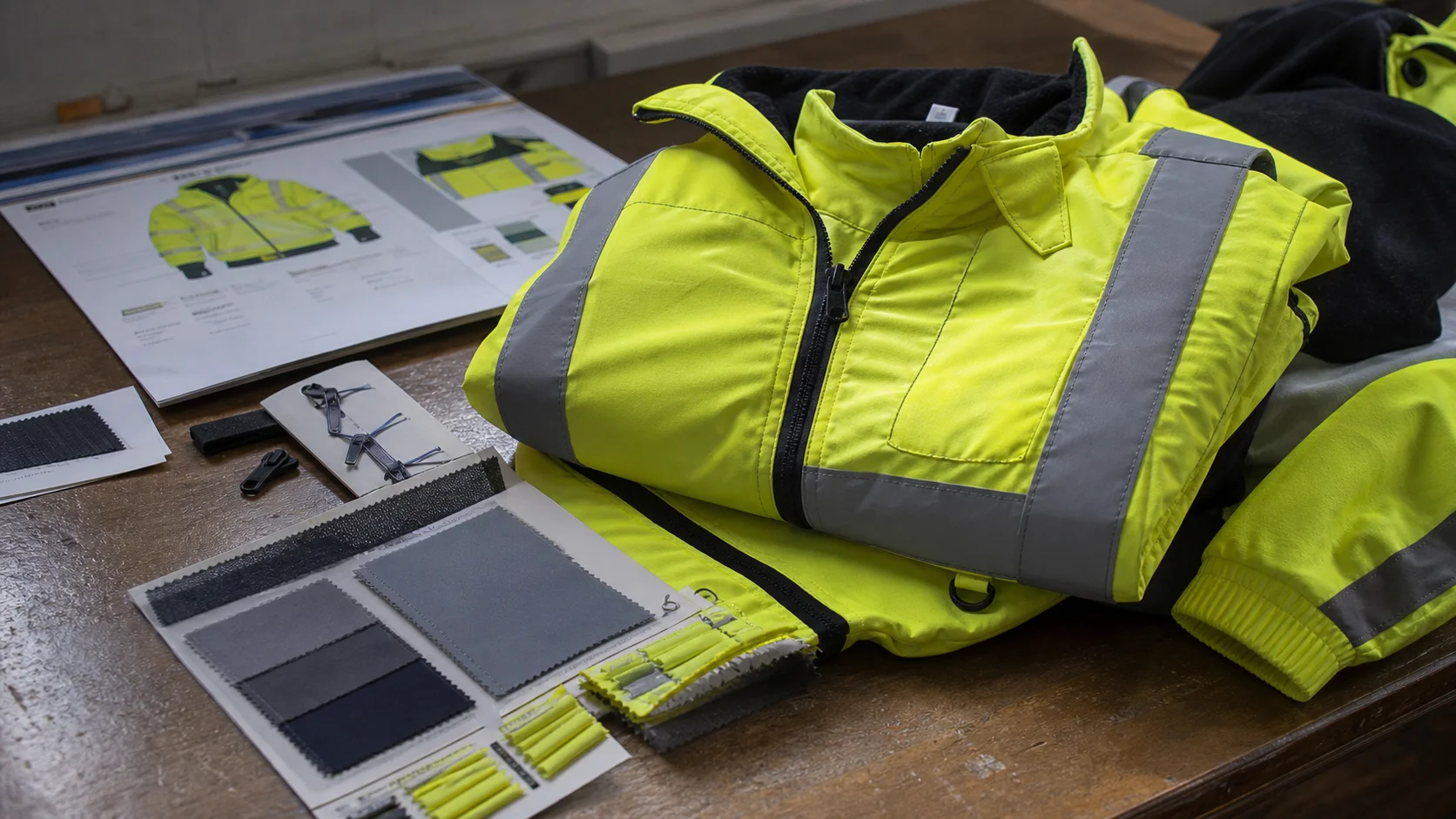
Some logistics environments require hi-vis outerwear that conforms to internal safety standards or regulated visibility requirements. In those programs, reflective piping, reflective tape, and fluorescent shell colors matter as much as the logo. A branded transfer on a hi-vis jacket should not interfere with reflective panel layout or reduce visibility performance in a critical area. Purchasing teams should review placement maps carefully before approving artwork.
Outerwear sourcing goes wrong when buyers approve jackets based on silhouette and color alone. For logistics fleet uniforms, fabric and trim details directly affect wear life, replacement rates, and logo performance. The spec sheet should be reviewed line by line.
Important fabric points include fabric content, GSM, coating or membrane type, breathability expectations, and water resistance claims. A typical fleet softshell may fall around 280 to 340 GSM, while lightweight rain shells may use much lower GSM fabrics with PU or TPU coating. Heavier is not always better, but fabric that is too light can shorten service life fast in logistics use.
Key trim and construction items to check include:
Fleet buyers should also ask whether the shell finish includes a durable water repellent treatment and how many wash cycles it is expected to maintain acceptable performance. Those claims vary widely. A low-cost DWR finish may drop off quickly, which does not always make the garment unusable, but it does affect wearer satisfaction.
From a branding standpoint, shell surface smoothness matters. Textured fabrics, heavy ripstop grids, silicone finishes, and heavily brushed surfaces can complicate transfer adhesion or reduce logo clarity. This does not rule them out, but it does mean lab dips and transfer strike-offs alone are not enough. A real pre-production branding test on bulk-equivalent fabric is a safer approval step.
Good logo placement on logistics jackets is a purchasing decision, not only a design decision. It affects visibility, wearability, and long-term durability. Left chest branding remains the standard because it is recognizable, cost-efficient, and less exposed to abrasion than some sleeve or lower-body placements. Upper back logos are common for route visibility and brand exposure in customer-facing deliveries.
Typical placement options include:
There are tradeoffs. Large back transfers look strong in marketing photos, but they can raise the decoration cost, increase application time, and create a stiffer hand feel on lighter jackets. Sleeve branding adds visual interest, yet sleeve seams, curvature, and movement can make placement less consistent. Chest logos cost less and are easier to standardize, but they provide less visibility from a distance.
Artwork files should be approved in production-ready format with exact dimensions, color references, and placement tolerances. The approval sheet should state whether the logo finish is matte, gloss, reflective, raised, or stretch. If color matching is important, ask the supplier how closely the transfer can match target colors on the selected shell color. Dark jackets usually simplify logo legibility, while fluorescent or bright shell colors may change the perceived contrast.
A reliable jacket branding program is built on controlled artwork, confirmed placement tolerances, and transfer testing on the actual fabric. Skipping any one of those steps usually shifts the risk into bulk production.
MOQ for bulk jackets with heat transfer branding varies widely depending on whether the order uses stock bodies, custom colors, custom patterns, or specialized trims. For semi-custom programs using existing jacket bodies with custom logo application, common MOQ ranges often start around 100 to 300 pieces per style or color. Fully customized outerwear programs usually begin higher, often around 300 to 1000 pieces per style depending on fabric development, size ratio complexity, and trim customization.
Buyers should be careful with unusually low MOQ promises on outerwear. Low entry quantities may be possible when using stock materials and limited customization, but fully custom jacket manufacturing carries real setup and material commitments. If the MOQ sounds too flexible for a detailed custom brief, there is usually a compromise somewhere in fabric choice, repeatability, or costing.
A sound sampling and approval process typically follows these steps:
For logistics uniforms, the pre-production sample is the critical checkpoint. This sample should reflect the actual shell fabric, actual zippers, actual transfer type, and actual logo placement. A digital mockup is useful, but it is not a substitute for a real branded sample. Bulk issues often come from assuming the transfer used on a showroom sample is equivalent to the transfer used in production. Buyers should request confirmation of transfer specification and application parameters before final approval.
If your sourcing process still needs a direct project discussion, the most efficient step is usually to define target use conditions, annual volume, and branding requirements early through /contact-us/.
Lead times for bulk jackets depend on several moving parts: fabric availability, trim sourcing, sample revision rounds, branding method confirmation, order size, and seasonal production load. Outerwear almost always requires more planning than basic knit uniforms. That is especially true if the order includes custom shell colors, reflective details, insulated constructions, or multiple logo placements.
For stock-body jackets with custom heat transfer application, a rough planning window may fall around 3 to 8 weeks after final approval, depending on quantity and material readiness. For fully custom jackets, total development and production timelines often extend to 8 to 16 weeks or longer. Those are only general working ranges. Actual timing shifts with seasonal demand and supplier capacity.
What matters more than headline lead time is dependency control. A late artwork approval, unresolved size chart issue, pending fabric lab dip, or trim substitution can delay the entire production line. Buyers often focus on the cut-and-sew calendar, but branding approval delays can be just as disruptive.
For fleet programs, it is smart to build in buffer time for:
If a company expects rolling replenishment rather than a one-time seasonal buy, it should ask whether the same fabric, color, and transfer specification can be repeated later. Reorder consistency is often more valuable than squeezing the first order cost down by a small percentage.
Jackets with heat transfer branding combine garment production risk with decoration risk. That means inspection should not stop at general workmanship. The branding itself needs clear pass-fail criteria. In logistics uniforms, the most common issues are not dramatic factory errors. They are repeatable small defects that become costly across hundreds or thousands of units.
Common inspection risks include:
A practical inspection plan should include measurement checks, visual review, branding placement verification, carton assortment review, and random adhesion checks where appropriate. If the jacket includes reflective transfers, confirm the reflective effect under suitable lighting rather than relying only on room-light appearance.
One overlooked point is packaging pressure and transfer cure stability. If garments are folded and packed too quickly after branding application, some transfer types may be more vulnerable to marking or imperfect settling. Buyers do not need to micromanage factory operations, but they should ask whether the supplier has an established post-application handling process.
Inspection risk also rises when a supplier outsources branding separately from garment manufacturing. That is not automatically a problem, but the handoff between garment production and transfer application needs control. Any mismatch in temperature settings, pressing dwell time, or placement jigs can show up in the finished order.
Buyers comparing quotes for bulk branded jackets should separate the cost into major components: shell fabric, lining or insulation, trims, garment construction complexity, transfer type, number of logo positions, packaging, and freight. Without that breakdown, low quotes can be misleading.
The main cost drivers usually include:
There is no single best buying strategy for every fleet. A premium softshell with durable branding may cost more upfront but reduce replacement frequency and improve wearer acceptance. A lower-cost jacket may be enough for short-term campaigns, seasonal contractors, or lower-exposure route teams. The mistake is using one cost logic for all operational scenarios.
Purchasing teams should also consider the tradeoff between full customization and speed. A stock-body jacket with branded transfers is often the fastest path for urgent uniform deployment. A fully custom jacket offers better brand control and potentially better function, but it adds more development time and approval steps. For many logistics businesses, a phased approach works better: start with a controlled stock-body program, then move to a custom outerwear spec once wear data and staff feedback are available.
To better understand a supplier’s broader manufacturing approach and whether it matches your sourcing expectations, it can help to review company background information at /about-us/.
The most efficient jacket sourcing projects start with a clear brief. Buyers should define who wears the jacket, in what climate, for how many months per year, with what branding visibility requirement, and under what wash conditions. That sounds basic, but many outerwear delays come from trying to finalize product details after sampling has already started.
A strong sourcing brief for logistics fleet uniforms should cover:
It also helps to standardize what “approved” means. An approved bulk jacket should not just meet visual expectations. It should meet agreed specs for fit, logo placement, trim quality, and branding adhesion. If the buyer only approves by appearance, the supplier may still interpret performance details differently.
From a purchasing standpoint, the best results usually come from reducing avoidable variation. Fewer shell colors, fewer logo placements, and a narrower trim matrix can improve consistency and shorten lead times. That does not mean settling for a generic product. It means concentrating customization where it adds the most brand and functional value.
For logistics fleets, that often means prioritizing:
When buyers make those choices early, bulk outerwear sourcing becomes much more manageable.
Buying bulk jackets with heat transfer branding for logistics fleet uniforms is less about choosing a logo method and more about building a dependable outerwear program. The right jacket must perform in active field use, carry the brand clearly, fit consistently across team sizes, and hold up through laundering and repeated wear. Heat transfer branding is often the right decoration route for this category because it protects shell integrity and supports clean logo reproduction, but only when the transfer type matches the jacket fabric and the approval process is properly controlled.
Most sourcing problems in this segment come from shortcuts: skipping pre-production branding tests, under-specifying fabric and trim quality, approving artwork without placement tolerances, or chasing unrealistically low MOQ and lead-time promises. A better purchasing decision balances durability, visibility, budget, and replenishment potential. For logistics fleets, that balance usually matters more than any single feature claim.
If the objective is a scalable uniform program rather than a one-off buy, focus on clear specs, disciplined approvals, and inspection points that reflect real field use. That is the practical route to branded jackets that look consistent, wear well, and support logistics operations over time.
Get a free quote from Fabrikn — your trusted B2B clothing manufacturer with 10+ years of experience. MOQ as low as 200 pieces.
Get a Free Quote →Softshell jackets are often the most versatile option for many fleets because they balance mobility, light weather protection, and branding compatibility. Rain jackets work better in wet climates, while insulated jackets suit colder operating conditions. The best choice depends on route exposure, season length, and safety requirements.
For many outerwear programs, yes. Heat transfer branding is often better on coated, water-resistant, or lightweight shell fabrics because it avoids needle holes and can produce cleaner logo detail. Embroidery can still work on some jackets, but it may affect waterproof performance or cause puckering on lighter fabrics.
For stock-body jackets with custom heat transfer branding, typical MOQ ranges often start around 100 to 300 pieces per style or color. Fully customized jacket manufacturing usually starts higher, often around 300 to 1000 pieces or more, depending on fabric, trims, and construction complexity.
Stock-body programs with approved branding may take roughly 3 to 8 weeks after final approval if materials are ready. Fully custom jackets often require 8 to 16 weeks or longer once development, sample revisions, and production are included. Lead time depends heavily on approvals, fabric sourcing, and seasonal factory load.
The most common risks are logo misplacement, edge lifting, cracking after wash, heat marks on the shell fabric, uneven reflectivity, and poor adhesion on textured or coated materials. These risks are easier to control when buyers require a pre-production sample using the exact bulk fabric and final transfer specification.
Yes. Reflective heat transfers are widely used on logistics and transport outerwear. Buyers should confirm reflectivity performance, placement suitability, and wash durability before approving the bulk order, especially if the jacket also includes high-visibility or safety-related design elements.