
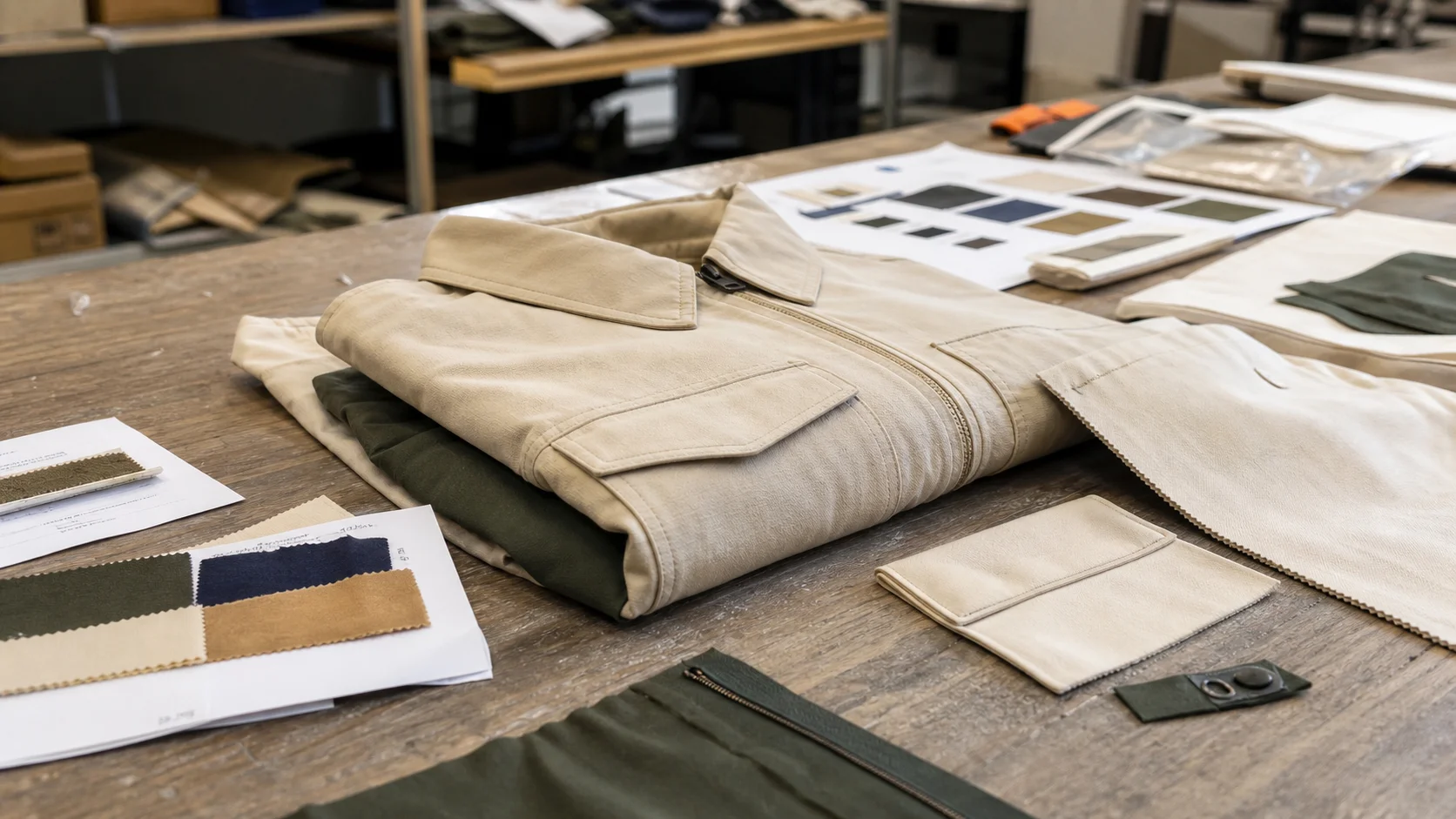
A detailed outline for mining procurement teams evaluating bulk workwear coats, with a focus on colorfastness compliance, test methods, fabric performance, and production controls specific to industrial outerwear.
Buy Bulk Workwear Coats With Colorfastness Compliance - Fabrikn production reference
Mining procurement teams do not buy workwear coats on appearance alone. They buy against operating risk. In that context, colorfastness compliance is not a cosmetic detail. It affects garment life, uniform consistency, worker presentation, and in some cases the visibility performance of high-contrast panels and trims over repeated use.
Bulk workwear coats used on mine sites are exposed to abrasive dust, UV, repeated industrial laundering, body oils, rain, and constant movement against equipment surfaces. A coat that looks acceptable at shipment can lose shade depth quickly if the dyeing and finishing process is not controlled. Once fading, crocking, or shade migration appears across batches, the procurement problem becomes expensive. Replacements rise, complaint handling expands, and site managers start questioning the reliability of the entire apparel program.
For that reason, colorfastness compliance should be treated as a sourcing control, not just a lab checkbox. Buyers need clear specifications, realistic test methods, pre-production approvals, and shipment inspection criteria that match actual mining use conditions. Teams that skip this discipline often end up paying more through reorders, short-term substitutions, and field rejection.
If your outerwear program includes insulated coats, waterproof shells, softshell jackets, or heavy-duty canvas work coats, the safest purchasing approach is to define colorfastness expectations early and tie them to sample approval and final release. That reduces ambiguity with suppliers and gives procurement teams a practical basis for acceptance decisions.
For companies reviewing broader apparel development and sourcing support, it also helps to align coat compliance with vendor management and production planning workflows, such as those outlined on /services/.
Colorfastness compliance refers to a garment’s ability to retain its original shade and resist color transfer during use, washing, rubbing, perspiration exposure, light exposure, and weathering. In mining workwear, this matters because garments are not worn in light office conditions. They face a punishing care and wear cycle.
A practical procurement definition should cover several separate risks:
Mining procurement teams usually deal with more than one garment category at once, so the temptation is to apply a generic color standard across all outerwear. That is not always a good buying decision. A lightweight showerproof shell, a PU-coated rain jacket, and a brushed cotton duck work coat may all need different performance thresholds because their fibers, dye classes, finishes, and wash profiles differ.
The stronger approach is to set compliance by end use. A coat worn near haul roads, wash plants, or open-cut areas may require more emphasis on light fastness and rubbing fastness. A coat used in underground or maintenance settings may place heavier pressure on soil-release finishing, wash stability, and seam area appearance after repeated cleaning.
Buyers should also separate “passable for corporate uniform use” from “fit for industrial workwear issue.” Those are different standards. Many fashion-oriented outerwear factories can produce a visually good sample, yet still struggle with repeatable bulk performance once darker shades, fluorescent contrasts, or waterproof finishes enter the program.
Most colorfastness problems in bulk workwear coats do not start at final inspection. They start earlier, often in spec writing or fabric nomination.
If the purchase order only states “navy workwear coat” or “charcoal padded jacket,” the supplier has too much freedom. Different mills may use different fiber blends, dye classes, and finishing routes to hit price. The result is shade inconsistency and unstable post-wash appearance.
Typical outerwear fabrics for mining-related workwear include:
Each material responds differently to dyeing, coating, and testing. Cotton-rich fabrics can show stronger wash fade if dye selection is weak. Polyester shells may hold color well but still fail on rubbing or trim mismatch. Coated fabrics can complicate testing if the face finish changes how rubbing and wet exposure behave.
Two-tone coats are common in mining workwear. Navy with orange, charcoal with yellow, and other high-visibility combinations can look sharp in a salesman sample. Bulk trouble shows up when dark and bright areas age differently. The shell fabric may pass, while pocket welts, reinforcement panels, storm flaps, or hood parts shift tone faster.
Procurement teams should request testing and approval on the actual combination of body fabric, contrast fabric, reflective application, and sewing thread. Testing only the main shell leaves a known gap.
Lab dips are useful, but they are not enough. A coat can match the target shade before production and still change noticeably after washing, curing, coating, or seam sealing. This is especially relevant in dark navy, bottle green, red, and black, where visual movement is easier to spot across batches.
Bulk workwear inspections often emphasize count, carton marks, measurement tolerance, and basic workmanship. Those are necessary controls, but they do not replace functional review. If inspectors do not compare lot shading, rubbing sensitivity, trim consistency, and post-finish appearance, the shipment may technically pass while still creating field complaints.
Mining procurement teams reduce colorfastness disputes by writing tighter specifications before sampling starts. The goal is not to make the tech pack overly complicated. The goal is to remove avoidable ambiguity.
A practical bulk workwear coat specification should include:
This is where procurement judgment matters. The cheapest quoted coat is often based on the loosest technical assumptions. Once a buyer adds clear fastness grades, approved trims, and after-wash appearance standards, some price gaps between suppliers begin to make more sense.
Buyers should also specify whether approval is required at fabric stage, garment stage, or both. For higher-risk programs, both are advisable. Fabric approval catches shade and performance issues early. Garment approval catches interactions between shell, trim, stitching, and finishing.
Exact test standards vary by market and compliance framework, but sourcing documents commonly define target grades for:
The important point is consistency. If the test method is named but the minimum acceptable grade is omitted, a dispute is almost guaranteed later.
Not every test deserves the same weight for mining outerwear. Buyers should prioritize by actual use condition.
This is usually a baseline requirement for all bulk workwear coats. It indicates how much the garment shade changes and whether color stains adjacent fabrics after laundering. If workers are issued coats for repeated site use across seasons, this test should not be treated as optional.
Procurement teams should confirm the assumed wash protocol. A factory may quote compliance under a mild home-laundry method, while the end user expects stronger industrial care. That mismatch can make a “passing” result commercially meaningless.
Dry and wet crocking matter in mining because coats are constantly in contact with gloves, vehicle seats, harness points, and equipment surfaces. Dark shades are a common risk area. If a navy or black coat transfers color when damp, complaints can surface quickly.
Wet rubbing is often where cheaper dyed fabrics struggle. Buyers comparing offers should ask direct questions on this point instead of assuming all dark workwear fabrics perform equally.
Outdoor mining environments place strong pressure on light fastness. UV exposure can flatten shade depth and create visible differences between newer and older issue stock much faster than expected. This is especially relevant for site teams trying to maintain a consistent uniform image across mixed replacement cycles.
These tests become more important when coats are worn for long shifts in variable temperatures. Collars, cuff areas, and inner facings can show early change if dye fixation is weak or if trim materials react differently from the shell fabric.
Procurement teams often focus on shell fabric reports and overlook the accessories. That is a procurement gap. Sewing thread, reflective tape edge staining, zipper tapes, and contrast binding can all create apparent colorfastness failures at wearer level even when the shell itself passes.
A strong purchase process asks for relevant test visibility on the full bill of materials, not just the main body cloth.
Sampling is where buyers either prevent trouble or authorize it.
For bulk workwear coats, a cautious approval flow usually includes:
Skipping directly from a visual sample to bulk PO can save a little time on paper, but it increases the odds of commercial delay later. A pre-production sample made from the actual lot-standard materials is one of the best checkpoints a buyer can insist on.
Mining procurement teams should pay attention to the following during sample review:
If the order supports it, a limited wear trial is worth considering. A short field test does not replace lab compliance, but it often reveals practical issues that paperwork misses, such as seat-contact rubbing, cuff edge fade, or soil visibility on certain finishes.
Teams that need support structuring development checkpoints and supplier communication can usually benefit from a more formal sourcing workflow through pages such as /about-us/ and related operational resources.
Bulk workwear coat procurement always involves tradeoffs between compliance stability, price, and timing.
MOQs vary by fabric complexity, customization level, and whether the supplier is using stock materials or custom-developed inputs. As a practical market guide:
These are planning ranges, not fixed rules. The main procurement point is that lower MOQ flexibility often comes with reduced control over custom dye lots and fewer options for matching trims precisely. That can affect color continuity.
Lead time for bulk workwear coats usually depends on several linked stages:
A reasonable planning assumption for customized coat orders is often around 60 to 120 days after final approval, with technical programs sometimes extending beyond that. The shorter offers in the market are not always wrong, but they should be checked carefully. Fast lead times can mean stock fabric substitution, compressed approval windows, or reduced retest tolerance.
There is a point where a lower FOB cost stops being a savings. If a supplier reaches price by using less stable dyed fabric, lower-grade zipper tapes, or unverified trim sources, the procurement team may buy reissue risk instead of value.
The better commercial question is not “Who is cheapest?” It is “Which offer gives acceptable compliance stability at the total program cost we can defend?” In mining workwear, that usually favors balanced sourcing over the rock-bottom quote.
Pre-shipment inspection should confirm more than appearance at first glance. For workwear coats, inspectors should review both workmanship and compliance-sensitive details.
Useful inspection points include:
Inspection risk tends to increase when orders are split across lines, stitched in more than one batch, or packed over several days without tight lot segregation. Even compliant fabrics can create a shipment problem if shade management on the sewing floor is weak.
Buyers should also be careful with acceptance based only on supplier-issued reports. Independent testing or third-party inspection is not necessary for every order, but it becomes much more relevant when the program is large, safety-sensitive, or tied to strict end-user contracts.
Mining procurement teams are usually better served by suppliers that can explain their process clearly than by suppliers that simply promise every standard will be met.
When evaluating vendors for bulk workwear coats, ask practical questions such as:
Those questions quickly separate technically organized suppliers from traders relying on optimistic assumptions.
It also helps to review how the supplier handles communication during development. Delays in trim confirmation, unclear wash method references, or vague answers on test thresholds are early warning signs. In workwear sourcing, operational clarity usually correlates with lower bulk risk.
If the procurement team is planning a larger outerwear or uniform program and wants to discuss specification alignment, development flow, or quotation support, a direct inquiry through /contact-us/ is the practical next step.
Bulk workwear coats for mining teams should be purchased as a controlled performance item, not as a generic outerwear commodity. Colorfastness compliance sits at the center of that decision because it affects durability perception, replacement cost, and consistency across the issued workforce.
The strongest buying approach is straightforward:
Procurement teams that take these steps usually reduce avoidable claims and improve vendor accountability. Teams that do not often end up solving the same problem after delivery, when the options are narrower and the cost is higher.
In short, compliance is not an added extra for mining outerwear. It is part of the purchase requirement. When workwear coats are sourced with that mindset, the result is usually better continuity, fewer field complaints, and a more defensible total cost of ownership.
Get a free quote from Fabrikn — your trusted B2B clothing manufacturer with 10+ years of experience. MOQ as low as 200 pieces.
Get a Free Quote →It refers to the coat’s ability to retain its color and resist staining or transfer during washing, rubbing, light exposure, perspiration, and normal site use. For mining procurement teams, it is a practical durability and consistency requirement.
There is rarely one single most important test. Washing, rubbing, and light fastness are usually the key priorities for mining outerwear because garments face repeated cleaning, abrasive contact, and outdoor exposure.
Many programs start around 300 to 500 pieces for simpler stock-supported options, while custom-developed coats often fall around 800 to 1,500 pieces per style/color. Technical fabrics and specialized trims can push MOQs higher.
For custom workwear coats, production commonly takes around 60 to 120 days after final sample and material approval. Fabric development, trim sourcing, testing, and seasonal capacity all affect the actual lead time.
Dark shades such as navy, charcoal, and black are more likely to show rubbing issues, wash fade, press marking, and trim mismatch if dyeing and finishing are not tightly controlled.
No. Fabric swatches and lab dips are useful early controls, but garment-level approval in actual bulk materials is much safer. It helps catch trim mismatch, finishing effects, and post-wash appearance issues before mass production ships.