
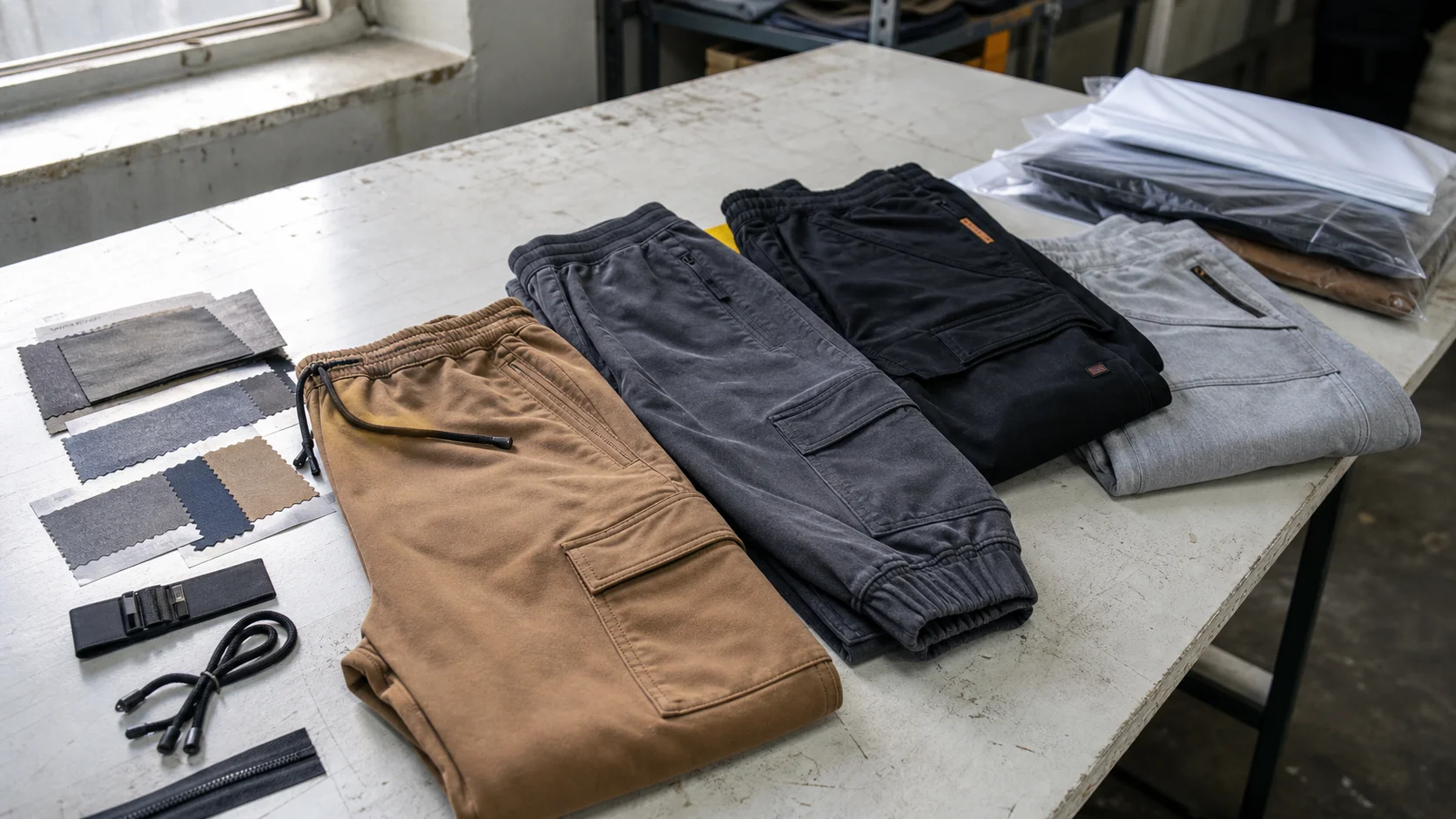
A product-specific outline for wholesale buyers evaluating a bulk jogger production factory, covering jogger construction, manufacturing stages, quality...
Bulk Jogger Production Factory for Wholesale Buyers - Fabrikn production reference
A bulk jogger production factory is not just a sewing unit that runs sweatpants at scale. For wholesale buyers, it is a supply partner that needs to balance fit consistency, fabric performance, trim control, and commercial lead times. Joggers look simple on paper, but the category carries more technical variation than many buyers expect. A fleece jogger for winter retail, a lightweight French terry jogger for resorts, and a nylon-spandex performance jogger all require different production planning.
That matters because wholesale buying decisions are usually made under margin pressure. Buyers need a factory that can deliver the target price without quietly downgrading fabric weight, drawcord quality, pocket bag strength, or waistband recovery. A weak production setup often shows up later in the form of shade variation, twisted side seams, poor cuff recovery, and unstable sizing after wash.
In practical terms, the right bulk jogger production factory should be able to handle pattern development, size grading, fabric sourcing, sampling, trim approvals, inline quality checks, and final inspection before packing. Buyers who treat joggers as a basic commodity often end up with avoidable claims. Buyers who treat them as a fit-sensitive, fabric-dependent product usually make better sourcing decisions.
For brands and importers exploring broader manufacturing capabilities, it helps to review a supplier’s service scope before sending a tech pack. A clear overview of development and production support on /services/ can help buyers assess whether the factory is structured for bulk programs rather than one-off quoting.
Not every apparel supplier is built for jogger production. Some factories are strong in fashion bottoms but weak in knitwear finishing. Others can sew fleece well but struggle with technical woven joggers that require cleaner pocket construction and tighter measurement tolerances. Wholesale buyers should separate “can make” from “can repeat consistently in bulk.” Those are not the same thing.
A dependable bulk jogger production factory should usually offer the following:
Buyers should also check whether the supplier can support both men’s and women’s joggers, plus youth sizing if needed. Fit blocks differ. A factory that only copies measurements without understanding rise balance, thigh ease, taper shape, and cuff opening proportion may still produce garments that technically match the chart but wear poorly in store.
Commercially, the strongest factories are transparent about what they do in-house and what they outsource. Printing, embroidery, washing, and specialty trims are often handled through partner units. That is not automatically a problem. The real issue is visibility. If outsourced processes are poorly controlled, delivery dates slip and color matching problems become harder to trace.
Fabric selection drives most of the cost and performance outcome in jogger production. Buyers who focus only on GSM and composition miss the more important question: how does the fabric behave after wash, stretch, wear, and bulk cutting? A 320 GSM cotton-poly fleece can feel stable in hand but still show torque or pilling if knitting quality and finishing are weak.
Common jogger fabric options include:
Wholesale buyers should request full fabric specifications before sample approval. That usually includes composition, GSM tolerance, usable width, shrinkage standards, colorfastness expectations, pilling performance targets, and finishing details such as brushed back, enzyme wash, peach finish, or moisture-management treatment.
Construction details matter just as much. Joggers are often judged by customers on comfort and shape retention, which makes certain areas high risk:
A practical sourcing approach is to define seam type, stitch density, elastic width, drawcord material, eyelet finish, and pocket bag fabric in the tech pack. Leaving these points open can make quoting easier at first, but it also invites inconsistency between the development sample and the bulk order.
Fit is another area where buyers should stay disciplined. Joggers need the right balance between comfort and silhouette. A factory may offer to “follow sample exactly,” but buyers still need to confirm front rise, back rise, thigh width, knee position, inseam tolerance, and cuff opening across the size range. Size grading errors are common in bottoms, especially when the factory scales a single approved sample without checking how the taper behaves in larger sizes.
MOQ is often the first question wholesale buyers ask, but it should not be the only one. A low MOQ can be useful for testing new styles, yet it may limit fabric options, dyeing efficiency, and unit cost competitiveness. For bulk jogger production, typical MOQs often fall into these ranges:
These are common commercial ranges, not fixed rules. The actual MOQ depends on fabric mill minimums, trim development, printing methods, and whether the order is cut from ready greige or custom-knitted fabric. Buyers should ask which part of the MOQ is driven by fabric and which part is driven by the sewing factory. That distinction helps during negotiation.
Sample approval usually moves through several stages:
Skipping steps may save time early and cost time later. For joggers, a pre-production sample is especially important because waistband tension, cuff recovery, fabric shrinkage, and seam appearance often change once final materials are used.
Lead times also need sober planning. A standard bulk jogger order may require around 45 to 90 days from final approval, but that range moves quickly depending on fabric availability, lab dip approval, trim sourcing, print scheduling, and seasonality. Custom dyeing, branded cords, metal trims, and washed finishes add time. Woven joggers with multiple zippers or bonded panels usually need tighter line planning than basic fleece styles.
Buyers who want predictable shipping should ask for a stage-based timeline rather than a single promised delivery date. That schedule should cover fabric booking, lab dips, strike-offs, sample approvals, bulk cutting, inline inspection, final packing, and shipment readiness. If any of those milestones are vague, the delivery risk is already higher than it looks.
Jogger production has several failure points that can affect wholesale performance. Some defects are obvious during final inspection. Others only appear after washing or retail use. That is why a factory’s quality system matters more than polished sample photos.
Typical inspection risks in bulk jogger production include:
Bulk buyers should ask whether the factory checks fabric shrinkage before cutting and whether pattern adjustments are made from test results. This is a key control point. Many jogger claims begin when bulk cutting starts from nominal measurements without accounting for actual shrinkage behavior from the approved lot.
Inline inspection is also worth attention. Problems like skipped stitches, seam grin, raw edge curling, or waistband mismatch are easier to correct mid-production than at final audit. A factory that only relies on end-of-line checking is taking a more expensive route to quality.
From a purchasing standpoint, measurement tolerance alignment should be written and approved before production. Joggers are comfort garments, but they still need defined tolerances for waist, hip, thigh, rise, inseam, and cuff opening. Loose tolerance language often creates disputes later, especially when the factory considers the style casual and the buyer expects retail precision.
Bulk jogger orders are rarely damaged by one large mistake alone. More often, the issue is a stack of small compromises in fabric, trim, measurement control, and finishing that only becomes visible when the full shipment is packed.
Every wholesale buyer wants competitive pricing, but jogger sourcing has clear tradeoffs. The cheapest quotation may rely on lighter-than-expected fabric, lower cotton content, weak rib quality, narrower elastic, or reduced seam reinforcement. Those cuts are not always visible in a quotation sheet. Buyers need to read beyond FOB price.
Key cost drivers in jogger production usually include:
A sensible buyer compares quotes against a specification matrix, not against price alone. If one factory is 12% cheaper, the reason needs to be visible in the specs. Sometimes the lower quote is legitimate because of line efficiency or fabric mill access. Sometimes it is simply under-specification that will surface later as a quality dispute.
There is also a strategic choice between vertical convenience and specialized sourcing. A supplier with broader development support can simplify communication and shorten coordination time. A more specialized producer may offer sharper execution in a narrow jogger category but less flexibility across related products. The right decision depends on whether the buyer is building a full program or chasing a single price-sensitive style.
For wholesale buyers who are still narrowing their supplier list, a basic company profile review on /about-us/ can help frame whether the manufacturer is positioned for long-term apparel development or only transactional production support.
Factory vetting should move beyond catalog images and fast quotes. Joggers are a repeat-order item for many distributors, retailers, startups, and private label programs. That makes supplier stability more important than one good sample.
Wholesale buyers should ask direct questions in these areas:
A serious supplier should be able to answer these questions clearly. Vague answers usually signal one of two problems: limited technical control or a sales-first process that has not aligned with production reality.
Buyers should also review how the supplier handles communication during development. Quick quoting is useful, but technical clarity is more valuable. If the factory is not asking for waistband specs, cuff details, trim finish, print placement, or wash standards, it may be pricing with assumptions that create rework later.
One practical move is to begin with a controlled trial order. That allows buyers to measure sample accuracy, response time, bulk consistency, and packing discipline before committing larger seasonal volume. The goal is not to chase perfection from the first run. The goal is to test whether the supplier identifies and manages risk professionally.
In the wholesale jogger business, speed matters, but structured support matters more. Buyers often need help refining specs, selecting commercially realistic fabrics, aligning MOQ expectations, and preventing avoidable approval delays. A factory or manufacturing partner that can guide these steps carefully is usually more valuable than one that simply says yes to every request.
The best sourcing outcomes happen when product development, costing, and production planning are connected early. That reduces surprises around fabric substitutions, trim lead times, and measurement corrections after grading. It also protects margin by keeping the approved sample closer to the eventual bulk result.
If you are evaluating a bulk jogger production factory for wholesale buying, the safest approach is to combine technical review with commercial review. Check the fabric and trim specs. Confirm the sample path. Understand MOQ logic. Ask what can delay production. Review inspection standards. Then judge the quote against the real specification, not just the headline price.
That process takes more work up front, yet it is usually the cheaper route. Wholesale programs lose money when returns rise, repeat orders stall, or shipments require claims management. Buyers who choose suppliers based on development discipline and production transparency tend to build more stable jogger programs over time.
For buyers ready to move from inquiry to specification review, the next step is a direct production discussion through /contact-us/. A clear brief with target fabric, quantity, fit direction, and trim expectations will usually produce a more accurate manufacturing conversation than a price-only request.
Get a free quote from Fabrikn — your trusted B2B clothing manufacturer with 10+ years of experience. MOQ as low as 200 pieces.
Get a Free Quote →Typical MOQs often start around 300 to 500 pieces per style for basic orders, then move to 500 to 1,000 pieces per color for custom-dyed or more specialized programs. The exact number depends on fabric minimums, trim development, and process complexity.
A common lead-time range is about 45 to 90 days after final sample and material approval. Fabric sourcing, custom dyeing, print scheduling, trim production, and seasonal line congestion can all extend that timeline.
Common options include cotton French terry, cotton-poly fleece, CVC blends, polyester-spandex knits, and woven nylon or polyester stretch fabrics. The right choice depends on price target, fit direction, end use, and season.
Frequent risks include shade variation, shrinkage issues, seam twisting, weak waistband recovery, inconsistent cuff measurements, pocket distortion, and print or embroidery defects. These are best controlled through pre-cut fabric testing, inline checks, and clear bulk specifications.
Yes. A pre-production sample made in approved bulk fabric and trims is one of the best ways to confirm fit, construction, shrinkage behavior, and finishing before mass production begins.
Compare quotes against a specification sheet, not price alone. Fabric weight, composition, elastic quality, trim finish, stitching standards, decoration, and packaging all affect the real value of the offer.