
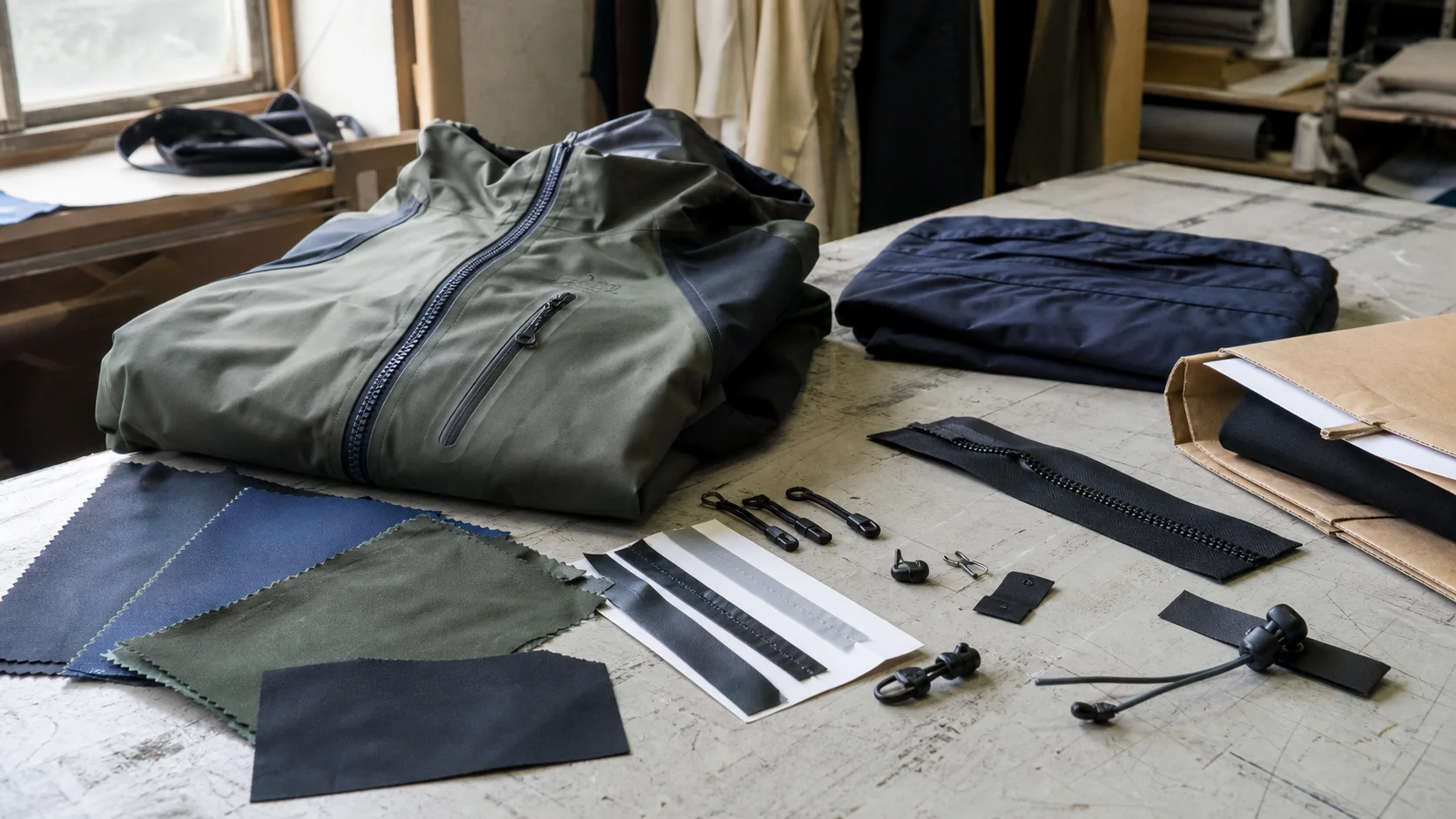
A detailed outline for industrial retailers sourcing bulk workwear coats with shrinkage testing requirements, covering fabric performance, wash protocols, compliance, sizing stability, and production approval checkpoints.
Bulk Workwear Coats With Shrinkage Testing - Fabrikn production reference
Bulk workwear coats with shrinkage testing are a practical requirement for industrial retailer orders, not a premium extra. In workwear, size consistency affects returns, shelf confidence, repeat orders, and end-user trust. A coat that measures correctly before washing but loses sleeve length, body length, or chest tolerance after laundering creates problems across the supply chain. Retailers end up handling complaints, replacements, and damaged product reputation.
For outerwear sold into industrial supply channels, shrinkage control has to be built into sourcing and manufacturing from the start. That means selecting stable fabrics, testing them under agreed care conditions, locking measurements before bulk cutting, and checking that trims and construction methods do not distort the garment after washing. Retail buyers usually focus on price breaks, delivery windows, and carton efficiency. Those points matter, but shrinkage performance is just as important when the product is expected to survive repeated use.
Bulk workwear coats often sit in a demanding category. They may be worn in warehouses, workshops, construction support environments, transport operations, utility service settings, or general industrial retail use. In each of those channels, the coat has to look durable, fit predictably, and hold its dimensions after care cycles. A poor shrinkage outcome does not only affect comfort. It can also expose weak seam balance, puckering, lining tension, zipper waviness, and inconsistent panel behavior.
Buyers reviewing suppliers for this category should look beyond sales claims and focus on process. A capable manufacturer should be able to explain fabric shrinkage standards, test methods, acceptable tolerance, sample approval stages, and how the bulk order is controlled before shipment. Retailers that need reliable support for development and production planning often start by reviewing a supplier’s services and technical scope before moving into costing discussions.
Industrial retailers buy workwear coats differently from fashion chains. The priority is usually continuity, not novelty. The coat must be commercially safe, technically stable, and repeatable across restocks. Buyers in this segment often need products that can sit in inventory programs or reorder cycles without major fit variation between batches.
In practical terms, most industrial retailers look for the following:
A retailer ordering 2,000 to 20,000 units of workwear coats cannot absorb the same margin of error that a small promotional order might tolerate. If medium and large sizes shrink unevenly, the whole run can become difficult to sell. If sleeve length drops beyond spec after laundering, the issue turns into a return risk. If the body twists because the fabric was not stabilized correctly, the product can fail customer expectations even if the original pre-wash measurements looked acceptable.
That is why shrinkage testing belongs in the buying brief. Buyers should specify target care conditions, acceptable dimensional change, and measurement points to be reviewed after testing. Leaving those details open creates room for dispute later.
Shrinkage testing is most useful when it is part of a sequence, not a one-time lab exercise. In bulk workwear coats, the normal approach starts at fabric stage and continues through sample review and pre-production control. The exact workflow varies by fabric type, finish, and construction, but the commercial logic is straightforward: test early, confirm pattern allowances, then protect bulk consistency.
Before bulk cutting, the shell fabric should be checked for dimensional stability under the agreed care method. If the coat includes lining, rib, cuff material, or contrast panels that may react differently, those components also need review. A shell may shrink moderately while the lining remains stable, which can create pulling or bubbling after wash. That issue is common in coats with quilted or padded construction if the material pairing is not balanced.
Typical shrinkage testing looks at warp and weft direction change after laundering or care simulation. Buyers should request clear reporting on:
If test results show controlled but real shrinkage, the garment pattern can sometimes be adjusted with shrink allowance. This is a normal technical correction. It is only effective when the shrinkage behavior is consistent. Unstable or erratic fabric results are harder to correct through pattern grading alone.
Buyers should be cautious when a supplier promises to “fix it in production” without showing test data. In workwear, that usually signals risk. Pattern compensation can help, but it does not solve poor fabric stability.
After material behavior is understood, buyers should review size set samples or a pre-production sample made in actual bulk fabric and trims. This step matters because coat construction can influence final measurements. Fusing, topstitch tension, lining attachment, padding distribution, and wash treatment can all affect the result.
Production monitoring should include dimensional checks against approved specs. If the order requires wash-tested bulk confirmation, that should be agreed before cutting starts. Inline inspection is especially useful when the coat has multiple panels, heavy fabric, or complex pocket construction that can shift tolerance during sewing.
Not all workwear coat fabrics behave the same way. Fabric selection drives cost, durability, hand feel, and shrinkage performance. Buyers who want low complaint rates should evaluate fiber content, weave structure, finishing method, coating treatment, and whether the fabric is pre-shrunk or mechanically stabilized.
Cotton-rich twills and canvases are common in workwear because they feel substantial and wear well in many environments. They also carry more shrinkage risk than many synthetic-heavy fabrics. If the garment is washed repeatedly, untreated or poorly stabilized cotton blends can lose dimension in both body and sleeve length. Cotton-rich options can still work well, but they need proper finishing and clear testing standards.
Polyester-cotton blends are widely used in industrial outerwear because they balance durability, easier care, and better dimensional stability than high-cotton constructions. For many retailers, this is the practical middle ground. A common shell weight might fall around 240 gsm to 320 gsm for lighter workwear coats, while heavier cold-weather versions can go beyond that depending on padding and structure.
Synthetic shells can offer strong stability and weather resistance, especially when paired with PU, PVC, or other coating/lamination systems. The tradeoff is that the coat may feel less natural, and performance depends heavily on finish quality. Low-cost coated fabrics can pass basic dimension tests but fail in surface appearance, delamination risk, or seam slippage over time.
Heavy-duty workwear fabrics are often chosen for abrasion resistance and a rugged commercial look. These fabrics can perform well, but their thickness can hide early production problems. A coat may appear solid at first inspection while still carrying shrinkage imbalance or sewing tension that becomes visible only after wash. Heavy fabric also affects seam bulk, needle selection, and topstitch consistency.
Buying judgment: the cheapest fabric that meets pre-wash appearance targets is rarely the safest option for industrial retail. Stable post-wash performance usually protects margin better than a small initial fabric saving.
Retailers placing industrial outerwear orders should define product specifications in writing before sample approval. Loose specs often lead to disputes on quality, shrinkage, and acceptable tolerance. A clear tech pack or purchase specification sheet reduces confusion and helps align sampling with bulk production.
Acceptable shrinkage levels depend on fabric and end use, but buyers often target controlled dimensional change within a low single-digit percentage after agreed washing conditions. The exact pass level should be confirmed in advance because outerwear fabrics, quilted builds, and coated materials do not all behave the same way. A supplier should not be left to choose the acceptance standard alone.
Workwear coats use functional trims, and trim mismatch can create secondary quality failures. A stable shell fabric paired with a low-grade zipper, poorly dyed rib, or weak pocketing can still produce a bad retail result. In shrinkage-sensitive garments, trim compatibility matters because the fabric, tape, lining, and reinforcement all react under sewing stress and care treatment.
Component Common Retail Expectation Risk if Not Controlled Shell fabric Stable weight, color, and shrinkage result Size change, twisting, uneven appearance Lining Balanced with shell movement Bubbling, pulling, restricted fit Zipper Smooth function and tape stability Waviness, failure, puckering Padding Even distribution after care Cold spots, distortion, bulk imbalance Velcro or snaps Secure attachment and durability Premature failure in useSampling is where many industrial retailer programs either become safe or stay exposed. A proper sample approval sequence gives buyers visibility before money is tied up in full production. For bulk workwear coats with shrinkage testing, a typical process may include several stages.
This stage checks design interpretation, construction feasibility, and estimated fabric direction. It may not use final bulk material. Buyers should avoid treating this sample as quality approval for shrinkage or final fit.
The fit sample is used to review silhouette, ease, length balance, and functional wear points. For workwear coats, this should include movement review at shoulder, sleeve, and body sweep. If the retailer sells across layered-use environments, the fit should account for garments worn underneath.
A size set is important for industrial retail because size grading errors become expensive quickly in bulk. Even when the base size fits correctly, larger or smaller sizes can drift in proportion. Shrinkage allowance needs to be reflected consistently across the range.
This is usually the most important approval stage. The pre-production sample should use actual approved bulk fabric, lining, trims, color, labeling, and construction method. If shrinkage testing is part of the program, this is the stage where buyers should connect lab results with real garment measurement review.
A cautious sample approval flow often includes:
Retailers needing support on product development and production coordination often benefit from a clearer sourcing workflow. General capability and process overview can be reviewed through a supplier’s about us and operational pages before moving into order placement.
MOQ and lead time are central to bulk workwear coat sourcing, especially for industrial retailers managing color continuity and broad size curves. There is no single standard, but practical ranges help buyers plan.
For bulk workwear coats, many manufacturers quote MOQs by style, color, and fabric commitment. A common starting point may be around 300 to 600 pieces per color for simpler programs, while more specialized constructions or custom-developed fabrics may push MOQs to 800, 1,000, or more per color. If the buyer wants multiple shell colors, custom trims, embroidery variations, or special coatings, the MOQ can rise further.
Very low MOQs may be possible for stock fabrics and basic trims, but the tradeoff is reduced customization and sometimes weaker price efficiency. Buyers should be careful with offers that combine very low MOQs, aggressive lead times, and heavy customization. One of those promises usually gives way under production pressure.
Lead time for industrial outerwear depends on more than sewing capacity. The critical variables usually include:
A straightforward repeat order in a proven fabric might move faster than a new development order. A realistic bulk lead time for workwear coats often falls in a range such as 45 to 90 days after final approvals, though complex programs may require more. Buyers should ask when the clock actually starts. Some suppliers count from deposit date, while others count from final fabric and sample approval, which is the more meaningful milestone.
If shrinkage testing is essential, build time for it into the critical path. Compressing testing into the end of the sample cycle is risky. It is better to lose a week at fabric approval stage than lose a full production run because measurements shift after wash.
Bulk workwear coats can look acceptable at final visual inspection and still fail in the market. Industrial retailers should monitor the recurring risk points that affect function, fit, and claim rate.
This is the central risk when shrinkage control is weak. Body length, chest width, sleeve length, and cuff opening may all shift. A coat that shrinks unevenly across sizes can become difficult to reorder because buyer confidence in the size chart drops.
These issues may show up more clearly after wash. They can distort front plackets, pocket position, and side seam balance. Heavy twill and canvas constructions are not immune.
Improper tension, incompatible interlining, or unstable zipper tape can produce appearance defects that worsen after care treatment. These defects are especially visible on coated or tightly woven synthetic shells.
Repeat industrial programs need shade continuity. If body fabric, collar, pocket flap, or lining lots vary, retail presentation suffers. This is a larger risk when reorder batches are placed without proper color standard control.
Buttons, snaps, hook-and-loop, cord locks, reflective tape, and zipper pulls all need suitable performance levels. The shell fabric may pass testing while trims underperform in wear.
Retailers often focus on garment quality but underestimate packing discipline. Size ratio mistakes, wrong labels, barcode mismatch, and poor carton marking create downstream warehouse cost even if the coat itself is acceptable.
Industrial retail buyers rarely choose between a “good” and “bad” option. The real decision is usually between different risk profiles. A lower-cost quote may be viable if the fabric is proven, the style is simple, and the supplier can document stable testing. A higher-cost quote may be justified if it includes stronger material control, better trim quality, and more reliable production planning.
The key tradeoffs usually look like this:
From a purchasing standpoint, one of the safest decisions is to simplify variables on first orders. If the retailer is launching a new workwear coat program, it is often wiser to limit unnecessary trim customization, confirm stable fabric performance, and establish a reliable fit block before expanding options. Once the production process is proven, color extensions and feature upgrades become easier to manage.
Buyers should also define inspection expectations early. A reasonable process may include inline inspection, final random inspection, and carton verification. If the order carries a high claim risk or tight retail deadline, a third-party inspection before shipment may be commercially justified.
Clear communication matters. If the retailer has strict shrinkage targets, those requirements should appear on purchase orders, spec sheets, and sample comments. Verbal assumptions are weak protection in production. For direct inquiry on program requirements, quoting, or technical coordination, buyers can use the contact us page to align specifications before bulk commitment.
Bulk workwear coats with shrinkage testing are a sensible sourcing priority for industrial retailer orders. In this category, post-wash dimensional stability is tied directly to fit consistency, return control, and repeat-order confidence. Retailers that treat shrinkage testing as a formal part of material approval and pre-production planning are usually better protected than those relying on visual inspection alone.
The safest buying approach combines stable fabric selection, documented shrinkage standards, disciplined sample approval, realistic MOQ planning, and inspection checkpoints during production. There is always pressure to reduce cost and shorten lead time. In workwear outerwear, cutting too deeply on testing or material control usually shifts the cost downstream into returns, claims, or lost customer trust.
For buyers sourcing in volume, the practical target is not theoretical perfection. It is repeatable performance at commercial scale. That means coats that arrive on spec, hold size after care, and meet the durability expectations of industrial retail customers. Shrinkage testing is one of the clearest tools available to support that result.
Get a free quote from Fabrikn — your trusted B2B clothing manufacturer with 10+ years of experience. MOQ as low as 200 pieces.
Get a Free Quote →Shrinkage testing measures how much a workwear coat fabric or finished garment changes in size after washing or care treatment. It usually checks dimensional change in length and width directions so buyers can confirm the product stays within approved tolerance.
Industrial retailers need consistent sizing across bulk orders and repeat programs. If coats shrink beyond tolerance, the result can be higher returns, fit complaints, and reduced confidence in the size chart. Testing helps control that risk before mass production.
Common options include cotton-rich twill, polyester-cotton blends, heavy canvas, duck fabric, and synthetic coated shells. Each has different tradeoffs in comfort, durability, weather resistance, and shrinkage behavior.
Many programs start around 300 to 600 pieces per color for relatively standard styles, while custom fabrics or more complex coat designs may require 800 to 1,000 pieces or more per color. The actual MOQ depends on fabric, trims, construction, and customization level.
Lead times often range from about 45 to 90 days after final approvals, though this depends on fabric sourcing, testing, sample revisions, and factory scheduling. New developments generally take longer than repeat orders.
A cautious process often includes a development sample, fit sample, size set, and pre-production sample in actual bulk materials. Buyers should also connect shrinkage test results to sample approval rather than treating testing as a separate paperwork step.
Sometimes, yes. If fabric shrinkage is consistent and controlled, patterns can be adjusted with shrink allowance. This does not solve unstable fabric performance, so testing still matters at the material stage.
Typical risks include excessive shrinkage, seam puckering, zipper waviness, skewing or twisting after wash, trim failure, shade variation, and packing errors. Most of these problems are easier to reduce when specifications and inspections are defined early.