
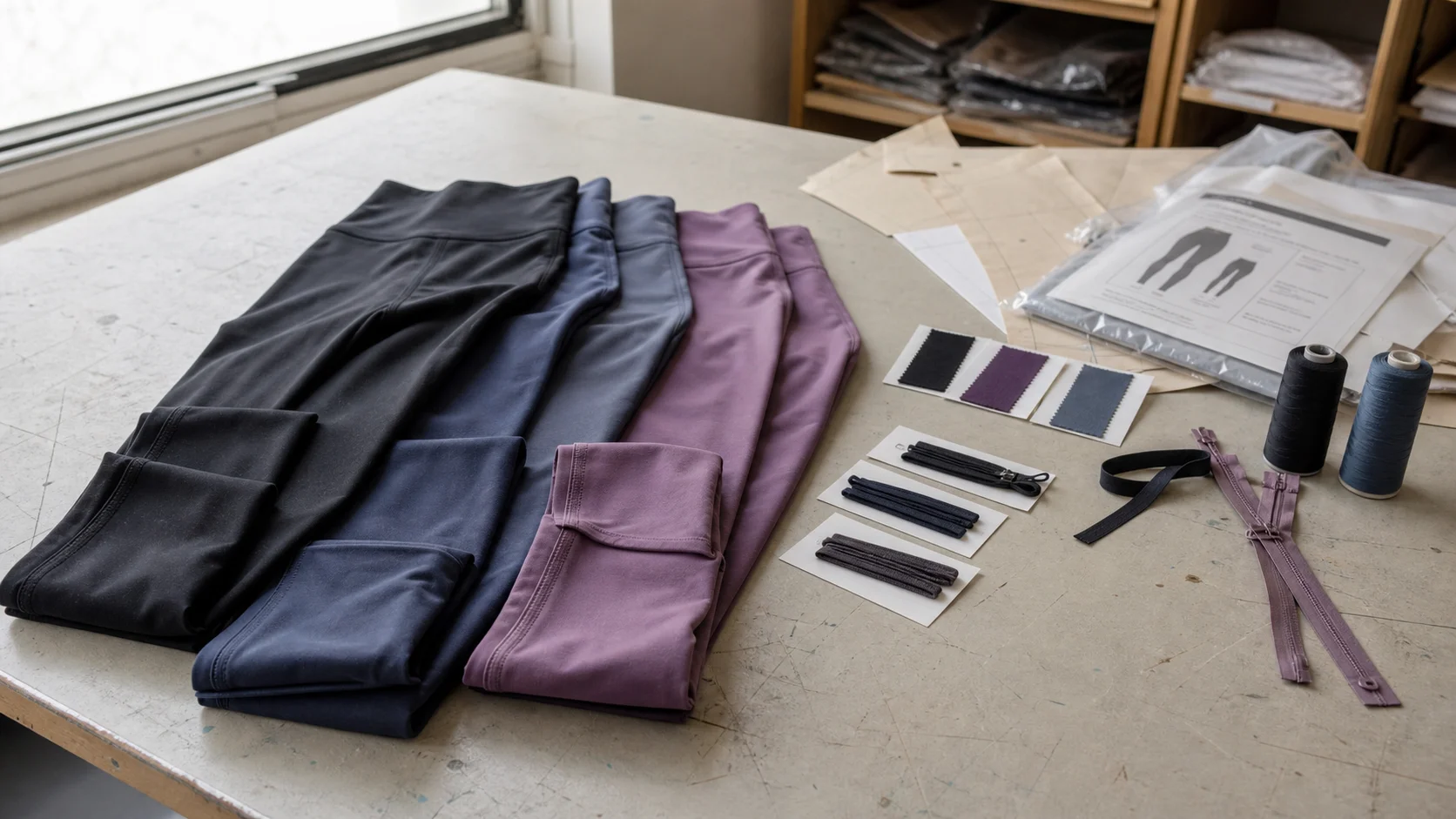
A focused outline for fitness brands sourcing OEM activewear sets with shrinkage control, covering fabric behavior, lab testing, pattern allowances, wash protocols, and production checkpoints specific to performance sets.
OEM Activewear Sets With Shrinkage Control - Fabrikn production reference
OEM activewear sets with shrinkage control are built for brands that want more than blank leggings and standard tops with a logo added later. In practical sourcing terms, OEM means the product is developed to your brand’s specification: fabric composition, weight, hand feel, compression level, fit block, waistband construction, stitching package, trim branding, care label content, color standards, packaging, and testing requirements.
For fitness brands, that difference matters. A matching set is usually sold on silhouette, fit confidence, and repeatability. If the sports bra fits correctly but the leggings lose length after washing, the set stops feeling premium. If the fabric face twists, shrinks unevenly, or relaxes too much after heat exposure, customer returns rise fast.
That is why shrinkage control is not a side issue in private label apparel. It sits close to the center of product engineering. A brand can spend heavily on influencer campaigns and still lose margin if the garment dimensions move outside tolerance after the first home wash.
Buyers looking for stable OEM activewear sets usually need a supplier that can manage several variables together:
If your brand is comparing private label development options, it helps to review the broader production support available through a manufacturer’s services before locking in the first set program.
Activewear is under more stress than casual knitwear. The fabric is expected to stretch hard during wear, recover well, resist bagging, survive frequent washing, and still hold clean body-contouring lines. That makes shrinkage more complicated than a simple length loss percentage.
In activewear sets, shrinkage problems usually show up in five ways:
A small amount of controlled shrinkage can be engineered into the pattern. Uncontrolled shrinkage creates claims. The commercial issue is simple: customers rarely describe the problem in technical terms. They say the set “fits wrong after wash,” “got smaller,” or “doesn’t match the original size.” For a fitness brand, those reviews damage both product trust and replenishment sales.
There is also a visual problem. Activewear sets are frequently sold through front-facing photography and close-up fit videos. Buyers expect the same smooth look at home that they saw online. When fabric shrinks unpredictably, vertical panel lines pull, hems ripple, and bra underbands may roll or bite harder than intended.
The safest purchasing position is to treat shrinkage control as a pre-production requirement, not a post-complaint correction.
That approach usually saves time, even if development takes longer at the beginning.
Shrinkage starts long before garments are stitched. In many cases, the root cause sits in fabric preparation, finishing, or testing discipline.
For OEM activewear sets, the common technical starting points include:
A polyester-spandex interlock set and a nylon-spandex brushed set may both look premium in photos, but they do not behave the same way through finishing and wash cycles. Nylon-rich fabrics often deliver a softer, more elevated hand feel for leggings and bras, but they can be less forgiving if finishing controls are inconsistent. Polyester-based performance fabrics may offer better colorfastness and easier cost management, though the hand feel can vary widely depending on yarn selection and finishing.
Some brands make a mistake by approving fabric based only on stretch, opacity, and softness. Those are necessary checkpoints, but not enough. A sourcing team should also ask for tested shrinkage results in both warp and weft directions, or wale and course directions for knitted fabric, depending on how the mill reports data.
Good shrinkage control usually depends on three linked approvals:
Skipping any of those steps creates avoidable risk later in the order cycle.
There is no single best fabric for every fitness brand. The right choice depends on training category, price point, target compression, surface finish, and the brand’s tolerance for development cost.
Nylon-spandex fabrics are common in premium leggings sets, yoga sets, and seamless-adjacent cut-and-sew programs. Typical compositions include 75/25, 78/22, and 80/20 nylon-spandex. These blends often offer a smooth hand, strong recovery, and clean dye appearance. The tradeoff is that buyers need tighter finishing control and reliable heat setting to keep shrinkage within target.
Polyester-spandex options such as 85/15, 88/12, or 90/10 are often used for training sets, entry-to-mid price point ranges, and moisture-management programs. Polyester can be commercially efficient and more scalable for some brands. The tradeoff is that cheaper polyester yarns can feel less refined, and poor brushing or finishing can produce surface issues that mask dimensional instability until washing.
Cotton blends are less common for compression-led activewear, but they still appear in lounge-active hybrids, warm-up sets, and studio collections. Cotton raises shrinkage risk significantly unless pre-shrunk processing is handled well. For performance categories, it is usually the harder route if a brand wants tight post-wash dimensional stability.
For many OEM activewear sets, a realistic shrinkage target is often within 3% to 5%, depending on fabric type and wash protocol. Some premium programs aim tighter. That sounds straightforward, but it only works if the test method is agreed in advance. One party may be testing gentle cold wash, while the end customer uses warm water and tumble drying. If the care instruction and test method do not match likely consumer behavior, the approval loses value.
Fabric is only half the shrinkage story. Garment engineering also matters.
In OEM activewear sets, the following construction details often affect post-wash stability:
A common example is the waistband on leggings. If the shell fabric is stable but the waistband elastic shrinks more aggressively after wash, the finished garment can feel smaller even when the leg panels remain close to spec. The customer experiences that as a sizing issue, not an elastic issue.
Sports bras have a similar problem around underbands, neckline binding, and removable cup openings. A technically attractive sample can pass fit initially and still fail in use if trims react differently to washing than the main fabric.
Direct sourcing judgment matters here: brands should avoid treating shrinkage as only a fabric-lab problem. The garment must be tested as a full assembly. That includes logos, elastics, linings, mesh inserts, bra paddings, zipper tapes if present, and bonded details where applicable.
A disciplined OEM development process gives fitness brands the best chance of getting shrinkage under control before bulk production. The most reliable sequence usually looks like this:
The brand defines silhouette, intended use, target fit, fabric composition, GSM, colorways, logo application, packaging, and testing expectations. If shrinkage is a priority, the brief should state acceptable measurement change after wash.
The supplier proposes fabric options or develops to spec. At this stage, buyers should ask for base fabric data, not only swatches. If the set includes leggings and sports bra in the same fabric, ask whether lining components or power mesh inserts have separate test results.
The first sample checks shape, construction feasibility, and initial fit direction. It is not the right stage for final approval. Many sourcing problems start when a brand rushes from a visually good proto to bulk without enough wash validation.
Measurement corrections are applied. Panel shaping, strap length, rise, waistband height, inseam, and logo scale are refined. If shrinkage data is already available, pattern makers can build measured allowances into the spec where needed.
This is the critical stage. The garment should be measured before wash, tested under the agreed care method, then re-measured and reviewed for appearance, recovery, seam condition, and trim behavior. A single wash result is useful, but brands with higher quality positioning often request repeated wash cycles for a clearer picture.
Do not rely only on one base size if the style is core to the business. Grading can shift risk. Leggings in larger sizes may respond differently at waistband and hip if tension balance is not right.
Once approved, bulk should still be monitored. Fabric lot variation can undo a well-developed sample if controls are loose.
Brands that want a more customized production route often benefit from discussing the full development sequence through an experienced private label partner’s about us and capability pages before committing to timelines that are too short.
MOQ and lead time for OEM activewear sets depend heavily on how custom the program is.
Typical MOQ ranges in this category are often:
Those ranges move depending on fabric mill requirements, number of sizes, and whether tops and bottoms are packed as fixed sets or sold separately.
Lead times also vary by development depth:
The tradeoff is simple. Better shrinkage control usually requires more front-end time. Pre-testing fabric, revising patterns, and confirming wash behavior can delay launch dates slightly, but it reduces expensive post-launch corrections. Brands that push for unrealistically fast bulk placement often pay later in claims, remakes, discounting, or damaged retention.
On costing, shrinkage control is rarely a single line item. It shows up indirectly through:
That added cost is usually justified for brands positioning themselves above the budget tier. The cheaper option on paper is not always the cheaper option after returns.
Inspection for OEM activewear sets should go beyond visual defects. Needle damage, skipped stitches, oil marks, and shading matter, but shrinkage-related risk needs its own control points.
Key QC priorities include:
There is a practical risk buyers often miss: matching sets can pass individual piece inspection while still failing as a coordinated product. The bra may remain stable while the leggings shrink more in length, making the overall set feel mismatched after care. Inspection should account for set-to-set consistency, not only garment-by-garment pass rates.
Another frequent issue is over-reliance on pre-shipment inspection alone. By that stage, corrective options are limited. Inline inspection during cutting and sewing is more useful when shrinkage allowances, panel orientation, or elastic application need control.
If the product promise is premium fit retention, the QC plan should include dimensional stability checks before shipment, not just aesthetic approval.
Fitness brands buying OEM activewear sets with shrinkage control should be selective about what they ask, and realistic about what the factory can guarantee.
The strongest purchasing approach usually includes these steps:
It is also worth separating negotiable points from non-negotiable ones. Logo method, packaging upgrades, or some trim details may be flexible if cost needs to come down. Dimensional stability should be treated differently if the brand wants repeat customers.
For newer fitness labels, there is a temptation to over-customize too early. That can raise MOQ, complicate testing, and slow launch. A better route is often to begin with one or two core silhouettes in proven fabric platforms, then expand once the fit and wash performance are stable.
For established brands, the smarter play is often deeper standardization: approved fabric library, fixed shrinkage benchmarks, repeat test methods, and locked construction details for best-selling sets. Consistency tends to outperform novelty in replenishment-heavy activewear programs.
If you are evaluating a supplier for OEM activewear sets with shrinkage control, the right conversation is not only about price. It is about process discipline, approval stages, fabric traceability, and response when test results fall outside tolerance. Brands ready to move from concept to bulk can start those discussions through the manufacturer’s contact us page.
Get a free quote from Fabrikn — your trusted B2B clothing manufacturer with 10+ years of experience. MOQ as low as 200 pieces.
Get a Free Quote →Shrinkage control means managing fabric and garment processing so the finished sports bra, leggings, shorts, or top stays within agreed measurement tolerance after washing. It usually involves fabric testing, heat setting, pattern adjustment, and wash approval before bulk production.
Many buyers target around 3% to 5% depending on the fabric type and wash method. Premium programs may require tighter performance. The important point is to define the test method and care standard in advance, because results are only meaningful when measured under the same conditions.
Nylon-spandex and polyester-spandex blends are both widely used. The better option depends on the hand feel, compression, price point, and finishing quality you need. The safest buying decision comes from tested fabric performance, not composition alone.
Typical MOQ often starts around 200 to 300 sets per color for simpler programs and can rise to 500 or more per style-color for more customized OEM development. Custom fabrics, multiple trims, and deeper branding usually increase MOQ.
Sampling often takes 2 to 4 weeks per round, though custom fabric development, dye approvals, and wash testing can extend the timeline. Brands should allow enough time for at least one proper pre-production wash-test stage.
This usually happens when the sample was approved on appearance and initial fit without enough dimensional stability testing. Fabric finish, elastic behavior, binding tension, and trim reaction can all change the fit after wash.
Both. Fabric testing helps identify early risk, but the full garment must also be tested because construction, elastics, linings, and logo applications can affect post-wash performance.
In most cases, yes. For fitness brands selling fitted sets, shrinkage-related returns are expensive and can damage review quality. Spending more on testing and development upfront is often the better commercial decision.