
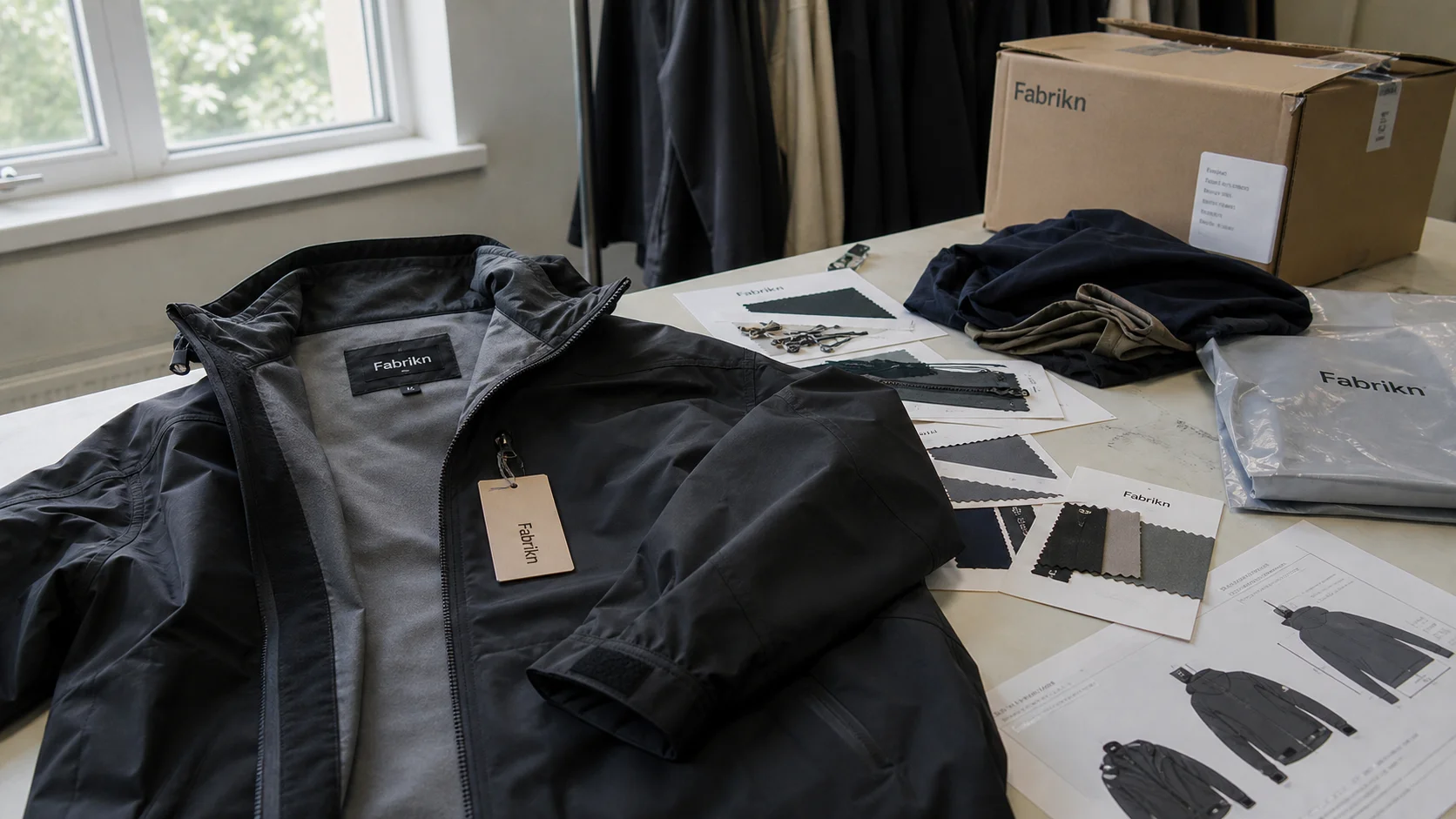
A product-specific outline for distributors sourcing wholesale workwear coats with trim, covering trim construction, factory capabilities, compliance, decoration compatibility, and program planning for outerwear assortments.
Wholesale Workwear Coats With Trim for Distributors - Fabrikn production reference
Wholesale workwear coats with trim sit in a practical corner of the outerwear market: high repeat potential, measurable performance expectations, and frequent customization needs. For distributors, the sourcing challenge is not just finding a factory that can sew coats. The real task is building a supply program that can handle fabric consistency, trim accuracy, size continuity, reorder discipline, and decoration compatibility across multiple customer accounts.
In distributor programs, “trim” can mean reflective tape, contrast binding, reinforced panels, piping, branded zipper pullers, hook-and-loop closures, rib cuffs, snaps, cord locks, bartacks, elbow patches, or other functional details that change both cost and production difficulty. Those details matter because trims often create the gap between a clean prototype and a difficult bulk order.
Buyers in the outerwear and jackets category usually evaluate these coats on four points: durability, weather resistance, presentation, and price control. A lightweight coated shell may look competitive on paper, but if the reflective tape peels, the snap finish corrodes, or the cuff rib shrinks after washing, the distributor absorbs the complaint cycle.
That is why wholesale workwear coats with trim sourcing for distributor programs should be approached as a specification exercise, not a style-shopping exercise. The supplier needs to control the full chain: shell fabric, lining, insulation if used, trim sourcing, labeling, packing, and inspection standards. If one part of that chain is loosely defined, the order becomes vulnerable.
Distributors that want stable replenishment usually benefit from suppliers who can support pre-production development, bulk planning, and documentation. Buyers comparing vendors often start with product categories and capabilities, then move into sampling and compliance discussions. A practical first step is to review a manufacturer’s service structure and development scope through pages such as /services/ before pushing into quotation rounds.
The category covers more than one silhouette. In wholesale terms, workwear coats with trim may include insulated utility coats, softshell work jackets, waterproof seam-sealed coats, canvas chore coats, hi-vis site jackets, cold-storage parkas, service technician outerwear, and industrial wash-compatible outer layers. Each version uses trims differently.
For distributors, classification matters because each product type leads to a different costing and approval path. A canvas coat with contrast stitching is not sourced the same way as a PU-coated waterproof coat with reflective tape and seam sealing. The second product carries more failure points and usually needs more approval checkpoints.
It is also worth separating decorative trim from functional trim. Decorative piping or contrast binding may elevate shelf appeal, but functional trims drive purchasing value. Reflective tape placement, zipper gauge, snap holding strength, cuff recovery, and reinforcement patch abrasion resistance all affect how the garment performs in the field.
Distributors rarely buy only one coat for one season. Most are building a line architecture that supports stock programs, decorated-to-order business, or account-specific uniforms. That changes the supplier brief.
A distributor-focused supplier should be able to support:
Typical distributor programs also need flexible commercial structure. Initial MOQs for outerwear are often higher than knit basics because shell fabrics, lining materials, insulation, and trims create more inventory positions for the factory. A common starting range is around 300 to 800 pieces per style, often split by color, with color-level MOQs frequently landing in the 150 to 300 piece range depending on fabric availability and trim customization. Highly customized reflective trims, branded zipper pulls, or custom-dyed rib can push those minimums higher.
Buyers should treat very low MOQ promises carefully. A supplier may accept a low opening order by substituting stock trims or blending fabric lots, which can create reorder inconsistency later. For a distributor program, consistency is usually worth more than a headline MOQ.
When sourcing wholesale workwear coats with trim, the specification sheet should be detailed enough to survive handoff from merchandiser to factory floor. General wording such as “durable polyester shell” or “strong zipper” is not sufficient.
Common shell options include polyester oxford, pongee, ripstop polyester, cotton duck canvas, poly-cotton twill, softshell bonded fabrics, and nylon blends. The right fabric depends on use case.
Buyers should ask for fabric weight, yarn count where relevant, coating type, waterproof or water-resistant target, breathability claims if marketed, colorfastness expectations, and shrinkage tolerances. If the coat is meant for industrial laundering, that requirement should be declared at the start. It affects shell, lining, thread, tape, and closure choices.
Trim sourcing is where many outerwear programs become unstable. A coat may use ten or more trim items, and any one of them can delay production or fail in wear testing.
A practical sourcing judgment: if the coat’s sales argument depends on field durability, avoid overcomplicating trims just for visual differentiation. Every custom part adds another approval step and another replenishment risk. Standardized, proven trims often deliver a better distributor margin over time than heavily customized ones.
Construction should align with use, not just appearance. Needle count, seam type, SPI expectations, reinforcement points, and seam sealing requirements need to be documented. Storm flaps, articulated sleeves, underarm gussets, double-entry pockets, inner chest pockets, and adjustable cuffs all affect sewing time and bulk performance.
Distributors should also review decoration compatibility early. A coat that looks ideal may become difficult to embroider if insulation migrates, lining is not accessible, or pocket placement interferes with logo zones. That issue is easy to miss in the sample stage and expensive to solve after bulk arrival.
Costing outerwear is rarely linear because trim complexity changes labor content quickly. Two coats with similar fabric weight can have very different FOB pricing if one uses seam sealing, multiple pocket compartments, custom snaps, reflective tape, and a detachable hood.
Typical MOQ ranges for wholesale workwear coats with trim are:
Program Type Typical MOQ Range Notes Stock fabric, standard trims 300-500 pcs per style Best option for testing a new distributor line Custom color, mixed standard trims 500-800 pcs per style Depends on shell fabric dyeing minimums Heavy trim customization 800-1500+ pcs per style Branded pulls, custom tape, special rib, molded parts raise riskSampling should move through clear stages rather than one vague “sample approval.” A sensible path is:
This process helps catch trim problems early. Reflective tape width, zipper wave, snap placement, cuff measurement variance, label content, and embroidery access issues often appear between proto and PP sample stages.
On cost control, distributors should isolate price drivers instead of pressing blindly for one target number. The strongest levers are usually shell fabric type, insulation weight, reflective trim method, number of pockets, closure complexity, and seam sealing coverage. Some buyers cut cost by simplifying pocket design or switching custom trim colors to stock-matched components. That tends to be safer than downgrading zipper quality.
If a supplier offers major cost savings without a clear spec difference, examine whether the quote excludes testing, uses lighter hidden materials, lowers stitch density, or assumes substitute trims. On workwear outerwear, unexplained low pricing usually reappears as a quality issue.
Lead times for workwear coats with trim depend less on sewing speed and more on material coordination. Outerwear production often requires shell, lining, insulation, zippers, labels, reflective materials, and packaging to converge at the right time. One delayed trim can hold the line.
A common planning framework looks like this:
These are working ranges, not guarantees. Custom-dyed shell fabrics, branded zipper pull molds, special reflective tape orders, seam-seal testing, and holiday calendar congestion can all extend timelines. Distributors launching cold-weather programs should build backward from delivery date with margin for correction cycles.
One purchasing tradeoff is whether to hold greige or stock fabric positions for faster reorder capacity. That can improve continuity but may increase carrying cost or require stronger forecast confidence. For distributors with proven repeat styles, that trade can make sense. For new programs, it usually does not.
If your team is still evaluating sourcing structure or vendor communication flow, it helps to review the manufacturer’s background and operating model before placing outerwear programs with high trim density. Pages like /about-us/ can help clarify whether the supplier is positioned for development support or only simple order execution.
Quality control on wholesale workwear coats with trim should focus on known failure areas, not only final appearance. Outerwear passes visual review more easily than it passes field use. A clean carton assortment does not confirm trim durability.
Inspection planning should start before bulk. Distributors should request trim cards, lab dips where needed, fabric test references, and pre-production sample confirmation. During production, inline checks are valuable for pocket alignment, reflective placement, stitch quality, and trim attachment strength. Final random inspection should verify measurement tolerance, workmanship, labeling, carton assortment, and packing integrity.
A useful buying discipline is to define critical, major, and minor defects in advance. Reflective tape omission, wrong fiber content label, failed zipper operation, or nonconforming waterproof construction should usually be treated as serious issues. Slight thread ends or minor packing variation belong in a different category. Clear defect standards reduce disputes later.
In workwear outerwear, the most expensive defect is not always the most visible one. Hidden material substitution and weak trim attachment can create returns long after goods clear final inspection.
Distributor programs work best when the supplier relationship is built around documentation and repeatability. That means standardizing what can be standardized and customizing only what creates real commercial value.
A strong program structure often includes:
Distributors should also think about account segmentation. A high-volume standard work coat for broadline distribution should not be sourced the same way as a niche account-specific utility coat with custom reflective layout and branded trims. The first needs stability and margin discipline. The second may justify lower efficiency in exchange for program exclusivity.
Another practical decision is trim rationalization. If several styles can share the same zipper family, snap finish, rib color, or reflective tape specification, purchasing becomes easier and replenishment risk drops. This is one of the simplest ways to make a wholesale outerwear line more scalable.
Communication standards matter as much as product standards. The supplier should be able to confirm sample comments, spec revisions, material substitutions, and ex-factory timing in a documented way. Loose communication is manageable in T-shirts. It is a liability in trimmed outerwear.
For distributors comparing manufacturers, the best next move is usually a targeted inquiry with style scope, estimated annual volume, target market, and trim requirements spelled out from the start. That makes quotation feedback more useful and exposes capability gaps earlier. A direct project brief can be started through /contact-us/.
Wholesale workwear coats with trim sourcing for distributor programs is a detail-driven buying process. The category offers solid repeat potential, but it punishes weak specification control. Distributors should look beyond basic style appeal and focus on trim reliability, reorder consistency, sample discipline, and realistic lead times.
In purchasing terms, the strongest programs usually share a few characteristics: fabrics chosen for actual end use, trims simplified where possible, approval stages documented clearly, MOQ expectations aligned with material realities, and inspections built around known outerwear failure points. Those habits protect margin better than chasing the lowest opening quote.
For outerwear and jackets programs, the right supplier is rarely just the cheapest or the fastest. The right supplier is the one that can reproduce approved workwear coats with trim consistently, explain tradeoffs early, and support distributor growth without creating avoidable quality surprises.
Get a free quote from Fabrikn — your trusted B2B clothing manufacturer with 10+ years of experience. MOQ as low as 200 pieces.
Get a Free Quote →Many programs start around 300 to 800 pieces per style, depending on shell fabric, number of colors, and trim customization. Programs with custom reflective tape, branded zipper pullers, or special rib/cuff parts often require higher minimums.
Trims create more supply points and more failure points. Zippers, snaps, tape, elastic, hook-and-loop, labels, and pullers may come from different sources, and each one can affect lead time, durability, and color consistency.
A careful outerwear program usually goes through proto, revision or fit sample, pre-production sample, and sometimes a size set plus top-of-production review. Skipping these stages can save time early but often increases bulk risk.
Ask for fiber content, fabric weight, construction, coating or finish details, colorfastness expectations, shrinkage tolerance, and any relevant performance claims such as water resistance or industrial wash suitability. If the product includes insulation or lining, those specs should be listed separately.
The main concerns are reflective trim placement, zipper function, snap attachment strength, seam quality, size consistency, trim color matching, and any waterproof seam-seal performance if applicable. Final visual inspection alone is not enough for this category.
The safer cost levers are simplifying pocket design, limiting unnecessary custom trims, consolidating trim families across styles, and using stock-supported components where possible. Cutting essential zipper, fabric, or attachment quality usually creates higher downstream cost.