
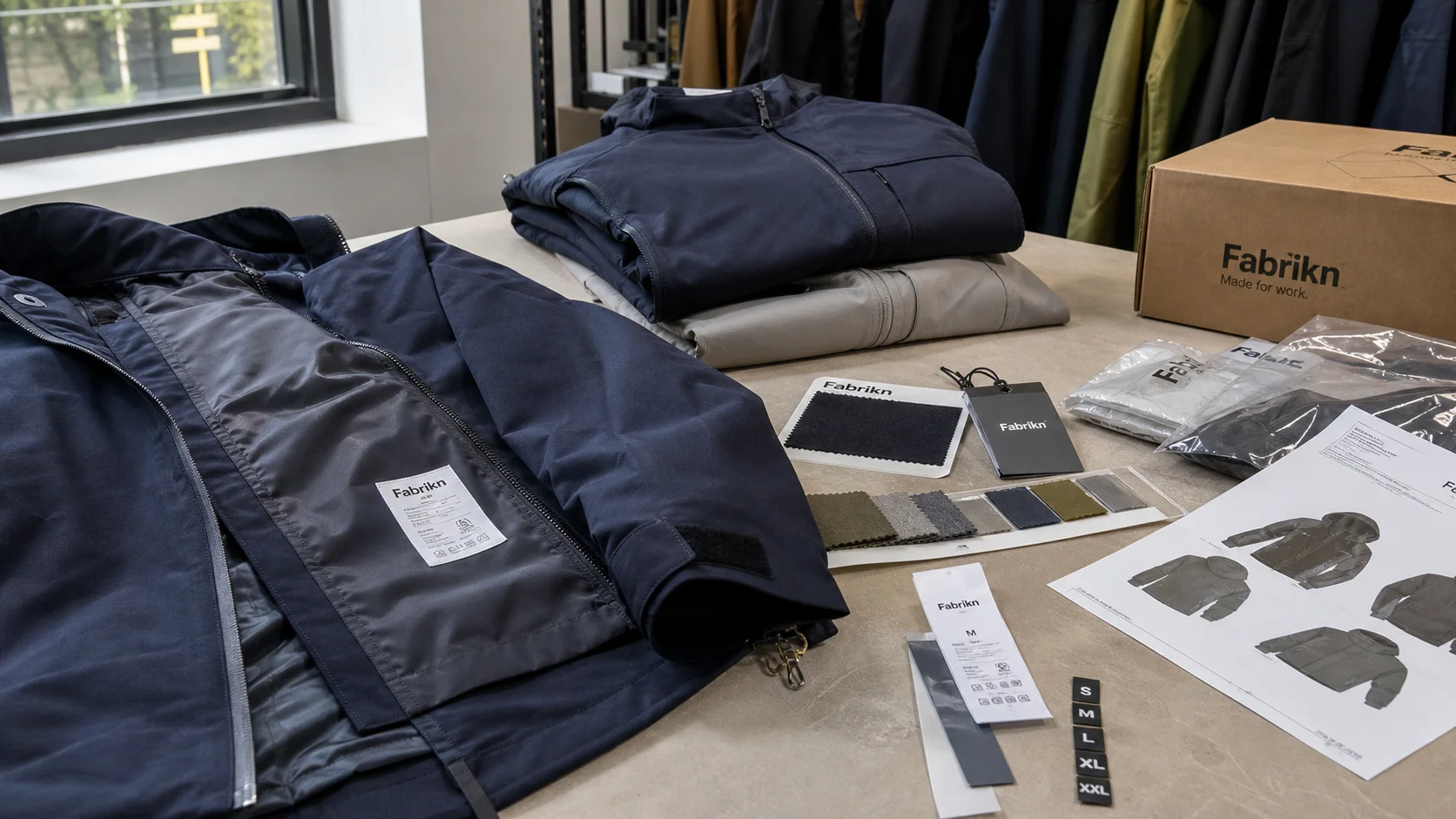
A focused outline for corporate dress code distributors sourcing bulk uniform jackets with trim, covering trim specs, production details, compliance, branding, and ordering considerations specific to outerwear programs.
Bulk Trimmed Uniform Jackets for Distributor Sourcing - Fabrikn production reference
Bulk uniforms with trim sourcing for corporate dress code distributors is a category that looks straightforward on paper and becomes technical as soon as the first fit sample arrives. A jacket can appear simple, yet the moment trim enters the specification, the sourcing job changes. Contrast piping, braid, shoulder tabs, cuff accents, reflective details, binding, branded zipper pulls, epaulettes, woven patches, and color-block panels all introduce extra matching points, approval stages, and production risk.
For distributors serving corporate dress code programs, trimmed uniform jackets sit in a demanding middle ground. Buyers need a clean professional look, stable replenishment, and practical pricing. End users want comfort, size consistency, and a polished appearance that matches brand standards. Factories need clear technical packs, repeatable trim sources, and realistic delivery windows. If any one of those pieces is weak, the program usually suffers in the same predictable ways: color mismatch across repeat orders, delayed approvals, rejected bulk due to trim placement issues, or margin erosion caused by unplanned rework.
That is why distributor sourcing in this segment should be handled as a specification and control exercise, not only a price negotiation. The right supplier is not always the one with the lowest FOB quote. In many cases, the better purchasing decision is the source that can control trim shade, keep sizing stable, and maintain repeatability across bulk lots.
For teams building a longer-term outerwear program, it helps to work with a supplier that can support development, production planning, and spec alignment in one workflow. A useful starting point is reviewing available manufacturing support through services and clarifying project requirements early through contact channels.
Uniform jackets without trim can be replaced more easily because the garment relies mainly on base fabric, silhouette, and logo application. Trimmed uniform jackets are different. The trim often carries the visual identity of the program. In corporate dress code distribution, that can mean a hospitality chain using contrast piping to distinguish front-of-house staff, a facilities team using reflective trim for visibility, or a premium service brand using tonal edge binding for a cleaner upscale look.
Trim serves both function and branding. That dual role is where sourcing decisions become more sensitive.
Distributors should also recognize the downside. Every added trim line is another place where cost, delay, or inconsistency can enter the order. A clean design with disciplined trim placement is usually easier to scale than a heavily decorated jacket that depends on multiple special components from different sub-suppliers.
Purchasing judgment: if the corporate customer wants a premium look but needs reliable replenishment, tonal trim or stock-supported trim colors are often safer than highly customized contrast components that must be redyed for every repeat order.
Not every jacket category performs equally well for distributor programs. The best option depends on wear environment, laundering expectations, and image requirements.
Softshell jackets are widely used for transport, logistics, field service, property management, and corporate staff working between indoor and outdoor settings. They typically combine a woven face, membrane or coating, and fleece or brushed inner layer. Trim applications often include reflective piping, contrast zipper tape, molded zipper pulls, chest patch areas, and cuff tabs.
These jackets offer broad seasonal usability and decent branding space. The tradeoff is that color matching between shell fabric and trim can be difficult, especially when the shell has a textured face and the trim is smooth polyester.
Bomber styles remain common in security, facilities, ground staff, and general corporate service programs. They are practical, recognizable, and often cost-efficient at scale. Typical trim includes rib with contrast stripes, shoulder tabs, reflective bands, sleeve utility details, and woven badges.
Bomber jackets are commercially strong when buyers need a durable silhouette with broad size acceptance. Rib quality is a key issue. Low-grade rib loses recovery quickly, which makes the garment look tired before the shell fabric is actually worn out.
For hospitality, reception, luxury retail support, and premium corporate environments, tailored uniform jackets with piping, welt trims, contrast lapel details, or braid accents are still relevant. These programs require stronger pattern control and fit approval. They also need better pressing standards and stricter tolerance management than casual outerwear.
The advantage is image. The drawback is complexity. This category usually has higher development cost and a narrower tolerance for workmanship defects.
For outdoor teams and colder climates, insulated jackets may include quilt lines, storm plackets, reflective trim, corded piping, cuff adjusters, and reinforced panels. These are functional garments first, but corporate identity still matters.
Distributors sourcing this type should treat bulk weight and carton planning carefully. Insulated jackets consume shipping volume quickly, and trim additions such as multiple tapes or heavy branded hardware can further increase landed cost.
Trim is often discussed as decoration, but in bulk production it is really a supply chain category of its own. The most stable jacket programs use trims that are available, testable, and replaceable within an agreed tolerance.
Color continuity is usually the first problem. Trim suppliers and shell fabric mills often use different dye systems and substrates. A navy shell and navy tape may both pass visually under one light source and clash under another. If the corporate customer is sensitive to appearance, lab dip approval and bulk shade band control matter.
Sewability is the second problem. Some trims distort the panel they are sewn to. Reflective tapes can stiffen seams, thick piping can ripple curved edges, and low-quality binding can twist after wash or wear. The technical pack should state placement, finished width, stitch type, and whether the trim must be pre-shrunk or tested for wash response.
Availability is the third problem. Custom trim can improve branding, but it often lengthens lead time and raises MOQ. For many distributor programs, stock-backed trims or semi-custom trims are a better commercial choice.
Purchasing judgment: branded zipper pullers and custom woven tapes look strong in presentations, but they are rarely the smartest starting point for a new distributor program unless annual volume is already clear.
Trimmed jackets fail when the base garment specification is loose. Before sample development moves too far, buyers should freeze the fabric and construction framework.
Corporate distributors often underestimate the effect of laundering and daily wear on trim-heavy jackets. A decorative tape that looks crisp in a sales sample may pucker after cleaning. A bonded softshell that looks substantial may delaminate faster if the chosen reflective application needs heat levels that stress the shell.
That is why the better approach is to review the whole garment as a system. Fabric, trim, stitch method, pressing temperature, and finishing process all need to work together.
Buyers who want a stable sourcing base should also look at the supplier’s development discipline and communication process. Background information on production capability and operating approach is often available through a supplier’s about page, but real confidence should come from technical review, samples, and bulk controls rather than brand claims alone.
MOQ for trimmed uniform jackets depends less on the jacket body and more on the trim package. A plain softshell may be workable at a lower opening quantity, while a custom-trim bomber with special rib, molded pulls, and woven tape will usually need a higher threshold.
Program Type Typical MOQ Range Main Cost Driver Risk Level Basic stock-trim jacket 300-500 pcs per style/color Base fabric and standard hardware Moderate Semi-custom trimmed jacket 500-1000 pcs per style/color Dyed trim matching and added operations Moderate to high Highly customized uniform jacket 1000-3000+ pcs per style/color Custom trim development and lower efficiency HighThese ranges are typical, not fixed. The real MOQ can move depending on size spread, fabric availability, and whether trims can be sourced from stock.
Pricing should be reviewed in layers:
Distributors should be cautious when a quote looks unusually low for a trim-heavy program. The missing cost often returns later through downgraded hardware, substitute trim quality, or change requests after sample approval.
Sample approval is where most preventable sourcing problems can be reduced. Skipping steps to save time usually creates delays later in the cycle.
A pre-production sample should never be treated as a formality in this category. It is the checkpoint where buyers confirm that the actual shell, actual rib, actual zipper, and actual tape work together. If one trim is still substituted at this stage, approval risk remains open.
For distributor programs with multiple stakeholder approvals, it helps to define who signs off on appearance, who signs off on fit, and who signs off on packaging and labeling. Too many orders stall because sales teams approve aesthetic details while operations teams later reject barcode placement or carton assortments.
Lead time for bulk trimmed uniform jackets is driven by the slowest approved component, not just cut-and-sew capacity. That is a key planning point for distributors promising delivery into managed corporate accounts.
A typical schedule may include:
In practical terms, many programs land in an overall 60-120 day window from confirmed development start to shipment readiness. Reorders can be faster if fabric and trim are continuity-supported. Reorders can also be slower than expected if the original custom trim is no longer available or if the previous dye lot is impossible to match cleanly.
The main dependencies include:
Purchasing judgment: if a corporate account requires strict replenishment, buyers should prioritize continuity materials over highly specialized trims unless the volume justifies safety stock.
Quality inspection for trimmed jackets should focus on the points where appearance and function meet. General workmanship checks are not enough.
Inspection should include both visual and measurement criteria. For example, a jacket may measure within tolerance overall while still failing visually because piping height differs from one collar side to the other. In corporate dress code distribution, that kind of defect is more serious than it might be in promotional apparel because the garment is worn as part of a controlled brand image.
Carton-level shade variation is another issue worth monitoring. If bulk production pulls shell fabric or trim from mixed lots without control, the shipment may technically pass piece inspection and still create account complaints after delivery.
When the order value or account sensitivity is high, inline checks plus final random inspection are safer than relying only on end-stage review.
Distributor sourcing should test operational competence, not just sample appearance. A supplier may produce one good sales sample and still struggle with repeat bulk control.
Distributors should ask direct questions about what parts of the jacket are stock-supported and what parts are custom-made. That single distinction affects MOQ, repeatability, liability, and delivery reliability.
It is also worth asking how the supplier handles trim substitutions if a nominated component becomes unavailable. The wrong answer is a vague promise that “same quality” will be used. The better answer is a formal approval path with clear reference standards.
For distributors buying bulk uniforms with trim sourcing for corporate dress code distributors, the following checklist is commercially useful:
Bulk trimmed uniform jackets can be a strong category for corporate dress code distributors when the sourcing model is built around control, not guesswork. The garments carry more visual value than plain outerwear, but they also bring more variables into development and production. Fabric, trim, fit, lead time, and inspection all interact.
The most reliable buying approach is to simplify where possible, specify carefully where detail matters, and avoid treating custom trim as a minor add-on. In this category, trim is often the deciding factor in whether a uniform jacket looks premium in bulk or merely acceptable in a sales sample.
Distributors that manage this well usually gain a practical advantage: fewer approval surprises, steadier repeat orders, and better margin protection over the life of the account.
Get a free quote from Fabrikn — your trusted B2B clothing manufacturer with 10+ years of experience. MOQ as low as 200 pieces.
Get a Free Quote →Typical MOQ often starts around 300-500 pieces per style and color for simpler programs using standard trims. Orders with custom rib, custom reflective tape, branded hardware, or multiple special trims often move into the 500-1000 piece range or higher.
Lead time increases because trims may require separate sourcing, dye matching, sampling, and approval. Production can only move smoothly when the shell fabric and every critical trim are available and approved together.
Custom-dyed piping, striped rib, reflective applications, branded zipper components, and specialized woven tapes tend to create more risk. They are harder to replace quickly and more likely to cause color or performance issues if standards are not locked early.
Use detailed tech packs, approve pre-production samples in actual materials, and inspect trim placement, shade consistency, seam puckering, and hardware function during inline and final checks. A trim map and clear tolerance sheet are especially important.
Often yes, especially for replenishment-based programs. Stock trims usually shorten lead time and reduce MOQ pressure. Custom trims make sense when brand identity depends on unique detailing and annual volume is large enough to justify the added complexity.
A strong starting package includes a tech pack, artwork, trim references, color standards, measurement chart, target price range, expected order volume, and any mandatory performance requirements. Clear inputs reduce revision cycles and improve costing accuracy.