
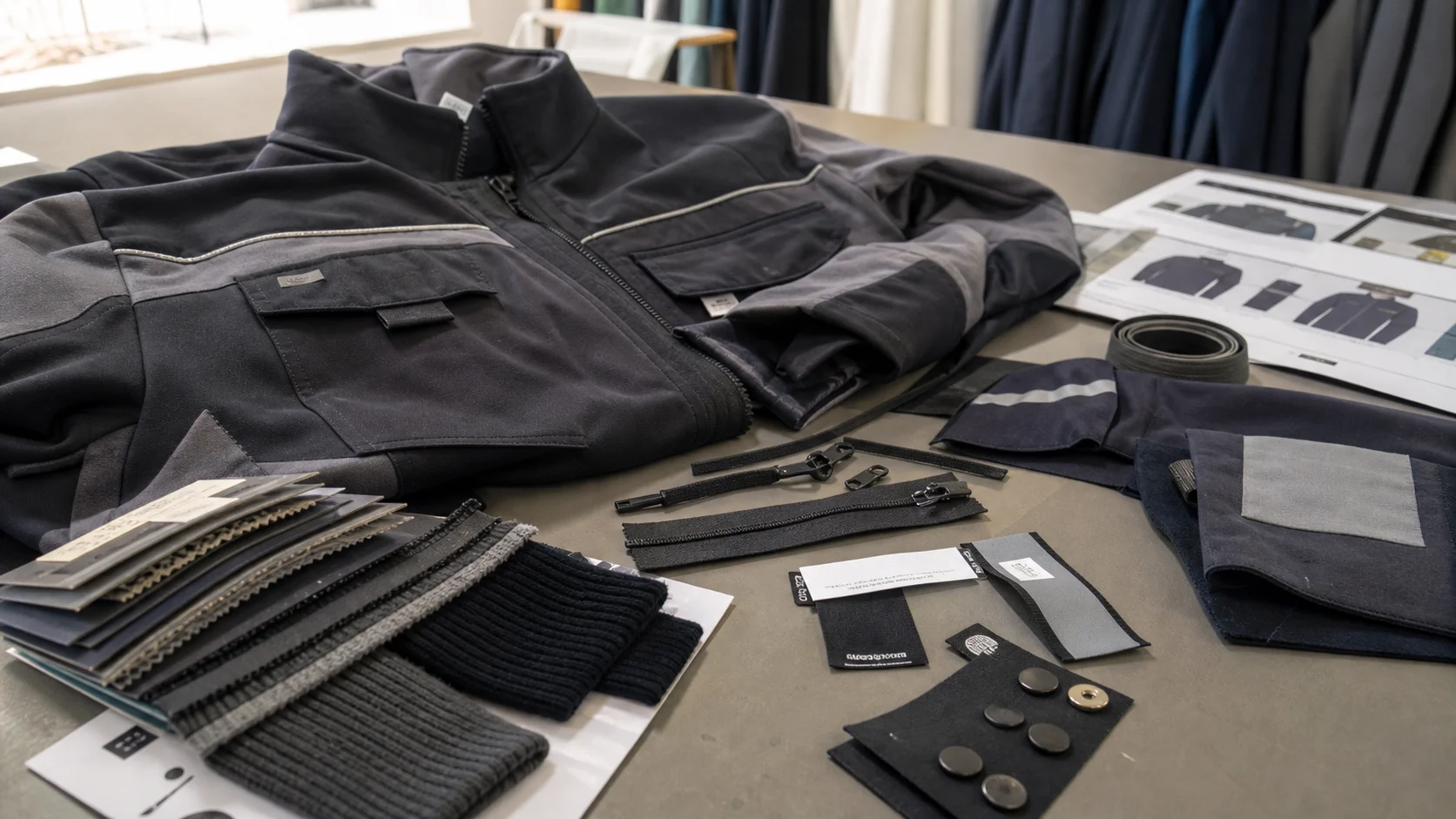
A detailed outline for school district apparel buyers evaluating wholesale uniform jackets with size grading, covering fit consistency, grading specs, wearer ranges, decoration impacts, and bulk ordering decisions.
Wholesale Uniform Jackets With Size Grading - Fabrikn production reference
School district outerwear programs are rarely simple. A district may need staff jackets, student uniform jackets, transportation department outerwear, and spirit-adjacent cold-weather pieces that still meet dress code requirements. In that environment, size grading is not a technical side note. It is one of the main factors that determines whether a bulk uniform jacket program performs well after delivery.
For school district apparel buyers sourcing wholesale uniforms with size grading, the goal is practical: consistent fit across a broad size run, predictable replenishment, and fewer wearability complaints once jackets reach campuses. A supplier that can sew a sample is not automatically a supplier that can grade that style properly from youth sizes through adult extended sizes.
Uniform jackets create more fit challenges than basic knit shirts. Sleeve length, shoulder width, chest ease, body length, zipper line, hood proportion, and cuff opening all change the way a jacket wears in motion. Poor grading usually shows up quickly. Smaller sizes may feel restrictive at the armhole. Larger sizes may become too long, too boxy, or unbalanced at the collar and pocket placement. Those issues lead to exchanges, delayed rollouts, and avoidable inventory waste.
That is why district buyers should treat grading methodology as part of vendor qualification, not just product development. If the program involves climate-use garments that students or staff wear daily for months, fit consistency has direct purchasing consequences.
A solid supplier should be able to discuss target size ranges, base size, grade rules, tolerance standards, and which measurements change between sizes. If that conversation stays vague, buyers should be cautious. Outerwear fit errors are more expensive to fix after production than many other uniform categories.
Buyers comparing vendors can also review a supplier’s broader production support, including development and sourcing services, before placing a program. A useful starting point is a general overview of capabilities at https://fabrikn.com/services/.
Quote accuracy depends on input quality. When buyers ask for pricing on wholesale uniform jackets with size grading, vague product descriptions usually create broad estimates that change later. That makes budget planning harder, especially in district purchasing cycles where approvals often involve multiple stakeholders.
Before requesting quotes, prepare a specification summary that covers the following points:
For school use, buyers should also specify whether drawcords are prohibited in youth jackets. This is a common safety consideration and should be confirmed early, not after sample approval.
The most practical RFQ packages include a measurement chart, target size breakdown, estimated annual quantity, and expected replenishment pattern. If the district is likely to reorder small volumes by school or season, that detail matters because the most efficient factory for a 10,000-piece initial order may not be the best partner for fragmented repeat buys.
Purchasing teams that are still shaping the product brief can save time by aligning early with a supplier on development feasibility and fit strategy before formal quoting. Buyers who need that step can usually start the conversation through https://fabrikn.com/contact-us/.
Not every jacket category is equally suitable for school district programs. The right option depends on climate, wear frequency, budget ceiling, laundering expectations, and how formal the uniform standard needs to look.
These are often used for mild-weather student uniforms, coaches, and event staff. They are cost-effective, relatively easy to decorate, and lighter to store and distribute. Common shell fabrics include 100% polyester woven or nylon with water-resistant finishing.
They work well when price sensitivity is high, but the tradeoff is limited warmth. If the district expects one jacket to cover extended cold conditions, a thin windbreaker will generate user complaints even if the fit is correct.
Softshell jackets are a common choice for administrators, staff, transportation teams, and higher-end student uniform programs. Typical fabric is a bonded polyester/spandex outer with a fleece or brushed inner backing. These jackets present well, provide moderate weather protection, and hold embroidery cleanly.
The tradeoff is cost. Softshells are usually more expensive than basic woven jackets, and size grading needs close review because stretch fabrics can mask fit issues in samples while still producing inconsistent measurements in bulk.
Fleece jackets are useful as mid-layer or indoor/outdoor transition pieces. Anti-pill polyester fleece in the 240 to 320 GSM range is common. They are usually straightforward from a construction standpoint, though zipper quality, pilling performance, and seam bulk should be monitored.
Fleece programs are often easier to fit than structured woven jackets, but buyers should watch body length and sleeve length grading. Oversized large sizes can quickly look sloppy in staff programs.
Districts in colder regions may need quilted or padded outerwear with poly fill insulation, storm flaps, rib cuffs, and lined hoods. These styles are more complex and require more robust fit approval because insulation thickness affects mobility and perceived size.
The tradeoff is obvious: better cold-weather performance, higher cost, longer lead time, and greater inspection risk.
Some districts want a more traditional school identity look while still keeping the garment uniform-compliant. These styles may use melton-look bodies, contrast sleeves, striped rib trim, and chenille or embroidered branding. They can work for select programs, but they are less universal from a replenishment standpoint and more sensitive to trim continuity.
For most district-wide bids, simpler silhouettes with stable fabric availability tend to be the safer purchasing decision.
Size grading affects both fit and cost structure. Buyers should understand how factories typically price graded outerwear rather than assuming one unit cost applies evenly across the entire range.
In wholesale uniform production, common MOQ patterns include:
These are typical market ranges, not universal rules. MOQ can shift based on fabric sourcing method, decoration, number of colors, and whether the supplier holds stock materials.
Buyers should also ask how extended sizes are treated. Some suppliers quote one blended price for XS through 4XL. Others apply size upcharges from 2XL or 3XL upward because larger panels increase fabric consumption and may require different marker efficiency. Neither approach is unusual, but the pricing method should be transparent before approval.
As a purchasing judgment, separate fit blocks are usually worth considering when the wearer groups are materially different. A single unisex grading approach may simplify ordering, but it can create dissatisfaction if the jackets must serve both younger students and adult staff under one pattern strategy.
Buyers should expect measurement tolerances in production. For outerwear, tolerance allowances are commonly broader than for lightweight tees because layered construction, lining, padding, and wash or finishing effects can influence final measurements. The exact tolerance should be listed on the tech pack and approved by both sides.
A buyer who demands extremely tight tolerance on every point without considering jacket construction may narrow the supplier pool and drive up costs. A buyer who allows loose tolerance across critical fit points risks inconsistent wear. The right balance is to control the measurements that affect use most directly: chest, sweep, sleeve length, shoulder width, and body length.
Purchasing Factor Lower-Cost Option Higher-Control Option Main Tradeoff Fabric sourcing Stock fabric Custom dyed fabric Lower MOQ vs better color control Size range Core sizes only Extended size run Simpler inventory vs broader wearer coverage Fit strategy Single unisex block Separate graded blocks Operational simplicity vs better fit accuracy Decoration Standard embroidery Multiple logos/patches Lower cost vs stronger branding Sampling Base size sample only Multi-size fit set Faster approval vs reduced grading riskSchool district buyers should not rush the sampling phase for wholesale uniform jackets with size grading. Most preventable production problems show up here if the process is structured properly.
A typical outerwear sampling path may include:
The first prototype is rarely enough for district approval. Buyers should expect at least one round of fit comments, and possibly more for insulated or highly structured jackets. If the program spans youth and adult sizes, approving only one middle sample is risky. A more reliable approach is to review a size set, often including at least one small size, one mid size, and one larger size.
This matters because grading errors do not always show in the sample size. A medium may look acceptable while the youth small becomes too short and the adult 3XL becomes disproportionately wide.
One overlooked issue is logo proportionality. A left-chest embroidery size that looks balanced on adult medium may appear oversized on youth XS. Buyers with mixed size runs should decide whether decoration size stays fixed or scales by garment category.
Another practical point: keep written approval records. Verbal approvals create disputes later, especially when measurements differ from expectations but still fall within unstated tolerance bands.
Lead time for uniform jackets depends on more than factory sewing capacity. Fabric availability, color lab dips, trim sourcing, sample revisions, decoration approvals, and shipping method all shape the schedule.
Typical lead-time patterns in this category may look like this:
These are planning ranges, not guarantees. Buyers should always request a critical path rather than relying on a single delivery promise.
Lead time risk increases when the district requires custom color matching, imported specialty zippers, or mixed embellishment methods. Every added dependency creates another point where schedule drift can start. In practice, standardizing fabric and trim choices often improves delivery reliability more than pushing for aggressive ship dates.
For replenishment programs, ask whether the supplier can reserve matching fabric lots or repeat the same fabric specification later. If not, future reorders may show shade variation. That problem is especially visible when schools combine new and old jackets in the same campus issue cycle.
Outerwear carries more inspection variables than many basic uniform products. District buyers should align on quality checkpoints before bulk production starts.
Inspection should include both workmanship and measurement review. A jacket can look visually acceptable and still fail the program if the finished measurements drift beyond approved tolerance in key sizes.
Buyers should also confirm packaging standards. If jackets are folded poorly, packed damp, or shipped without adequate carton planning, the receiving process becomes harder and presentation suffers.
A practical purchasing view is that inspection spending is usually justified for district outerwear, especially on first orders or more complex insulated styles. The cost of late discovery is higher once garments are decorated, packed, and scheduled for distribution.
For school district apparel buyers, the best supplier is not always the one with the lowest quote. The safer choice is often the partner that can manage grading discipline, sample control, documentation, and repeatability over multiple order cycles.
When evaluating suppliers, look for evidence that they can support:
Ask direct questions. Can they produce a size set before bulk? Can they explain grade rules in plain terms? Can they flag when a requested size range should be split into different fit blocks? Those answers matter more than polished sales language.
It also helps to review the supplier’s company background and operating approach before moving into development. Buyers who want that context can review https://fabrikn.com/about-us/.
In most district programs, the best purchasing result comes from balancing four factors: fit coverage, durability, price control, and repeatability. If one of those is pushed too hard, another usually gives way. A very broad size run with complex decoration and low MOQ may be possible, but unit cost will usually rise. A low-cost jacket may look attractive on paper, but weak grading and poor trim reliability can erase the savings after distribution begins.
That is the central sourcing judgment for wholesale uniform jackets with size grading. Buyers should not treat the garment as a generic promotional item. It is an operational uniform product, and the sourcing approach should reflect that.
Get a free quote from Fabrikn — your trusted B2B clothing manufacturer with 10+ years of experience. MOQ as low as 200 pieces.
Get a Free Quote →Size grading is the process of increasing or decreasing a jacket pattern from a base size to create a full size run. In school district outerwear, it affects chest width, sleeve length, body length, shoulder width, and other fit points. Good grading keeps the garment proportionate across youth, adult, and extended sizes.
Typical MOQs often start around 300 to 500 pieces per style/color for simpler programs and can move to 500 to 1,000 pieces or more when custom fabrics, complex trims, or broader size runs are involved. Exact minimums depend on fabric sourcing, decoration, and the number of size categories required.
Yes, especially when the order includes both youth and adult sizes or extended sizes. A single sample size does not show how the jacket behaves across the full range. Size set review reduces the risk of grading problems before bulk production.
Production timing depends on sample approval, fabric availability, trim sourcing, and seasonality. Many uniform jacket programs need several weeks for development and several more for production. Custom dyeing, insulation, or multiple fit revisions usually extend the timeline.
Common risks include inaccurate grading, zipper failure, shade inconsistency, puckering around decoration, sleeve twisting, and labeling errors. Measurement checks across multiple sizes are important because visual inspection alone will not catch all fit-related issues.
Sometimes, but not always. A unisex block can simplify ordering and reduce complexity. Separate fit blocks may deliver better results when wearer groups are very different or when appearance and comfort standards are stricter. The best choice depends on the district’s user mix and budget tolerance.