
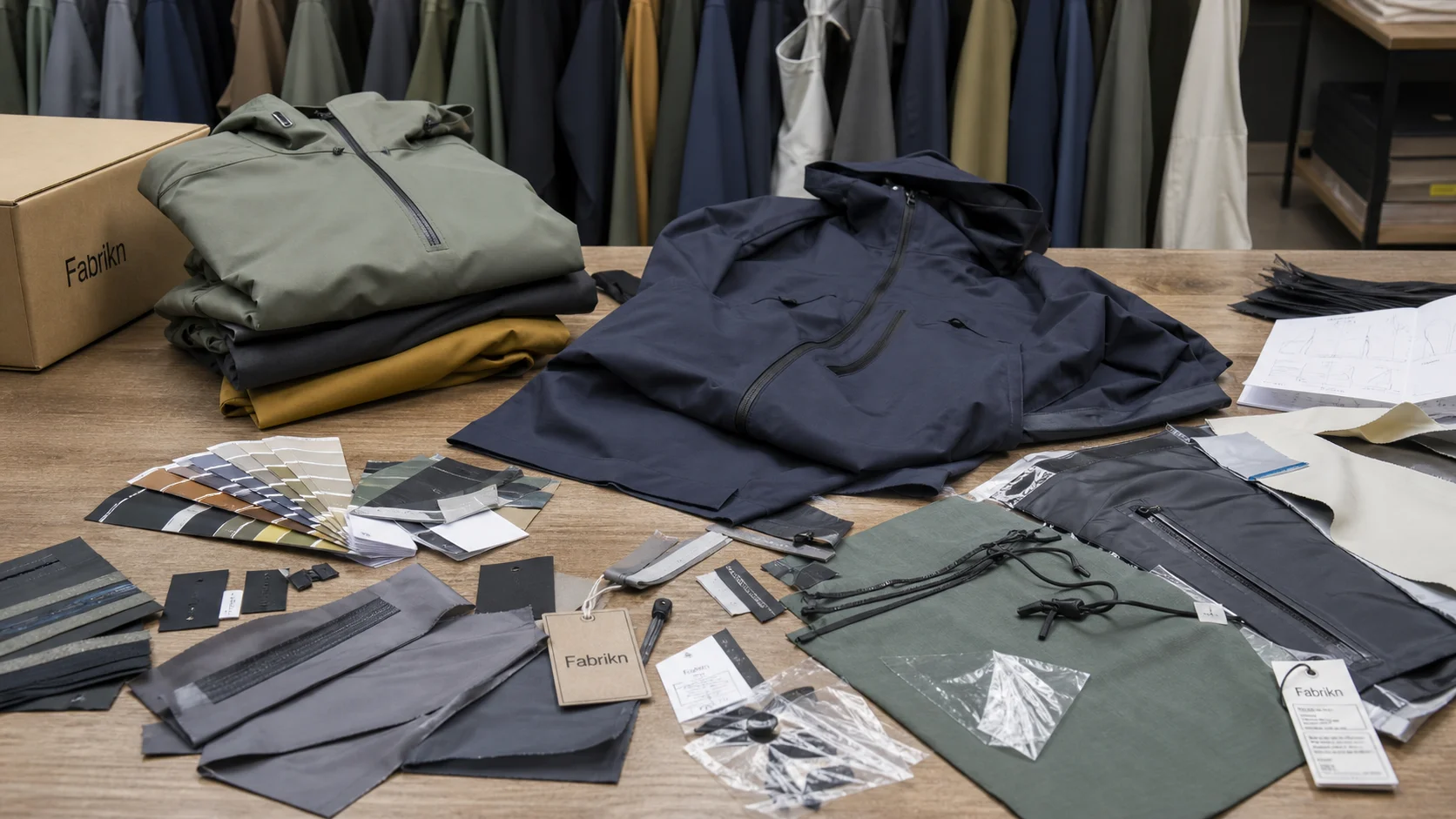
Country of Origin Labels for Apparel Packaging with checks for samples, fit, MOQ, QC evidence, pricing terms, and delivery risk.
Fast answer: Country of Origin Labels for Apparel Packaging: Costs should be judged by production evidence, not by a generic sourcing promise. The buyer needs sample proof, cost breakdowns, QC checkpoints, and delivery buffers in writing.
Ask for recent sample photos, measurement tolerances, fabric or print test assumptions, decoration test notes, packing examples, and a named inspection checkpoint. These details show whether the team can repeat an approved sample at bulk volume.
Separate garment cost, decoration, labels, packaging, sampling, testing, freight, and rush charges. When every cost line is visible, it becomes easier to reduce colorways, adjust size depth, or reserve more time for sampling.
One tiny label has sunk more shipments than bad stitching ever did. Across factory audits and customs hold reports, the same pattern kept turning up: roughly one in five apparel shipments had a labeling error, while the garments themselves were usually fine. Country of origin labels for apparel packaging look harmless right up until a port officer flags a carton, a marketplace rejects a SKU, or a retailer charges back $500 to $2,500 for relabeling and rework.
Seen it many times, in more than 200 factories across eight countries. A $0.03 sticker on a polybag can trigger a three-day delay, then an airfreight scramble that wipes out the margin on a $12 tee. Customs does not care that the embroidery was perfect or that the French terry 320 GSM passed inspection. If the origin claim differs across hangtag, carton, and commercial invoice, the shipment turns into a problem.
Three reasons, plain and simple: border clearance, retail trust, and packaging durability. Authorities compare documents line by line. Buyers notice when a “Made in Vietnam” hangtag sits inside a carton printed “Packed in Cambodia.” And the label has to survive handling, humidity, and pallet compression for three to four weeks in transit and warehouse storage.
Where does it go wrong? Packing tables. Old artwork files. A SKU suffix changed in one room and never copied into the others. Nobody checks whether the master case says country of packing or country of origin. I’ve seen factories with 98% sewing quality and 60% labeling accuracy. That gap costs money.
The cheapest supplier often delivers the priciest mistake. A low-cost factory quotes $0.08 per carton label instead of $0.14, misses a language requirement, prints the wrong origin line on 20,000 polybags, then forces a full reprint. The correction bill can run $400 to $1,200 before labor, freight, and delay penalties. If you work with clothing packaging solutions, judge the packaging quote alongside compliance, not after it.
Country of origin labels for apparel packaging reach farther than most buyers expect. Hangtags, sticker labels, polybags, inner cartons, master cases, and sometimes the shipping marks on outer packs can all be involved. Some components need a legal origin statement. Others exist for internal traceability, audit files, vendor records, or customs documentation.
Legal source and packing site are not the same thing. Country of origin is the legal source assigned to the product under the importing market’s rules. Country of packing tells you where the item was packed, bagged, or boxed. Country of final assembly points to the place where the last substantial transformation happened, which may or may not match the packing country. Buyers mix these up constantly.
Classic error: a private-label brand asks for “Made in India” on the carton because the cut-and-sew work happened there, but the final assembly or finishing step took place in Bangladesh. Documentation no longer lines up. For private label clothing, the packaging file has to track the face label and the movement of each SKU through packing, folding, bagging, and boxing.
Regional terminology shifts too. In the US, buyers treat country of origin, fiber content, and care labeling as separate compliance buckets. In parts of Europe, retailers may ask for origin on the packaging plus traceability documents showing fabric mill, dye house, and packing site. In Asia, especially in export hubs like China, Vietnam, Bangladesh, and India, some factories treat origin as a customs-document issue only, which is risky when the retailer wants it printed on every retail-ready component.
Packaging rules and product label rules get tangled fast. A woven neck label may need one legal origin line. A carton may need another. A polybag may need recycling text, warning text, and batch code, but not always a visible origin declaration. That depends on market, retailer, and channel. A wholesale order into department stores can demand stricter packaging disclosure than a direct-to-consumer shipment, even at the same MOQ 500 pieces or MOQ 5,000 pieces.
Same label, different outcome. I have seen a carton accepted in Los Angeles, held in Rotterdam, and questioned again by a UK marketplace fulfillment center because the wording was technically correct but the placement was wrong. That is the mess buyers walk into when they source across borders.
In the US, origin disclosure ties closely to Customs and Border Protection expectations, and textile products often need clear country marking on the product itself and, in many cases, consistent packaging marks. Retailers and marketplaces are usually less forgiving than customs. If the carton says one country and the hangtag says another, a purchase order dispute can follow even when the goods are legal. Data from the U.S. Commercial Service on textile and apparel trade shows how often apparel trade flows cross multiple processing countries before arrival, which is exactly why documentation discipline matters.
The EU tends to be stricter on consumer communication and retailer documentation, though actual origin marking requirements can vary by member state and product category. Packaging language matters. So does durability. A paper label that smudges after 48 hours in a humid container is a problem in Hamburg, Milan, and Madrid. UK buyers often mirror EU habits, but after Brexit many importers now want separate files for UK and EU stock, with distinct carton text and SKU mapping.
Asia is not one rulebook. Japan and South Korea expect precise product information and clean documentation. In Southeast Asia, especially for export orders, the retailer may care more about commercial consistency than consumer-facing origin language. China-based fulfillment centers can be exacting about barcode placement, carton hierarchy, and Chinese-language packing marks, while India-based export factories may be more used to buyer-issued artwork that changes late in production.
According to the World Trade Organization, trade documentation remains one of the main friction points in cross-border shipments, and apparel is especially exposed because of its multi-stage sourcing. A label accepted on a domestic carton in Bangkok may fail on a wholesale pallet bound for New York if the master case omits the packing country or the retail bag uses an outdated origin claim. I have watched brands lose two to three weeks on this error alone.
For buyers comparing stricter versus looser regimes, the rule is blunt: the stricter the retailer, the more placement, legibility, and consistency matter. A luxury department store may demand 12-point type, permanent ink, and dual-language carton marks. A discount channel may accept a simpler print spec, but still charge back if the origin code conflicts with the invoice. If the goods come through cut and sew manufacturing, every step from fabric roll to final pack has to agree on origin, or the label becomes a liability.
Cost swings are real. For 1,000 units, paper origin labels usually run about $6 to $18 depending on size and finish. Sticker labels sit around $8 to $22. Woven labels are higher, often $18 to $45 for small runs. Printed cartons are in another bracket entirely, commonly $120 to $380 per 1,000 depending on board grade, color count, and whether the carton includes variable origin text. Drop below 3,000 units and the numbers climb fast.
Printing method changes price and lead time. Digital printing works for short runs, variable SKUs, and 3- to 7-day turnaround, but unit cost is higher at low volume and colors can shift slightly between batches. Flexographic printing is cheaper at 5,000 pieces and above, often by 15% to 30%, but pre-press setup takes longer and plate changes add cost. Thermal printing is common for carton stickers and shipping marks; it is fast, usually 24 to 72 hours, but it can fade under heat or friction if the ribbon grade is poor.
Durability matters more than buyers think. Paper labels tear under moisture. Film labels survive warehouse abrasion better. Woven labels are stable but not always suitable for carton marking. Adhesive labels can lift at the corners if the carton board is dusty, recycled, or compressed at low humidity. A $0.02 savings on label stock can turn into a $180 relabeling bill per 1,000 cartons when the adhesive fails during monsoon-season storage.
MOQ changes the picture quickly. At MOQ 500 pieces, a digitally printed origin sticker might cost $0.032 each. At MOQ 5,000, the same label can drop to $0.011. Setup, plate, and file-prep costs still have to be spread across the run. Buyers who chase the lowest quote often ignore remake risk. A factory willing to print 1,000 labels below market may be assuming you will not notice a font mismatch until the shipment is already packed.
For brands trying to align packaging, labels, and retail-ready presentation, custom apparel production should be planned with the packaging spec in hand. I have seen a $9 hoodie carry a $0.28 woven label and a $0.09 carton sticker, while a $45 fleece used a $0.05 thermal mark because the retailer never saw the outer pack. Price does not always predict complexity.
The cleanest production flow starts with artwork approval, not packing day. First comes the spec sheet: origin wording, carton hierarchy, barcode format, ink color, language, and placement. Then pre-press checks the file, often in PDF and editable vector format. After that, the factory prints a sample, the buyer signs off, and only then does bulk packing begin. That sequence saves days.
Delays show up in familiar places. Translation checks can add 1-2 days. SKU changes can force a label reversion if the art file still carries an old product code. Vendor sign-off can stall when the sourcing team, the compliance team, and the packaging vendor each use different documents. Customs review can add another 24-72 hours if the importer asks for supporting origin logic.
Domestic packaging production usually moves faster. A carton printer within the same country may finish a small run in 3-5 business days, then deliver within 24 hours. Overseas packaging production can take 7-14 days before shipping, plus transit. If the labels are produced in the same factory that packs the garments, the risk of miscommunication rises unless the PO is crystal clear.
I’ve watched one missing PO detail trigger a full reprint. The buyer forgot to specify that the master case needed a carton-level origin mark, not just a retail hangtag. The factory packed 12,000 units, sealed 240 cases, then got stopped because the distribution center required printed origin on each outer box. Reprinting cost $310, and the delay pushed delivery by six days. Small omission. Large bill.
The smartest factories use a simple gate: no artwork, no packing. No PO code, no print. No sample approval, no bulk run. That discipline is boring. It also protects margin when manufacturer, factory, and supplier teams are coordinating production for wholesale and custom programs in China or elsewhere.
A good audit catches problems before ink hits the board. I always check five items: artwork version, legal wording, carton hierarchy, barcode placement, and signed sample approval. If any one of those is missing, the job is not ready. For multi-country sourcing, I also ask for the origin logic sheet showing fabric country, trimming country, assembly country, and packing country.
Red flags are easy to spot. A factory that cannot explain the difference between packing country and origin country is not ready for private-label export. A supplier that refuses to show sample photos before bulk is hiding something or rushing. Low-cost programs often reuse old label files, which is how a 2023 carton ends up on a 2025 order. That is the sort of mistake that creates chargebacks and relabeling.
My approval workflow is simple: one PDF master, one redline round, one signed sample, one named approver. Anything more complex invites drift. If you can, build this into your get a free quote stage so the supplier prices compliance, not just printing. That saves you from the “we can fix it later” trap, which is rarely cheap and never fast.
It also helps to ask for quality checks before bulk production. A good factory will confirm print accuracy, color consistency, adhesive strength, and carton durability, especially for wholesale and bulk programs with tight timing. If the source is in China, verify that the proof matches the final pack format before the production run starts.
Start with a spec sheet that names the exact label type, material, size, ink, placement, and origin wording. Then run a compliance review before you ask for pricing. After that, approve a sample, run a pilot of 100 to 300 pieces, and only then release mass production. That sequence reduces rework, chargebacks, and border holds because it forces alignment early.
Negotiate price on volume, not on vague promises. Ask for tiered quotes at 500, 2,500, and 10,000 units. Ask whether the setup fee is separate for digital, flexo, or thermal printing. Ask whether the supplier can hold printed stock for 30 to 60 days in case the SKU shifts. If they cannot explain how origin is tracked across cartons, polybags, and hangtags, the quote is too cheap.
I’ve watched brands save $120 on labels and lose $2,400 in delays. That is not procurement discipline. That is false economy. Trust is built when the carton, the product, and the paperwork all say the same thing, in the same language, with the same dates and codes. In apparel, that consistency is worth more than the lowest quote on the sheet.
Before you place a bulk order, confirm that the apparel packaging plan matches the market, the production site, and the retail channel. A factory in China may offer a lower unit price, but the real savings only matter if the label spec, custom artwork, and wholesale timeline are aligned. For many brands, that is the difference between a smooth launch and an expensive reprint of country of origin labels for apparel packaging.
They usually include origin wording, SKU or style code, barcode placement, and sometimes packing country or batch information. For retail cartons, the label may also include carton count, size range, and handling marks. The exact contents depend on the market and the buyer’s compliance rules.
Paper labels often run $6 to $18 per 1,000, sticker labels $8 to $22, woven labels $18 to $45, and printed cartons $120 to $380. MOQ has a strong effect on unit price, and small runs usually cost 20% to 50% more per piece than larger runs. Setup and artwork fees can add another $25 to $150.
Digital label jobs can take 3-7 days, thermal labels 24-72 hours, and flexographic print 7-14 days once plates are ready. Overseas production can add another 7-14 days for shipping and customs. A sample approval delay of 2 days can push the full schedule by a week.
Yes, but only if the legal logic supports it. The carton may show packing country while the garment label shows country of origin, provided both are accurate and documented. A mismatch without documentation can trigger customs review, retailer chargebacks, or relabeling costs of $200 to $1,500 per shipment.
Check the artwork file, sample pack, purchase order, and supplier’s origin logic sheet before bulk starts. Confirm the label on the hangtag, polybag, carton, and master case all match the approved wording. If the order has multiple countries of sourcing, ask for written sign-off from the factory and buyer before print release.