
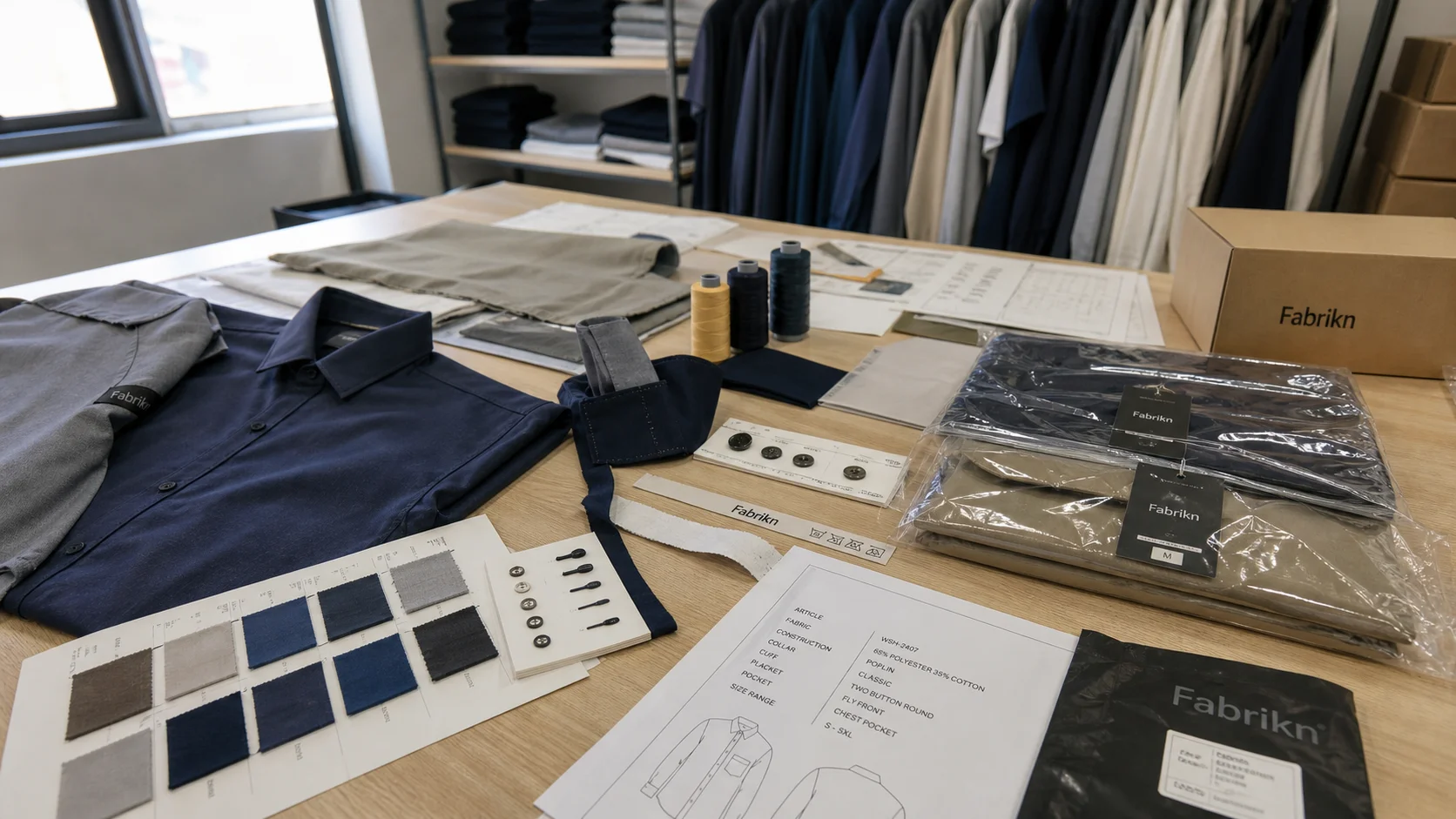
Country of Origin Tags for Clothing Exports with checks for samples, fit, MOQ, QC evidence, pricing terms, and delivery risk.
Fast answer: Country of Origin Tags for Clothing Exports: Rules, Costs should be judged by production evidence, not by a generic sourcing promise. The buyer needs sample proof, cost breakdowns, QC checkpoints, and delivery buffers in writing.
Ask for recent sample photos, measurement tolerances, fabric or print test assumptions, decoration test notes, packing examples, and a named inspection checkpoint. These details show whether the team can repeat an approved sample at bulk volume.
Separate garment cost, decoration, labels, packaging, sampling, testing, freight, and rush charges. When every cost line is visible, it becomes easier to reduce colorways, adjust size depth, or reserve more time for sampling.
A shipment can stall for days over a label no one bothered to check twice. I watched a $300,000 order sit in a port warehouse for 11 days because the sewn-in labels said “Made in China” on styles finished in Vietnam. That is the kind of mistake country of origin tags for clothing exports can turn into when the details get left for later.
Customs officers do not care that the designer meant to fix it next week. Retailers care even less. If the origin marking is wrong, border clearance can disappear, a launch window can slip 2-4 weeks, and a full carton relabeling job can cost another $1,500 to $8,000 depending on volume. Brands still treat country of origin tags for clothing exports like a last-minute branding exercise. That usually ends with pallets in limbo.
Origin marking is not paperwork fluff. It affects border release, store acceptance, and consumer trust. A department store buyer will reject a carton if the carton mark says one country and the garment label says another. A customs broker will flag the discrepancy. A marketplace operator may hold the units until revised documents, photos, and sometimes a signed correction letter arrive.
Mass-market basics take the hardest hit on volume. Picture 50,000 cotton tees at $2.10 FOB and a margin thinner than tissue paper. One wrong origin line can freeze the whole container. Premium apparel feels the pressure differently. Buyers expect cleaner documentation, and they will pay $18.00 or $24.00 FOB for better handling, but the label story still has to be perfect.
Factory visits reveal the same failures again and again. Labels stored in the wrong bin. Old artwork sitting on a phone. A production line using sample labels from a previous season because “same style, same factory, close enough.” Close enough is how you pay for air freight twice. For custom baby clothing manufacturing, the stakes climb even higher because buyers often require exact fiber, care, and origin consistency across body, packaging, and carton marks.
Rules differ by market, which is annoying and not remotely surprising. In the US, country of origin tags for clothing exports often hinge on where the garment was wholly assembled or substantially transformed, though textile rules can get very specific depending on the product and components. The EU leans on customs-origin concepts tied to the last substantial transformation. The UK follows similar customs logic post-Brexit, yet paperwork and import declarations still need to line up cleanly.
Canada uses origin marking rules that can differ from a buyer’s commercial assumption, and GCC markets often care about Arabic labeling, fiber content, and retailer-specific compliance beyond the basic origin statement. A brand shipping woven shirts from Bangladesh into Dubai may find one importer wants origin on the neck label, another wants it on the care label, and a third wants it repeated on the carton. Bureaucracy with a barcode scanner.
Country of manufacture, country of origin, and fiber origin are three different beasts. Buyers confuse them constantly. A tee can be made in Cambodia, use Japanese fabric, and have Turkish thread. The origin tag still may not say Japan, even if the fabric cost $4.80 per meter and the buyer is emotionally attached to the mill. That is where substantial transformation rules matter.
According to the International Trade Administration’s trade resources, textile and apparel trade remains one of the most tightly scrutinized categories because origin affects tariffs, labeling, and import controls. Brands I worked with in North Africa and Eastern Europe assumed a simple final-assembly shift would change the origin statement. Sometimes it did. Sometimes it did not. One Albania-to-Italy program with a 600-piece MOQ looked clean on paper, then died on the details because the wrong entity was listed as manufacturer.
Speed causes most of the mistakes in Asia. North Africa usually brings multi-step sourcing across mills, cut rooms, and finishers. Eastern Europe often carries old documentation habits from domestic production. A supplier may know how to make the garment at $6.25 FOB and still fumble the label language. That is why private label clothing services need tighter document control than a simple blank tee program. Apparel buyers do not get points for optimism. They get charges for bad declarations.
The biggest failure is also the easiest to avoid: the wrong country on the label. A factory prints “Made in Vietnam” because the sample was developed there, then bulk production shifts to Cambodia after a capacity crunch, and nobody updates the artwork file. I have seen this on 8,000-piece runs and on 80,000-piece runs. The size changes. The error does not.
Next comes mismatch between care labels, fiber content, and origin data. One tech pack says 100% cotton, another says 95% cotton and 5% spandex, and the final carton list still references the old composition. A $0.04 woven label becomes a customs query. Then the factory says the subcontractor handled printing, the agent says the mill changed thread supplier, and everyone points at email threads from 3 weeks earlier like they are legal evidence.
Inconsistent carton, hangtag, and sewn-in label data cause even more trouble. If the hangtag says “Made in Pakistan,” the neck label says “Made in China,” and the carton mark says “PRC,” the buyer compliance team will not admire your creativity. Multi-country production chains make this worse. A cut and sew manufacturing program with outsourced printing, embroidery, and washing can have 4 different vendors touching one style.
Error rates are often higher in fast, low-margin programs than in premium collections. Cheap basics look simple, so everyone rushes them. Bad idea. A $3.40 hoodie order with a 10,000-piece MOQ often gets under-documented and handed to junior staff. A $45 jacket order usually gets more review because everyone is scared of losing the account.
Last year, one brand had a factory stamp labels by hand for a 1,200-piece emergency reorder. The factory “saved” $180 in label setup and created a $2,700 relabeling bill. That is the kind of math factories love to forget. Small savings. Big repairs.
Costs change with format, order size, and how disciplined the approval process is. A sewn-in satin label may cost $0.03 to $0.08 per piece at 10,000 units, while setup can add $25 to $90 per artwork version. Printed neck labels are often cheaper, around $0.01 to $0.03 per piece, though they can be less durable after enzyme wash or heavy abrasion. Hangtags cost more, usually $0.05 to $0.20 each, because paper, string, and printing all add up.
At 1,000 units, the unit price is ugly. A woven label might run $0.08 to $0.15 each because the loom setup gets spread across fewer pieces. At 10,000 units, that can drop to $0.02 to $0.05. At 50,000 units, you might see $0.012 to $0.025 if the artwork is clean and the supplier is not padding the quote. For wholesale and bulk programs, that difference matters because many brands underestimate how quickly labels become a material cost line.
Setup fees and reprint costs hurt more than the label itself. A single revision can mean $40 to $120 in new artwork, $60 to $150 for revised plates or digital proofing, and 5-7 days lost waiting for approval. If the wrong origin is discovered after packing, relabeling can run $0.06 to $0.18 per unit plus labor. Air freight for replacements? I have paid $1,100 to $4,800 to move corrected labels on a rush order. That kind of pain sticks.
According to ISO quality management guidance, disciplined document control is a core part of quality systems, and apparel brands ignore that at their own expense. A cheap printed neck label saves money up front, but it also leaves less room for error if your artwork changes at the last minute. Sewn-in labels cost a touch more, yet they usually survive washing, packing, and retail handling better. Hangtags are the least durable but the easiest to change before shipment.
I tell brands to compare upfront cost against correction risk. A label system that costs $0.04 more per piece may save $3,000 on one delayed container. A system that needs two approvals instead of one is annoying. Fine. So is paying storage fees because a carton was held for 9 days. If you are buying custom or cut and sew manufacturing at scale, assume the cheapest label is not always the cheapest program.
Here's what most people miss: the label format that looks cheapest on a quote sheet can be the most expensive once you count reprints, inspection delays, and port storage.
Start with the tech pack. Not the mood board. Not the WhatsApp message. The tech pack should show the origin statement, label size, placement, fiber content, care instructions, and approved artwork version. I want the same origin line in the PO, spec sheet, label file, and packing list. If one says “Made in Bangladesh” and another says “Made in BGD,” fix it before bulk order, not after 12,000 units are sewn.
Then review the pre-production sample like a customs officer with a migraine. Check the sewn-in label, hangtag, carton mark, and polybag wording. Measure the label placement from the seam. I usually ask for 2 sample sets: one for lab dip approval and one for final trim approval. If the product uses a complex finish like stone wash, pigment dye, or 320 GSM French terry, I also confirm whether the label survives the wash process without curling or bleeding.
Third-party inspection helps, but only if the document trail is clean. Ask your inspector to verify label content against approved artwork, production records, and carton specs. A 20-piece or 30-piece AQL check will not save you if the master carton says one thing and the garment says another. Put one control point at trim receipt, one at pre-sewing, one at final packing. That is not overkill. That is basic survival.
My preferred workflow is simple: PO issued, origin statement locked, artwork approved, sample signed off, bulk trim ordered, in-line check completed, final inspection passed, carton release confirmed. If you are running more than 2 factories on one style, assign one owner for document control. Do not let the factory, agent, and brand team all assume the other person updated the file. Assumptions are expensive.
For a baby line, I would be even stricter. Brands buying from custom baby clothing manufacturing suppliers should verify label softness, safety, and wash durability together, not separately. A scratchy label that passes compliance is still a bad idea. Compliance and wearability are not enemies. They are roommates that keep fighting over rent.
Send your factory one clean pack today. Include the final artwork PDF, the approved tech pack, the PO, the carton marking spec, and a one-line origin statement that cannot be interpreted three different ways by three different people. Put version numbers on every file. I like something brutal and obvious: SS26_STYLE104_LABEL_V7. If someone edits it, you should know in 30 seconds, not after customs asks why carton 17 differs from carton 18.
Brief your agent, mill, and trim supplier at the same time. The mill needs to know whether fabric origin affects your claim. The trim supplier needs the correct wording and size. The factory needs to know which label goes into which size range. In a 5,000-piece order, a single misplaced label roll can contaminate the whole run. One box of wrong labels ruined 3 styles because everyone shared the same packing table.
Correction before shipment is always cheaper than correction after a hold. If the issue is caught before packing, you may only pay $50 to $200 for reprinting and a few hours of labor. After customs hold, add brokerage fees, storage, and possibly air freight. If the goods are already at port, a relabeling team can cost $0.10 to $0.30 per unit plus overtime. Ugly, but manageable. If the goods are in a bonded warehouse, the paperwork gets more exciting and less fun.
Escalation should be mechanical. First, freeze production on the affected style. Second, isolate the wrong labels by lot number. Third, confirm the approved origin with your broker or compliance advisor. Fourth, issue a corrected label file and written sign-off. Fifth, update the carton and packing lists so the correction does not die halfway through the chain. If a supplier argues, ask them to show the approval log. Silence usually says enough.
Brands moving into private label clothing services should lock this process before they add fancy packaging, metallic hangtags, or imported trims. Pretty packaging does not fix bad origin data. It just gives you a nicer box to hold the wrong information.
Supplier selection decides whether compliance feels boring or expensive. Ask direct questions. Who approves label content? How many people touch the artwork? Can they show a label traceability log for the last 3 months? Do they keep trim approval records by lot number? A factory with dedicated compliance staff will answer in specifics. A weak factory will tell you “no problem” and hope you stop asking.
Better suppliers document by default. They send label photos, sign-off sheets, carton mockups, and change logs without being chased. They know what a 500-piece sample run looks like versus a 20,000-piece bulk run. They can explain whether the same origin statement applies across both. The bad ones treat every question like a personal insult. I stopped awarding orders based on charm after losing $14,000 on one cheerful factory that could not trace a single label roll.
Red flags are easy to spot. Vague origin answers. No approval log. Different files in email, WeChat, and Dropbox with no master version. A factory that cannot tell you whether the sew room or the trim room owns label verification is not ready for export work. If they also insist the PO is “just for reference,” walk away. Reference documents are how people end up in meetings with customs officers.
For brands scaling with cut and sew manufacturing, award the order to the supplier that can explain risk, not the one quoting $0.08 less per garment. Reliable factories reduce relabeling, reduce holds, and reduce the number of times you have to explain yourself to a broker. That saves real money.
If a supplier passes the document test, the sample test, and the traceability test, then ask for a small paid pilot before a full season buy. A $2,000 test run can save a $200,000 mistake. If you want a fast starting point, request a custom clothing quote and compare how clearly the supplier answers the origin questions before you send a real PO.
Most exports need the country of origin, and many buyers also require fiber content and care instructions on the same label set. For apparel, the wording must match the approved production documents and carton marks. A mismatch between label, PO, and packing list is one of the fastest ways to trigger a hold.
Printed neck labels can cost about $0.01 to $0.03 per piece, while sewn-in woven labels often run $0.03 to $0.08 at moderate volume. Hangtags are usually $0.05 to $0.20 each. At low MOQs like 1,000 units, setup fees can push the effective cost much higher.
Clean approvals can take 2-5 days if the artwork is already final. If the supplier needs revisions, expect 5-10 days because proofs, rechecks, and reprints add time. If labels are caught late, relabeling and inspection can delay shipment by 1-3 weeks.
Yes, but the label must be updated before bulk production or shipment. If the manufacturing country changes from one factory to another, the origin statement may also change depending on customs rules and substantial transformation. Never assume a sample label is still valid after a production move.
Check the tech pack, approved sample, final carton spec, and packing list. A third-party inspector should confirm the actual garment label against the approved artwork before carton release. If the goods are already at port, verify with your customs broker immediately, because delays get expensive fast.