
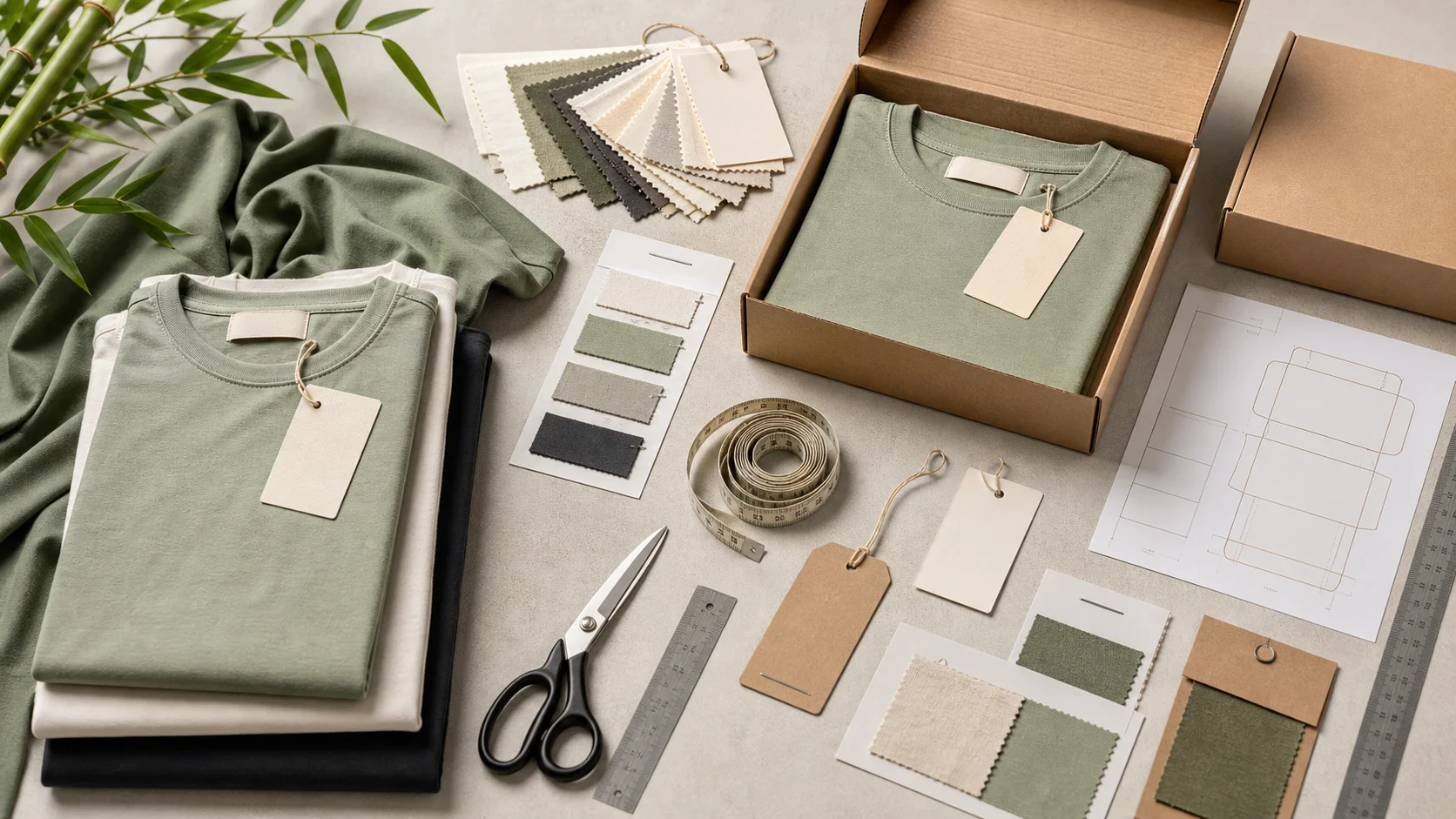
Private Label Clothing Packaging Manufacturer for Brands compared by sample evidence, fabric or trim specs, MOQ, AQL terms, cost lines, delivery timing,...
Fast answer: Private Label Clothing Packaging Manufacturer for Brands: Material, Print, MOQ, and QC Terms should be judged by production evidence, not by a generic sourcing promise. The buyer needs sample proof, cost breakdowns, QC checkpoints, and delivery buffers in writing.
Ask for recent sample photos, measurement tolerances, fabric or print test assumptions, decoration test notes, packing examples, and a named inspection checkpoint. These details show whether the team can repeat an approved sample at bulk volume.
Separate garment cost, decoration, labels, packaging, sampling, testing, freight, and rush charges. Clear cost lines make it easier to reduce colorways, adjust size depth, or reserve more time for sampling.
The garment can be excellent and still lose the room in the first five seconds. I’ve watched it happen on factory floors in Vietnam, Portugal, and Los Angeles: buyers lift the package, glance at the finish, and decide the price in their heads before they’ve even checked the stitching. A private label clothing packaging manufacturer is not selling paper and tape. It is selling the first impression that turns a product into a brand.
That matters more at budget prices than many founders expect. A $12 tee in a thin polybag with a crooked label reads like a $12 tee, even if the fabric is 220 GSM cotton and the stitching is clean. Move the same shirt into a neatly folded carton, add tissue, and the perceived value can jump enough to support an $18 to $22 retail test. I’ve seen the opposite too. A $68 sweatshirt packed like a wholesale afterthought lost premium status before customers ever felt the 420 GSM fleece.
When I visited a knitwear plant outside Ho Chi Minh City, the garments were fine. The packaging was not. Boxes crushed at 18 to 22 units high in transit, and returns were driven by scuffed collars, bent hangtags, and oily marks from low-grade inks. The brand paid $0.14 more per unit for sturdier mailers and a better fold spec, then cut damage claims by 31% in two months. No fabric upgrade. No new pattern. Just packaging that could survive shipping.
In Portugal, a premium basics label changed only the outer box and tissue weight, moving from 18 gsm tissue to 30 gsm and from a 1.2 mm carton to a 1.8 mm carton. Their production cost rose by $0.42 per order, but the average order value rose by $4.80 over the next quarter. The garment quality stayed fixed. Perception did the heavy lifting. That is why private label clothing brands should treat packaging as merchandising, not decoration.
The cheapest packaging is rarely the cheapest outcome. A flimsy sleeve, a loose sticker, or a box that opens in freight creates hidden costs in rework, replacement, and weak repeat purchase rates. Some factories can quote a mailer at $0.08 and make it sound clever. Then the brand spends $0.25 in service recovery and loses a second order worth $45. That math is ugly. And common.
The fastest way to burn time is to ask for “something premium” and expect the factory to read your mind. I’ve seen sample rounds stretch from 10 days to 7 weeks because the buyer forgot the fold method, the garment dimensions, or the shipping carton size. A private label clothing packaging manufacturer needs specifics, not vibes.
Start with the garment type. A hoodie, a rib tank, and a baby bodysuit do not pack the same way. List the folded dimensions in centimeters, the preferred fold method, and whether the item ships on a hanger, flat, or compressed. Include branding files in vector format, Pantone references, and the print-area dimensions. Then state the sustainability target plainly: FSC paper, PCR polybags, compostable mailers, or a recycled-content threshold such as 30% or 50%.
Volume matters too. MOQ 500 pieces and 50,000 pieces are not the same conversation. If you omit order volume, the factory may quote a one-off prototype instead of a scalable production run, which creates cost creep on plates, dielines, and material sourcing. I’ve seen brands pay $180 for a sample set that looked perfect, only to learn the real cost rose 19% at production because no one had approved the board grade.
Your packaging tech pack should be short but exact. I include: box or mailer dimensions, inside fill, print sides, finishing method, artwork placements, target weight, transit tests, labeling rules, and carton pack-out. If you sell infant styles, this matters even more, and a resource like custom baby clothing manufacturing shows why fit, safety, and packaging can’t be separated. Baby packaging needs clearer labeling, tighter size control, and fewer sharp edges.
Before contacting a private label clothing packaging manufacturer, run a checklist. Is the SKU count fixed? Do you know your monthly forecast for 3 months and 6 months? Have you approved print files in CMYK and spot colors? Can you accept a 2% variance in color and a 1 to 2 mm tolerance in cut lines? If not, wait one day and write the brief properly. Two extra hours now save two extra sample rounds later.
I’ve sourced packaging in all three ways, and each route has a personality. Factory-direct gives control and usually the lowest unit cost. Brokers and agents reduce language friction and can consolidate small orders. Local suppliers are faster, easier to visit, and often more expensive, but they can rescue launches that cannot wait for a container crossing the ocean. The right answer depends on your margin target, your lead time, and your tolerance for mistakes.
Factory-direct often wins on price. A printed folding carton in China might land at $0.32 to $0.55 a unit at 5,000 to 10,000 units, while a domestic supplier in the US or UK can quote $0.70 to $1.20 for a similar spec. Freight changes the equation. Ocean shipping might add $0.06 to $0.14 per unit at scale, while air freight can spike packaging cost by 40% to 120% during urgent replenishment. Agents may add 5% to 12% commission, but that fee can be cheaper than a mistake on the first order.
Speed and control trade against one another. Local suppliers can turn a sample in 5 to 10 days and production in 2 to 4 weeks. Factory-direct overseas often needs 2 to 3 weeks for sampling and 4 to 8 weeks for production, before freight. Brokers sit in the middle. They can help smaller brands access lower MOQs, sometimes 300 to 1,000 units, but customization depth can be narrower because they are coordinating multiple factories rather than running one dedicated line. For brands with sewn product as the core, a reliable cut and sew manufacturing partner often pairs best with a packaging source that can match the same quality rhythm.
Here is a simple comparison I use:
For startups, a broker or local vendor can be safer if your SKU count is low and cash is tight. For scaling DTC brands, factory-direct becomes attractive once you can absorb the 30% deposit, the 40-foot container math, and the 6 to 8 week planning cycle. Retail programs usually want consistency across 2 or 3 seasons, so they value factory-direct control and documented repeatability. I’ve seen brands save $0.11 per unit by going direct, then lose $9,000 in delays because they skipped a proper samples-from-the-line check.
Material choice decides both protection and perception. Mailer bags are light, cheap, and efficient for basics. Folding cartons and garment boxes signal structure and premium positioning. Polybags protect against moisture and warehouse dust, but they rarely help a brand feel elevated unless they are clear, minimal, and properly labeled. Tissue, hangtags, and inserts are the smaller pieces that complete the story, especially for items with a 280 GSM French terry hoodie or a carefully washed overshirt.
I’ve seen brands overspend on the wrong layer. A thick box for a $16 tee can be wasteful if the garment ships in high volume and the customer never keeps the carton. Better to spend on a crisp insert, accurate folding, and a protective mailer. On the other hand, a $95 knit cardigan deserves more than a polybag and a sticker. The packaging should match the price point and the product’s handling risk. That is not vanity. It is unit economics.
Finishes are where quotes climb quickly. Lamination, foil, embossing, and specialty inks each add cost and complicate recyclability. Soft-touch lamination can add $0.08 to $0.20 per unit. Foil stamping often adds another $0.12 to $0.35. Embossing needs tooling and pressure control, which can raise setup fees by $150 to $600 per design. If you want a cleaner sustainability profile, keep finishes simple and let paper choice do the work. According to OEKO-TEX, chemical and material transparency are central to safer textile decisions, and buyers should care just as much about packaging inputs.
Shipping efficiency matters too. A 15% lighter carton can save meaningful freight cost over 20,000 units, especially when cartons are nested tightly or packed into master cases with 12 to 24 units each. Fiber-based mailers may reduce plastic use, but if they require double-wall construction to prevent crush, their footprint can rise. I compare end-of-life impact, shipping weight, and damage rates together. None of them works alone. For brands that sell shirts and lounge sets online, the most practical clothing packaging solutions are often the ones that balance cube efficiency with a clear unboxing moment.
Paper, plastic, and fiber-based options each have a place. The mistake is treating packaging as a moral contest instead of a logistics decision. A recyclable carton that arrives damaged is a poor environmental result. A heavier mailer that protects 99% of orders may actually be smarter than a lighter one that fails on the last mile. Use data. Weight, cube, damage rate, and customer retention tell the real story.
Before I sign a purchase order, I want proof, not promises. Color consistency should be checked against a master standard, not a sales sample that may have been handled by five people and printed on a different press. Glue strength should hold under humidity and compression. Cartons should survive stacking, vibration, and a few ugly drops in transit. The cheapest quote is irrelevant if the printed box arrives scuffed or the adhesive peels at the seam.
Ask for material specs, testing records, and certifications. That means GSM or caliper data for paper, ink system details, any FSC or recycled-content documentation, and independent test results where relevant. Data from ASTM standards are useful when you want measurable performance for compression, adhesion, and transit durability. If a supplier cannot produce a spec sheet within 48 hours, I treat that as a warning sign.
Country-specific compliance matters too. Claims like recycled, compostable, and biodegradable need evidence, because regulators and retailers are less forgiving than they were five years ago. In the UK and EU, vague green claims can trigger scrutiny. In the US, state-level rules vary, and import documents need to match the actual material composition. I’ve seen brands print “100% compostable” on a mailer that contained 12% non-compostable adhesive. That kind of shortcut can cost far more than the packaging itself. For international sourcing context, the U.S. International Trade Administration is a useful reference for import and market guidance.
Red flags show up fast during factory visits. One plant showed me three batches of the same carton, each with different shade variation and slightly different board stiffness. Another claimed “local materials” but stored imported film rolls with no traceable paperwork. A third had stunning samples and chaotic production records. Good suppliers show you the boring stuff: incoming inspection logs, batch codes, corrective actions, and a clear path from quote to QC. That is how you separate a decorative pitch from a real manufacturing partner.
If a supplier cannot explain recycled content by weight, cannot show a transit test, or shrugs at batch variance, walk away. The margin you think you saved will disappear in replacements, delays, and chargebacks.
My process is blunt because waste is expensive. First, write the RFQ with dimensions, artwork, material targets, order volume, and shipping terms. Then ask three suppliers for the same quote structure so you can compare apples to apples. Use one sample scorecard for all three: print fidelity, structure, transit durability, price, and lead time. I score each item from 1 to 5, then weight durability and total landed cost highest.
Next, negotiate the terms that actually move cash. MOQ can often be reduced if you accept one material choice instead of three. Tooling and print plates may be waived if you commit to a repeat order, especially above 10,000 units. Payment terms matter too. Moving from 50% upfront to 30% upfront can free budget for freight and the first launch. If you have a packaging vendor willing to hold stock, negotiate freight terms early and define who pays for split shipments.
Then pilot before scaling. Test one SKU, one colorway, or one market for 1,000 to 2,000 units. Track damage rate, unboxing feedback, and fulfillment speed for 30 to 45 days. If returns fall and customer photos improve, scale the format. If not, revise before you lock a seasonal order. I’ve seen brands rush into 20,000 units and regret a carton that looked beautiful but jammed on the packing line.
Good packaging economics are simple. Small pilots reveal big problems. A sample that looks great on a desk may fail in a real warehouse with 8-hour shifts, tape guns, and humid loading docks. Protect your margin by testing early and buying in stages, not by betting the whole season on a polished render. A disciplined private label clothing packaging manufacturer should welcome that process, because the numbers tell the truth before the freight bills do.
Scale rewards discipline. Standardize box sizes, tissue formats, and insert templates so you are not paying for new artwork, new dies, and new storage every season. I’ve watched brands cut packaging waste by 18% simply by using two carton sizes instead of five. They also reduced warehouse pick time by 11 seconds per order, which sounds tiny until you multiply it by 40,000 shipments.
Forecast around launches, holiday peaks, and replenishment cycles. If you know a November spike is coming, order 8 to 10 weeks early and keep a 10% safety buffer on the highest-volume SKU. Use one packaging format across collections if the product family is similar, especially for tees, sweats, and lounge sets. Customizing by category makes sense for outerwear, gifting, or fragile accessories, but too much variety eats margin and confuses the fulfillment team.
I’ve seen brands treat packaging as decoration. That mindset gets expensive fast. Packaging is a profit tool and a perception tool. A well-run program protects the garment, lowers damage, supports repeat purchase, and keeps the brand image steady from first order to the fifteenth reorder. A seasoned private label clothing packaging manufacturer can help standardize those decisions across production cycles without flattening the brand. The goal is consistency that still feels alive.
Costs vary by material and quantity. Basic polybags can run $0.03 to $0.10 each, while printed folding cartons often land around $0.32 to $1.20 depending on region, finish, and MOQ. Freight, tooling, and plates can add 5% to 20% to the total landed cost.
Send garment dimensions, fold method, artwork files, branding colors, target materials, sustainability requirements, and forecast volume. Include carton or mailer size, labeling rules, and your target retail price so the supplier can match packaging to margin. A complete brief can cut sampling time from 4 weeks to 1 or 2.
Sampling usually takes 5 to 15 days locally and 2 to 3 weeks overseas. Production often takes 2 to 4 weeks domestically and 4 to 8 weeks with factory-direct sourcing abroad, before freight. Add another 1 to 5 weeks for shipping depending on route and customs.
Yes, but the supplier should prove the claim with specifications and certifications. Ask for recycled-content documents, FSC proof where relevant, and any test results tied to compostability or recyclability. If the evidence is vague, treat the claim as unverified.
Choose local if speed, lower MOQs, and easier communication matter most. Choose overseas if your order volume is higher, you want lower unit cost, and you can plan 6 to 10 weeks ahead. I usually recommend piloting locally or with a broker, then moving overseas once specs are stable.