
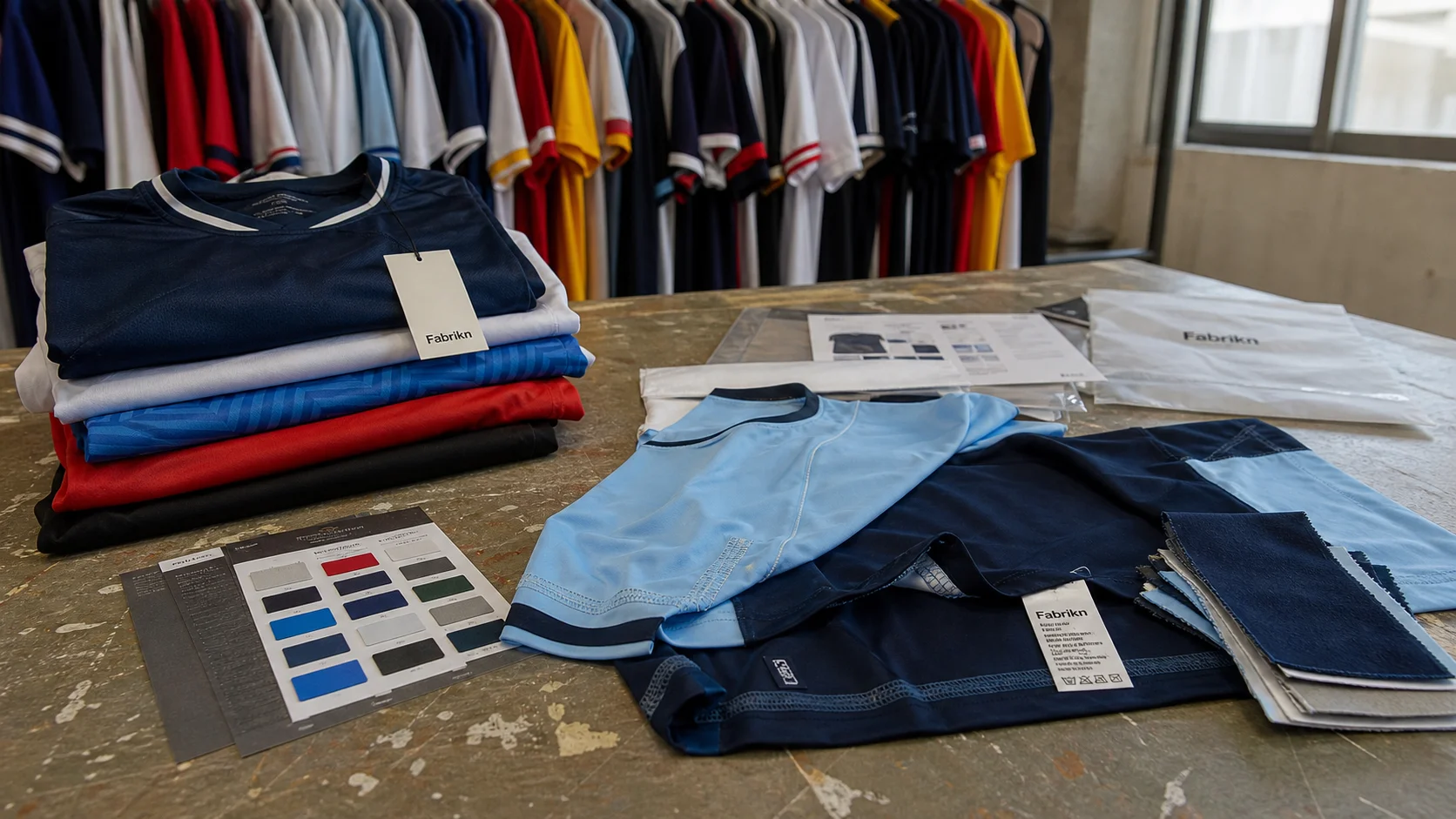
Custom Packaging Inserts for Fashion Brands with checks for samples, fit, MOQ, QC evidence, pricing terms, and delivery risk.
Fast answer: Custom Packaging Inserts for Fashion Brands: Costs, Fit, Impact should be judged by production evidence, not by a generic sourcing promise. The buyer needs sample proof, cost breakdowns, QC checkpoints, and delivery buffers in writing.
Ask for recent sample photos, measurement tolerances, fabric or print test assumptions, decoration test notes, packing examples, and a named inspection checkpoint. These details show whether the team can repeat an approved sample at bulk volume.
Separate garment cost, decoration, labels, packaging, sampling, testing, freight, and rush charges. When every cost line is visible, it becomes easier to reduce colorways, adjust size depth, or reserve more time for sampling.
A silk shirt that arrives looking like it slept in the box for a week can undo months of brand work in one unzip. I have seen a perfectly good tee dismissed as “cheap” because the carton gave the wrong first impression. That is the quiet power of custom packaging inserts for fashion brands. They are not decoration. They are the difference between a product that arrives composed and one that arrives apologizing for itself.
In factory audits, one pattern kept showing up: weak internal packaging pushed damage rates up by 3% to 8% on longer routes, and return reasons drifted from fit issues to “poor presentation” or “arrived damaged.” For DTC labels shipping 5,000 to 20,000 units a month, that is not cosmetic. A 4% avoidable return rate on a $75 average order value can erase margin fast, especially once reverse freight and repacking add another $6 to $12 per order. Brutal math.
Luxury, contemporary, and mass-market brands do not want the same thing from inserts, and factories know it. Luxury buyers often specify rigid support, tissue wrap, and dust sleeves because they expect products to hold shape after 2 to 3 weeks in transit. Contemporary brands usually want lighter structures at $0.18 to $0.65 per set, while mass-market teams push for speed and carton efficiency, sometimes at the expense of fit. I have stood at lines in Italy, Vietnam, and India where the same dress was packed three different ways, and each choice told me exactly who the customer was supposed to be.
The hidden cost is that weak internal packaging gets treated like an afterthought during development. Brands spend $12,000 on campaign photography, then approve a box insert after 12 minutes on a supplier call. Backwards. Poor presentation changes perceived value, and perceived value affects repeat purchase behavior. According to ISO, packaging performance standards exist because transport stress is measurable, not theoretical. If the internal structure fails, the customer sees it before they ever see the garment.
The brands that get this right are not the ones with the fanciest mockups. They are the ones that know garment weights, fold thickness, and shipping routes before they approve a single insert. Evidence first, pretty renderings second.
In practical terms, inserts are the pieces that stop a garment or accessory from moving, crushing, or rubbing itself to death in transit. Tissue paper. Card dividers. Molded pulp trays. Foam alternatives. Garment supports. Dust sleeves. Even a small gift card tucked into a controlled cavity. For custom packaging inserts for fashion brands, the real job is fit. If the insert is off by 5 mm, the product shifts. Off by 10 mm, and the carton starts behaving like a drum.
Folded knits usually need compression control more than rigidity. A 320 GSM French terry hoodie often ships well with a folded board, tissue wrap, and a simple side guard that prevents shoulder collapse. Structured jackets need more shape retention, especially around lapels and sleeves. Lingerie, including products developed through custom bra manufacturing, needs delicate support: soft tissue, cup protection, minimal surface friction. Accessories and small leather goods tend to require dividers and dust sleeves, while shoes usually need toe shapers or molded pulp inserts to stop vamp collapse and scuffing.
There is a reason premium brands obsess over insert geometry. A garment insert can support premium storytelling without adding clutter if it disappears into the packing process and only appears to the customer as order. I have seen brands add three layers of packaging, then wonder why labor time rose by 18 seconds per unit and line output fell by 12%. That is not luxury. That is waste.
Common mistakes are predictable. Overpacking makes cartons bulge and raises freight costs. Mismatched dimensions create pressure points. Inserts that look expensive in a prototype room can fail in a carton after 700 kilometers of truck transport. This is why brands working on private label clothing should test inserts alongside the actual folded product, not in isolation. The insert must fit the item, the box, and the route.
The failures I see most often in factory audits are boring and expensive: pressure damage, moisture exposure, sliding inside cartons, and rubbing between components. A silk blouse can pick up a permanent crease where a sleeve presses against the box wall for 17 days at sea. Denim can leave dye transfer on light tissue if the fabric is not cured properly. Leather can take a pressure mark from a stiff edge that looked harmless on the sample table.
That is why insert design matters as much as outer carton strength. When the fit is right, the product is suspended or stabilized, so carton shock does not transfer directly into the garment. On long-haul sea freight, where transit can run 18 to 35 days, even a small amount of humidity can make paper-based components swell and lose shape. In humid ports like Ho Chi Minh City or Santos, I have seen a 2 mm change in board thickness turn a precise insert into a loose one.
Transit testing should reflect actual failure points, not lab fantasy. I prefer vibration, drop, and compression checks that simulate stacked cartons, conveyor drops, and last-mile handling, because those are the moments where product presentation breaks. According to ASTM, packaging test methods exist for a reason: stress must be repeated, measured, and compared against performance thresholds. A pretty prototype is not proof.
I once visited a factory packing embellished dresses for a mid-tier brand at $95 retail. The insert looked polished, but the carton cavity was 8 mm too wide. The dress shifted, beadwork rubbed the edge, and 6% of units failed incoming QC at the warehouse. The damage was not dramatic enough to spot from a photo. It was enough to trigger returns and markdowns.
For leather goods, the best protection often comes from a combination of soft tissue, structured support, and a dust sleeve. For denim, crease control matters more than softness. For embellished items, separation between hard and soft components is non-negotiable. I have seen brands spend $1.10 per unit on elaborate printed internals and still lose money because the insert fit was wrong by a few millimeters. Exactness beats ornament every time.
Material choice is where sustainability claims meet factory reality. Paperboard is common because it is cheap, printable, and easy to die-cut. Molded pulp brings better cushioning and a stronger recycled narrative, but it can be inconsistent if the supplier is running mixed fiber streams or poor drying cycles. Corrugated is strong and familiar, yet bulky. Foam still appears in some lower-cost programs because it is light and protects well, but many brands are phasing it out due to recyclability concerns and customer backlash.
Recycled PET and textile-based inserts sit higher on the price curve and can make sense for accessories, premium sportswear, or reusable packaging systems. I have seen fabric sleeves used inside luxury hosiery and knitwear programs where hand-feel mattered as much as protection. The trade-off is cost. A textile insert can run $0.35 to $1.80 per unit depending on construction, while a basic paperboard divider may land at $0.08 to $0.22.
Here’s what most people miss: recycled content is not the same as good performance. A board with 80% post-consumer fiber may look better in a sustainability deck, but if it warps in humidity or sheds lint onto silk, the brand creates waste somewhere else. Mixed coatings, glossy laminations, and heavy inks can also block recyclability. That is why I ask suppliers for substrate details, adhesive specs, and regional recyclability pathways, not just a recycled-content percentage.
Material consistency is one of the biggest factory-side headaches. Paperboard is easy to source in most regions, but quality drift happens when mills change fiber blends to manage cost. Molded pulp can vary by wall thickness and edge finish. Foam arrives uniform but becomes a reputational problem in markets where consumers expect less plastic. According to Textile Exchange, material choices increasingly face scrutiny on recycled inputs and traceability, and packaging sits in that same compliance conversation even when brands pretend it does not.
Across price points, the pattern is clear. Entry-level basics can use simple board, tissue, and a slim divider at $0.10 to $0.30. Mid-market labels often do best with molded pulp or reinforced paperboard at $0.22 to $0.70. Luxury goods may justify custom-finish board, fabric sleeves, or shaped trays at $0.80 to $2.50. The wrong move is buying the most expensive material without testing whether it actually protects the product you are shipping. I have seen plenty of expensive failure.
Pricing for custom packaging inserts usually breaks into three bands: budget, mid-market, and premium. A budget insert program for a volume order of 10,000 to 25,000 units might sit at $0.09 to $0.22 per set, with tooling or die fees around $150 to $600 and samples at $35 to $120. Mid-market programs often run $0.24 to $0.75 per set with $300 to $1,200 in setup costs. Premium inserts can reach $0.90 to $3.50, especially when fabric, multi-part structures, or specialty finishing are involved.
MOQ changes the math quickly. A startup ordering 500 pieces may pay $0.60 to $1.40 per unit because the supplier spreads setup across too few cartons. A brand ordering 20,000 can cut that by more than half. But lower unit cost is not the whole story. If the insert slows packing by 10 to 15 seconds per order, the labor cost can wipe out material savings. A line that packs 1,200 units a day losing 12 seconds per unit gives away 4 hours of labor across a 1,200-unit week.
Freight also matters. Bulky inserts increase dimensional weight, and dimensional weight charges can add 8% to 18% on air shipments. I have seen a brand save $0.14 on each insert and then lose $0.31 per carton in shipping because the carton profile expanded. That is why landed cost has to include material, setup, packing labor, freight, and rejects. Otherwise the spreadsheet lies.
Last year I worked with a brand that sold tailored outerwear at $240 retail. They upgraded from a plain paperboard spacer to a structured insert system with sleeve guards and a carton stabilizer, moving from $0.28 to $0.74 per unit. Returns linked to packaging damage dropped from 5.2% to 1.7% over two drops, and repeat purchase rose by 6% in the next collection. The upgrade paid for itself in under one season.
The middle zone is often the smartest spend. For products in the $60 to $150 range, a carefully engineered insert that costs $0.25 to $0.60 can protect margin better than a flashy premium pack. The math is simple: if one return costs $9 to process and the insert prevents even 1 in 20 returns, you have a case. If it saves a customer from thinking your product was packed cheaply, the value is even higher.
Sustainability claims only matter if they survive documentation. Buyers should verify FSC certification, recycled content percentages, compostability claims, and whether a material is actually recyclable in the destination market. A board that is recyclable in one country may be rejected in another because of coatings, adhesives, or contamination from mixed materials. That gap is larger than most brand teams admit.
Inks and glues are easy to overlook. Soy-based inks may sound friendly, but the adhesive that bonds layers can be the real problem. Laminations can turn an otherwise recyclable insert into landfill-bound waste. Dye migration matters too, especially on light fabrics and silk. I have seen a black tissue layer mark a cream blouse after 11 days in humid storage, and the issue was not the garment. It was the packaging chemistry.
European buyers usually ask for more documentation up front, especially around recycled claims and waste directives. UK teams tend to be similarly cautious, while US buyers sometimes focus first on functionality and then ask for proof later. Asian sourcing teams can be very strong on execution, but compliance depth varies by market and by retailer. The best programs build a spec sheet that lists substrate, coating, adhesive, recycled content, and disposal pathway.
For external reference, the OEKO-TEX framework is useful when packaging components come into close contact with textiles, and it reminds brands that chemical safety is not just about the garment. Packaging can contaminate fabric long before a customer notices the label. For trade and sourcing guidance, the U.S. Commercial Service is also a useful authority when importing packaging components across regions.
The cleanest route is rarely the most complex one. Choose a single-material insert where possible. Keep coatings minimal. Avoid mixed-material assemblies unless protection truly demands them. Ask suppliers for test data, not slogans. If a brand can reduce waste while keeping the garment pristine, that is a real sustainability win. If the product arrives damaged, the packaging was not sustainable. It was just optimistic.
The fastest way to waste 3 to 6 weeks is to brief an insert with no technical detail. I want garment dimensions, folded dimensions, carton specs, closure method, route, climate, and the shelf experience you expect the customer to feel. If you are packing a jacket with shoulder structure, say so. If the product travels by sea for 24 days and then sits in a warehouse for 10 more, say that too.
The sourcing sequence should be simple. First brief. Then artwork and dieline review. Then prototype. Then transit or compression test. Then final approval. Factories cannot quote cleanly without garment weight, target pack count, and dimensions to the nearest millimeter. If the team works in cut and sewn categories, a partner such as cut and sew manufacturing will usually ask for the same rigor because fabric behavior changes with construction, not just size.
Sample rounds should be controlled, not chaotic. I ask for one sample based on the actual final garment and one sample using the worst-case packed unit, because production drift is real. If a supplier needs 14 days for a prototype and another 7 days for adjustment, build that into the calendar. A good plan leaves room for one revision cycle, not four.
Decision gates save weeks. Marketing signs off on visual finish. Operations signs off on pack speed and carton fit. Quality signs off on protection. Procurement signs off on cost and MOQ, which may sit at 500 pieces for simple board and 2,000 or more for shaped solutions. If all four groups approve different things at different times, the program stalls. I have watched that happen more than once.
For brands that already buy clothing packaging solutions, insert development should sit beside carton development, not after it. Document the final spec with dimensions, substrate weight, coating, adhesive, folding sequence, and approved photos. Save the sample and label it with date, supplier, and revision number. Then test one more round against shipping conditions. That final record prevents arguments when the next production run drifts by 2 mm.
Simple paperboard or tissue-based inserts usually cost $0.08 to $0.30 per set at volumes above 5,000 units. Molded pulp or reinforced structures often land between $0.22 and $0.75, while premium fabric or multi-part systems can reach $0.90 to $3.50.
Most projects take 3 to 6 weeks from brief to approved sample. Simple inserts can move faster, but shaped or branded solutions often need 1 to 2 extra revision rounds and another 7 to 10 days for tooling or final adjustments.
Many suppliers quote 500 to 1,000 pieces for basic paperboard designs, but shaped or printed inserts often need 2,000 to 5,000 pieces for practical pricing. Smaller runs are possible, though unit cost usually rises by 30% to 80%.
Yes, but only if the material matches the product. Single-material paperboard, molded pulp, or recycled fiber options can work well for many garments and accessories. The key is testing for crush, moisture, and fit before launch.
Start with a manufacturer, factory, or supplier that can show dielines, material specs, and transit test results, not just mockups. For custom packaging inserts for fashion brands, I prefer vendors who can quote with garment dimensions, carton specs, and route data in hand, because that is where the real quality, production control, wholesale pricing, and bulk performance sit. If sourcing from China, ask for sample photos, QC checks, and clear MOQ terms before you commit.