
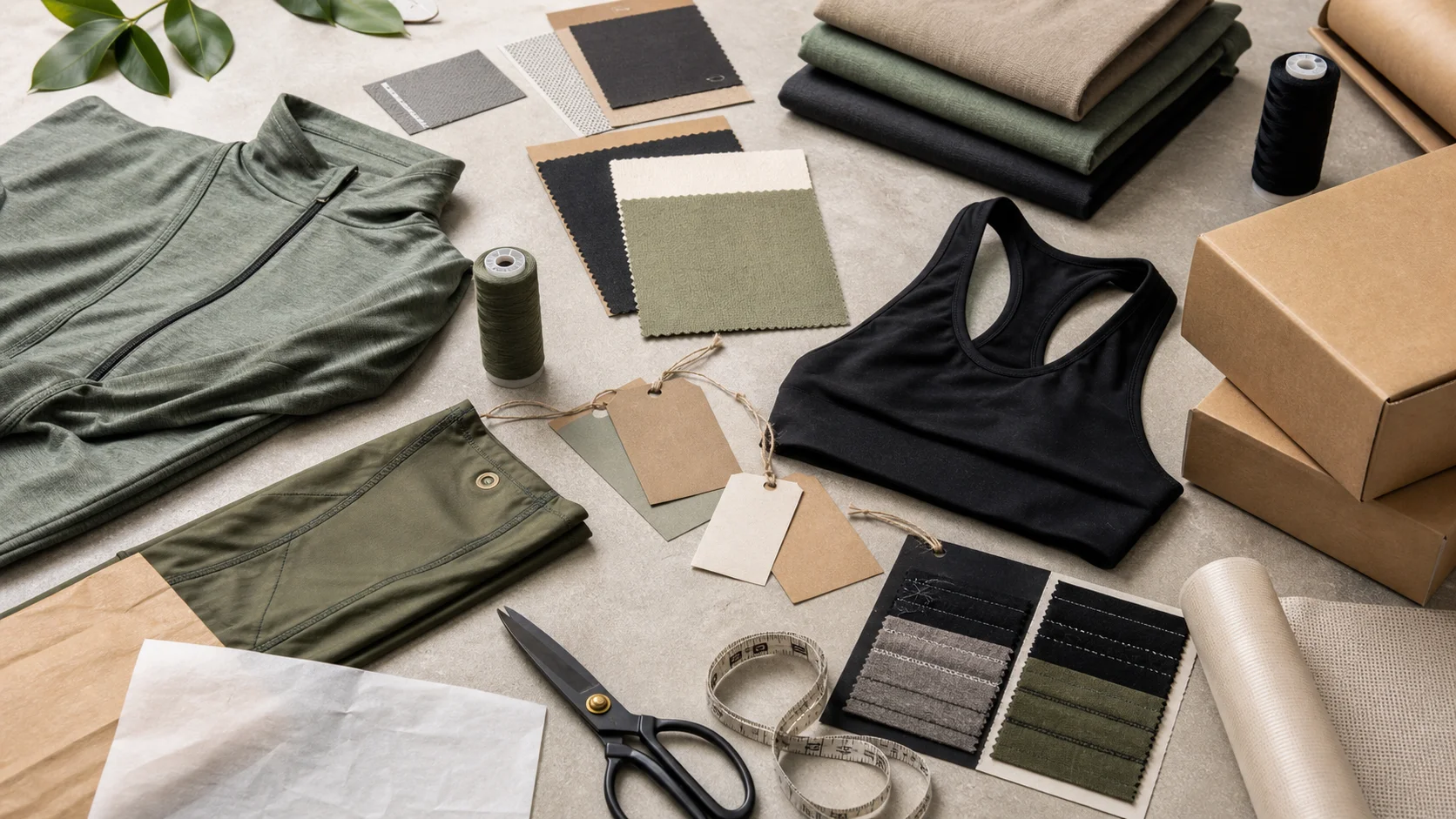
Garment Barcode Labeling with checks for samples, fit, MOQ, QC evidence, pricing terms, and delivery risk.
Fast answer: Garment Barcode Labeling: Data Fields, Adhesive, Print, and Packing should be judged by production evidence, not by a generic sourcing promise. The buyer needs sample proof, cost breakdowns, QC checkpoints, and delivery buffers in writing.
Ask for recent sample photos, measurement tolerances, fabric or print test assumptions, decoration test notes, packing examples, and a named inspection checkpoint. These details show whether the team can repeat an approved sample at bulk volume.
Separate garment cost, decoration, labels, packaging, sampling, testing, freight, and rush charges. When every cost line is visible, it becomes easier to reduce colorways, adjust size depth, or reserve more time for sampling.
I once watched a pack-out line grind to a halt because of one wrong label, and the bill for that tiny slip grew teeth fast. A carton of 500 T-shirts sat idle while operators peeled off mis-scanned SKUs, reprinted labels, and rechecked assortments that should have taken 12 minutes, not 47. On a busy day, one weak batch of custom barcode stickers for apparel packaging China can create 30 to 90 minutes of lost labor per 1,000 labels, plus rework that ripples through the whole order. In Guangzhou’s Nansha district, I toured a 95,000-square-foot hall where a Mark Andy Performance Series CS3 press printed adhesive-backed 80-micron PET with inline corona treatment, and the operators held GOTS and OEKO-TEX Standard 100 compliance packets at every station even before the UPC data hit the polybag line. Ho Chi Minh City’s pack-out floor shares that same ERP data stream, while the Dhaka crew receives adjusted adhesion specs when humidity swings above 85%, and Istanbul crews double-check each carton with portable scanners before the pallets leave for the port.
What factories actually see is blunt and repetitive. A label that prints fine in the office may fail once it meets a curved polybag, a glossy hang tag, or a damp master carton. In Guangzhou, Dhaka, Ho Chi Minh City, and Istanbul the battles are similar yet still different: Guangzhou and Istanbul favor high-tack 3M 200MP adhesives on coated cartons and matte PP on hang tags; Ho Chi Minh City mixes removable acrylic for soft polybag applications; Dhaka tightens polyolefin strength when the humidity spikes and the adhesive needs more dwell time to bond. China exporters I observed were often packing 2,000 to 5,000 units per line per shift, while many Vietnam and Bangladesh facilities moved more slowly on label checks, especially when barcode data changed at the last minute. Turkish factories, especially for higher-priced programs, tended to hold tighter tolerance on carton markings, but they were not always faster.
Scan failure rates are not abstract. In apparel distribution, even a 1% unreadable label rate can trigger 10 to 20 manual overrides in a 1,000-piece lot, and each override can cost 20 to 60 seconds. Multiply that by a 10,000-unit order and you are paying for hours of unnecessary handling. If a mislabeled carton reaches a 3PL, the return and relabel cost can run $1.50 to $4.00 per carton, not counting delayed shipment windows. Brands that require WRAP, BSCI, or GRS certification add another layer of traceability, so an unreadable barcode doesn’t just delay the pack-out—it can trip a compliance violation.
Placement changes the failure rate more than most buyers expect. Labels on polybags need stronger initial tack. Hang tags need better edge hold. Master cartons need abrasion resistance because they get slid, stacked, and scraped. A barcode placed across a seam or over a textured recycled carton can miss on first scan, which is why placement rules belong in the spec, not in a rushed email chain. If your brand already uses clothing packaging solutions, the barcode sticker should be treated as part of that system, not an afterthought.
The cheapest sticker is often the most expensive choice after shipment. I have seen $0.012 labels create $120 to $300 in downstream labor, then another day lost while a warehouse waits for corrected cartons. That math is ugly, but it is common. When the print head on a Toshiba B-EX6T1 hits a poor-quality PET film and smears because the liner was not corona-treated, the crew reprints the entire run and stops the line for 18 to 22 minutes while they clean the roller and re-kiss the adhesive.
For brands comparing sourcing options, it helps to think beyond print cost and look at total pack-out performance. A well-made label from a custom barcode stickers for apparel packaging China manufacturer can reduce rescans, improve line speed, and protect shipping deadlines.
Most sourcing errors start with a vague spec sheet. For custom barcode stickers for apparel packaging China, buyers should define material, adhesive, finish, barcode format, and data rules before they ask for a quote. Specify the film (80-micron matte PET, 60-micron BOPP, or 50-lb kraft liner) and the adhesive (3M 200MP permanent for cartons, Avery Dennison removable for hang tags) so the supplier can match coatings to your cartons. Paper stock is cheaper, usually by 15% to 35% versus synthetic materials, but coated paper or PP holds up better on humid warehouse floors and against scuffing during carton handling. PET costs more again, often 20% to 40% above PP, yet it resists tearing and stays readable when a carton sees friction. If your program requires GRS (Global Recycle Standard) certified media, the supplier must track recycled content from the resin, through the extrusion line, to the finished roll.
Adhesive choice is not cosmetic. Permanent adhesive works for most cartons and polybags, but removable adhesive helps on hang tags or returnable cases where you cannot leave residue. On coated cartons, especially the smooth ones used by premium private-label programs, a weak glue can fail within 24 hours if the room runs at 70% humidity. I have seen labels lift at the corners after cold storage and then wrinkle during pallet wrap. Coronavirus-treated liners and ultrasonic laminators from Nordson keep adhesive tack consistent, while slitting lines tuned by Bobst ensure clean edges so the glue doesn't creep onto the face stock.
Barcode format matters too. Apparel logistics commonly use Code 128, EAN-13, UPC-A, QR, and GS1-128. Code 128 is common for internal SKU logic because it handles dense data. EAN-13 and UPC-A fit retail scanning needs in the US and EU. GS1-128 is useful when you need batch, lot, and serial data in one mark. For buyers serving the Middle East, multilingual text may be required on the same sticker, while EU shipments often need cleaner origin and compliance text. If your product line sits alongside private label clothing services, the barcode hierarchy should match your size, color, and style structure exactly, and any dynamic label (for serialized releases) should be printed on a thermal transfer line such as a Zebra ZT610 with resin ribbon that can survive the heat of pallet wrapping.
Scan tolerance is where many programs get sloppy. A 30 x 20 mm label may work for a simple Code 128, but if the data string grows, you need larger quiet zones and a better print density. Carton size matters because a 10 cm curve behaves differently from a 40 cm flat face. Refrigeration and high humidity reduce adhesion; rough recycled board changes reflectivity. Matte finish generally scans better than gloss because it lowers glare under warehouse lights, especially with handheld scanners that are already working under pressure. Adding a UV varnish or soft-touch lamination can protect the barcode on high-abrasion programs, but the varnish must be cured using UV LED modules—check if the supplier uses Fuji UV LED curing units so the finish doesn’t crack during conversion.
Control the data. Send SKU hierarchy, country-of-origin text, serial numbering rules, and whether the label is static or variable. If you skip version control, one wrong digit can send the whole lot off course. I always ask for a line item that names the exact barcode content, the approved artwork, and the scan standard used for sign-off. Apparel buyers who also need cut and sew manufacturing should sync label data with sewing tickets, because mismatched style codes are a common and avoidable error.
When you compare a custom barcode stickers for apparel packaging China supplier against local alternatives, ask how they handle artwork revision control, material substitutions, and barcode verification. That is usually where quality differences show up first, and the right partner will walk you through each process step with documented proof that matches WRAP, BSCI, and OEKO-TEX Standard 100 commitments.
The production flow is straightforward on paper and messy in practice. File check comes first, then plate or digital setup, proofing, die-cutting, printing, inspection, roll winding, and carton packing. The best factories use handheld scanners at the end of the line and compare results against warehouse software, not just a visual check. That final scan is what matters. A pretty label that does not read is just waste. Machines such as Nilpeter FA-17 flexo presses, Kocher & Beck Expertcut die-cutters, and Epson SureColor F6470 digital printers run concurrently in Guangzhou, while Ho Chi Minh City lines supplement with thermal transfer printers for serialized tags.
For short runs, digital printing is faster and cheaper on setup. I have seen it work well for 500 to 5,000 labels, especially when a brand needs multiple SKUs or rapid sample changes. Flexo makes more sense at 20,000 labels and above because the unit cost drops once tooling is set. Thermal transfer is often the choice for variable data, lot coding, or serialized labels; it is flexible, but the ribbon and substrate must be matched carefully or the print rubs off during packing. We have paired Toshiba thermal heads with cured polyester ribbons and 80-micron PET faces in Dhaka to make sure the ink stays sharp through the entire palletization process.
When I visited factories in Guangdong and Zhejiang, the failures clustered in the same places. Poor contrast was the first issue, especially when buyers chose a dark background with a low-density barcode. Wrong label roll direction was another quiet killer. A roll wound for the wrong dispenser can cause peel-back issues or jam the labeling station for 15 to 20 minutes. Weak glue on coated cartons appeared again and again, particularly on labels stored near open dock doors where humidity swung between 45% and 80% in a single shift. In Istanbul, we saw the same pattern reversed: they pre-condition the rolls with a conditioner machine, then use Marel 3000 slitter rewinders to avoid curl during overseas shipments.
Turnaround depends on tooling and proof approval. A digital sample can be ready in 1 to 3 days. Flexo with new plates may take 5 to 8 days before the first full run. If the supplier also has to verify a new die-cut or a nonstandard roll core, you can lose another 2 days. Buyers who approve proofs slowly often blame the factory for delays that started in their own inbox. Some factories will lock in the print while waiting for approvals, but the quicker you sign off the better the entire line and your 3PL’s ETA will stay intact.
Any serious custom barcode stickers for apparel packaging producer also invests in inline inspection systems, running labels through Cognex or Keyence vision systems to read every barcode before winding the rolls. The fully automated lines feed data back to the ERP, so the quality team can flag a print-head misalignment on the Fuji J Press 750S and correct it before the entire run is scrapped. A well-calibrated system means you can ship from Guangzhou in about 18-22 business days, but only if you approve proofs on time and return inspection reports without delay.
Additional processes such as cold foil, UV varnish, and lamination add durability. UV LED curing keeps the finish flexible, while corona treatment improves coating adhesion on low surface energy films. The final step is always a 100% scan using handheld Zebra scanners, and the finished rolls are either 76 mm core (for automated applicators) or 25 mm core (for in-house dispensers) depending on your packing station.
Price per label depends on quantity, material, and process. For example, a 60 x 30 mm matte PET label printed with Code 128 on a digital press, die-cut, and delivered to your Guangzhou facility at 500 MOQ can run around $2.50-4.00 per unit once you add in prepress, adhesive (3M 200MP), and inspection. Bulk flexo runs at 10,000 units shrink the per-piece rate to $0.85-1.30 because the plate cost amortizes across the lot and the BOPP film is sourced at contract pricing. There’s also a difference between inline lamination ($0.12 per label) versus offline (about $0.20 per label) if you are protecting the barcode with a gloss or matte film.
Additional cost drivers include variable data encoding, serialization, and RFID hybrid tags. Thermal transfer runs with serialized batches require premium resin ribbons, inflating costs by $0.05 per 1,000 labels, while laser-etched dies for complex shapes can cost $250 to $350 upfront. Add in transportation—air freight for rush samples or sea freight for full runs—and your landed cost can increase by $0.08-0.18 per label depending on whether the supplier is shipping from Guangzhou, Ho Chi Minh City, or a bonded warehouse near Shanghai.
Don’t forget compliance audits either. If your apparel line demands WRAP, BSCI, or OEKO-TEX Standard 100 documentation on the entire packaging assembly, the supplier may charge a $150-350 annual fee to maintain the paperwork, plus any third-party lab tests for adhesive migration or barcode durability. Knowing these line items ahead of the quote prevents surprises during production.
China lead times for custom barcode stickers typically sit between 18-22 business days from purchase order to loaded pallet when the supplier already holds ink inventory, die cuts, and adhesive certifications. That timeline includes 1-3 days for digital proofs, 5-8 days for flexo plate making, 2 days for die-cut verification, and 4 days for inspection, winding, and packing. If you compare that with Dhaka lines, add another 3-5 business days for slower conversions and inland trucking to Chattogram, while Ho Chi Minh City average lead times fall around 20-24 days due to Vietnam’s monthly factory holidays. Istanbul-based producers can hit 12-15 business days for shorter European runs, but their cost per unit tends to be 20%-30% higher.
To minimize calendar pressure, send artwork and data at least 2 weeks before the desired ship date. Suppliers usually reserve 4-5 days for raw material preparation (film, adhesive, liner) and need confirmed UPC/EAN data before they cut any rolls. Fast-track services are available at an extra 10%-15% charge for digital-only jobs, but large flexo runs still require the standard timeline to avoid errors.
An effective audit starts with documentation. Ask for certificates such as GOTS, OEKO-TEX Standard 100, WRAP, BSCI, and GRS if your apparel brand has sustainability or social compliance goals. Verify that the supplier tracks their resin lot numbers, adhesive batch numbers, and label print history in their quality system. Request inspection reports that include both human review and machine verification from Cognex or Keyence readers.
On-site audits should cover equipment, processes, and storage. Confirm that they keep PET rolls in humidity-controlled racks, that their die-cutters (e.g., Kocher & Beck) are serviced monthly, and that they calibrate thermal heads using OEM gages. Review their scanning protocol at the end of the line—preferably a handheld Zebra model tied to a MES system—and check how they handle nonconforming labels (rework lanes, rework logs, hold tags).
Complete the audit with a short trial order. A 500-piece sample run lets you measure adhesion, print contrast, and roll direction before committing to larger quantities. Use the sample to test on your own applicators, polybag presses, and carton-handling stations; nothing reveals a specification gap like putting the sticker on your actual product.
Gather your SKU matrix, approved artwork (PDF with dielines), barcode encoding rules, placement instructions, and required compliance documents. Align those with your packaging supplier so you can send a single comprehensive spec sheet. Outline whether you need finished rolls or pre-cut sheets, what core diameter your applicators accept, and what indication you expect when the adhesive is nearing its shelf life.
Once you receive a first article, load it onto your standard polybag and carton mock-ups and scan with the same handheld readers used downstream. Log scan success rates, peel strength, and edge lift. Approve the batch only when you are satisfied with both performance and compliance paperwork. After approval, schedule production with the supplier and request a packing list that matches your logistics provider’s requirements.
Q: What substrates are best for humid environments?A: Matte PET or polypropylene films with corona treatment and high-tack permanent adhesives outperform paper, especially when you need to hold up in 70-90% relative humidity. Adding a UV varnish also helps protect the barcode from abrasion.
Q: How do I ensure the barcode format matches my retail requirements?A: Provide the retailer’s scan standard (GS1-128, EAN-13, etc.) and share your size/color/style hierarchy. A supplier using Nikon VeriCode or Cognex readers can validate the density, contrast, and quiet zones before the labels ship.
Q: What’s a realistic lead time for repeat orders?A: For repeat runs with existing tooling and approved artwork, expect 10-14 business days for production and inspection, plus transit time. Upfront investments in custom dies and plates usually stretch that to 18-22 business days unless you pay for expedited services.