
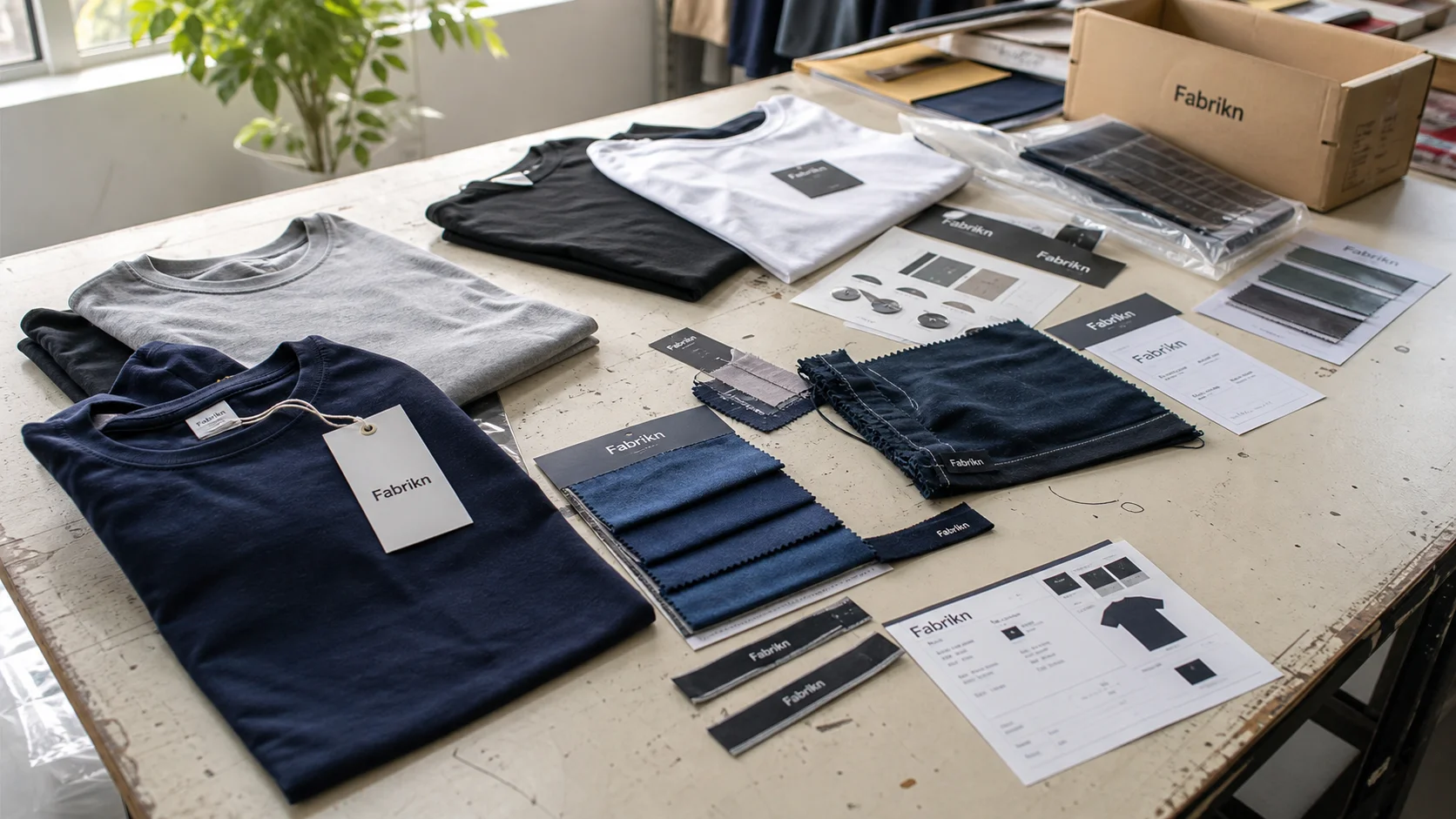
Custom Thank You Inserts for Apparel Packaging compared by sample evidence, fabric or trim specs, MOQ, AQL terms, cost lines, delivery timing, and rework...
Fast answer: Custom Thank You Inserts for Apparel Packaging: Material, Print, MOQ, and QC Terms should be judged by production evidence, not by a generic sourcing promise. The buyer needs sample proof, cost breakdowns, QC checkpoints, and delivery buffers in writing.
Ask for recent sample photos, measurement tolerances, fabric or print test assumptions, decoration test notes, packing examples, and a named inspection checkpoint. These details show whether the team can repeat an approved sample at bulk volume.
Separate garment cost, decoration, labels, packaging, sampling, testing, freight, and rush charges. Clear cost lines make it easier to reduce colorways, adjust size depth, or reserve more time for sampling.
The box opens. The clothes are fine. What lingers is the little piece of paper someone remembered to make useful. I've watched carton after carton leave factories with tissue, hang tags, polybags, and a last scrap of copy nobody bothered to brief, even though custom thank you inserts for apparel packaging can shape what happens after the unboxing moment. That matters. It's often the only owned media touchpoint a DTC brand gets without paying Meta or Google for another click. I have seen factories where the insert was the only branded element that survived the pile of hang tags, and everyone somehow celebrated that as the day's big win (and yes, the line supervisor even posed with it). In Guangzhou packaging halls, the insert is the last element to ride a six-station Heidelberg Speedmaster before the carton is taped shut, while in Dhaka the same copy may first pass through a Bobst die-cutter and an MBO folder to nestle beside a folded tee. And yet, once you start paying attention, you see how uneven the effort can be.
The numbers are blunt. A $12 tee may only support a simple thank-you card, while a $68 hoodie can justify a care guide plus a referral prompt, and a $180 outerwear piece can carry a longer story about fabric origin, repairs, and lifespan. When the insert is printed on a 350 gsm recycled cotton board with two PMS inks, a satin UV spot, and starch-based lamination adhesives, the 500 MOQ cost sits around $2.50-4.00 per unit in Ho Chi Minh City, where Komori Lithrone and Heidelberg presses run double shifts to hit 18-22 business days lead time for the entire run. I've seen premium labels spend $8.00 to $14.00 per order on rigid mailers and custom tape, then skip the one item customers keep after the box gets recycled. Backwards. From what I know, a neat thank-you with one clear call-to-action wins every time over a postcard crammed with three promotions. It drives me a little crazy when the insert is perfect but someone's handwritten note still looks like a coded ransom letter.
Repeat sales rarely come from the package alone. They come from what the insert asks the customer to do next. A clear note can lift review rates, drive QR scans, and make social sharing feel intentional instead of forced. In my experience, those notes also calm down the customer-service queue when they include a simple “Need help?” prompt (yes, even the packing gang reads them now). In Istanbul's customer-service centers, that same prompt is the first reference for reps before the phone rings, shaving off 45 seconds of hold time per ticket because it already lists the care-guide URL and reorder link. According to ISO standards on information clarity and traceability, simple, verifiable claims outperform vague branding language because buyers process them quickly and trust them more. And frankly, the best ones feel like a friend nudging you, not a billboard.
In Vietnam and Portugal, one thing kept surprising me: low-cost inserts often looked more premium when the paper stock was heavier and the copy was shorter. A 350 gsm uncoated card certified to GRS and printed with OEKO-TEX Standard 100 inks cured on a Kolbus folder, plus a quick run through a starch-based gluer, felt sharper than a glossy 250 gsm leaflet crammed with four offers and a long founder manifesto. More content does not equal more value. Usually, it means clutter. I've seen operations where simply swapping to heavier stock convinced buyers that the brand cared, even when the cost delta was pennies.
At higher price points, custom thank you inserts for apparel packaging should match the purchase logic. A buyer spending $180 on a coat expects proof, not noise. That might mean a repair note, fiber composition, and a 3-step care plan. A letterpress panel produced on a Heidelberg Windmill that names the GOTS-certified merino and the repair hotline, along with a 3-step care plan, satisfies that expectation. A customer buying a $12 tee does not need a lecture. They need a human thank-you, a reason to come back, and one useful action that takes 10 seconds, not 30. And no surprise, the simpler route feels kinder.
Simple job, even if brands overcomplicate it: thank the buyer, reinforce the promise, and guide the next step without sounding pushy. Works across a $24 baby tee and a $220 technical shell. The order changes. The fundamentals do not.
I tend to break insert messaging into six threads—thank-you notes that build warmth, care instructions that cut returns, sustainability proof, loyalty offers designed to land another order in 30 to 60 days, referral codes for brands with strong community behavior, and founder messages that explain why the label exists. For brands also refining clothing packaging solutions, the insert should mirror the same tone and visual discipline as the mailer or box. Any sustainability statement should tie back to verifiable certifications such as GOTS, OEKO-TEX Standard 100, WRAP, BSCI, or GRS, and mention whether the inks were cured on an LED UV line, whether the starch adhesives are compostable, and which mill provided the certified fiber, so the claim feels anchored instead of vague.
Visuals help most when they clarify. QR codes earn their space if they lead to a care guide, a reorder page, or registration. Fabric-care icons can reduce support questions. A small origin map can support a premium story if it names the mill, the country, and the process. But what does not help is a crowded back panel with five badges, two discount codes, and a paragraph in six-point type (and no, adding another QR code does not make it more helpful).
Trust breaks fastest through weak copy. Generic gratitude feels lazy. Vague eco-claims feel slippery. Too many CTAs make the insert look desperate. Heavy discount language tells customers the original price was padded. In Europe, buyers often respond better to restraint and proof. In the U.S., they may tolerate a more direct promotional tone, but only if the claim feels earned. Funny enough, dialing back bonus codes works better because the insert feels like a conversation rather than a clearance rack.
Any sustainability statement should be traceable to a material, process, or certification. If the insert says recycled, name the percentage. If it says certified, name the standard. If it says low-impact printing, explain what that means in practice. Data from Textile Exchange supports the broader point that buyers increasingly expect material specificity, not generic green language.
Format changes perception before the first sentence gets read. A flat card, a swing tag, a folded leaflet, a tissue-wrap message, a belly band, and a QR-only slip all do different jobs, and I have watched the wrong one sink otherwise strong packaging. The best choice depends on product category, order value, and how much assembly time the factory can absorb (and yes, the pack-out crew is judging, so keep it simple).
Basics and entry-price tees usually work well with a single 90 x 55 mm or 100 x 150 mm card. Premium knitwear can carry a folded leaflet because the customer expects more texture and detail. Accessories often suit swing tags or belly bands, especially if the item is small and the pack-out must stay fast. Outerwear benefits from a card with care and warranty notes. Limited-edition capsules can justify a numbered insert or a short letter from the founder, and the goal is to match the format to the product vibe, not invent another shoebox puzzle for the packers.
A strong brief makes the supplier's job narrower and the quote more reliable. For custom thank you inserts for apparel packaging that convert, include the target customer, sales channel, expected order quantity, size range, decoration needs, packaging requirements, and delivery market. Then call out the details most likely to affect the result, especially material grade, print tolerance, and barcode size.
The brief should also explain what cannot change. Some brands care most about hand feel, some about price, some about launch timing, and some about retail compliance. When those priorities are not written down, suppliers tend to optimize for whatever is easiest to quote. Clear priorities help the factory make better tradeoffs before the first sample is cut or printed.
Ask the supplier to respond with assumptions, not just a price. A useful reply states MOQ, sample route, production capacity, inspection plan, packing method, and freight handoff. If the answer is vague, the project may still work, but it needs a tighter pre-production stage before money and calendar pressure build up.
The best time to catch problems is before the pre-production sample is approved. Check measurements, color, placement, material behavior, shrinkage, construction, labels, and packaging in the same review instead of approving each item in isolation. Many bulk issues are not caused by one dramatic mistake; they come from several small unchecked assumptions.
For custom thank you inserts for apparel packaging that convert, pay special attention to folding method, pack-out sequence, and retail compliance. These details often look minor in an email but become expensive once cutting, printing, sewing, packing, or shipping begins. A simple checklist with owner, due date, and approval status keeps the brand team and factory aligned.
Bulk production should not start until the supplier can explain how the approved sample becomes a repeatable production standard. That means reference sample storage, line instructions, inline checks, final inspection, and defect handling. A factory that can describe this process clearly is usually safer than one that only promises speed.
Price differences are useful only when the quotes cover the same work. Compare sample cost, material source, trims, decoration, packaging, testing, inspection, and freight assumptions. A low unit price can become expensive if it excludes items the brand needs before launch.
Timeline promises deserve the same scrutiny. Ask what happens if the first sample needs revision, whether materials are in stock, when the production slot is reserved, and how export packing is handled. The most reliable supplier is often the one that gives a realistic calendar instead of the fastest optimistic answer.
Before making the final decision, write down the specification, approval owner, delivery expectation, and the one or two risks that would cause the most trouble if missed. For custom thank you inserts for apparel packaging that convert, this usually means checking material grade, print tolerance, barcode size, and the support process after the order is placed.
This last review does not need to be complicated. It simply makes the decision easier to repeat, easier to explain, and easier to verify when the finished product or jewelry arrives.
One useful way to pressure-test the decision is to ask what would happen if the order had to be repeated in six months. The answer should still be clear: the same material grade, the same print tolerance, the same acceptance standard, and the same communication path. If a second order would depend on memory or guesswork, the first order is not documented well enough yet.
Another useful check is to separate preference from requirement. Preference is the look, wording, or finish the brand likes. Requirement is the measurement, tolerance, certificate, material, or delivery condition that cannot fail. Good buying decisions keep both visible, so the final choice is not pushed around by the last email, the cheapest quote, or the prettiest sample photo.
Finally, ask who owns each approval. A project with one accountable owner for sample review, one owner for final content or artwork, and one owner for delivery sign-off usually moves faster than a project where every decision is shared loosely across a team. Clear ownership reduces delays and makes the finished result easier to judge.