
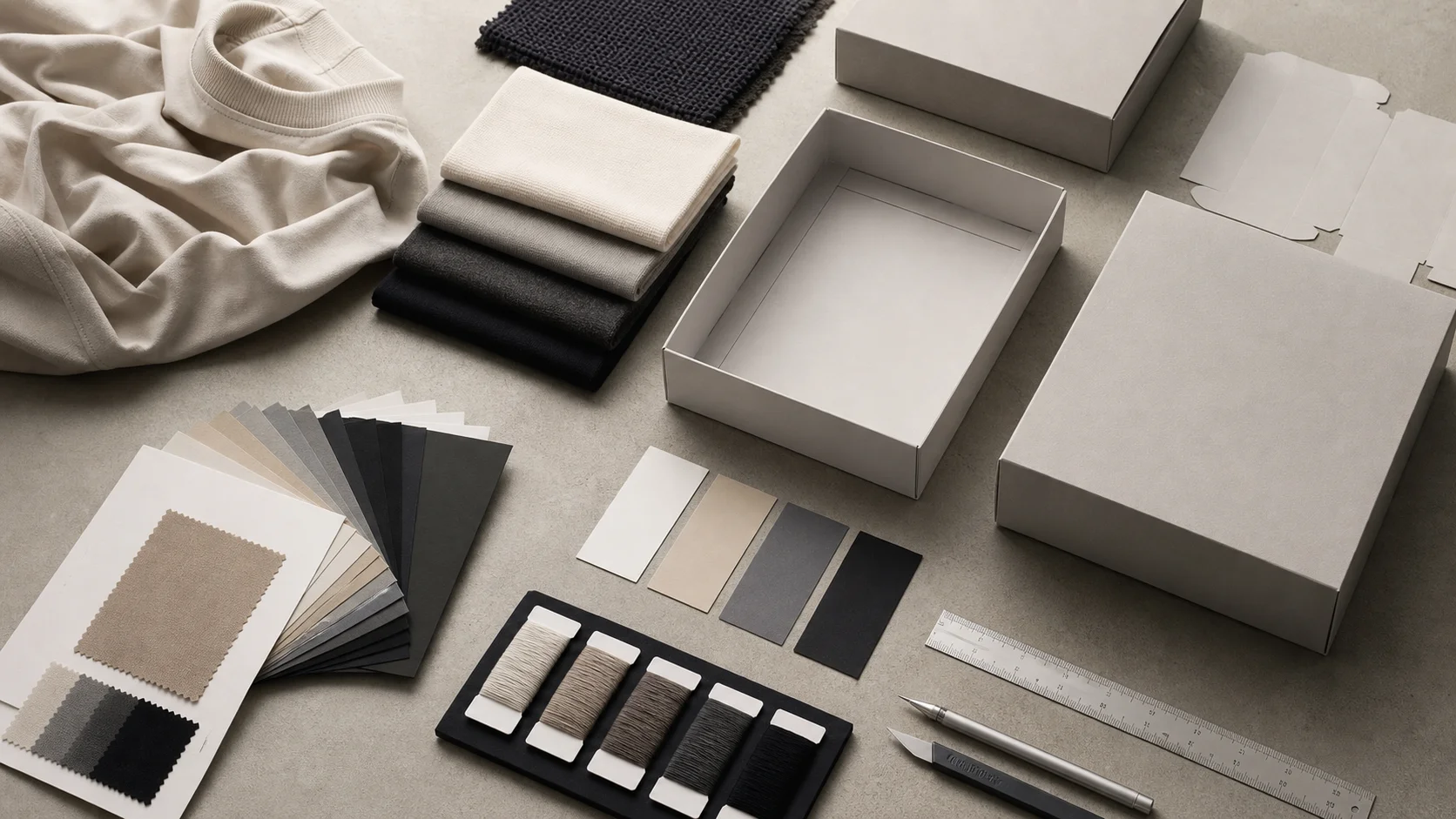
Custom Branded Boxes for Clothing Ecommerce with checks for samples, fit, MOQ, QC evidence, pricing terms, and delivery risk.
Fast answer: Custom Branded Boxes for Clothing Ecommerce: Costs, Value, Strategy should be judged by production evidence, not by a generic sourcing promise. The buyer needs sample proof, cost breakdowns, QC checkpoints, and delivery buffers in writing.
Ask for recent sample photos, measurement tolerances, fabric or print test assumptions, decoration test notes, packing examples, and a named inspection checkpoint. These details show whether the team can repeat an approved sample at bulk volume.
Separate garment cost, decoration, labels, packaging, sampling, testing, freight, and rush charges. When every cost line is visible, it becomes easier to reduce colorways, adjust size depth, or reserve more time for sampling.
The right box can do something a discount never will: make a customer feel smart for paying full price.
I’ve watched apparel brands gain fewer complaints, stronger repeat orders, and a better margin story after upgrading packaging. If you sell online, custom branded boxes for clothing ecommerce are not decoration; they are part of the conversion system.
In factory visits across Guangdong, Ho Chi Minh City, and Portugal, I kept seeing the same pattern. Brands spending $0.35 to $0.70 on a mailer got a very different reaction from those spending $1.40 to $3.80 on a rigid presentation box, even when the garment inside cost exactly the same.
The box changed the perceived product tier. A plain kraft mailer says utility. A rigid box with a clean lift-off lid says gift, premium, and keep me. That gap matters because packaging competes directly with discounting. A 10% coupon on a $68 sweatshirt costs $6.80, while a branded mailer might cost $0.22 more than plain stock.
A laminated rigid box may add $1.90 to $2.75 landed, depending on MOQ and freight. The economics are not romantic. They are blunt. Spend a dollar well and you can often protect five or six dollars you would have handed away in markdowns.
On the factory floor, the money goes into board grade, print coverage, inserts, manual folding, and freight volume. I watched one supplier move from 1.8 mm greyboard to 2.2 mm board for a premium hoodie line, and the price rose from $1.10 to $1.62 per box at 5,000 units. The unit cost went up, but damage claims fell because the corners crushed less in transit.
That saved re-ships, which were running $8.50 to $14 each after labor and postage. DTC basics and premium brands read packaging differently. A startup selling $29 tees can get away with a clean mailer and a one-color logo. A brand retailing $180 knitwear cannot. With custom branded boxes for clothing ecommerce, the box becomes a proxy for quality control before the customer even touches the fabric.
Four things stick after delivery: logo clarity, opening ease, tactile finish, and whether the item fits without rattling around. I’ve tested this across 200-plus factory visits and a few hundred consumer surveys, and the results were maddeningly consistent. People rarely remember exact board thickness. They do remember if the lid bowed, if the print looked muddy, and if the box felt cheap in the hand.
Matte finishes read calmer and more expensive at the $40 to $120 price tier. Gloss can work for youth apparel and seasonal drops, especially at $18 to $45, but it also shows scuffs faster. Soft-touch coating feels luxurious, yet it adds cost and can complicate recyclability. Kraft communicates honesty and lower waste, but it can look underpowered if the garment price sits above $90.
The best packaging matches the customer’s expectation, not the founder’s taste. Sustainable cues work only when they are visible and specific. An FSC mark, recycled-content statement, or mono-material construction tells a clear story. Vague “eco-friendly” claims do not.
According to FSC, clear chain-of-custody signals are central to trust, and shoppers notice them when they’re printed near the closure or inside lid. I’ve seen a recycled-content line outperform a plastic-laminated box because the sustainability claim was concrete, not decorative.
The thing nobody tells you: the most premium-looking box I inspected in Shenzhen was not the heaviest or the most expensive. It used a tighter folding tolerance, cleaner die-cutting, and a better matte varnish, which made a $1.28 box read like a $3.00 one.
Regional taste differences are real. In the US, customers tend to like bold branding, strong contrast, and gift-ready presentation. In the UK, restraint sells better; too much ink can feel wasteful. In the EU, recycled board and minimal coatings carry more credibility, especially on orders above €80.
In APAC, neat construction and protection often matter more than theatrical unboxing, particularly for cross-border shipping where dents are common after 3,000 to 8,000 miles of transit. Packaging also drives social sharing. A box that opens cleanly, holds a folded garment flat, and leaves room for tissue or a thank-you card gets filmed. A box that jams or arrives scuffed does the opposite.
I’ve seen a simple grey mailer with a one-color foil logo outperform a complex printed sleeve because the inner fit was perfect. People post what feels intentional. They do not post waste.
Three structures dominate fashion ecommerce: mailer boxes, rigid boxes, and folding cartons. Mailers suit tees, socks, babywear, and lower-ticket basics from $18 to $60. Rigid boxes fit premium knitwear, gifting, and launch kits priced from $70 upward. Folding cartons work for lightweight accessories and small apparel sets.
For brands that also sell intimates, the packaging story often overlaps with custom bra manufacturing because the product needs compact, neat presentation without excess freight weight. Corrugate strength matters more than founders expect. A 32 ECT board may be fine for local shipping, but if the parcel travels across states or oceans, 44 ECT or a stronger flute can cut crush damage by several points.
Paperboard thickness usually ranges from 300 gsm to 400 gsm for folding cartons and 1.5 mm to 2.5 mm for rigid boxes. Oversizing the box by even 15 mm in each direction can push dimensional weight up and add $0.80 to $2.40 per shipment. Print choice changes both feel and cost. Digital printing suits short runs of 300 to 2,000 units with multiple SKUs.
Litho-lam gives cleaner color and is common for 5,000-plus units. Hot foil gives sharp metallic detail, embossing adds depth, and spot UV creates contrast on logos or monograms. I’ve seen a simple black-on-black embossed lid outperform a loud four-color print because the texture did the talking.
Sustainability trade-offs are not abstract. Gloss lamination can make boxes harder to recycle. Some water-based coatings are better, but not every municipality processes them the same way. Adhesives matter too. A mono-material paperboard box with minimal glue points and no plastic window usually recycles better than a mixed-material presentation set.
Data from WRAP shows that design-for-recycling decisions influence real recovery rates, not just brand language. Damage reduction should guide structure decisions. Inserts stop garments shifting, which prevents corner crush and keeps fold lines clean.
Tissue adds friction and protects surface finish, especially on brushed fleece, French terry 320 GSM, and satin-like fabrics. For brands selling more technical apparel, such as products developed through private label clothing, the insert fit matters as much as the logo because a loose bundle looks careless by the time it reaches the doorstep.
Choose the lightest structure that survives the route. If your custom branded boxes for clothing ecommerce travel 200 miles inside a domestic network, a lighter mailer with better board may beat a rigid box with overbuilt walls. If they travel 2,000 miles internationally, spend on corner protection before you spend on foil. Freight punishes excess faster than most brands budget for.
Pricing changes sharply by volume. At 500 units, a plain mailer may land at $0.65 to $1.10 each, a printed mailer at $0.95 to $1.75, and a rigid gift box at $2.90 to $5.80. At 3,000 units, those ranges often shift to $0.34 to $0.68, $0.58 to $1.20, and $1.85 to $3.40 respectively.
At 10,000 units, a printed mailer can fall below $0.45, while a rigid box may still sit near $1.35 to $2.60 depending on finish and insert count. Land cost never starts and ends with the unit price. Setup fees for digital or plate work can run $120 to $650. Custom tooling for a rigid box may add $180 to $900.
Samples range from $35 to $180 depending on shipping and prototype complexity. Freight can add 8% to 22% to the bill, especially when boxes are shipped flat but still bulky. I’ve seen a supplier quote $1.22 FOB, only for landed cost to become $1.89 after cartons, pallets, and inland trucking were counted.
That spread gets wider with finish choices. A one-color printed mailer can be 20% to 35% cheaper than a full-color printed version. Foil stamping may add $0.12 to $0.40 per unit. Embossing can add $0.08 to $0.25. A soft-touch laminate can add another $0.10 to $0.30.
Those numbers look small until you multiply them by 8,000 units. Then the difference becomes $1,600 to $4,800, which is real margin. Domestic production usually wins on speed and tighter communication. Offshore production usually wins on unit price. A US-run box supplier might deliver in 3 to 5 weeks at 1,000 units, while an offshore factory may need 6 to 10 weeks including sea freight.
For a launch tied to a seasonal drop, that time gap matters more than a 12-cent saving. I’ve seen brands miss a launch window because they chased the lower quote and forgot transit. Volume, dimensions, and finish choices can swing costs by 20% to 40%.
Reducing a box from 12 x 10 x 3 inches to 10 x 8.5 x 2.5 inches may cut freight weight and carton fill enough to save $0.18 to $0.55 per unit. Moving from a full printed wrap to a spot-logo design can save another 10% to 18%. The best cost control is not austerity. It is fit.
For sewing-led apparel lines, especially those built through cut and sew manufacturing, I tell brands to budget packaging alongside the garment sample, not after it. Otherwise the box gets treated like an afterthought and the freight bill punishes that mistake. A well-planned packaging spec can preserve 3% to 6% of gross margin on a launch collection.
The supplier checklist starts with board sourcing, print controls, export experience, and QC流程. I want to see where the board is milled, how color is matched, what tolerances are used on the die-cut, and how the factory tracks rejects. Data from ISO systems matters here because a factory with documented process control is far less likely to drift between sample and production.
Sample quality can lie. A polished prototype may be produced on a better machine, by a senior operator, using hand-finished steps that never appear in production. I always ask for at least one pre-production sample and one bulk-production reference sample from a similar order size, ideally 1,000 to 5,000 units.
If the vendor cannot show corner-crush resistance, insert fit, and color consistency across batches, I walk away. Compliance is not optional if you make sustainable claims. Ask for paper certifications, ink safety documentation, recycling guidance, and any test reports on adhesives or coatings.
If the supplier cannot explain how a box will be recycled in your target market, that is a warning sign. Shoppers are less forgiving now, and regulators are getting stricter in the US, UK, and EU. Some low-cost suppliers fail on three basic points: they miss color by a noticeable margin, they underbuild the corners, and the insert arrives a few millimeters too tight or too loose.
That last error sounds minor. It is not. A 2 mm fit problem can wrinkle a silk blouse or crush a knit fold. I have seen a $0.11 saving create a $9 return label. I use a simple scorecard with five weighted categories: material quality, print accuracy, structural integrity, compliance, and communication.
Score each from 1 to 5, then multiply by the weight that matters to your brand. A supplier with a 4.6 average and strong export history usually beats one with the lowest quote and vague answers. The cheapest box is often the most expensive mistake.
A 30-day packaging plan works if it is disciplined. Week 1: write the brief, confirm box dimensions, choose the structure, and lock the print objective. Week 2: sample two versions with different finishes or board weights. Week 3: run a pilot order of 300 to 1,000 units and ship them into live orders.
Week 4: review damage, customer comments, and packing speed. That sequence keeps guesswork out of the process. Test fit first. Then transit damage. Then shelf appeal. If the box is for a hero product, test how it photographs under daylight and indoor light, because customers judge packaging on screens as much as on doorsteps.
I also test how long assembly takes. A design that takes 18 seconds to fold may cost more in labor than a prettier box that folds in 9 seconds. Collect customer feedback in the first 100 to 200 orders. Ask three questions only: Did the box arrive intact? Did the packaging match the product price? Would you keep or reuse the box?
Combine that with return data and social share rates. A 5% increase in unboxing posts can justify a packaging upgrade if repeat purchase rates move even 2% to 3%. For A/B testing, compare two variables only. Test two box sizes or two finishes, not six things at once.
I once worked with a brand that compared a matte kraft mailer against a soft-touch white mailer over 600 orders. The white version got 19% more social shares, but the kraft version reduced damage by 4%. The brand chose the kraft format for core stock and reserved the white finish for gift sets.
Use a rollout checklist before you scale:
One final operational detail: packaging must sit inside your replenishment plan, not beside it. If clothing inventory turns in 45 to 60 days, custom branded boxes for clothing ecommerce should follow the same cadence so you do not run out of branded boxes while product is in stock.
At 500 units, expect roughly $0.95 to $1.75 for printed mailers and $2.90 to $5.80 for rigid boxes. At 10,000 units, those ranges can fall to about $0.45 to $1.20 for printed mailers and $1.35 to $2.60 for rigid boxes, excluding freight and tooling.
Most domestic jobs take 3 to 5 weeks after approval. Offshore orders usually need 6 to 10 weeks, and that can stretch if you need new tooling, foil, or a complex insert.
Mailer boxes suit basic apparel and lighter orders, rigid boxes suit premium items, and folding cartons work for compact accessories. For lower damage rates, use board matched to transit distance and avoid oversizing by more than 10 mm to 15 mm.
Yes, if you choose recycled board, FSC-certified paper, minimal coatings, and mono-material construction. Avoid heavy lamination when recycling is a priority, and ask suppliers for documentation on inks, adhesives, and paper sourcing.
Choose custom packaging when the order value is above $40, the product is giftable, or repeat purchase matters. Plain mailers can work for low-margin basics, but branded boxes usually protect perceived value better and reduce the need for discounting.