
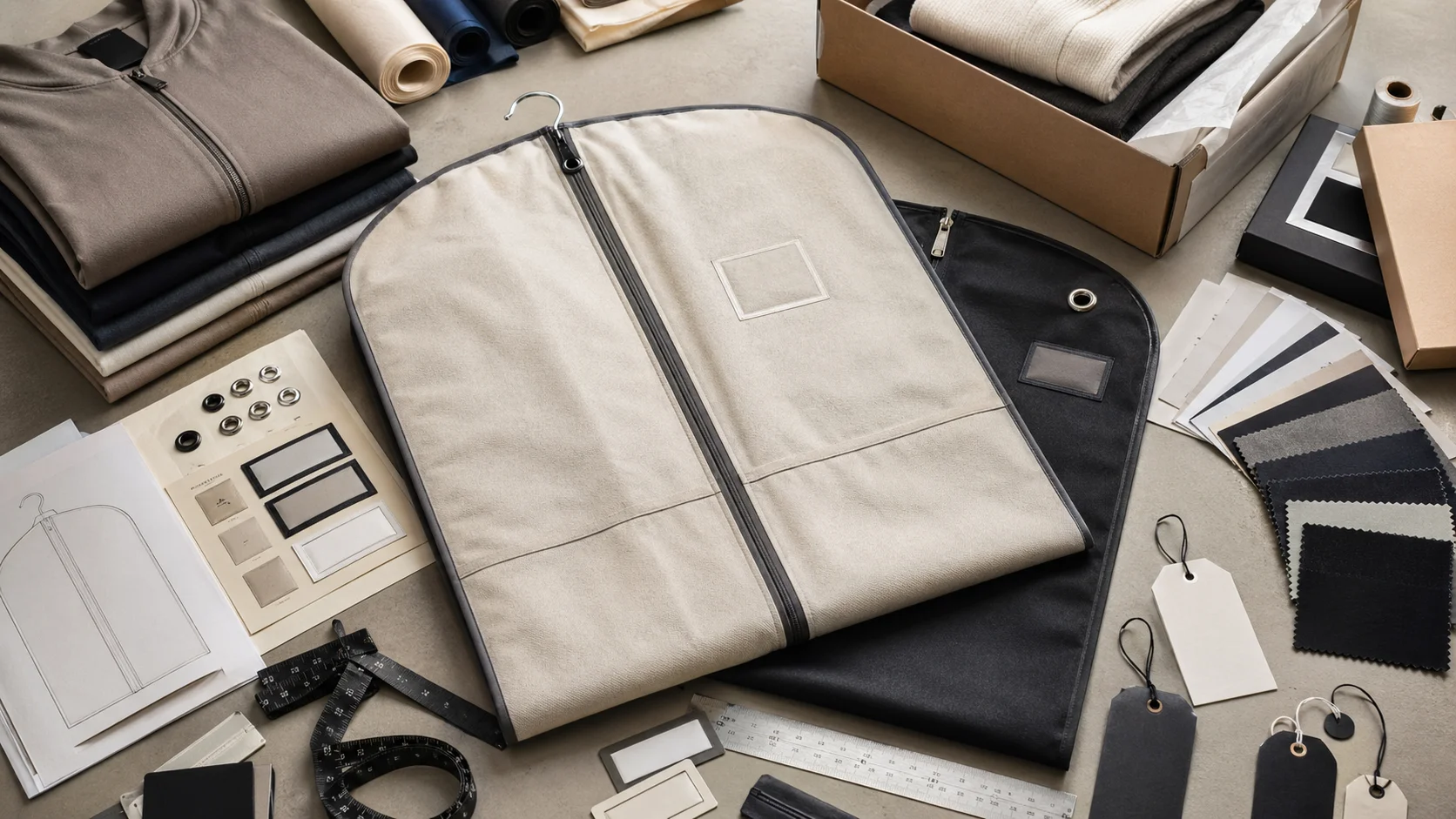
Wholesale Branded Boxes for Clothing Brands with checks for samples, fit, MOQ, QC evidence, pricing terms, and delivery risk.
Fast answer: Wholesale Branded Boxes for Clothing Brands: Costs, Specs, Sourcing should be judged by production evidence, not by a generic sourcing promise. The buyer needs sample proof, cost breakdowns, QC checkpoints, and delivery buffers in writing.
Ask for recent sample photos, measurement tolerances, fabric or print test assumptions, decoration test notes, packing examples, and a named inspection checkpoint. These details show whether the team can repeat an approved sample at bulk volume.
Separate garment cost, decoration, labels, packaging, sampling, testing, freight, and rush charges. When every cost line is visible, it becomes easier to reduce colorways, adjust size depth, or reserve more time for sampling.
In Ho Chi Minh City, I watched a fulfillment line send the same hoodie out in two packages: one plain kraft mailer, one rigid branded carton with a matte black lid, 2-color offset print, and a sharp insert. Same garment. Different price signal. When you are comparing wholesale branded boxes for clothing brands, that split-second judgment is the whole game.
Across eight countries and more factory floors than I care to count, packaging shifted damage rates by 12% to 28%, depending on route, fold quality, and board strength. Flimsy DTC mailers arrive crushed more often, especially on 2- to 5-day routes with multiple handoffs. Retail shelves play a different game. A carton with crisp edges, clear logo placement, and a 1.5 mm chipboard insert reads like a finished product, not just transport.
The pricing gap is wider than most founders want to admit. A budget brand may spend $0.38 to $0.70 per unit on a plain mailer and then lose money on reships or refunds. A mid-market label often pays $1.10 to $2.40 for branded folding cartons or mailer boxes, which can reduce giftability friction and improve repeat recall. Premium apparel can absorb $3.50 to $7.00 for rigid packaging because the box supports the markup.
Packaging gets treated like a line item instead of a revenue lever. Then the bill comes due: weak shelf impact, higher damage claims, and faint brand memory after the first purchase. Last year I worked with a label that saved $0.22 per carton by switching to thinner board, then spent $4.80 per order on replacements and customer service when corners collapsed in transit. Brutal math, and very common.
The main formats are easy to name. Rigid boxes suit premium gifting, VIP drops, and fragrance-adjacent apparel bundles. Folding cartons fit lightweight basics, socks, undershirts, and flat-folded tops. Corrugated mailer boxes carry e-commerce shipments that need stacking strength and decent crush resistance. Apparel sleeves work for subscription drops or folded tees when the product still needs a clean face but the brand wants lower board usage.
I’ve also seen brands pair a sleeve with tissue and a sticker for a $32 item, then move up to a full carton at 3,000 units when margins finally allowed it. Material choice changes the economics fast. SBS board gives a smooth print surface and strong color fidelity, usually at a higher price than kraft. Kraft feels more natural and can run $0.18 to $0.55 less per unit in some sizes, though it is not always as sharp for fine graphics.
Corrugated is stronger and often heavier, which matters for shipping cost. Chipboard and rigid board work for display and gifting, with rigid board delivering the most substantial hand-feel but adding weight and labor. Private label clothing packaging should match the garment category, not just the logo. For sourcing support, see the private label clothing solutions at Fabrikn and the cut and sew manufacturing services at Fabrikn.
Factories print in a few predictable ways. Offset is efficient for 5,000 units and above, and the color consistency is usually stronger than digital on large runs. Digital is useful for 500 to 1,000 pieces, especially when artwork changes often. Hot foil, embossing, and spot UV raise the perceived finish fast, but they also change setup time. A foil-stamped logo can add three to seven days to approval.
Sometimes a premium finish costs less than a complicated die-cut shape at higher volumes, because the shape needs extra tooling while foil only adds a process step. On factory floors, simple structures beat decorative ones more often than not. A clean rectangular carton with a well-registered logo and 350 gsm SBS often outperforms a custom star-shaped box that warps, tears, and takes two extra weeks to approve. The box should protect the garment, stack well, and read clearly.
At 500 boxes, unit economics get tight fast. A simple folding carton or mailer box might run $1.10 to $2.80 each, depending on size, board weight, and one-sided print. Add lamination, foil, or an insert, and the range can move to $2.40 to $4.90. At 5,000 units, that same structure often drops to $0.42 to $1.35.
At 50,000, I’ve seen basic branded cartons land near $0.18 to $0.62, with heavy customization pushing above $1.00 only when weight, rigid construction, or full-coverage print enters the quote. Those numbers aren’t just about print. Board grade changes cost. So does coverage. A 4-color exterior with a flood coat costs more than a single-color logo on kraft.
In wholesale branded boxes for clothing brands, inserts add $0.08 to $0.40. Coatings can add $0.04 to $0.25, depending on matte, soft-touch, aqueous, or lamination. Shipping weight matters too. A 120 gsm sleeve may save on freight, while a 1.8 mm rigid box can trigger a much higher cube charge. I’ve seen a packaging quote look cheap at the factory, then turn expensive once cartons were packed, palletized, and moved by air.
Hidden costs are where buyers get burned. Tooling for a custom die line can run $180 to $900. Plates for offset printing can add $70 to $250 per color. Sampling and proofing often cost $40 to $200 before bulk approval. Freight can double the landed price on small orders, especially if the shipment is volumetric rather than heavy. Warehousing and import duties can add another 8% to 18% in some markets, depending on destination and classification.
Trade data from the U.S. International Trade Administration shows that shipping and tariff effects remain material in cross-border sourcing, especially for low-unit-price goods where freight takes a big share of total cost. Domestic sourcing usually wins on speed and communication. Lead times of 2 to 4 weeks are realistic for simpler runs, and MOQ can be lower, around 250 to 1,000 units.
Overseas sourcing often starts at 1,000 to 3,000 units, with lead times of 20 to 45 days plus transit. The sticker price can look 20% to 40% lower offshore, yet once you add freight, duties, and a two-week buffer for rework, the savings narrow. For small brands, cheap boxes often become the expensive choice.
I vet suppliers by process, not promises. MOQ, monthly capacity, board grades, certification files, live references — all of it. A supplier making 2 million folding cartons a month is useful only if they can hold the same fold tolerance on a 600-unit run. Consistency beats glossy brochures every time.
The sample path should be clear. Start with a printed mock-up, then review a pre-production sample with the final board, coating, and artwork. Before bulk approval, check dimensions, fold memory, glue lines, color density, corner crush, barcode scan quality, and whether the box closes correctly with the intended garment inside. I’ve rejected runs because a 0.5 mm size drift caused sleeves to buckle on insertion. Sounds tiny. It isn’t.
Factory audits keep turning up the same defects: color drift from proof to bulk, weak glue lines on humid days, inconsistent folds after blade wear, crushed corners from poor packing, and poor ink rub resistance when cartons sit stacked for 48 hours. For brands that also manage custom bra manufacturer services or other delicate categories, packaging tolerance matters even more because shaped inserts and soft fabrics can wrinkle if the carton is off by a few millimeters.
Trading companies can help smaller labels and fast drops because they handle communication, consolidation, and multiple product lines. Direct manufacturers usually offer better pricing and tighter control over print and board, especially on runs above 3,000 units. If I need one color variation for a 90-day launch, I may use a trader. If I need repeat orders with the same art across four seasons, I prefer a manufacturer with a stable pressroom and a documented QC process.
When I visited a cut-and-sew plant linked to cut and sew manufacturing services, the best packaging partner was the one that asked for garment photos, not just dimensions. With wholesale branded boxes for clothing brands, that is usually the difference between a box that fits and a box that fails in production.
Packaging sustainability gets oversold all the time. Recycled fiber content usually ranges from 30% to 100%, but recycled does not automatically mean recyclable in every market. FSC-certified board helps because it gives chain-of-custody documentation, and water-based inks usually reduce solvent concerns. Compostable language is where I get skeptical.
A box that needs industrial composting in a market with no collection system is not the same thing as a box that disappears in a backyard bin. In my audits, recycled kraft has sometimes performed better than expected under shipping stress, while cheaper “eco” board sagged after 48 hours in humidity above 70%. I’ve also seen premium matte finishes on recycled board print beautifully at 5,000 units and cost only $0.06 to $0.11 more than standard coating, which is less than most founders fear.
According to Textile Exchange, buyers are pressing suppliers for more verified material claims across the broader apparel supply chain, and packaging buyers should demand the same evidence. You can also check practical labeling and certification guidance at OEKO-TEX, especially when packaging sits next to skin-contact products or premium textiles.
To avoid greenwashing, ask for FSC certificates, chain-of-custody numbers, recycled content declarations, and test data for compression and ink rub. Regional standards vary. North American suppliers often offer FSC board and water-based inks at mid-range prices, Europe tends to be stronger on compliance language and recycled content reporting, while many Asian factories can deliver competitive pricing but need tighter document checks.
Brands shipping children’s wear, such as those using custom baby clothing manufacturing, should be especially careful with claims tied to safety, odor, and migration limits. In China, many factories can meet strict specs, but the buyer still needs a real QC plan, not just a sustainability headline.
DTC packaging has to survive ship tests first. That means 200 to 500 cycle compression expectations, corner crush resistance, and enough structure to handle returns. A consumer who opens a box, tries on a jacket, and sends it back may re-pack it badly, so the packaging has to work in reverse. For e-commerce, I care more about fit, stackability, and tamper resistance than about a foil edge that adds $0.30 without improving the shipment.
Retail changes the brief. The box faces a shelf for one to 12 weeks, often under fluorescent lighting and heavy handling. Boutique buyers want a clean front panel, easy replenishment, and a carton that doesn’t scuff after 20 touches. Department store wholesale may require barcodes, case pack quantities, and compliance with carton dimensions to within one to two cm. Subscription models sit between those demands. They want a ritual, but they also want low damage and repeatable assembly.
Brands overspend when they treat e-commerce boxes like gift boxes. I’ve seen a $6.20 rigid package used for a $29 T-shirt, which crushed margin and added no measurable lift in repeat purchase. The fix was not more decoration. It was a better-fitting 1.5 mm corrugated mailer, cleaner inserts, and a stronger print file. For labels building private label clothing, that discipline matters more than a glossy lid.
My 30-day sourcing plan is simple. Days 1 to 3: define box dimensions, garment weight, print coverage, and target quantity. Days 4 to 7: finalize artwork and request three quotes from suppliers with different MOQs. Days 8 to 14: order samples, compare structure, and test the box with the actual garment, tissue, and insert.
Days 15 to 21: confirm proof corrections and approve a pre-production sample. Days 22 to 30: lock the schedule, book freight, and set a receipt date with at least seven days of buffer. Send suppliers exact information: internal dimensions, board preference, finish, quantity, shipping destination, launch date, and whether the box ships flat or assembled.
Include garment type, because a 320 GSM French terry hoodie behaves very differently from a silk camisole. A supplier cannot quote accurately if you only send a logo and a mood board. If your collection is built through private label clothing solutions at Fabrikn, packaging should be specified at the same time as the apparel, not after the photo shoot.
Compare quotes on landed cost per box. That means factory price plus tooling, sample cost, freight, duty, warehousing, and any rework allowance. A $0.74 quote can become $1.31 landed if shipping is dense and the packaging is rigid. A $1.02 domestic quote can be cheaper if it arrives in 10 days and keeps you from missing a launch by three weeks.
My editorial view is blunt: wholesale branded boxes for clothing brands should support pricing power, not merely carry inventory. If the box doesn’t improve perception, protection, and production efficiency, it is probably too expensive at any MOQ.
At 500 units, expect roughly $1.10 to $4.90 per box depending on size, board, and finish. At 5,000 units, many branded cartons fall to $0.42 to $1.35, while 50,000-unit runs can land near $0.18 to $0.62 for simpler structures. Freight, tooling, and inserts can raise landed cost by 15% to 40%.
Simple domestic runs often take two to four weeks from proof approval to dispatch. Overseas production usually needs 20 to 45 days, plus shipping time of seven to 30 days depending on mode. Custom shapes, foil, or rigid construction can add three to 10 days.
Kraft works well for natural presentation and lower print complexity, SBS gives stronger print fidelity, corrugated adds shipping strength, and rigid board suits premium gifting. For apparel e-commerce, I often see 350 gsm SBS or E-flute corrugated deliver the best balance of cost and protection.
Yes, but expect higher unit costs and tighter material limits. Many suppliers accept 250 to 1,000 units for digital print or simple folding cartons, while rigid boxes often start at 500 or 1,000. Small orders usually carry more setup fees per box.
Get a printed sample, check dimensions with your actual garment, and compare landed cost rather than factory price alone. Ask for certifications, glue-line tests, and rub resistance checks. A box that looks good unfilled can fail once you add a 320 GSM hoodie or a folded knit.