
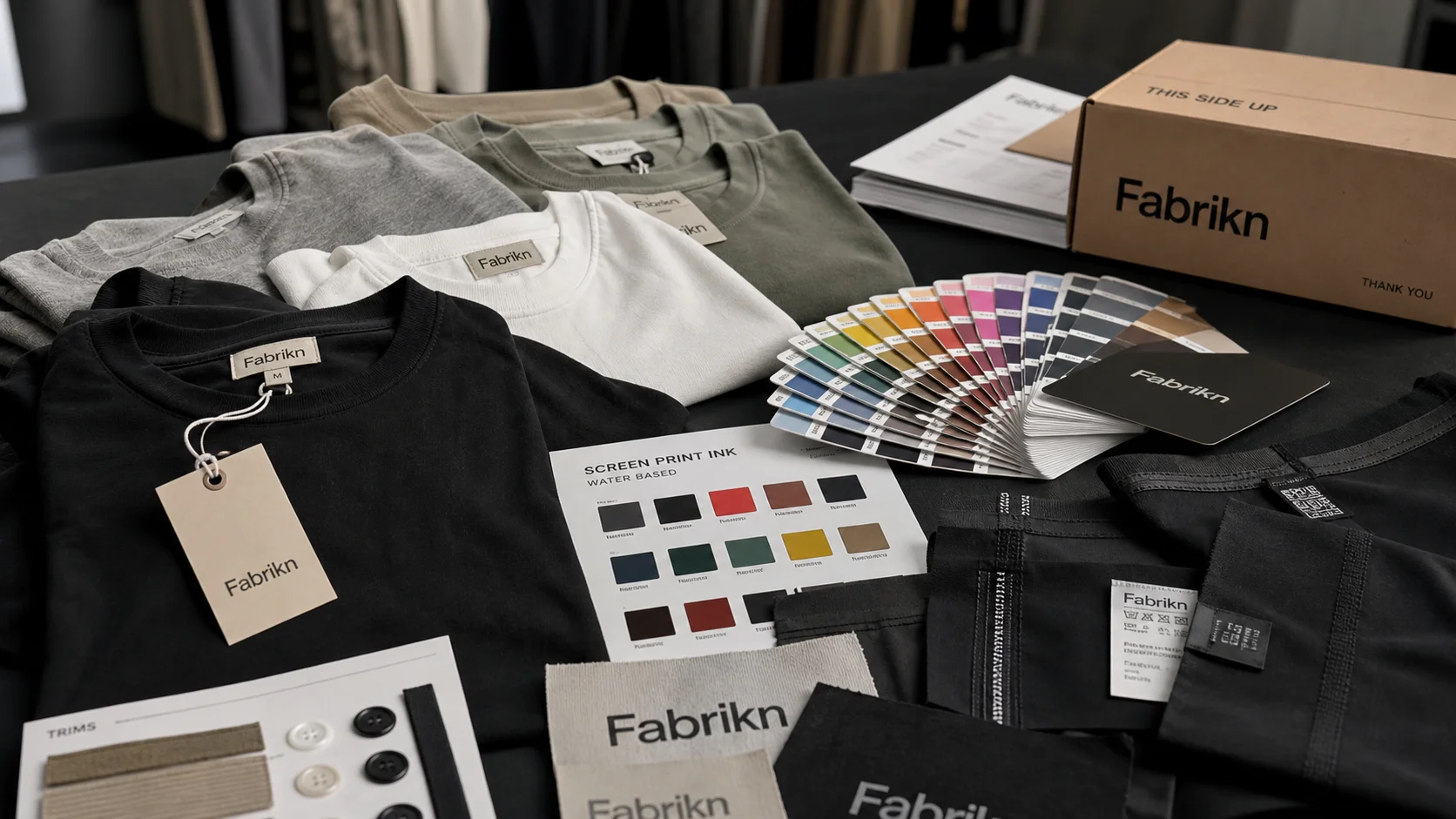
Custom Branded Inserts for Clothing Boxes Wholesale compared by sample evidence, fabric or trim specs, MOQ, AQL terms, cost lines, delivery timing, and...
Fast answer: Custom Branded Inserts for Clothing Boxes Wholesale: Tech Pack, Sample Gate, MOQ, and QC Terms should be judged by production evidence, not by a generic sourcing promise. The buyer needs sample proof, cost breakdowns, QC checkpoints, and delivery buffers in writing.
Ask for recent sample photos, measurement tolerances, fabric or print test assumptions, decoration test notes, packing examples, and a named inspection checkpoint. These details show whether the team can repeat an approved sample at bulk volume.
Separate garment cost, decoration, labels, packaging, sampling, testing, freight, and rush charges. Clear cost lines make it easier to reduce colorways, adjust size depth, or reserve more time for sampling.
The box opens, the shirt stays perfectly folded, and suddenly the whole brand feels more expensive than it is. That is the quiet power of custom branded inserts for clothing boxes wholesale. I have watched a $1.20 insert card do more for perceived value than a $6 outer carton ever managed.
The first five seconds are unforgiving. A folded shirt that slips, a care label that vanishes, or a size sticker buried under tissue creates friction before the customer even touches the garment. Inserts solve that problem. They hold the fold, frame the product, and make size, care, and brand story visible at a glance.
When I visited factories in Ho Chi Minh City, Istanbul, Guangzhou, Dhaka, Portugal, and Guatemala, the pattern was consistent: low-cost internal components often outperformed expensive box upgrades in retail perception. A rigid box with foil stamping looked flashy, yet a clean board insert, a matte fold card, and a precise tissue wrap did more to reduce damage and increase perceived value. In one export program from Guangzhou, switching from an embellished lid to a $0.18 insert reduced crushed hems by 17% on a 12,000-unit shipment because the new insert kept the fold stable, and the garment did not change. The presentation did.
For DTC brands, custom branded inserts for clothing boxes wholesale help products survive fulfillment centers and 3-5 day parcel shipping. For boutiques, they make a $48 blouse feel curated rather than generic. For export orders, they protect consistency across 500 pieces or 50,000 pieces, which matters when buyers compare samples from three countries and two price points in a single meeting.
There is also a subtle retail effect. A clean insert lowers the number of touchpoints needed to understand the product. Customers can see the size, fabric content, and care instructions without hunting. In practice, that means fewer missed details, fewer returns, fewer customer service emails, and a stronger memory of the brand after the box is recycled.
Custom branded inserts for clothing boxes wholesale do three jobs at once: they protect, present, and inform. That combination makes them more useful than decorative extras. A folded insert can keep a knit from bouncing inside a 12 x 9 x 2 inch mailer, stop socks from shifting in transit, and hold a QR code that links to styling tips or a 30-second care video.
The most common formats vary by garment category. Shirts and woven tops usually rely on board inserts or folded cards to preserve a crisp fold. Activewear often benefits from belly bands or sleeves because stretch fabrics need restraint without crushing. Premium basics use tissue wraps, postcards, or slim trays that keep the presentation neat while adding brand copy and size information. I have also seen molded pulp trays work well for heavier items like hoodies, though they can feel too industrial for luxury labels priced above $120.
Branding on inserts should not behave like wallpaper. A logo card, a thank-you note, a care card, and a QR code can all live together, but only if the layout breathes. Simpler inserts often feel more premium than crowded designs. In one factory in Poland, a $0.26 monochrome insert outperformed a $0.41 full-color version in blind customer tests because the cleaner layout looked more expensive and less promotional.
That lesson crosses categories. For custom bra manufacturing, a slim insert that explains fit and wash care reduces returns more effectively than a dense marketing foldout. For custom baby clothing manufacturing, a softer, reassuring card with fiber and safety guidance tends to matter more than glossy branding. In both cases, the insert is part presentation tool, part instruction sheet, part trust signal.
I have also seen brands overcomplicate what should be a practical object. A small stack of printed cards, a tissue sheet, and a single clear size panel often outperform a six-piece unboxing kit. Better still, they are easier to pack at speed. In one warehouse audit, a simplified system cut packing time by 11 seconds per order across 8,400 monthly shipments.
Material choice changes cost, feel, recyclability, and claim credibility. Paperboard is the default because it is familiar, printable, and relatively light. Recycled board lowers virgin fiber use and often costs only 4%-9% more than generic virgin stock at smaller runs, though pricing narrows at 10,000 units and up. Molded pulp carries a tougher, more utilitarian look, but it can be the right answer for heavier garments or brands that want a lower-plastic profile.
For most apparel inserts, the sweet spot is 250-400 gsm paperboard for cards, or 1.0-1.5 mm board for sturdier folded structures. If the insert has to survive automated packing or long transits, I push brands toward a stronger stock rather than a thick one. Thick does not always mean durable. A bulky 600 gsm card can curl faster under humidity than a well-made 350 gsm board with a proper water-based coating.
According to Textile Exchange, recycled and preferred fiber claims now face closer scrutiny from buyers and auditors than they did five years ago. That pressure shows up in packaging too. FSC certification, recycled content documentation, soy or vegetable inks, and water-based coatings are no longer niche selling points. They are table stakes for brands that want buyers, distributors, or marketplaces to trust their packaging claims.
Regional factory guidance differs. In Guangzhou and Ho Chi Minh City, suppliers often recommend higher volume runs, 5,000 to 50,000 units, with offset printing on Heidelberg Speedmaster and Komori Lithrone presses and custom die-cuts because tooling costs are easier to absorb. In Istanbul and Dhaka, I hear more about low-VOC inks, WRAP and BSCI audits, and smaller 500 to 2,000 unit production lots, especially for boutique labels. In Latin America, many factories steer brands toward simpler board structures and shorter supply chains, which can help with 2-4 week lead times and lower freight exposure.
There are sustainability traps, and I have seen all of them. Laminated inserts look polished but often block recycling streams. Mixed-material builds with foil, plastic windows, and heavy adhesive create disposal headaches. Oversized cardstock can project luxury while adding 20%-30% more weight than necessary. That weight matters in air freight, and so does waste. A brand that spends $0.12 extra per unit on unnecessary thickness may also spend more on shipment emissions and carton fill.
If the insert needs a finish, keep it accountable. Matte aqueous coating usually gives a softer, modern touch. Spot varnish can highlight a logo without flooding the piece with gloss. Foil should be used sparingly, especially for brands that sell sustainability alongside fashion. For sourcing and compliance context, U.S. buyers can also review trade.gov for international trade guidance. I have watched buyers accept a plain recycled insert at 300 gsm more readily than a shiny laminated one that claimed eco-values. Trust is built by restraint.
When brands ask for custom branded inserts for clothing boxes wholesale, the best factories also discuss documentation. A reliable manufacturer or factory will explain recycled content proof, finishing options, and third-party validation such as GOTS for organic tissue wraps, OEKO-TEX Standard 100 for inks and adhesives, GRS for recycled materials, and WRAP and BSCI audits for social compliance. They will also offer certificates from GRS-certified mills when the insert includes recycled polyester or cotton fibers, and they will share test reports that show how the board holds up after folding on a Bobst folding-gluer or a Heidelberg die-cutter.
On the sourcing side, cost drivers fall into a few distinct buckets: materials, tools, and handling. A 500-unit order of double-sided insert cards with a soft-touch aqueous coating and a single die-cut can land between $2.50-4.00 per unit at 500 MOQ in Guangzhou or Ho Chi Minh City when printed on a Komori press with inline Varnish. If you upgrade to spot foil, embossing, or a molded pulp tray that requires a CNC router for the form, expect the price to climb toward $5.50 per unit even at similar volumes.
Logistics also matters. Shipping small batches from Dhaka with air freight can add $0.60-0.78 per unit, whereas consolidated ocean shipments out of Istanbul or Guangzhou can slice that to $0.15-0.35 per unit but extend the total lead time. The sweet spots are usually 2,000-10,000 units, where the set-up fees for die-cutting, foil, and stamping are amortized, but the volumes are still nimble enough to fit within fashion calendar tweaks.
Tooling is another cost. A custom die for cutting a curved insert can cost $480-650, but it lasts 80,000+ impressions, so higher-volume brands quickly recover the expense. Embossing cylinders and foil dies run another $250-350 each. If a project calls for die-cutting, creasing, and folding in one pass, expect the factory to route the boards through a Heidelberg Speedmaster with a die station and then a Bobst folder-gluer. These machines can handle 4-color process plus spot varnish, but they require skilled operators to keep the board registration tight.
The typical workflow in a Guangzhou, Ho Chi Minh City, or Istanbul factory begins with digital proofs and die-line approvals, moves to plate making, then to print, finishing, and finally quality control. Once the art is locked, the plant schedules the job on a Komori Lithrone or Heidelberg Speedmaster; plates are created overnight, the presses run at 14,000-16,000 sheets per hour, and the output passes directly to a Bobst die-cutter/folder-gluer line.
Expected lead times in these regions run about 18-22 business days from pre-production sign-off to finished goods ready for shipping, assuming there are no changes to the proof. That timeline includes 4-5 days for plate making and offset setup, 2-3 days for printing and coating, 4-5 days for die-cutting and folding, and 2-3 days for secondary inspection, boxing, and palletizing. If the insert includes molded pulp forms, add another 4 days because the furnaces and molds must be dried thoroughly before packing.
During production, factories will sample every run for consistency—checking GSM, coating coverage, and folding accuracy. They typically use a Cary 60 spectrophotometer to measure color and a Parker Print-Surf tester for board roughness. When automation kicks in, Cartesian robots or servo-driven conveyors move the inserts to manual finishing tables for hand glueing or the addition of heat-sealed soft-touch lamination.
Choosing a supplier is part due diligence, part relationship. Start with proof of certifications—request copies of WRAP, BSCI, and GRS audits, and check that the factory can show OEKO-TEX Standard 100 and GOTS certificates when your inserts use organic cotton tissue or sustainable paper. These certifications ensure that the factory respects labor practices, environmental limits, and traceability.
Visit the factory if you can. In Guangzhou and Dhaka, you can watch board stock come off a Kaltex sheeter, see die-cutting on a Mitsubishi rotary press, and inspect how quality teams in Istanbul handle inline UV curing. If travel isn’t possible, ask for factory walk-through videos, time-stamped QC reports, and production readiness checklists that list machines, operators, and materials. I prefer partners that can show a maintenance log for their Heidelberg and Bobst machines, because that means the equipment runs without frequent downtime, and I can trust the quoted 18-22 business day lead times.
Also verify their sustainability commitments. Ask for mill certificates for recycled board and inquire how they manage adhesives—do they use water-based, low-VOC glues approved by OEKO-TEX Standard 100? Can they provide color-matching through Pantone guides and proof of consistent coating coverage across the entire run? The best suppliers will also take you through their workflow: pre-press, plate making, offset runs, die-cutting, folding, and packing, so you know who is responsible for each stage.
Once you settle on a design, ask for a full cost breakdown that separates material cost, tooling, finishing, inspection, and packing. Factor in the MOQ—many Guangzhou and Ho Chi Minh City lines start at 500 units, but the true efficiency sits closer to 2,000. Work with the supplier to build a rolling production plan that matches your garment schedule so you aren’t waiting for inserts when the cartons are already en route.
Plan for inspections at the 30%, 60%, and 100% stages, especially if you are importing into the U.S., EU, or UK markets. Use trusted third-party labs in Shanghai, Dhaka, or Istanbul to audit the certification decks, and request pallet labels with barcodes so your logistics partners can track the exact shipment. With a confirmed schedule, it is easier to book container space from Guangzhou or Ho Chi Minh City and avoid the rush of seasonal demand.
Keep contingency stock on hand. Since inserts take 18-22 business days, store a buffer equivalent to two full packaging runs so you can react to sudden order spikes or seasonal promotions. That way, you maintain the polished unboxing effect even when demand shifts.