
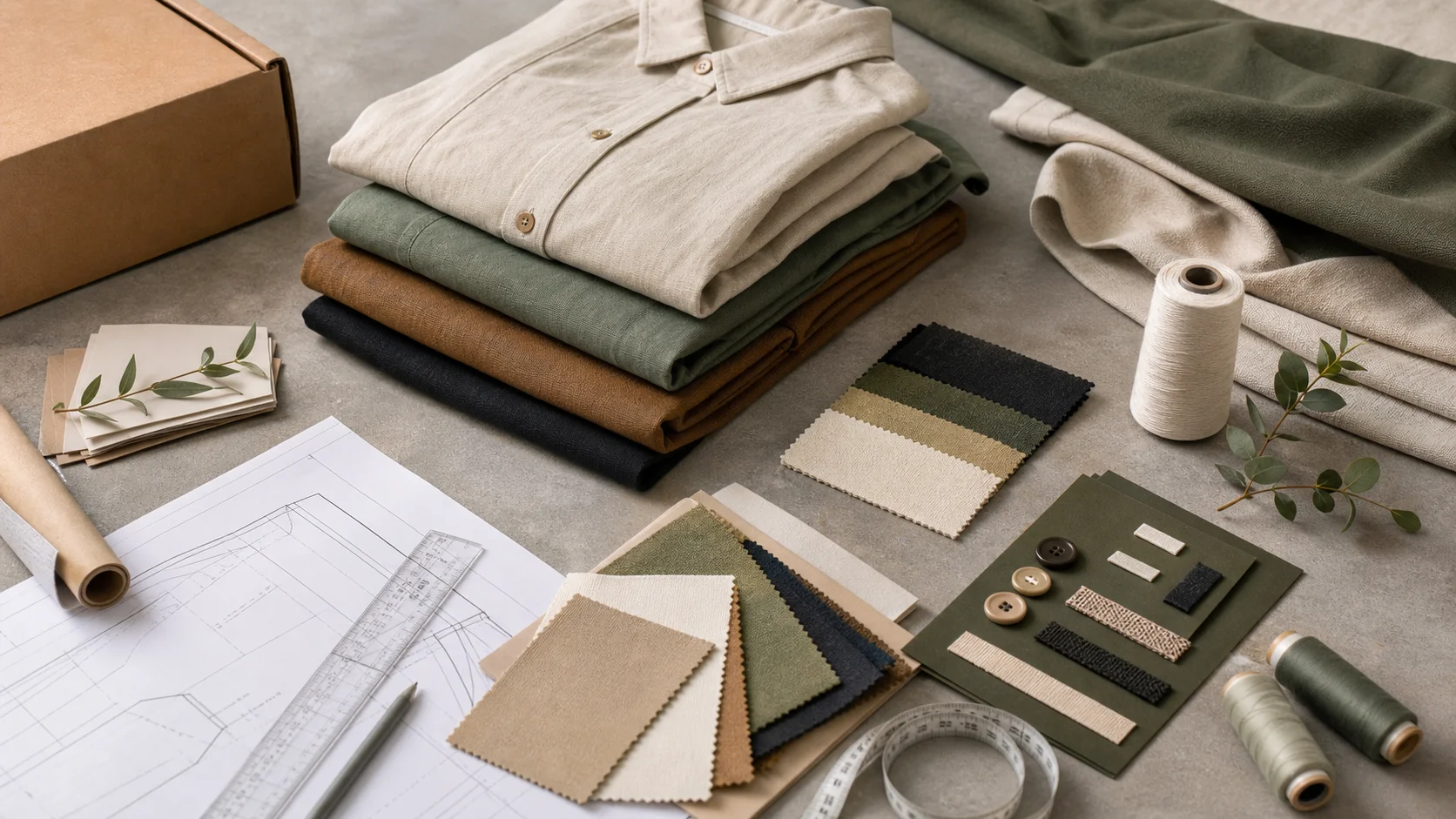
Fashion Ecommerce Poly Bags with checks for samples, fit, MOQ, QC evidence, pricing terms, and delivery risk.
Fast answer: Fashion Ecommerce Poly Bags: Film, Specs, Closure, and Cost should be judged by production evidence, not by a generic sourcing promise. The buyer needs sample proof, cost breakdowns, QC checkpoints, and delivery buffers in writing.
Ask for recent sample photos, measurement tolerances, fabric or print test assumptions, decoration test notes, packing examples, and a named inspection checkpoint. These details show whether the team can repeat an approved sample at bulk volume.
Separate garment cost, decoration, labels, packaging, sampling, testing, freight, and rush charges. When every cost line is visible, it becomes easier to reduce colorways, adjust size depth, or reserve more time for sampling.
The cheapest-looking thing in the box is often the one doing the heaviest lifting. When brands source custom poly bags for fashion ecommerce orders, they are not just choosing packaging; they are choosing first impressions, transit protection, and warehouse speed in one shot. A bag that arrives crushed, cloudy, or badly sealed can drag down perceived value before the garment is even unfolded.
I’ve watched a $0.03 packaging upgrade shift customer reviews, cut transit damage, and lift repeat purchase intent in ways a glossy website banner never managed. These bags are not glamorous, but they work. After 200+ factory visits, I saw luxury brands in Italy and South Korea using heavier 2.5-3.0 mil bags with crisp one-color logos, while value brands in Vietnam and mainland China leaned on 1.5-2.0 mil stock bags plus labels to keep unit cost under $0.05.
Mid-market labels landed in the middle, usually at $0.08-0.18 per bag, balancing appearance against freight weight. Thin film did more than protect fabric. It held the fold, reduced lint transfer, and kept a $38 knit from arriving like a $12 basic. In a warehouse near Ho Chi Minh City, one brand moved from loose folding to printed poly bags and saw damaged-in-transit complaints fall from 4.6% to 2.1% over 8 weeks.
Packaging changes review quality too. A neat fold, a clear barcode window, and a logo placed 25-30 mm from the top seal make picking and returns processing faster. Couriers handle thousands of parcels a day; orderly packages survive rough sorting better than wrinkled, overstuffed wraps. Brands love to talk about unboxing like theater, but factory floors tell a simpler story. Shipping tool. Brand cue. Small insurance policy.
Poly bags still dominate fashion fulfillment because they are cheap, light, and easy to customize at scale. A paper mailer can cost 2-4 times more, add 20-40 grams to shipment weight, and crease premium knits if sizing is off. For fast-moving apparel, that tradeoff is hard to defend. If you want a broader sourcing baseline for trims and garment programs, I often point teams to private label clothing services so packaging specs match the product strategy from the start.
Color does more work than logos. A frosted bag with a single black print can read premium at $0.09, while a bright clear bag with weak ink coverage can look cheap even at $0.22. I’ve compared unpacking tests in London, Shenzhen, and Los Angeles; the same tee in the same GSM bag scored 18-25% higher in perceived quality when the packaging looked intentional rather than generic.
Matte finishes cut glare and hide compression marks. Clear bags show the garment, which helps merchandising but exposes wrinkles and fold lines. Tinted bags, especially smoky gray and soft rose, work well for lingerie and athleisure because they signal privacy without hiding the product. On factory visits, full-coverage artwork kept producing more color variation, more registration issues, and more rejects than a stripped-back one-color logo. Simple can be stronger.
The thing nobody tells you: one-color print usually wins on consistency. At 5,000 pieces, it can save 12-18% versus four-color art and reduce press downtime by 20-30 minutes per run.
Courier handling punishes weak choices. Bags with excessive ink coverage scuff more easily in bin sorting. Bags that are too glossy show fingerprints and scratches by the time they reach the consumer. I’ve watched customer service teams spend hours on avoidable complaints about “used-looking” parcels that were structurally fine but visually sloppy.
For custom poly bags for fashion ecommerce orders, the first touch should answer three questions immediately: what is this brand, what kind of product is inside, and does this package feel worth opening. Keep the logo near the upper third, leave 8-10 mm of quiet space around the mark, and size the bag so the garment moves no more than 10-15 mm inside. If you need a manufacturing partner that understands garment construction as well as packaging, cut and sew manufacturing helps align pack size with the actual product dimensions.
Material choice starts with resin, though buyers often jump straight to print. LDPE is softer, clearer, and easier to heat-seal. LLDPE brings better puncture resistance and stretch, which helps when you are shipping denim, hoodies, or heavier rib knits. For most apparel programs, 1.5-3.0 mil is the practical band. Tees and thin woven tops usually sit at 1.5-2.0 mil. Sweatshirts, French terry 320 GSM, and light jackets often need 2.0-3.0 mil to avoid seam splits under compression.
Recycled content complicates the picture. Virgin resin usually prints cleaner, looks clearer, and seals more predictably. PCR, or post-consumer recycled content, can reduce visual clarity and introduce slight haze or gel dots, especially above 30-40% blend rates. PIR, or post-industrial recycled content, tends to be more consistent because the scrap stream is cleaner. Ask the manufacturer or factory for the actual blend percentage, resin source, and whether the film includes any recyclable-content certification. “Eco” is not a spec.
Compostable claims deserve extra skepticism. A compostable bag that needs industrial facilities and 58-60°C conditions does not solve most fashion ecommerce waste. According to Trade.gov guidance and international packaging standards, material claims need clear, testable definitions if buyers want compliance across borders. I always ask for film composition, ASTM or equivalent test references, and the exact recycling stream recommendation printed on the pack.
Closure choice should match product type. Adhesive strips work best for tees, casual tops, and light knitwear. Zip locks suit lingerie, swim, and items that are likely to be resealed by the customer. Perforation helps when merchants want quick warehouse opening, but it must not weaken the bag edge. For outerwear and denim, a stronger adhesive plus a hanging header or fold-over flap can reduce rework at packing stations. I’ve seen one weak adhesive cost a warehouse 14 seconds per order across 60,000 monthly units. Real money.
For brands building a wider apparel line, I also recommend checking the fit between packaging and product mix through browse our product catalog. A slim rib tank, a brushed hoodie, and a coated jacket do not belong in the same spec sheet. They should not share the same bag either.
Unit price shifts fast with size, thickness, print colors, and closure type. Add certification, and the quote moves again. A 12 x 16 inch 1.5 mil clear bag with no print may land around $0.03-0.05 at 10,000 pieces. Move to a 2.5 mil bag with one-color printing and adhesive strip, and you may see $0.07-0.12. Add four-color artwork, frosted film, and a zipper, and costs can climb to $0.18-0.35 depending on volume and region.
MOQ matters because tooling and press setup are spread across the order. A supplier in China may quote 5,000-10,000 pieces for basic printed bags, with some accepting 3,000 if the design is simple. Vietnam usually sits closer to 5,000-8,000, especially for custom film or specialty closures. Turkey can be quicker for Europe-facing brands, often 3,000-5,000 MOQ, but unit prices are commonly 10-25% higher than comparable Asian supply. Domestic supply in the US or UK may start at 1,000-3,000, with prices sometimes 2-4 times higher than offshore options.
Lead time is the hidden cost. China can run 3-5 weeks for repeat orders, 5-7 weeks for new tooling. Vietnam often needs 4-6 weeks. Turkey may deliver in 2-4 weeks if stock resin is available. Domestic supply can ship in 1-3 weeks, which helps with launch drops and urgent restocks. I have watched brands choose the cheapest unit price, then pay more in air freight and lost sales when packaging arrived late.
Here is the practical pricing ladder I use with buyers. Stock bag plus sticker: lowest setup cost, fastest at 7-10 days, but weak brand signal and uneven presentation. One-color print: best balance for most fashion ecommerce, usually 5,000 MOQ, moderate setup, and strong consistency. Four-color print: useful for campaigns and premium gifting, but press waste rises 8-15% and color matching becomes tougher. Specialty closure such as zipper, double seal, or hang-tab header: best for elevated basics and reusable packaging, but you will pay for tooling and slower runs.
In factory quotes, the detail that changes everything is not the art file. It is the full specification sheet. Size tolerance of +/- 2 mm, seal width of 8-12 mm, resin grade, recycled content, and packaging count per carton all affect cost. If your team needs a faster pricing benchmark, you can get a free quote and compare like-for-like numbers before you commit to samples.
Recycled content only matters if the number is real and the bag still works. PCR content usually means post-consumer recycled plastic, which can reduce reliance on virgin resin but may lower clarity and print sharpness. PIR comes from factory scrap and is cleaner, often easier to process, and less likely to introduce odor or speckling. In my factory notes, 25-30% PCR is a common sweet spot for apparel bags that still need acceptable appearance.
A recyclable bag is not automatically recycled. Recovery rates depend on local collection systems, contamination, and whether the bag is designed for the right stream. Thin poly film is often accepted in store-dropoff programs, but many municipal kerbside systems still reject it. That is why print instructions matter. Mixed materials, heavy metallic inks, or bonded paper labels make processing harder. Packaging design can help or sabotage end-of-life performance.
I have seen factories improve environmental performance by reducing trim waste, moving to lighter gauges, and switching to water-based or lower-impact inks where print quality allows. A 2.5 mil bag can sometimes be reduced to 2.0 mil after transit testing, saving resin immediately. A higher-recycled-content bag that fails a seal test is not sustainable. It is scrap.
Poly bags still make sense for lightweight fashion, especially tees, knitwear, lingerie, and basics where moisture protection and low freight weight matter. Paper alternatives can work for premium gifting and heavy outerwear, but they often cost more and travel worse in wet climates. I judge packaging by actual impact, not moral theater. If the bag prevents 3% damage on a $28 tee, it may outperform a heavier paper mailer that looks virtuous and performs poorly. That is the inconvenient truth buyers need.
For deeper standards context, review Textile Exchange and OEKO-TEX guidance on material claims and certified inputs before finalizing a sustainability statement.
Lock the spec sheet before you lock the price. I ask buyers to confirm dimensions, gauge, seal strength, logo placement, tolerance, and pack count per inner carton. 12 x 16 inches, 2.0 mil, 8 mm side seal, 40 mm logo height, +/- 2 mm tolerance, 500 pieces per carton. Without that detail, supplier quotes are not comparable.
Test methods catch the failures that photos hide. Drop tests should simulate at least 1.0-1.2 meters, especially if the bag carries hardware or boxed accessories. Seal tests should confirm the closure survives repeated handling and moderate compression. Color matching checks matter for logos and tinted film, because a difference of even 5-8 Delta E can make a bag look off-brand under retail lighting.
The defects I see most often are boring and expensive. Weak seams. Bags cut 10 mm short. Adhesive strips that lift in humid transit. Smudged print where the ink was not fully cured. A sample that looks perfect at 20 pieces can fail at 5,000 if the press is not calibrated. Ask for a pre-production sample, then a golden sample signed off by both sides, then a shipment inspection before the goods leave the factory.
That sequence takes time, but it saves money. In one case, a brand avoided a 40,000-piece reprint because the first sample showed a logo drifting 6 mm left of center. Catching that in sampling cost them two weeks. Catching it after shipment would have cost thousands and a missed launch.
Start with a short buyer sequence. Step 1: measure your top 3 SKUs and note thickness, finish, and fold dimensions. Step 2: write one spec sheet for each bag size. Step 3: define print method, closure, and recycled-content target. Step 4: request samples from at least 2 regions. Step 5: compare quotes on the same carton count, same MOQ, and same delivery terms. Step 6: approve a golden sample. Step 7: confirm certification if you need it. Step 8: set a lead-time buffer of 10-14 days. Step 9: inspect the first production run. Step 10: reorder before stock falls below 6 weeks of demand.
Write briefs so suppliers can price apples to apples. State resin type, thickness in mil or microns, print colors, logo dimensions, closure style, tolerance, and carton pack count. If you are a startup, keep it simple: one-color print, standard adhesive, 5,000 MOQ. If you are scaling, push for better film consistency and a second bag size. If you are high-volume, negotiate annual volume bands and a backup resin source.
For brands with a seasonal drop calendar, packaging should not become the bottleneck. Think in 8-12 week replenishment cycles, not one-off purchases. The best buying teams treat custom poly bags for fashion ecommerce orders like any other production component: spec it, sample it, test it, then buy it. That rhythm keeps launches on schedule and costs from drifting.
Basic stock-style bags often cost $0.03-0.05 each at 10,000 pieces. One-color printed bags usually land around $0.07-0.12, while specialty closures and four-color art can reach $0.18-0.35 depending on region, thickness, and MOQ.
Most manufacturers and suppliers ask for 5,000-10,000 pieces for printed bags. Some factories accept 3,000 pieces for simpler designs, while domestic suppliers may quote 1,000-3,000 with higher unit prices. The smaller the run, the more setup cost affects each bag.
Repeat orders often take 3-5 weeks in China, 4-6 weeks in Vietnam, and 2-4 weeks in Turkey if materials are in stock. Domestic supply can be faster at 1-3 weeks. New tooling or custom film usually adds 1-2 weeks to production.
Yes, but quality depends on the blend and the factory process. PCR content around 25-30% often gives a workable balance of sustainability and appearance. Above 40%, clarity and print sharpness can drop, so ask for sample runs and color checks before approving production.
Poly bags work best for lightweight apparel, moisture-sensitive goods, and orders where freight weight matters. Tees, lingerie, knitwear, and basics often ship better in film than paper. Heavier outerwear and premium gifting may justify paper, but only if the bag holds shape and survives transit.