
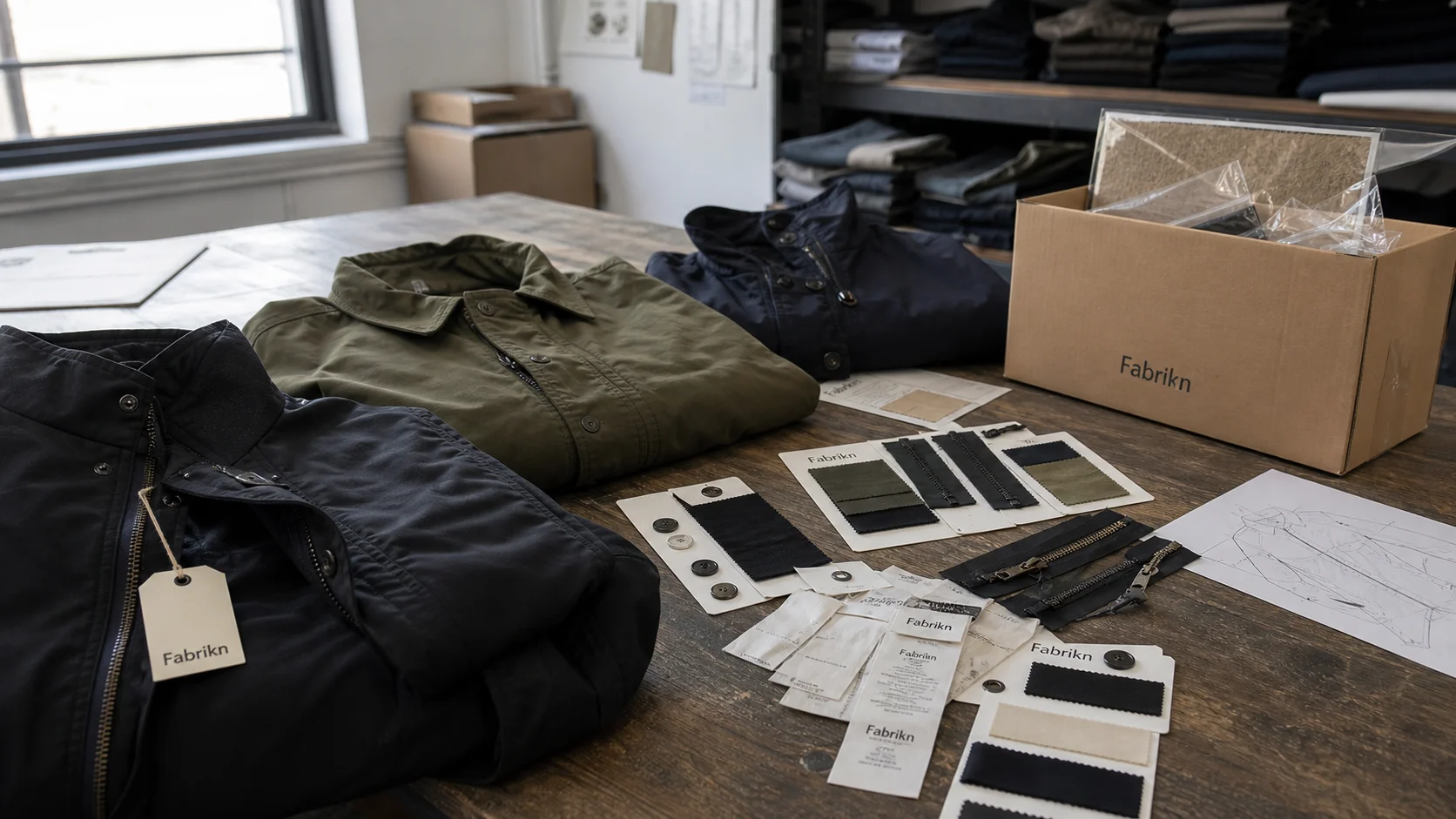
Custom Garment Care Labels with checks for samples, fit, MOQ, QC evidence, pricing terms, and delivery risk.
Fast answer: Custom Garment Care Labels: Compliance Text, Material, Print, and Timing should be judged by production evidence, not by a generic sourcing promise. The buyer needs sample proof, cost breakdowns, QC checkpoints, and delivery buffers in writing.
Ask for recent sample photos, measurement tolerances, fabric or print test assumptions, decoration test notes, packing examples, and a named inspection checkpoint. These details show whether the team can repeat an approved sample at bulk volume.
Separate garment cost, decoration, labels, packaging, sampling, testing, freight, and rush charges. When every cost line is visible, it becomes easier to reduce colorways, adjust size depth, or reserve more time for sampling.
One missing fiber line held up 14,000 units for 11 days in a Vietnam factory I visited last year, and the label itself cost less than $0.09 a piece. Tiny part. Huge mess. That is the ugly math behind custom care labels for clothing brands: a sliver of trim can stall a shipment worth $120,000 to $300,000 at wholesale.
I’ve seen this in premium denim, mid-market tees, and budget basics. Same mistake, different damage. A luxury brand absorbed a 2-week delay and reprinted labels at $180 in tooling plus freight. A mid-market label brand had 6 percent of its first drop returned because the care instructions were vague on heat settings. A budget brand lost far more, because shoppers read the poor label quality as poor garment quality.
Factory audits show why these problems surface late. Trim approvals often sit below pattern approval, fabric approval, and size set approval. By the time production gets to finishing, the line is already running, the cartons are booked, and no one wants to stop 8,000 pieces because the typography says “polyester” where the approved spec said “recycled polyester.” In a cut and sew factory I toured in Istanbul, the quality team found label mismatches only after final pressing, when rework would have cost $0.35 to $0.70 per unit plus 4 extra labor hours.
The hidden cost of getting the care copy wrong is bigger than compliance. A label that omits origin, misstates fiber content, or uses symbols inconsistently can trigger customs holds, retailer chargebacks, and customer mistrust. In the US and UK, I have seen brands spend $600 to $2,500 relabeling a small run of 1,200 to 3,000 units. On a 20,000-unit launch, that number climbs fast, especially when each garment needs a new sewn-in label and a new polybag insert.
There is also a perception gap by price tier. Premium buyers expect precision. They notice if a 220 GSM jersey tee has a scratchy satin label or if a cashmere blend arrives with care instructions that look copied from a generic template. Mid-market shoppers are less forgiving on fit problems, but label errors still erode trust. Budget customers may tolerate less polish, yet they are quick to return items if washing guidance is unclear and shrinkage reaches 3 to 5 percent.
I’ve learned that care labels behave like insurance. You barely notice them when they work. You remember them when they fail. And in factories, failures usually appear at the worst possible moment: after sampling, after bulk approval, and right before cartons are sealed.
Just last year, at a Guangzhou trim mill near Baiyun, I watched a 12-color Saurer jacquard loom, an IRM 1000 digital printer, and a set of Hasen heat-transfer presses weave and stamp 60,000 labels a day; the site quoted 18-22 business days for a new stripe-run sample and three extra days for COA, but when the brand delayed approval of the 4-mil silicone-backed adhesive, the new run missed both its freight window and the requested DHL pick-up.
Down in Dhaka, where a lean bodywear factory processes 25,000 units per week with automatic spreaders and RFID-tracked trim kits, a single care label mismatch triggered a customs hold because the Guangzhou supplier had not included the GRS-certified recycled yarn declaration, and the whole pallet sat in bonded space for 6 days while the documentation moved between agents.
US, EU, UK, and Australia rules are similar enough to tempt brands into copy-pasting, and different enough to cause expensive mistakes. In the US, fiber content, country of origin, and manufacturer or importer identity are central. The FTC expects accurate fiber disclosure, while care guidance is voluntary unless a brand chooses to include it. In Europe and the UK, textile fiber names, origin details, and consumer language standards matter more, especially if the product moves through retailers that demand local-language labeling.
For multi-region brands, version control is the real battle. A single tee sold in New York, Berlin, London, and Sydney may need four label variants, each with different language density, symbol preferences, and company address formatting. I have seen a brand print 50,000 labels with a comma in the wrong place because the EU file was mistaken for the UK file. The reprint cost them $1,100, plus 9 lost production days.
Mandatory elements vary, but the usual checklist includes fiber content, country of origin, care instructions, and either written text or care symbols. Optional elements include QR codes, batch codes, and sustainability claims. Those extras are useful only if the base data is clean. According to ISO guidance on standardized communication, clarity and consistency reduce user error. That matters when a consumer is standing in front of a washing machine with a garment worth $28 or $280.
Common compliance gaps show up in factories all the time. One is outdated country-of-origin language after final assembly shifts from one region to another. Another is fiber composition rounded too loosely, such as “95 percent cotton” when the lab report shows 93.7 percent. I have also seen missing care symbols on labels for baby bodysuits and athletic bras, where the absence of a simple wash icon can trigger retailer complaints. For custom baby clothing manufacturing, the tolerance for sloppiness is near zero.
Customs delays are not theoretical. A shipment can sit 3 to 10 days while brokers request revised documentation. Re-labeling in a destination warehouse can add $0.25 to $1.20 per piece, depending on whether the brand needs heat-applied stickers, sewn-in replacements, or full repackaging. That is why apparel compliance teams keep a master label file for each region, each season, and each material mix. Sloppy versioning looks cheap until the pallet is already on the dock.
Suppliers in Ho Chi Minh City I work with maintain digital QA boards so every batch rolling off the 12-head MHM printer matches the garment ship set, easily swapping between Vietnamese, English, German, and Arabic blocks to keep the Southeast Asia and Australia markets compliant on language density.
Label material decides how long the message survives. Woven labels feel premium and last through repeated laundering, but they can scratch on delicate skin if the edge finish is poor. Satin labels are softer and often cost less, usually around $0.04 to $0.12 per piece in volume, yet they can fray sooner if the stitching is weak. Cotton labels fit heritage brands and organic basics, though they may wrinkle and fade after 20 to 30 washes. Recycled polyester labels sit in the middle on cost and durability, generally $0.03 to $0.10 per piece depending on size and finish. Heat-transfer labels remove bulk, which matters on leggings, underwear, and performance tops.
Print method matters just as much as substrate. Screen print is durable for simple copy and low-color layouts. Thermal transfer can work well for variable data and internal tracking. Digital print handles small runs and multi-language layouts with less setup. Woven construction is not really “print” at all, but it remains the benchmark for longevity in premium garments. I have tested labels that looked perfect at delivery and failed after 15 industrial washes at 40°C because the ink cracked or the stitch line cut into the edge.
Different garments demand different solutions. Activewear needs stretch tolerance and abrasion resistance, especially for nylon-spandex blends and bonded seams. Luxury garments often use soft satin or fine woven labels so the finish feels intentional, even if the content is simple. Childrenswear needs low irritation and clear care text, with no rough edges. Basics can tolerate standard satin or recycled polyester labels if the artwork is clean and the fold is consistent. For brands building broader assortments, I often see a cut and sew manufacturing partner produce the garment beautifully, then lose points on a label that was chosen too late in the process.
Here’s what most people miss: premium brands sometimes choose simpler label constructions because they wash better. A neatly folded satin label with one-color print can outperform an elaborate woven label with dense thread on a brushed fleece hoodie. I saw this on a 320 GSM French terry program where a lighter, flatter label reduced customer complaints by 18 percent after the first two wash cycles. The fancy option was prettier on a hanger. The simpler one lasted.
Abrasion, laundering, and skin sensitivity are not minor details. If the garment is likely to be tumble dried, enzyme-washed, or stone-washed, the label must survive the same treatment path. If the customer is buying intimates, hosiery, or babywear, roughness matters more than visual richness. Brands sourcing custom bra manufacturing services in Ho Chi Minh City, Dhaka, or Istanbul often opt for OEKO-TEX Standard 100-certified inks and a 0.5-mm silicone-backed heat-transfer label cut on a Haarman CNC cutter, then sealed with ultrasonic pressing so the label lies flat and no raw edge irritates the skin.
Micro orders under 1,000 pieces—often used for direct-to-consumer relaunches—lean on digital print and heat transfer, and the per-piece cost hovers around $0.40 to $0.85 because the setup is minimal but the ink per square cm is higher. A boutique brand in Istanbul paid $0.60 per label for a 600-piece run printed on a Mimaki JV33 and finished with an automatic laser cutter; the result survived 30 washes.
For a 500-unit minimum order in Guangzhou or Dhaka, a premium woven label with a double-needle finish, silicone-supported fold, and bar-tacked tip runs $2.50-4.00 per unit when produced on an automatic Stäubli jacquard loom and finished with a combination of robotic trimming and steam setting. The MOQ of 500 still includes the cost of bespoke artwork files, a single pass on a 1,600 mm double-needle coverstitch machine, and the corresponding embroidery head calibration.
As volumes rise above 5,000 units, the cost per label drops into the $0.12 to $0.32 range because the mill amortizes tooling, preps ribbon dye lots, and runs through heat-setting ovens that cure adhesives in one pass. Shipping and duty add another $0.05 to $0.11 per label when the goods move from the Guanzhou mill to Hong Kong or the Ho Chi Minh City hub, plus the risk premium of a rushed air shipment when carts are delayed. Planning for 18-22 business days of label production and another 7 days of logistics keeps retailers from scrambling to relabel their side of the business.
Ask for proof of certifications before the first call. GOTS for organic cotton labels, OEKO-TEX Standard 100 for skin contact components, WRAP and BSCI for ethical factory conduct, and GRS for recycled content keep the story credible. When a supplier in Ho Chi Minh City walks you through their dye lab, you should see the same GRS yarns on the spools that the compliance report says they used in that woven logo.
Site visits in Guangzhou, Dhaka, Ho Chi Minh City, and Istanbul reveal whether the supplier actually runs the machines you need: a programmable Saurer jacquard loom for multi-color weaves, an Aura multi-head heat press for appliqué labels, and an automated ultrasonic cutter for clean edges. Ask for video of the bar-tack machine stringing through, the hot-melt adhesives being applied in a controlled humidity chamber, and the digital preflight proof on a GMP colorimeter. An electrostatic print head alone doesn’t prove capability; consistent dot size, color density, and thread tension do.
Evaluate the process: do they control thread tension on the jacquard? Do they back each label set with low-temperature adhesives so the garment laminates easily? Do they scan the batch in and tie it back to the digital proof? Suppliers that score highest on my checklist have a dedicated SQE, maintain 2.5-micron dope-sampling logs, and can trace each label to a specific dye lot, machine, and operator signature within 48 hours.
1. Lock the spec earlier than you think: finalize fiber content, language blocks, symbols, and placement in the first tech pack iteration, not on the final cut-and-sew. Share the spec with the label partner in Guangzhou or Ho Chi Minh City so they can prep their artwork and bid a single lane of production.
2. Request a physical sample and test it in the same machines the garment sees—tumble dry, enzyme wash, or stone wash—before full production starts. Have your lab engineer run a 5-point abrasion test and a seam-rubbing test on the label edge; many mills have a mini Martindale rig that simulates 25 washes in one cycle.
3. Build a version-control system within your PLM. Label files should include timestamps, approval stubs, and market tags. If the Autumn drop goes to Guangzhou, Dhaka, and a small Istanbul run for boutique distribution, bring those files together in a centralized folder so that the next production release cannot accidentally reference the wrong file.
4. Schedule redundancy. At 18-22 business days out, confirm the label mill is on track, and book an expedited 48-hour response station for e-file corrections in case the retailer requests a language change. Make sure the logistics partner can handle a partial shipment from Ho Chi Minh City to Europe while the rest ships out of Guangzhou.
Strong care labels show that you sweat the details. Retailers wince when an entire carton arrives with a wrong fiber percentage, especially for a multi-channel drop; they want the assurance that the label was clipped, sealed, and checked by the compliance team before it ever reached their SSC. Shoppers sense authenticity: a smooth satin label with clean typography, backed with OEKO-TEX Standard 100 or GOTS text and stitched with a dedicated double-needle bar-tack, signals that the same team spending time on the label also spent time sourcing Supima or recycled modal.
Strong labels also mean you can tell a cohesive sustainability story. Include GRS logos, mention the recycled yarn, and add a QR code that leads to your traceability report. When faced with two similar garments, the shopper often picks the one with clear care instructions, consistent symbols, and that little “Made in Vietnam” or “Assembled in Turkey” line printed with precision; it feels finished, like the brand knows every step from mill to rack.
Retail buyers equate tidy labels with reliable operations. If your care label mismatches your carton label or polybag insert, it suggests you may have cut corners elsewhere. Invariably, brands that treat their trims as strategic touchpoints—not just compliance widgets—get to scale faster and face fewer chargebacks.
Most suppliers will deliver a sample within 10-14 business days if you provide approved artwork, but plan 18-22 business days for more complex laminates or metallic inks so you leave room for lab dips and approvals.
Ask for GOTS or OEKO-TEX Standard 100 for any skin-contact label, WRAP or BSCI for the factory itself, and GRS when you claim recycled content. Keep those certificates on file; customs or retailers can request them at any time.
Yes, especially when you require multiple colors, fold types, and finishes. Printed satin labels have a lower base cost, but woven labels on a Stäubli jacquard loom offer longevity. For small runs you might pay $0.60 to $0.85 per printed label, whereas a woven label—depending on size and fold—can range from $2.50-4.00 per unit at a 500-piece MOQ.
Compare the physical sample to the approved digital file. Ensure every symbol matches, colors align, adhesives read the same as the garment spec, and the label has passed abrasion/wash testing. Confirm the supplier has recorded the batch number, machine ID, and operator signature in their QA log before you release the order.