
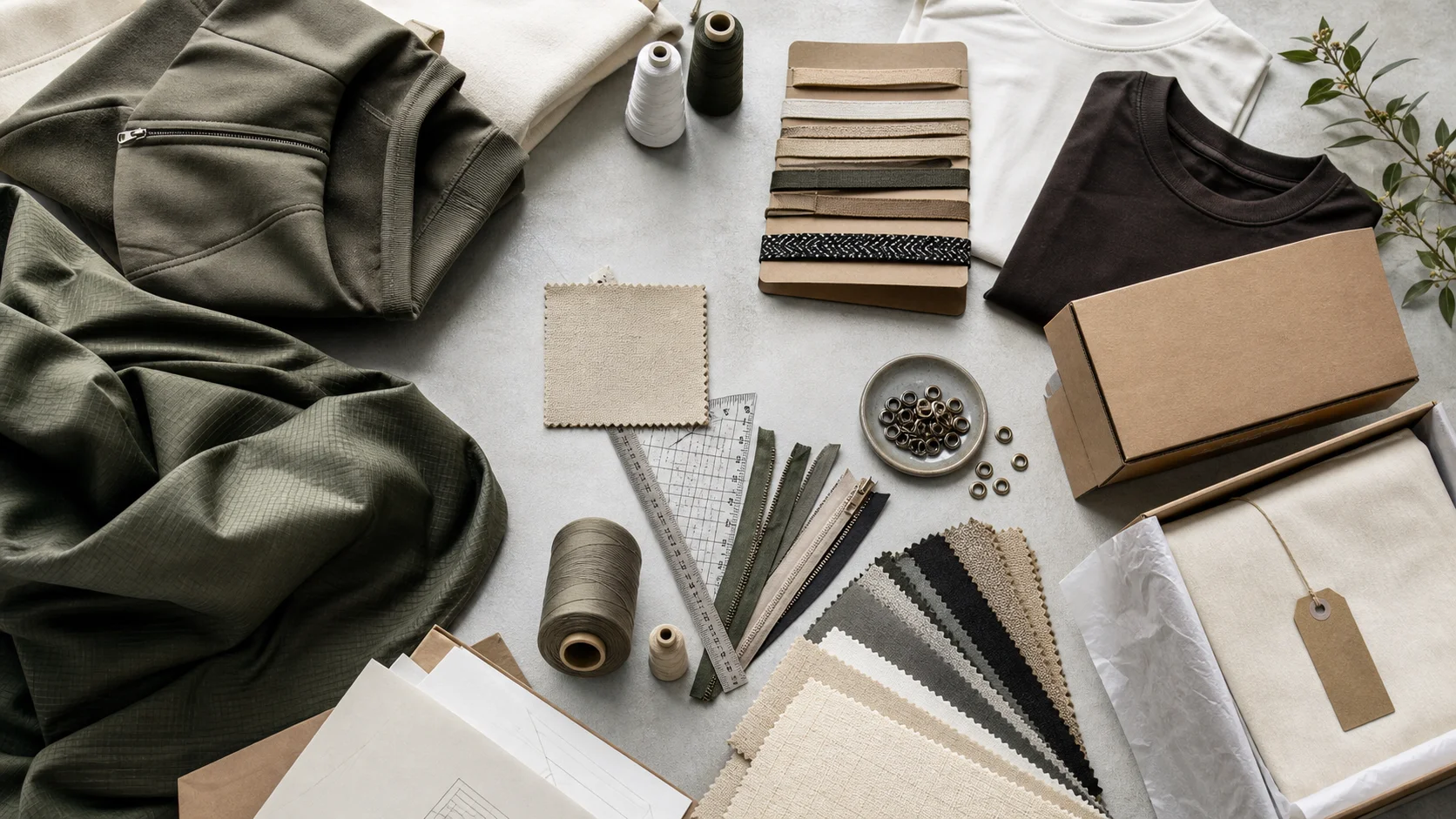
Custom Clothing Boxes Wholesale China with checks for samples, fit, MOQ, QC evidence, pricing terms, and delivery risk.
Fast answer: Custom Clothing Boxes Wholesale China: Costs, Quality, Timelines should be judged by production evidence, not by a generic sourcing promise. The buyer needs sample proof, cost breakdowns, QC checkpoints, and delivery buffers in writing.
Ask for recent sample photos, measurement tolerances, fabric or print test assumptions, decoration test notes, packing examples, and a named inspection checkpoint. These details show whether the team can repeat an approved sample at bulk volume.
Separate garment cost, decoration, labels, packaging, sampling, testing, freight, and rush charges. When every cost line is visible, it becomes easier to reduce colorways, adjust size depth, or reserve more time for sampling.
One carton price jump was enough to send a mid-market apparel brand back to the drawing board. The buyer had been sourcing locally, but when folding carton quotes moved from $0.42 to $0.50 a unit on a 5,000-piece run, the math changed fast. That’s why custom clothing boxes wholesale china still anchors so many apparel programs.
Across factory visits in Guangdong, Zhejiang, and Jiangsu, I kept seeing that same unit-economics advantage. Chinese suppliers spread tooling, prepress, printing plates, and board purchasing across larger runs. And that often cuts per-box cost by 30% to 60% versus small-run local sourcing. A 1,000-unit order usually pays for that inefficiency in full. A 10,000-unit order absorbs it. The math is blunt.
In Guangzhou I watched a Heidelberg Speedmaster XL 106 run a mixed offset and UV varnish job on 400 GSM SBS C1S board, while the nearby lamination line used a Martin automatic gluer to finish 5,000 rigid boxes ahead of a weekend shipping window. The same plant held WRAP and BSCI certifications, which made buyers comfortable sharing brand-sensitive art. The equipment, including a Bobst SP 104 die cutter, helps them lock tolerances under ±0.5 mm across the run. It was easy to see why tight specs stay in check there.
Quality is not a China-versus-everywhere story. It shifts by province, factory tier, and order size. A shop in Dongguan running 50,000 rigid boxes for export may hold tighter tolerances than a boutique domestic supplier charging twice as much for a 2,000-unit premium run. I have seen color variation measured at ΔE under 2.0 on large export accounts, while smaller luxury vendors drifted beyond 4.0 because they lacked disciplined line checks. And those line checks make all the difference.
The thing nobody tells you: some export factories produce more consistent lamination and die-cut accuracy than pricier boutique suppliers because they live under tougher QC routines and higher complaint pressure.
What buyers need isn't the cheapest box. They need the lowest total landed cost with predictable delivery and acceptable defect rates. A box at $0.34 is expensive if it arrives late, prints off-register, or forces a re-pack at destination. I have seen brands lose a week of launch prep over 3 mm of lid misalignment. Tiny error. Large bill.
That's why packaging decisions sit alongside sourcing decisions in broader product planning, much like private label clothing services or cut and sew manufacturing. Once packaging becomes part of the product, the supplier matrix matters just as much as the silhouette.
Pricing starts with the board, not the logo. Paperboard, rigid board, and corrugated inserts all carry different cost structures, and each one changes as soon as you add coating or finishing. A basic folding carton with CMYK print, aqueous coating, and no insert may land at $0.18 to $0.35 per unit on a 5,000-unit run. A mailer-style apparel box with an insert, spot UV, and a one-color foil accent can move to $0.55 to $1.20, while luxury rigid boxes with magnetic closures often sit between $1.80 and $4.50, depending on board thickness, paper wrap, and hand assembly time.
MOQs reshape the quote more than many buyers expect. A 1,000-unit run can cost 20% to 40% more per box than a 5,000-unit order because setup charges sit on a much smaller base. And plate fees, die cutting, proofing, and press make-ready do not disappear for small volumes. They simply hurt more. I have seen a $280 plate charge become nearly invisible at 10,000 units and painfully visible at 1,000.
Some suppliers in Ho Chi Minh City and Dhaka lean on $2.50-4.00 per unit at 500 MOQ for gusseted mailers that combine kraft-laminated inserts with biodegradable PLA film windows. The estimate includes a cold-foil stamping pass with a Bobst Expertcut machine, a digital-controlled die cut, and inline cellulose aqueous coating. Stack that against Guangzhou-based rigid box shops running 1,200 GSM greyboard wraps, and the scope differences become obvious.
And then come the hidden costs. Sample fees. Color matching. Inner tray revisions. Repacking at origin because cartons are packed in the wrong master case count. Repacking on arrival because the destination warehouse wants a different unit configuration. A quote that looks cheap at EXW can be a mirage once you add trucking, export handling, and duties.
Ask for EXW, FOB, and DDP quotes side by side. No theater. Just the whole bill. According to Trade.gov customs and landed cost guidance, landed cost can shift sharply once freight and duty assumptions enter the file, especially on low-value, high-volume imports. That matters for apparel packaging, where freight often determines whether the savings hold.
When I visited a plant outside Ningbo, the sales manager quoted a rigid box at $1.10 FOB. The DDP number landed at $1.46 after inland trucking, export docs, and destination handling. The domestic quote had been $1.52. That's the kind of comparison buyers need to run every time.
Quality starts with the board caliper. If the stock is too thin, the box crushes at the corners. Too heavy, and the cost and freight climb for no good reason. I look for crush resistance, edge wrap alignment, gloss consistency, and glue integrity before I care about the artwork. A good box feels square in the hand. A bad one squeaks, bows, or opens unevenly.
For consumer packaging, many brands tolerate only a low single-digit defect rate, and that's where AQL sampling becomes useful. If your program ships 20,000 units, even a 1% defect rate means 200 boxes that may need rework, discounting, or replacement. In apparel, where unboxing affects perception, that's not trivial. I have seen brands reject a shipment for 7 defective units in a 500-box sample because the errors were visible and repeatable.
Sample types answer different questions. Digital mockups tell you what the layout might look like. Pre-production samples tell you whether the plant can build to spec. Mass-production samples tell you what will actually arrive on a pallet. Skip any one of those, and you're guessing. Guessing is expensive.
Here is what I check on the floor: the corrugation line, die-cut waste, and humidity control. A polished showroom means little if the production hall stores board in damp conditions or leaves cut sheets exposed overnight. In humid weather, I have measured board moisture swings that translated into warped lids and weak glue bonds within 24 to 48 hours. The box looked fine at noon. By the next morning, it was not.
Request a signed specification sheet. Include exact board GSM, Pantone codes, tolerances, insert dimensions, and carton drop-test requirements. If the supplier will not put numbers in writing, that is a warning. According to ISO quality management standards, standardized quality systems depend on repeatable specifications, not verbal agreement.
For brands that also sell infant or kidswear, this discipline becomes even more relevant. I have seen packaging standards tighten once a buyer has worked through custom baby clothing manufacturing, where compliance, labeling, and presentation all get scrutinized harder than in casual adult apparel.
Mailers, folding cartons, and rigid boxes do not compete on beauty alone. They solve different commercial problems. A mailer-style apparel
A strong brief makes the supplier's job narrower and the quote more reliable. For custom clothing boxes wholesale china, include the target customer, sales channel, expected order quantity, size range, decoration needs, packaging requirements, and delivery market. Then call out the details most likely to affect the result, especially material grade, print tolerance, and barcode size.
The brief should also explain what cannot change. Some brands care most about hand feel, some about price, some about launch timing, and some about retail compliance. When those priorities are not written down, suppliers tend to optimize for whatever is easiest to quote. Clear priorities help the factory make better tradeoffs before the first sample is cut or printed.
Ask the supplier to respond with assumptions, not just a price. A useful reply states MOQ, sample route, production capacity, inspection plan, packing method, and freight handoff. If the answer is vague, the project may still work, but it needs a tighter pre-production stage before money and calendar pressure build up.
The best time to catch problems is before the pre-production sample is approved. Check measurements, color, placement, material behavior, shrinkage, construction, labels, and packaging in the same review instead of approving each item in isolation. Many bulk issues are not caused by one dramatic mistake; they come from several small unchecked assumptions.
For custom clothing boxes wholesale china, pay special attention to folding method, pack-out sequence, and retail compliance. These details often look minor in an email but become expensive once cutting, printing, sewing, packing, or shipping begins. A simple checklist with owner, due date, and approval status keeps the brand team and factory aligned.
Bulk production should not start until the supplier can explain how the approved sample becomes a repeatable production standard. That means reference sample storage, line instructions, inline checks, final inspection, and defect handling. A factory that can describe this process clearly is usually safer than one that only promises speed.
Price differences are useful only when the quotes cover the same work. Compare sample cost, material source, trims, decoration, packaging, testing, inspection, and freight assumptions. A low unit price can become expensive if it excludes items the brand needs before launch.
Timeline promises deserve the same scrutiny. Ask what happens if the first sample needs revision, whether materials are in stock, when the production slot is reserved, and how export packing is handled. The most reliable supplier is often the one that gives a realistic calendar instead of the fastest optimistic answer.
Before making the final decision, write down the specification, approval owner, delivery expectation, and the one or two risks that would cause the most trouble if missed. For custom clothing boxes wholesale china, this usually means checking material grade, print tolerance, barcode size, and the support process after the order is placed.
This last review does not need to be complicated. It simply makes the decision easier to repeat, easier to explain, and easier to verify when the finished product or jewelry arrives.
One useful way to pressure-test the decision is to ask what would happen if the order had to be repeated in six months. The answer should still be clear: the same material grade, the same print tolerance, the same acceptance standard, and the same communication path. If a second order would depend on memory or guesswork, the first order is not documented well enough yet.
Another useful check is to separate preference from requirement. Preference is the look, wording, or finish the brand likes. Requirement is the measurement, tolerance, certificate, material, or delivery condition that cannot fail. Good buying decisions keep both visible, so the final choice is not pushed around by the last email, the cheapest quote, or the prettiest sample photo.
Finally, ask who owns each approval. A project with one accountable owner for sample review, one owner for final content or artwork, and one owner for delivery sign-off usually moves faster than a project where every decision is shared loosely across a team. Clear ownership reduces delays and makes the finished result easier to judge.
The finished result should be judged against the approved standard, not against a vague idea of what looked good at the start. Compare the delivered item with the approved sample, written specification, photos, and any measurement or certification notes. If the result meets those points, the project is easier to reorder and easier to improve later.
If something is off, record it in practical terms: where the issue appears, how often it appears, whether it affects use, and what change would prevent it next time. That turns a complaint into a useful production note and helps the next order become more consistent.