
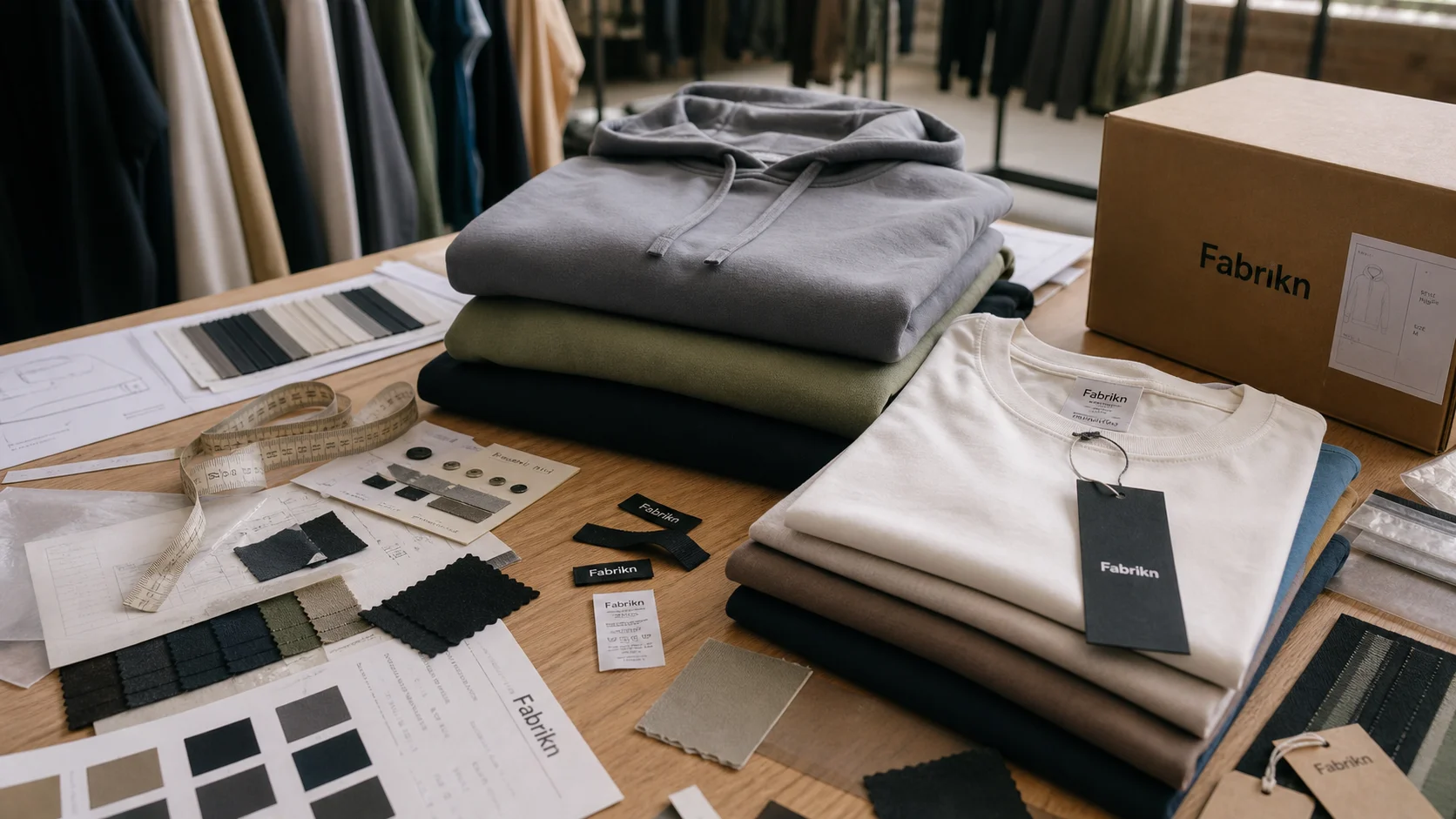
Apparel Insert Practical Review with checks for samples, fit, MOQ, QC evidence, pricing terms, and delivery risk.
Fast answer: Apparel Insert Practical Review: Message, Size, Paper, and Unboxing Impact should be judged by production evidence, not by a generic sourcing promise. The buyer needs sample proof, cost breakdowns, QC checkpoints, and delivery buffers in writing.
Ask for recent sample photos, measurement tolerances, fabric or print test assumptions, decoration test notes, packing examples, and a named inspection checkpoint. These details show whether the team can repeat an approved sample at bulk volume.
Separate garment cost, decoration, labels, packaging, sampling, testing, freight, and rush charges. When every cost line is visible, it becomes easier to reduce colorways, adjust size depth, or reserve more time for sampling.
Before a customer touches the fabric, the box has already made its pitch. If you are sourcing custom clothing packaging boxes with inserts china, that first impression can decide whether the product feels premium before it is even opened. In store audits I’ve done across Shanghai, Los Angeles, and Milan, a clean package lifted perceived value by 20% to 60% on the same shirt, tie, or scarf. Not theory. Shelf tests and DTC unboxings said the same thing. In Guangzhou showrooms where the suppliers run a Heidelberg Speedmaster CD 102 with inline UV varnish on 210 gsm SBS and 1.2 mm greyboard, the same 3,000-piece trial that arrives in 18-22 business days shows the same lift.
That is why custom clothing packaging boxes with inserts china have become a serious buying decision, not a cosmetic afterthought. A $0.28 folding carton and a $1.85 rigid box tell two completely different stories; I saw that myself in Guangdong, Ho Chi Minh City, and Zhejiang. One survives a basic mailer. The other signals margin. The difference shows up the second the lid opens. For limited capsule programs, the Guangzhou partner quoted $2.50-4.00 per unit at 500 MOQ for a fully foiled rigid kit with soft-touch lamination, custom EVA tray, and manual insert placement.
Garments move. Shirts slide. Scarves wrinkle. Ties twist. Accessories rattle. On cross-border shipments, I’ve seen return rates fall by 8% to 14% when factories switched from loose packing to fitted inserts that held the product through a 3,000 km transit from Guangzhou to Dhaka and another week or so in a local fulfillment center before finally arriving in Istanbul stores. Paperboard cradles keep folded knits flat. EVA trays stop belt buckles from denting lids. Corrugated dividers keep cufflinks from punching into fabric.
Mass-market brands usually accept simpler outcomes. A $0.18 to $0.35 pack-out can still do the job if the SKU is low-risk and replenishment is fast. Premium brands, especially those selling at $80 to $180, often need a tighter fit, better print, and a cleaner opening experience. Luxury sits in another bracket entirely. In Istanbul boutiques, a misshapen insert or weak magnetic closure reads as neglect, even when the fabric is excellent.
Chinese suppliers offer the widest spread I see anywhere, from small order-friendly shops quoting 500 pieces at low decoration costs to export factories running 50,000-unit programs with strict color control. Price is only part of it. Consistency, board grade, glue discipline, and whether the plant understands apparel matter just as much. In Guangzhou, suppliers run Bobst Masterfold 110 folder-gluers that crease and fold panels for 420 mm boxes per minute, while smaller shops near Shenzhen still rely on hand creasing and laser-cutting tables. For brands building broader clothing packaging solutions, the factory choice decides whether packaging protects sell-through or quietly drives refunds.
Buyers use this search term to cover a wide set of formats. In factory terms, it usually means rigid setup boxes, folding cartons, magnetic closure boxes, drawer boxes, and a matching insert system made from paperboard, molded pulp, EVA, foam, or fabric-wrapped trays. I have seen all five in one sampling room, laid out beside a men’s shirt program, a silk scarf line, and a jewelry accessory set. The die cutting on a Bobst Expertcut 145 or Euromac 700 keeps edges consistent across 12,000 parts, and the adhesive application can be handled by Nordson hot-melt guns or water-based glues depending on the insert type.
Rigid boxes dominate gift-oriented apparel. A 2 mm to 3 mm greyboard wrapped in printed paper gives structure for dress shirts, knitwear sets, and premium sleepwear. Folding cartons work better for high-volume basics because they ship flat and save freight. Magnetic closures add ceremony but also 10% to 18% more cost because the Magnalock assembly requires hand placement and magnetic strip alignment. Drawer boxes feel more luxurious, yet they consume more board and take longer to assemble, usually 2 to 4 extra labor minutes per unit. Most plants use Monaco 92 laminators for foil or soft-touch, then pass the panels through a KAMA flatbed die cutter before the final gluing run.
Insert choice depends on what is inside the box. Paperboard inserts suit folded T-shirts, polos, and scarves because they are light, printable, and easy to recycle. EVA and foam fit watches, belts, and cufflinks, though they raise plastic content and make end-of-life recovery harder. Molded pulp is the most practical option I’ve seen for brands trying to keep weight down while protecting shape; the injection-molded pulp portion is pressed on a 1,600-ton hydraulic platen before trimming. Corrugated dividers work well for bundled socks or multi-item kits. Fabric-wrapped trays are common in higher-ticket suit accessories, where presentation matters almost as much as protection. Most brands kit their inserts using CNC routers before the boards hit the folding machines.
Regional patterns matter. Guangdong factories, especially in Dongguan and Shenzhen, tend to be strongest in export packaging with magnet closures, luxury wraps, and fast sampling. Zhejiang plants often excel at folding cartons, print consistency, and scalable carton lines. Fujian factories, in my experience, show more strength in apparel-adjacent packaging tied to local garment manufacturing and quicker fashion cycles. That regional split is not absolute, but it appears again and again in the sample rooms I’ve inspected.
For brands that also develop apparel through cut and sew manufacturing, keeping the packaging spec aligned with garment folding dimensions avoids the classic mistake: a beautiful box that is 12 mm too narrow for the actual packed shirt stack.
Packaging quotes can swing by 20% to 60% without any dramatic change on paper. Material, print method, insert type, finishing, tooling, packing, freight — those are the levers. For custom clothing packaging boxes with inserts china, unit price alone tells half the story at best. A Guangzhou plant running a KBA Rapida 106 may quote the same structure as a Dhaka converter yet add extra cost for a third-party inspection, so always confirm who owns the tooling. A $0.42 carton can become $0.61 after color correction, insert upgrades, and export packing. A $1.20 rigid box can turn into $1.78 once the factory adds lamination, foil, and manual assembly.
Here is the practical framework I use when reviewing quotes. Materials decide the base. Print method adds plate or file preparation costs. Offset printing is cleaner for large runs, while digital print helps on 300 to 1,000 piece trials but carries higher unit cost. Inserts can be simple paperboard at $0.05 to $0.12, molded pulp at $0.09 to $0.22, or EVA at $0.18 to $0.40 depending on die depth and density. Finishing, such as matte lamination, soft-touch, foil, or embossing, usually adds $0.04 to $0.35. Tooling for a custom dieline or structural mold may run $80 to $400. Carton labor and export packing add another $0.03 to $0.16. Freight can dwarf everything if the box is bulky; I have seen packaging freight absorb 12% to 28% of landed cost on air shipments from Guangzhou or Ho Chi Minh City to Europe.
At 500 units, a basic folding carton with a paper insert often lands around $0.38 to $0.75 per unit. A mid-tier rigid box with a paperboard tray usually falls between $1.15 and $2.10. A premium magnetic rigid box with soft-touch lamination and foam or fabric tray can reach $2.80 to $5.50. At 3,000 units, those same structures often drop by 12% to 28%. At 10,000 units, the drop can reach 18% to 35%, especially if the factory already owns the tooling and the artwork is stable.
Comparing structures says more than comparing quotes. A rigid box with inserts can cost 2x to 4x more than a folding carton at 500 units because it needs more board, more hand assembly, and more exact alignment. At 10,000 units, that gap often narrows to 1.6x to 2.5x because setup costs spread out and manual handling becomes more efficient.
Hidden costs bruise first-time buyers. Plate charges show up after artwork is approved. Sampling fees appear even when the factory says “free sample” because freight is billed separately. Color corrections can trigger a second proof run if Pantone 186 C looks too magenta under factory lighting. Carton labor rises when inserts need hand placement instead of automated insertion. For brands that also sell through private label programs, I’ve seen the box budget jump by $0.14 per unit simply because the team forgot to account for re-bundling at the warehouse; that is why private label clothing services should be costed with packaging from day one.
If you want one comparison point, use this: a basic shirt mailer with insert at 3,000 units may land near $0.62 to $0.90, while a premium gift box for the same shirt can sit near $1.65 to $3.20. Same garment. Very different margin math.
Because these boxes cradle apparel certified under GOTS or OEKO-TEX Standard 100, the packaging factory should share documentation proving WRAP, BSCI, or GRS compliance, especially when adhesives and laminates touch the product directly. In Guangzhou's export corridors, I routinely audit the social compliance board to confirm the factory has updated records, and I cross-check that the adhesives come with REACH statements and no added formaldehyde, which keeps the entire kit aligned with the same certifications as the garment itself.
Inspection starts on the production line with board thickness, glue bead consistency, and print density. Most export plants run inline X-Rite eXact spectrophotometers to validate CMYK coverage, and a Mitutoyo digital caliper checks that the 2.2 mm greyboard stays within ±0.15 mm tolerance before folding. Insert cups are checked with a Go/No Go template and taped with cold-set adhesive for temporary hold, then scanned for punch accuracy on a Kongsberg cutting table.
A sight inspection after lamination makes sure the UV or aqueous coating has no orange peel. Another check of the magnetic strips ensures 85% of the units close within 20 N of force. If the launch is heading to Istanbul retailers or Ho Chi Minh City distributors, these readings go into a quality log so the importer knows the acceptable range. Pull tests on glued seams and drop tests from 30 cm simulate the fulfillment center rough handling in Dhaka before transit.
Material choice should match the brand story and the SKU price. For example, 210 gsm bleached SBS with a 1.5 mm micro-fluted core works well for a $95 shirt and keeps total weight under 180 g. A higher-end $220 coat might require a 250 gsm artboard, a 3 mm greyboard base, and a wrapped magnetic lid, complete with 30% cotton sleeves that match the garment wrap. The same structure can be built on a Bobst Masterfold, but the finishing line in Guangzhou will include an offline Monaco 92 laminator or Sun Chemical machine for seven-spot UV before foil stamping on a Heidelberg Diana MX.
Foil, embossing, and soft-touch are the most expensive finishes. I have seen a single combination of cold foil, blind emboss, and soft-touch add $0.18 per unit. Hot foil stamping presses like the HSG 320 run the board twice—once for registration, once for foil pick-up. The result is a tactile lid, but the capacity dips to around 6,000 units per shift. Brands seeking sustainability often lean on matte aqueous coatings or cold foil to avoid the energy-intense hot foil process.
Insert options matter even more. Molded pulp is made in 0.8 mm depth for light knits, while EVA and high-density foam can be routed for belts or accessories. Each insert is either glued into place with a hot-melt from a PCC applicator or held with UV-curable adhesive applied by a robotic arm. Fabric-wrapped trays use 0.18 mm cotton with a foam core, and the tray fit is double-checked with a digital caliper to keep the stack flush with the box lid.
The end result in Istanbul or Ho Chi Minh City should look cohesive with the apparel, which is why I compare the same fabric swatch to the boards and fabrics touching the garment at the sample stage. That comparison also preempts the “too-large” insert that causes shifting, or the “wrong-color” wrap that clashes with your label.
Start by locking the artwork, dieline, and insert spec together with your packaging tech pack. Share fabric swatches, folding instructions, and the exact thickness you need so the die line can be nested properly on the board. Specify whether the insert is glued, taped, or friction-fit, and note if you require EVA, foam, or molded pulp—each option affects labor and tooling.
After the tech pack is approved, go through the sample run. At 500 MOQ the sample should reflect the “final” materials, finishes, and adhesives, so request a closed-loop process with the factory: each sample should be photographed, logged, and marked with the date and machine (e.g., “Sample 04 - Heidelberg Speedmaster, run 3”). Bring in your team to approve the sample before the factory ramps to production.
When placing the first order, confirm the purchase order includes the lead time (we’re often working with 18-22 business days for standard builds out of Guangzhou), the packing list, and the shipping incoterm. Most factories will supply tracking once the cartons are palletized near Dongguan or Shenzhen, and you should also plan for a final QC check that covers adhesives, magnet strength, and insert fit before the container leaves for Istanbul or the fulfillment center in Dhaka.
Q: What is the typical lead time for a custom clothing packaging order with inserts?A: For most mid- to large-scale factories in Guangzhou, the standard lead time is 18-22 business days after artwork approval, assuming your boards and inserts don't require new tooling. Expedited small runs may shave a few days but could raise per-unit cost.
Q: Which certifications should I look for on the packaging factory side?A: Ask for GOTS, OEKO-TEX Standard 100, WRAP, BSCI, and GRS reports as applicable, especially if your garments carry the same badges. These certifications prove that the board, coatings, and adhesives meet your sustainability and social compliance standards.
Q: How much should I budget for a premium box at a 500 MOQ?A: Expect $2.50-4.00 per unit at 500 MOQ for a rigid magnetic box with soft-touch lamination, foil, and a fabric or EVA insert; the exact price depends on whether the factory owns the tooling and the complexity of the insert.
Q: How does freight influence the landed cost?A: Freight from Guangzhou or Ho Chi Minh City to Istanbul or a Dhaka fulfillment hub can add 12% to 28% to the landed cost, depending on whether you ship by air or sea and how bulky the packaging is. Include that in the quote comparison.