
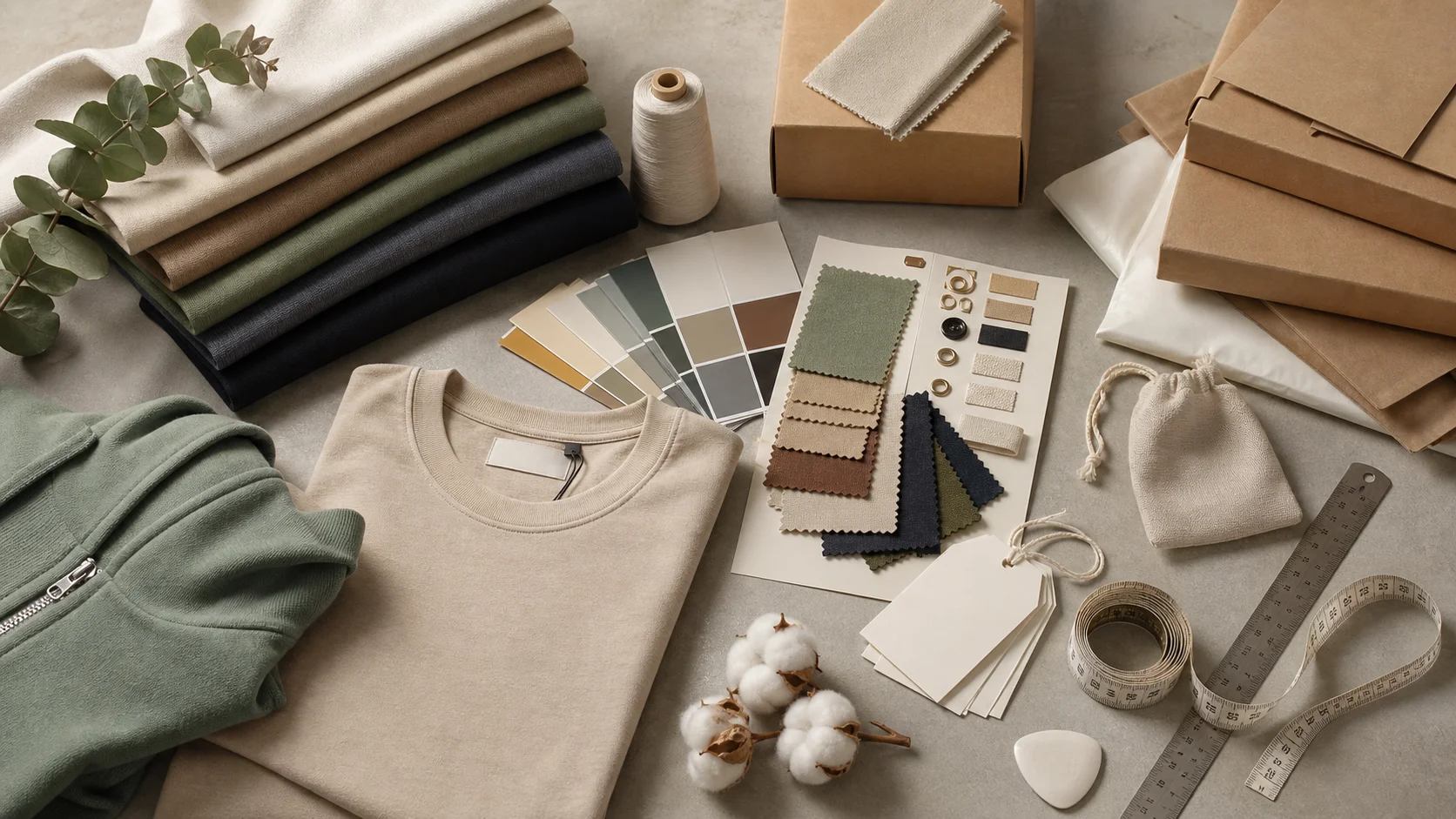
Overseas Clothing Packaging Checks with checks for samples, fit, MOQ, QC evidence, pricing terms, and delivery risk.
Fast answer: Overseas Clothing Packaging Checks: Samples, MOQ, Lead Time, and Risk should be judged by production evidence, not by a generic sourcing promise. The buyer needs sample proof, cost breakdowns, QC checkpoints, and delivery buffers in writing.
Ask for recent sample photos, measurement tolerances, fabric or print test assumptions, decoration test notes, packing examples, and a named inspection checkpoint. These details show whether the team can repeat an approved sample at bulk volume.
Separate garment cost, decoration, labels, packaging, sampling, testing, freight, and rush charges. When every cost line is visible, it becomes easier to reduce colorways, adjust size depth, or reserve more time for sampling.
Packaging can quietly eat your margin before the first carton leaves the floor. When a custom clothing packaging supplier for overseas brands is chosen well, packaging supports margin instead of draining it. One brand pays $0.42 for a flat mailer; another lands at $2.80 for a rigid box, inserts, and dunnage that tack on 180 grams before freight even wakes up. I’ve watched that gap swallow 11 percent of landed cost on small orders.
On factory floors in Vietnam, Italy, and southern China, packaging choices become freight choices fast. A carton that is 2 cm wider can push a parcel into a higher volumetric bracket. Add one extra insert and you’re carrying 20-40 more grams per unit. It sounds harmless until you multiply it by 10,000 pieces and 6-8 airfreight pallets.
Premium DTC labels often overpay for rigid packaging because it photographs beautifully. Mass-market brands do the opposite and hide cost in oversized poly mailers that crush collars, crease knitwear, and drive returns up by 2-5 percent. Damage in cross-border fulfillment is usually cumulative, not dramatic. Dented corners. Wrinkled tissue. A sleeve shifted in transit. Customers notice every bit of it.
Here’s the hidden mistake: picking a supplier with no overseas logistics experience. They may quote $0.18 less per unit, but if they don’t understand export cartons, palletization, and courier dimensional weight, the real price shows up later in rework, claims, and slow customs clearance. When I visited factories supplying Europe from Asia, the best ones treated packaging as part of the shipping system, not a decorative extra. That distinction matters more than a glossy sample card.
A real supplier does far more than print boxes. Strong teams handle material sourcing, dielines, artwork checks, sample production, print execution, packing specs, and export-ready documents. They also know whether a mailer box should ship flat, pre-glued, or nested, because that choice changes labor and freight. I’ve seen brands cut packing labor by 18 percent just by changing how inserts arrive at the warehouse.
There’s a sharp difference between a packaging trader, a converter, and a factory. A trader brokers work across multiple plants and can move quickly on sourcing, but quality control depends on the factory network. A converter runs print, cutting, folding, and assembly under one roof. An end-to-end manufacturer usually gives the cleanest accountability, especially for overseas brands juggling 2-3 markets at once.
For apparel, the familiar formats show up again and again: mailer boxes, hang tags, sleeve wraps, compostable mailers, retail cartons, tissue paper, polybags, garment labels. On one project, a brand shipping French terry 320 GSM hoodies used a 1.5 mm board mailer with a folded insert and saw damage claims drop from 4.2 percent to 1.1 percent across 7,500 units. The structure mattered more than the print finish.
Time zones and paperwork are not side issues. A custom clothing packaging supplier for overseas brands should manage multilingual coordination, proof approvals, customs documents, and carton marks without making the buyer translate every line. Fragmented sourcing creates trouble fast. One vendor prints. Another assembles. A third books freight. Then the warehouse gets 900 good boxes and 100 unusable ones. I’ve seen that exact mess in Spain and in Ho Chi Minh City.
If your brand already works with clothing packaging solutions, the question is not only who can make the box. It is who can keep the box, the label, the shipper, and the customs paperwork aligned across 3-6 week production cycles.
I have visited more than 200 factories, and the gap between a polished presentation deck and a real production floor usually shows up in the first 10 minutes.
The strongest supplier can show MOQ flexibility, color control, lead time reliability, QC logs, export records, and certification files without stalling. The weakest one sells the dream and hides the stockroom. Simple as that.
Audit the factory, not just the sales rep. Ask for live video walkthroughs, recent sample runs, and references from overseas clients with similar order sizes. If a supplier claims 90 percent color consistency, ask how they measure it. If they say board weight is 350 gsm, ask for a mill certificate and a caliper reading. No sample library? I move on.
China often wins on speed and print specialization, especially for coated cartons and high-volume rigid packaging. Vietnam is strong for labor-heavy assembly and shorter regional freight routes. India can be competitive on board stock and paper sourcing, though pre-press coordination may take longer. Turkey and Eastern Europe usually suit brands selling into the EU because transit times are shorter and freight variability is lower. I’ve seen 12-18 day ocean lanes from Turkey beat 30-35 day routes from East Asia on replenishment runs.
Red flags are easy to spot once you know what to ask. Vague defect standards. No proof of board weight. No test reports. No explanation of adhesive choice. No answer on carton compression. Those gaps become expensive in retail. If a supplier refuses to state whether a crease tolerance is ±1 mm or ±3 mm, they’re telling you they don’t track process control tightly enough.
Before you sign, use this checklist:
For brands that also sell intimate apparel, I often compare packaging capability alongside custom bra manufacturing because the product, folding method, and insert shape affect each other. A supplier that understands both can reduce waste and improve pack-out speed.
Unit price is only the first line on the quote. Landed cost includes material, print method, finishing, assembly, inner packing, export carton, freight, and duties. A simple economy mailer might break down as $0.22 board, $0.06 print, $0.03 die-cutting, $0.05 assembly, and $0.04 packing, before freight. A premium rigid box can jump to $1.10-2.40 before shipping. Compare quotes without the freight column and you’re comparing fantasies.
For overseas brands, packaging usually falls into three bands. Economy mailers sit around $0.35-0.90 landed for large runs, depending on size and route. Mid-tier printed boxes often land at $0.85-1.80. Premium rigid sets can reach $2.50-5.50 once insert trays and outer cartons are included. The same box can cost 30-45 percent more if it ships by air instead of ocean, especially once dimensional weight kicks in.
MOQ changes pricing sharply. A 1,000-unit order may price at $1.40 each, while 5,000 units can drop to $0.88 and 10,000 units to $0.71 if the setup is standard and the board is common stock. That’s not supplier greed. It’s setup labor, plate cost, and machine calibration being spread over more pieces. Small brands feel that hardest.
Timeline matters just as much. Sampling usually takes 5-12 days. Pre-press and dieline confirmation take 2-4 days if artwork is clean. Production runs 10-25 days for simple mailers and 20-35 days for rigid sets. QC, packing, and export booking add another 3-7 days. Ocean transit can be 18-40 days depending on origin and destination, while air freight often lands in 3-7 days but can cost 4-6 times more per kilo.
There’s also a near-market versus distant-supplier trade-off. A Turkish or Polish supplier may quote higher unit prices than a coastal China factory, but if you save 12 days in transit and cut buffer stock by 2,000 units, the cheaper quote stops looking cheaper. I’ve seen a London brand lower total inventory carrying cost by 14 percent after shifting packaging production closer to its fulfillment center. That kind of saving rarely appears on the invoice.
If you sell babywear, the packaging decision gets tighter because soft goods need cleaner folding and gentler finishes. Brands that pair packaging planning with custom baby clothing manufacturing usually catch size, labeling, and safety issues before they become expensive returns.
Recycled board, FSC paper, compostable mailers, and soy inks sound straightforward until they hit a wet dock or a stacked pallet. Recycled content can reduce virgin fiber use, but lower-grade board often loses stiffness. Compostable mailers can tear faster than conventional poly if the seam weld is weak. I’ve seen “eco” sleeves collapse under 18 kg of stack pressure in a warehouse test. The claim became more expensive than the old plastic version.
According to Textile Exchange, material claims need traceability if buyers want them to hold up in audits and retail review. In the EU, packaging scrutiny is especially hard on recyclability language and labeling clarity, while many US retailers ask for chain-of-custody proof and supplier declarations before they approve branded packaging. A certificate without batch linkage is just paper.
To understand broader packaging and textile compliance expectations, it also helps to review OEKO-TEX certification standards and the import guidance published by Trade.gov. A custom clothing packaging supplier for overseas brands should be able to align material selection, documentation, and destination-market requirements without slowing production.
There’s a practical balance to strike. A 350 gsm recycled board mailer may work for tees and light knits, but a 450 gsm structure can cut crush-related damage by 20-30 percent on heavier garments. If your product includes dense items like denim or layered fleece, stronger board and better corner locks matter more than a printed sustainability statement. Damage avoidance is the real environmental metric, because every return adds transport, repacking, and waste.
Never accept green claims without FSC paperwork, recycled-content certificates, or chain-of-custody evidence. Customs officers, marketplace auditors, and retail buyers increasingly ask for the same proof. I’ve watched brands spend months building a sustainability story and then lose it because one vendor could not verify where the paper came from. That failure is avoidable.
Packaging changes what customers think they bought. Not always rationally. A clean opening sequence, a slight paper texture, restrained print, and well-placed tissue can make a $48 shirt feel more expensive than the box alone suggests. The opposite happens too. Too much foil. Too many inserts. Too many layers. It starts to look anxious.
High-end brands often use fewer visual cues, not more. A matte box, one-color print, tight fold lines, and a single branded insert can outperform heavy embossing if the garment is already premium. Mid-market brands should resist copying luxury cues that add cost but don’t improve shelf impact. In my factory visits, minimal structures often photographed better for e-commerce and survived freight with fewer corner splits than ornate rigid sets.
The thing nobody tells you: simpler packaging usually survives line-haul abuse better because it has fewer failure points. One-piece mailers and well-scored cartons collapse less under pressure than multi-part decorative boxes. That can cut damage complaints by 1-3 percent on cross-border shipments, and it also shortens pack time by 6-12 seconds per order. Across 20,000 units, that matters.
Brands operating in several countries do not need separate packaging lines for every market. They need modular design. Keep the outer structure constant, change only the language panel, compliance label, and insert card. That keeps identity intact while letting you localize for Europe, North America, or the Middle East without rebuilding artwork from scratch. If your assortment spans categories, a brand system aligned with private label clothing services can keep the same visual code across tees, outerwear, and accessories.
Repeat purchase is tied to the unboxing experience, but not in a shallow social-media sense. A tidy, damage-free package reduces complaints, lowers support tickets, and makes reorder behavior more likely because the customer trusts the brand to deliver consistency. That trust shows up in lower return friction and cleaner review scores.
Start with a packaging brief that leaves little room for interpretation. Include dimensions, garment type, fold method, carton stacking limits, target freight mode, branding assets, sales markets, and required certifications. If your jacket ships folded at 28 x 24 cm and stacked 10 high, say so. If your target is ocean freight, not air, say that too. Vague briefs create rework.
Then request samples in layers. Ask for a structural sample first, then a printed sample, then a production-intent sample with the actual board, finish, and adhesive. Check the dieline, confirm the fold direction, and approve color against Pantone or LAB references before mass production begins. I prefer buyers to lock materials before print plates are made, because changing stock after pre-press can add 3-7 days and 8-12 percent to cost.
Testing should be boring and brutal. Run drop tests from 60-90 cm. Check humidity after 24-48 hours in a warm room. Use compression tests for stacked cartons. Assemble 20-50 units by hand and time the process. If the insert tears at the fold after the second assembly, fix it before ordering 5,000. Small failures get expensive quickly.
Set tolerance levels in writing. Print variation of ±5 percent may be acceptable on some packaging, but not if your logo sits near a trim edge. Fold lines can tolerate small deviations, but adhesive bleed should not show through tissue or sleeve wraps. Batch variation should be documented by lot number, not hand-waved. That’s where supplier onboarding stops being theory and starts being control.
Before the first PO, confirm how QC photos are delivered, who approves carton marks, and how replacement stock is handled if 2-3 percent of a run fails inspection. The goal is simple. No surprises at the warehouse. No excuses at customs. No mystery cartons arriving in the wrong size.
When you work with a custom clothing packaging supplier for overseas brands, the launch phase should feel structured, not improvised. A good supplier will help coordinate production, packaging, and freight so the final handoff is predictable from sample to shipment.
Economy mailers often land at $0.35-0.90 each, mid-tier printed boxes at $0.85-1.80, and premium rigid sets at $2.50-5.50 depending on size, finish, and freight mode. MOQ, board thickness, and ocean versus air shipping can move the price by 30-45 percent.
Sampling usually takes 5-12 days. Production takes 10-35 days depending on complexity, then add 3-7 days for QC, packing, and booking. Ocean transit can add 18-40 days, while air freight may arrive in 3-7 days.
Ask for MOQ, material thickness, print method, lead time, defect tolerance, and export documentation in writing. Then request photos of recent runs, a sample library, and at least one reference from a similar overseas brand. If they cannot answer clearly, keep looking.
Reliable suppliers show test reports, reference clients, live factory video, and clear QC standards. They should state board weight, color tolerance, assembly method, and replacement policy. A supplier that refuses to share records is risky, even if the quote looks attractive.
Yes, and the right choice depends on freight cost, lead time, and order size. Local suppliers can be better for rush orders under 1,000 units, while overseas suppliers often win on cost for 5,000 units or more. Which one fits your margin, transit window, and inventory plan?