
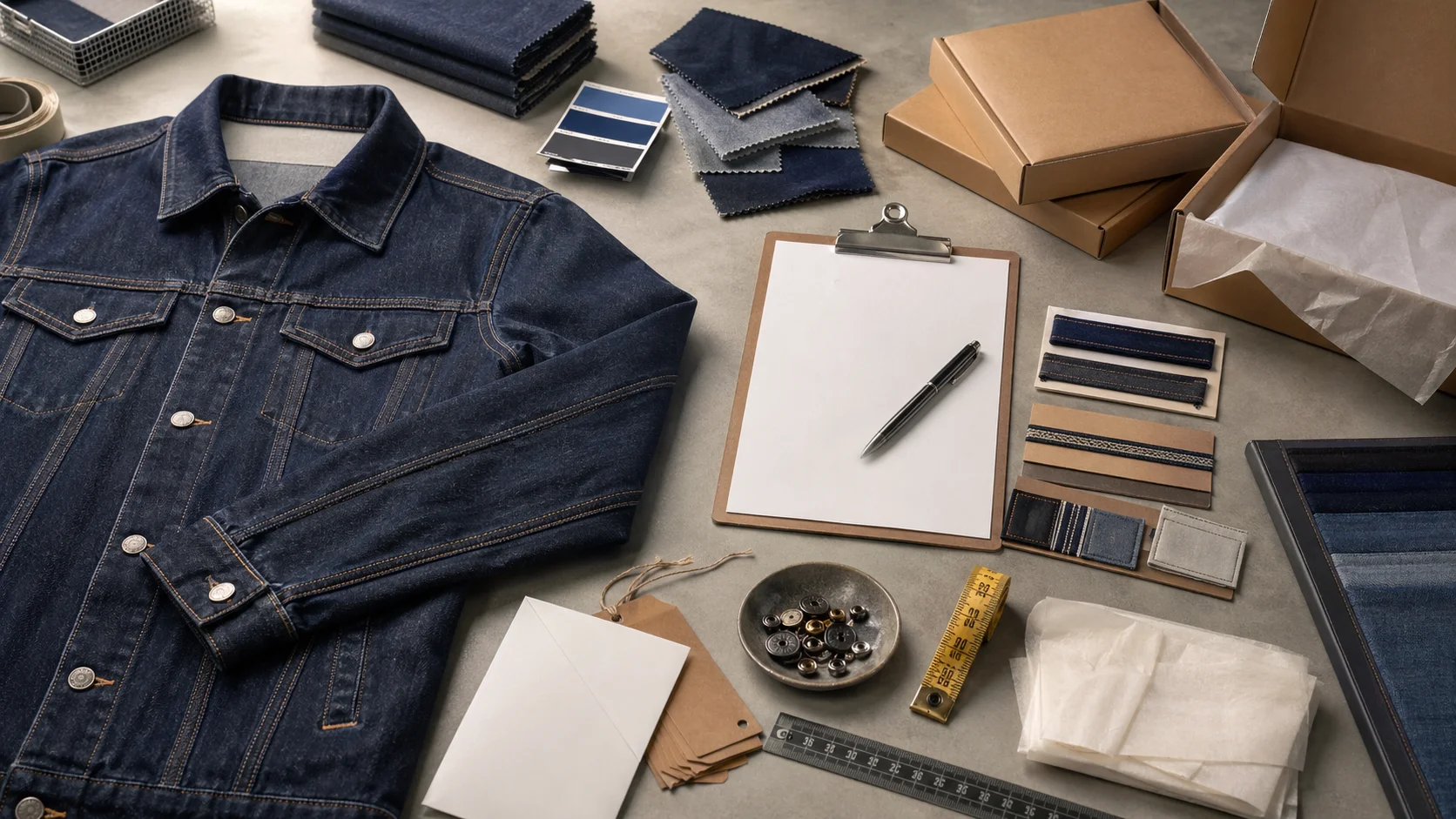
Overseas Brand Packaging Supplier Checks with checks for samples, fit, MOQ, QC evidence, pricing terms, and delivery risk.
Fast answer: Overseas Brand Packaging Supplier Checks: Samples, MOQ, Cost, and Risk should be judged by production evidence, not by a generic sourcing promise. The buyer needs sample proof, cost breakdowns, QC checkpoints, and delivery buffers in writing.
Ask for recent sample photos, measurement tolerances, fabric or print test assumptions, decoration test notes, packing examples, and a named inspection checkpoint. These details show whether the team can repeat an approved sample at bulk volume.
Separate garment cost, decoration, labels, packaging, sampling, testing, freight, and rush charges. When every cost line is visible, it becomes easier to reduce colorways, adjust size depth, or reserve more time for sampling.
The fastest way to lose money is to treat packaging like a finishing touch. I watched a 3% carton damage rate turn into a 12% margin leak, and the problem was not the product. It was the spec, the pallet pattern, and an insert that gave up halfway through a 4,800-kilometre sea lane.
Across factory visits in China, Vietnam, Portugal, and Turkey, the same mistakes keep showing up. Oversized cartons waste 8% to 15% of freight volume. Sloppy dielines create 2 to 5 mm print shifts. Weak corrugate crush strength adds broken returns, especially on routes with 20 to 35 days in transit.
That is why a custom packaging supplier for overseas brands has become a strategic partner, not a back-office vendor. European buyers usually care about recycling claims, FSC paper, and tight colour control. North American brands push speed, with 7 to 14 day revisions and aggressive sell-through calendars. Asian buyers often tolerate lower decoration cost, but they punish late approvals harder than anyone because factory schedules are crowded and export windows are narrow.
Brands sometimes spend $0.18 extra per unit on stronger board and save $0.42 in total landed cost once damaged goods, air rework, and customer service credits are counted. Counterintuitive? Sure. But trace the numbers. A cheaper box that fails in transit is not cheaper. It is deferred loss.
Packaging mistakes usually start before production even begins. One brand I reviewed approved a carton sample that was 6 mm too large on each side. The result: 14% less pallet efficiency and one extra container every nine shipments. Another had a barcode printed with 92% contrast instead of the 98% the warehouse scanner needed. Thirty-six hours later, 11,000 units were being hand-keyed into inventory.
Packaging is tied to freight in ways buyers underestimate. A 260 g mailer box might look lighter than a 320 g folding carton, yet if it ships in a non-optimised outer case, the cube penalty can wipe out the paper saving. I see this mistake most often in brands selling in the $18 to $35 range, because they chase tactile finishes without calculating pallet density.
Bottom line: packaging is logistics, damage control, and brand signalling in one line item.
A serious supplier handles the route from concept to carton approval. Dieline development comes first, then material sourcing, print testing, sampling, production, finishing, packing, and export paperwork. On a clean operation, design, prepress, and QC sit under one roof. Specialty jobs such as foil stamping, soft-touch lamination, or embossing may still be outsourced to approved partners with documented standards.
For overseas brands, the common formats are mailer boxes, folding cartons, paper inserts, hang tags, labels, and sleeves. When I visited a plant supplying both DTC apparel and cosmetics, the label department was running two shifts while the box line ran 1.5. That told me the buyer mix was skewed toward smaller, repeated orders with tighter SKU variation.
A broker only matches you with factories and takes a margin. A trading company may manage communication, consolidation, and sometimes inspection, but it usually does not own the presses. A direct factory partner controls the machine schedule and the QC floor, which matters when you need a 3,000-piece reorder in 12 days instead of 24.
That distinction matters for brands using clothing packaging solutions, because apparel cartons often need exact fold memory, fabric-safe inserts, and ink choices that do not rub during folding. Packaging teams also borrow specs from custom bra manufacturing programs, where delicate support components demand stricter carton protection than a standard tee box.
A proper supplier also tells you what not to overbuild. A 450 g rigid box with a magnetic closure may look luxurious, but if the product retails at $22 and ships in quantities of 20,000 units, the freight and assembly cost can outpace the brand value. The best suppliers say no. The average ones print whatever you ask for and leave you to absorb the consequences.
Factory inspection tells you more than a polished quotation ever will. I look first at colour consistency across archived samples, then at storage conditions for paper stock, then at calibration records for print and cutting equipment. If the paper piles are warped, the humidity is unmanaged, or the cutter has no dated calibration log, I assume the output will drift.
Best plants show QC checkpoints at incoming material, pre-press, in-line printing, die-cutting, and final packing. In one South China factory, I counted five checkpoints for a simple folding carton and eight for a premium sleeve with foil and emboss. In another plant 90 minutes away, there were only two checkpoints and a lot of confidence. Confidence is not quality.
Regional differences are real. Eastern European plants often excel at repeatability on medium runs of 5,000 to 30,000 units, with fewer cosmetic surprises and sharper paper handling. Some low-cost plants in South and Southeast Asia can hit a very attractive $0.07 to $0.12 per carton, but repeatability slips when artwork changes, especially on the second and third reorder. That is how a lower quote hides a higher failure rate.
Certification talk gets noisy fast. FSC, ISO 9001, and, if needed, a food-contact declaration can matter. OEKO-TEX is relevant for textile-touching packaging or inserts, and data from OEKO-TEX shows how chemical safety claims are increasingly audited across consumer goods supply chains. For broader trade and compliance guidance, trade.gov is also a useful authority for export-focused brands. By contrast, a wall full of certificates without batch traceability is marketing wallpaper.
Capacity needs proof, not promises. Ask for real machine counts, not “we have enough machines.” If a factory says it can handle 500,000 units per month, I want the exact number of offset presses, die-cutters, gluing lines, and workers per shift. A two-shift operation with three gluing lines is not the same as a one-shift shop with one tired team and no backup.
I also ask for three things: a recent defect report, a production schedule from the last 30 days, and photos of finished goods waiting for shipment. Those details reveal whether the factory is operating on contracts, or merely chasing inquiries.
Cost splits into five buckets: unit price, setup fees, tooling or plates, freight, and duty exposure. A simple kraft mailer box might land at $0.22 to $0.38 per unit at 5,000 pieces, while a premium rigid box with foil, embossing, and magnetic closure can run $1.80 to $4.50 depending on size, structure, and finishing. Plate fees may add $80 to $250 per colour, and die tooling can add $120 to $600 depending on complexity.
MOQ moves with material and decoration. Plain folding cartons can start at 1,000 to 2,000 pieces. Printed mailers often begin at 3,000. Rigid boxes or specialty sleeves with complex insert engineering may need 5,000 to 10,000. I once reviewed a quote for a 1,200-piece reorder that looked cheap until the supplier added a $190 setup fee and a $260 cutting die line item. The unit price was not the real price.
Lead time changes by programme type. Stock packaging can ship in 3 to 7 days. Semi-custom work, such as branded labels on standard cartons, usually takes 2 to 4 weeks. Fully custom packaging often needs 25 to 45 days for sampling plus 20 to 35 days for production, then 15 to 30 days by sea. Air freight cuts transit to 3 to 7 days, but it can add $1.20 to $4.00 per kg, which punishes bulky packaging fast.
Here is what most people miss: a lower MOQ can be expensive if it forces air freight. I have seen a 2,000-piece launch order cost 19% more per unit than a 10,000-piece order, even though the packaging factory quote was only 8% higher. The extra cost came from split shipping, rush proofs, and a last-minute art correction that delayed the sea booking.
Think in scenarios, not just quotes. A low-MOQ box at $0.52 with air freight may outperform a $0.34 box shipped by sea if your launch date is fixed and your retail margin is high. A premium finish like matte lamination plus hot foil may add $0.14 to $0.28, but if it improves shelf pickup by even 2% on a $28 item, the payback can be real.
For brands that use private label clothing and seasonal assortments, I recommend quoting the same brief in three bands: 2,000 units, 10,000 units, and 25,000 units. Compare carton dimensions, grams per square metre, print method, and ship mode side by side. If the supplier cannot quote all three cleanly, they do not understand scaling economics.
Bad dielines cause expensive chaos. A 1.5 mm bleed error can trim a logo. A barcode placed 8 mm too close to a fold can fail warehouse scanning. Language rules matter too, especially for bilingual packs headed to Canada, the EU, or the Gulf states, where Arabic text may need space hierarchy that changes the visual balance completely.
Market rules differ more than many buyers expect. The EU is strict on recycling symbols and claims that imply eco-performance without proof. The US is often more flexible on format but unforgiving on misleading wording. The UK has its own labelling conventions, and Gulf markets may require Arabic alongside English on primary packaging for certain categories. Data from WTO trade resources shows how cross-border compliance increasingly shapes packaging decisions before product leaves the factory. For sustainability claims, some brands also reference Textile Exchange to align material sourcing language with recognized standards.
When a reprint happens, the bill is ugly. I have seen artwork errors trigger $1,800 in plate replacement, nine lost production days, and a missed vessel booking that added another $2,600 in storage and rebooking fees. Food-contact packaging is even less forgiving. If a coating, ink, or adhesive is not approved for contact, the entire lot can be blocked.
Small structural choices affect warehouse efficiency too. A carton that stacks at 28 units per layer instead of 32 can push up pallet count by 14%. That means more handling, more damaged corners, and more headaches for 3PL teams already running tight receiving windows.
The best communication rhythm I have seen is simple: one weekly production call, one written recap within 24 hours, and one escalation channel for art or QC issues. Across time zones, that means the buyer sends questions by 4 p.m. local time, the supplier responds before its shift ends, and both sides freeze changes after approval. It sounds dull. It saves money.
Sample discipline matters more than charm. I want four stages: structural mock-up, printed proof, pre-production sample, and golden sample. The golden sample becomes the reference for colour, dimensions, and finish. On repeat orders, I compare batch photos against that standard and ask for a tolerance window on size, usually ±2 mm for small cartons and ±5 mm for larger mailers.
For brands scaling into broader product categories, packaging often follows the same logic as cut and sew manufacturing: the earlier you lock specs, the fewer surprises you pay for later. That applies to carton structure, insert depth, and even how shrink wrap sits around bundled packs.
Contract terms should cover defect thresholds, replacement terms, and incoterms. I prefer clear language on a 3% cosmetic defect cap, a 0.5% critical defect cap, and replacement shipping responsibility if the fault sits with the factory. If re-orders drift by more than the agreed colour tolerance, the supplier should rework or credit the run.
One serious rule: never let every team member negotiate a different version of the truth. The sales rep, production manager, and QC lead must work from the same approved file set, or repeat orders will slowly become a different product.
Start with a one-page brief. Include product type, target market, carton dimensions, print method, finish level, annual volume, target MOQ, and budget band. Then shortlist three suppliers and send the exact same brief. Compare them on unit price, setup fees, sample cost, lead time, and freight assumptions. If one quote is 22% lower but omits tooling, it is not comparable.
Ask for QC photos, machine lists, and recent export examples before you even talk about price. Red flags are easy to spot: vague MOQ answers, inconsistent sample quality, silence on lead times, and a factory that cannot explain how it handles 2-colour versus 4-colour print runs. I also back away when a supplier says “no problem” to everything. Real factories have limits.
My 30-day sourcing plan is blunt. Week 1: lock specs and target markets. Week 2: send RFQs and request samples. Week 3: review factory evidence, not just quotations. Week 4: approve one supplier, one backup, and one shipping plan. If the packaging will support apparel, you can align it with broader product programs such as clothing packaging solutions from the start.
The brands that get this right treat packaging as an operating system. The ones that fail treat it as a print job. I have seen the difference across 200-plus factories, and it shows up in freight bills, return rates, and how confidently a shipment clears customs.
A supplier manages dielines, sampling, material sourcing, print production, finishing, packing, and export paperwork. A direct factory partner usually handles more of the process in-house than a broker or trading company, which helps control lead time and quality. For overseas brands, that often means 3 to 6 approval steps before shipment.
Simple mailer boxes often cost $0.22 to $0.38 each at 5,000 pieces, while premium rigid boxes can run $1.80 to $4.50 each depending on finish and structure. Setup fees, plates, and die tooling can add $200 to $900 per project. Freight and duty can add another 10% to 30% to landed cost.
Stock packaging can ship in 3 to 7 days. Semi-custom packaging usually needs 2 to 4 weeks, while fully custom programs often take 25 to 45 days for sampling and 20 to 35 days for production. Sea freight can add 15 to 30 days more, depending on route.
Compare three suppliers against the same brief and ask for machine counts, QC photos, sample stages, and export references. Check whether they can explain tolerances, MOQ, and finish options without changing their answer each time you ask. A supplier that gives clear, consistent numbers is usually safer than one with the lowest price alone.
Costs go wrong when brands ignore setup fees, use oversized cartons, or switch to air freight because sampling ran late. I have seen a $0.12 carton become a $0.41 landed unit once reprints and rush shipping were added. The biggest misses usually come from poor dielines and weak freight planning.