
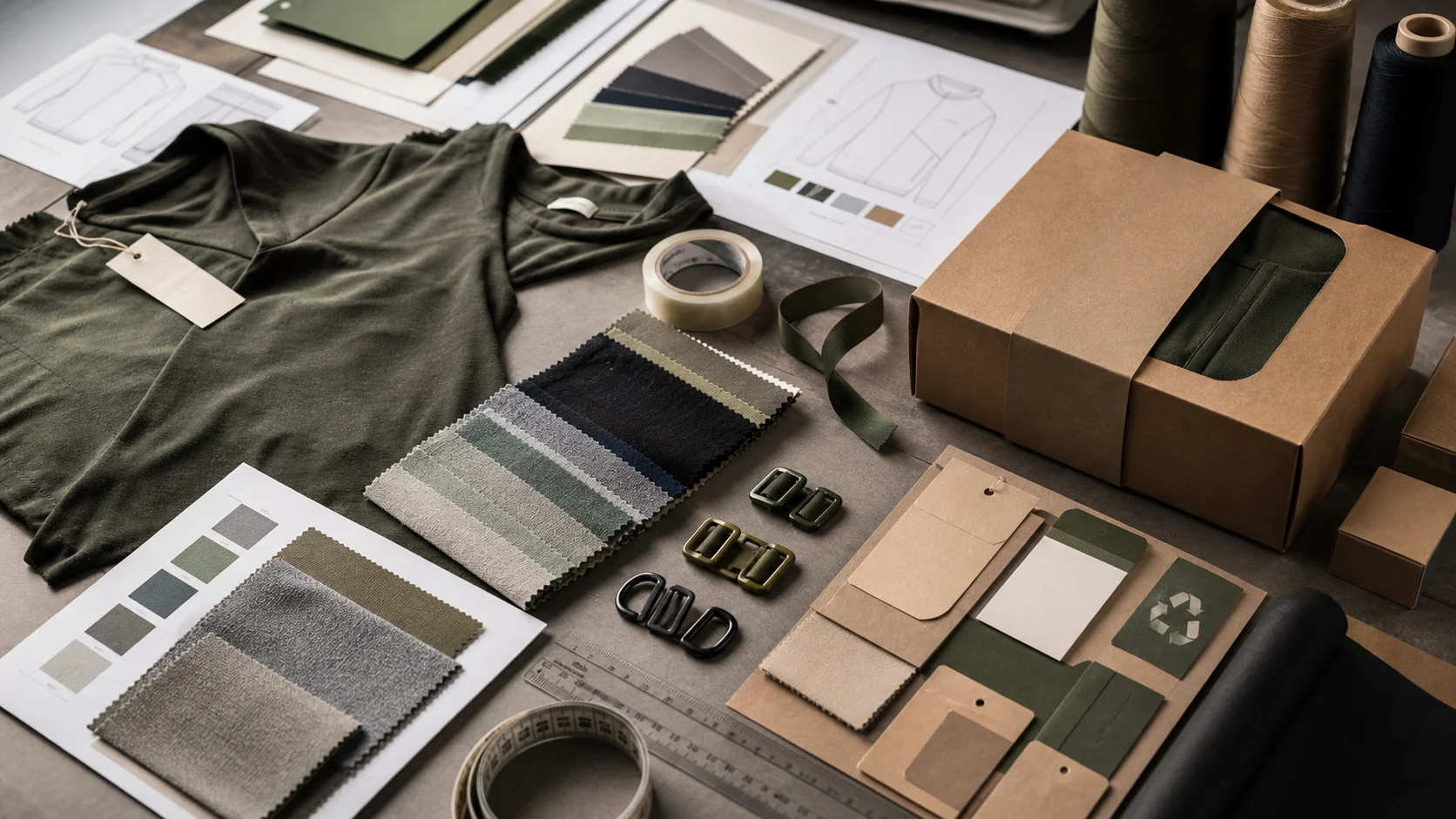
Custom Composition Label Printing for Fashion Brands compared by sample evidence, fabric or trim specs, MOQ, AQL terms, cost lines, delivery timing, and...
Fast answer: Custom Composition Label Printing for Fashion Brands: Material, Print, MOQ, and QC Terms should be judged by production evidence, not by a generic sourcing promise. The buyer needs sample proof, cost breakdowns, QC checkpoints, and delivery buffers in writing.
Ask for recent sample photos, measurement tolerances, fabric or print test assumptions, decoration test notes, packing examples, and a named inspection checkpoint. These details show whether the team can repeat an approved sample at bulk volume.
Separate garment cost, decoration, labels, packaging, sampling, testing, freight, and rush charges. Clear cost lines make it easier to reduce colorways, adjust size depth, or reserve more time for sampling.
On factory floors in Vietnam, Turkey, and Portugal, I have watched a $0.02 label decision stall a 12,000-piece shipment. Most buyers treat custom composition label printing for fashion brands like paperwork, but in production it behaves like a chain reaction. One wrong fiber line, and the whole lot starts slipping toward relabeling, re-inspection, and a missed vessel cutoff. In my experience, the smartest buyers treat label proofing like a safety check before the shipment leaves the dock.
At a Guangzhou label house tucked between the Pearl River delta dyehouses, a Roland VersaCAMM thermal transfer press running OEKO-TEX Standard 100-certified polyester ribbon can print 25,000 neck labels in a single 8-hour shift, and the operators track each batch through to WRAP-certified finishing. I have seen the same print file hit an Istanbul embroidery line, a Dhaka cut-and-sew hall, and a Ho Chi Minh City inspection room within 36 hours because the production plan assumed those labels were ready the moment the trims team signed off.
Sampling misses the danger more often than people admit. Brands obsess over silhouette, hand feel, and trim color, then approve labels from a half-read mockup that does not match the garment. Honestly, this approach works better because it forces the team to pause, read, and double-check before the cutters start stacking bundles (and yes, the earlier the better). I once saw a multi-SKU order with eight colors and three sizes per style require 2,400 replacement labels because the care copy told users to tumble dry a fabric that would not survive it. It felt like chasing a runaway spool of thread (and frankly, the QA team needed another espresso) when that many labels needed reprinting.
That is margin leakage, plain and simple. Frankly, margin leakage is the sneakiest budget thief on the floor (and it refuses to show a badge). If a factory has to open, replace, and reclose 5,000 garments, labor alone can add $0.18-0.45 per unit, before freight changes and packing delays. On a premium run with MOQ 500 pieces per style, the fix can feel minor, but on a 20,000-piece program, finance notices.
Returns tell the same story. Consumers read labels, especially in premium and sustainable fashion where trust matters. A $68 knit has to feel more credible than a $14 tee, and the label is part of that proof. In my experience, consumers treat the label as a mini contract and nothing kills trust faster than a smudged fiber list. Legible composition information reduces care confusion, while a flimsy label that fades after 10 washes can trigger complaints even when the garment itself is fine.
Fast fashion buyers usually push for the lowest unit cost. Premium brands do the opposite. They will pay $0.12-0.28 for sharper typography, better durability, and a cleaner fold finish, while volume programs may try to squeeze printed satin labels down to $0.03-0.06 at scale. Cheaper on paper. More expensive in the wash test. I have seen that pattern in four countries, and it keeps repeating. Honestly, this approach works better because those premium labels actually preserve the brand story and give customer service fewer headaches (and the compliance team sleeps better).
Compliance rules change faster than creative teams expect. In the US, fiber content must be accurate and country of origin must be clear. In the EU and UK, care expectations are stricter, and many retailers want standardized symbol sets aligned with ISO care labeling practice. According to the International Organization for Standardization, care symbols are not decoration. They are technical language buyers use to reduce risk. In my experience, compliance is a team sport, and if the merchandiser and legal team aren't sitting together, you end up with a label that reads like a short story with missing punctuation (yes, that chat log stays open on my laptop at odd hours).
One label file rarely works everywhere. A shirt sold in Germany, Canada, and Japan may need separate language versions, different fiber naming conventions, and a different legal placement for the origin statement. In my experience, nothing keeps me on my toes like juggling those multi-market requirements, and the terminology spreadsheet lives on my desktop (don't ask how many tabs are open). Organic cotton, recycled polyester, traceability claims — all of it has to be backed by evidence. I have watched quality teams reject a batch because the word “recycled” appeared on the artwork, but the paperwork supported only a 60 percent recycled blend.
Certification ties the story together. When a Dhaka-trim supplier promises GOTS-certified cotton tape and the Ho Chi Minh City finishing line runs BSCI audits, I want that documented on the label proof I sign off. A GRS traceable yarn, accidental flame-resistance declarations handled by WRAP, and OEKO-TEX Standard 100 testing for dyes are all part of the compliance package, and auditors will ask for the LOT number. I make a point of double-checking the percentages and symbol size because the inspector's ruler is not going soft on me. It makes me want to hug the QA lead (not literally; they would call security) when the paperwork finally matches the garment.
Premium and sustainable brands get scrutinized more heavily because they sell trust, not only product. Their shoppers expect transparency, and retailers expect documentation. That is why I spend as much time reviewing label evidence as I do reviewing fabric hand feel. In my experience, rotating label proofing with fabric approvals cuts a few rounds of rework. It connects directly to private label clothing programs, where the label becomes part of the brand promise, not a last-minute insert.
Compliance teams and production teams often live in separate silos, which lets simple label errors survive. A merchandiser approves the artwork, the factory prints from an older version, and nobody catches the mismatch until carton audit. On one trip to a three-line knitwear plant, I saw 9,600 labels reprinted because the English and French order of care text had been flipped. It frustrates me to the point of wanting to chain the print shop to the boardroom (but I settle for a stern email) when the versions climb out of sync.
Material choice decides how a label behaves after 20, 30, and 50 washes. Woven labels are the toughest option and still the default for premium tailoring, denim, and outerwear. Printed satin is softer and cheaper, which is why it shows up in lingerie, loungewear, and volume basics. Cotton labels support a natural brand story, though sloppy edge finishing makes them fray. Recycled polyester is the strongest fit for performance claims, especially in activewear and outerwear. In my experience, adhesives behave like relationships: strong only when compatibility is verified (and yes, that means testing them on actual swatches before the line call).
Print method matters just as much. Thermal transfer works well for variable data and short runs, usually 300-2,000 pieces. Flexographic printing suits higher volumes and stable artwork, often 5,000 pieces and up. Screen printing gives rich opacity on darker substrates. Digital printing handles fast artwork changes without expensive plates. Testing four colorways of one style? Digital can save 2-3 weeks and one proof cycle, and I've seen it do exactly that when the art director keeps tweaking the ink.
I always ask suppliers about wash resistance, rub-fastness, and color fastness under heat and detergent exposure. In my experience, a label that looks perfect at delivery can blur after 15 washes if the ink and base fabric are mismatched. I once saw a French terry 320 GSM hoodie keep its shape beautifully while the inside-neck label went illegible after 18 washes because the adhesive bled into the print layer.
A common solution is to drop a 65/35 GRS-certified recycled polyester/cotton blend into the neck tape, run it through a Ho Chi Minh City heat transfer press, and finish with a double-needle stitch that protects the edges during ironing. Alley press operators in Istanbul prefer SBS (styrene-butadiene-styrene) adhesives on satin labels because they bond cleanly to micro-modal fibers, and in Guangzhou the name badge line uses a four-station hot peel die cutter to keep corners square. Machines like the Mimaki JV300 with eco-solvent inks or industrial inkjet printers with pigmented dye offer predictable opacity, while laser etching rarely fails compliance checks for metallic threads.
Price points push brands toward compromise. Entry-level labels may save pennies per unit, yet if they trigger complaint rates of 1.5 to 2 percent, the hidden cost can exceed the savings. Premium durable labels, especially on products sold above $50, often reduce rework and improve the first 30-day customer experience, especially when the label is backed by GOTS and OEKO-TEX Standard 100 certifications.
Labor, material, and compliance costs all compete for the same dollars. A Dhaka-based woven label supplier charging $2.50-4.00 per unit at 500 MOQ for double-sided woven tags offers pre-approved artwork, chemical testing, and BSCI and WRAP audits included. By contrast, a Guangzhou print house pushing digitial satin labels at $0.18 per piece usually requires a second shipping charge just to return corrected Proofs. If the label requires special inks for metallic foil or a laminated finish, add $0.12-0.25 per unit, which can knock a $6 retail price out of its sweet spot.
What drives the price beyond base textile cost? Certification hoops like GOTS, GRS, and OEKO-TEX Standard 100, adhesive sampling, rush tooling for new laser die cuts, and freight for prototypes inbound from Istanbul or Ho Chi Minh City. Again, the cheapest option is not always the best when the brand promise is at stake.
Start with a spec sheet that includes fiber breakdown, care instructions, origin claims, and placement requirements for every market. Splitting the brief into language layers—English/French at minimum—keeps the kit organized. Share approved PMS values and, if you can, a high-resolution sample garment. Add a compliance addendum that lists required certifications (OEKO-TEX, GOTS, WRAP, BSCI, GRS) and auditing expectations so suppliers can verify traceability before ink hits the substrate.
Expect 18-22 business days for a full custom label cycle when you include artwork confirmation, PP sample runs, wash tests, and certifications. That usually breaks down to 2-4 days for approvals, 3-5 days for tooling and die cutting, 5-7 days for printing, and another 2-6 days for finishing, auditing, and packing. Rush orders can shave a few days, but they spike the risk of errors, which is why I never lock production without a signed proof and a city-specific plan for Guangzhou, Dhaka, or Istanbul line readiness.
Line up your compliance documents, lock in your preferred label houses across Guangzhou, Dhaka, Ho Chi Minh City, and Istanbul, and cascade the artwork through the same gatekeepers who approve trim samples. Be explicit about materials, processes, and certifications, and demand runoff testing before mass production. Keep the QA lead informed, add label proofing to every factory visit agenda, and build slack into the timeline for contingencies.
Q: What material should I choose for premium knitwear labels?A: Choose woven GOTS-certified cotton with a satin face and SBS adhesive, then test in your approved heat press before committing to bulk.
Q: How do I avoid reprints mid-run?A: Ensure your merchandiser, compliance, and print supplier review each phase, use consistent artwork templates, and confirm that batches are tied to OEKO-TEX Standard 100, WRAP, and BSCI documentation.
Q: What should go on the spec sheet for multiple markets?A: Include fiber percentages, care symbols with ISO references, translated size information, and a signed certification checklist for GRS or other sustainability claims.