
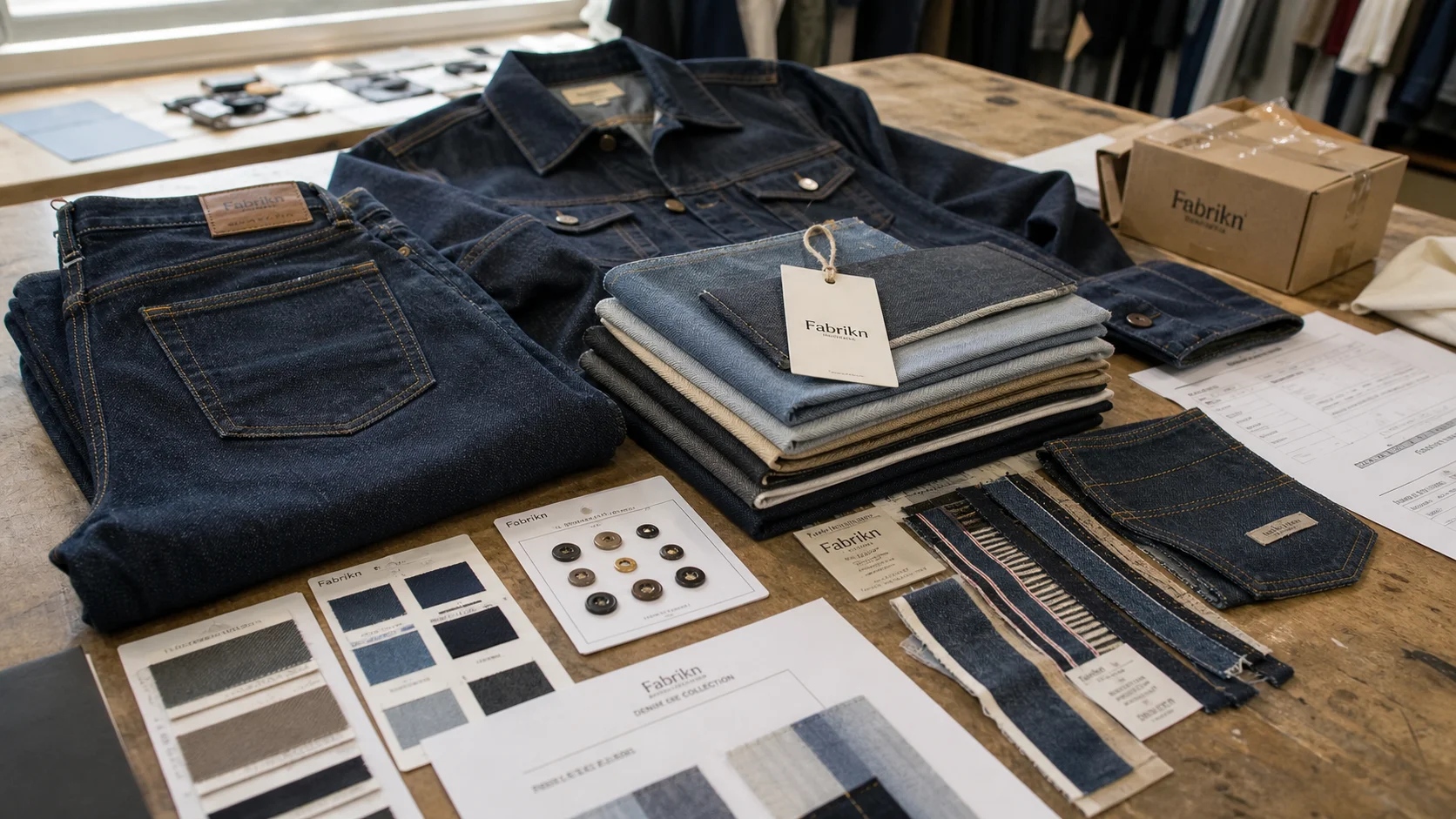
Source A Custom Denim Manufacturer for Private Label compared by sample evidence, fabric or trim specs, MOQ, AQL terms, cost lines, delivery timing, and...
Fast answer: Source A Custom Denim Manufacturer for Private Label: Material, Print, MOQ, and QC Terms should be judged by production evidence, not by a generic sourcing promise. The buyer needs sample proof, cost breakdowns, QC checkpoints, and delivery buffers in writing.
Ask for recent sample photos, measurement tolerances, fabric or print test assumptions, decoration test notes, packing examples, and a named inspection checkpoint. These details show whether the team can repeat an approved sample at bulk volume.
Separate garment cost, decoration, labels, packaging, sampling, testing, freight, and rush charges. Clear cost lines make it easier to reduce colorways, adjust size depth, or reserve more time for sampling.
How to Source a Custom Denim Manufacturer for Private Label - Clothing Manufacturer manufacturing guide
Finding a custom denim manufacturer for premium private label sourcing is less about chasing the lowest unit cost and more about controlling fit, fabric, trim quality, wash consistency, and repeatability. Denim is unforgiving. Small mistakes in shrinkage, shade banding, pocket placement, or stitch tension show up fast, especially once a private label brand starts ordering the same style across multiple seasons.
The right supplier should be able to translate a design brief into a stable production program, not just cut and sew a one-off sample. That means understanding fabric construction, wash ranges, labeling rules, grading, and the practical limits of a factory’s equipment. It also means asking the right sourcing questions before you commit to a first run.
If you are building a premium private label line, think in terms of product consistency and margin protection. A slightly higher factory price can be a better commercial decision if it reduces rework, rejects, and customer returns. For brands that need structured support, it can help to review a supplier’s services early in the process and use the contact us page to request a proper development conversation rather than a generic price quote.
A capable custom denim manufacturer should be able to handle style development, pattern changes, fabric sourcing, wash development, and final production without losing control of fit or finish. The best sign is not a polished sales deck. It is the detail in the questions they ask back.
Expect a serious supplier to ask about target gender, body type, fit block, wash category, trim finish, labeling method, expected size range, and forecast volume. A factory that quotes too quickly without clarifying those points may be guessing. Guessing is expensive in denim.
For premium private label sourcing, prioritise manufacturers that can show consistency in these areas:
One useful filter is whether the manufacturer treats denim as a technical category. Basic woven sewing capability is not enough. Denim production includes fabric distortion, finishing effects, hardware application, and washing variables that can change the final hand feel and fit.
Some factories are better at rigid denim, others at comfort stretch, coated finishes, or vintage-style washing. A factory that is strong in one segment may still be a poor fit for your product if your line depends on soft premium hand feel or exact vintage coloration.
Keep the conversation specific. Ask what fabric weights they work with most often, what wash types they handle in-house, and whether they can support laser, ozone, resin, or enzyme finishing if your design requires it. If they outsource washing, ask how they manage communication and quality control across those steps.
In denim sourcing, the factory that asks fewer questions is often the one that will create more problems later.
A premium private label denim program starts with a clear technical brief. A vague idea like “high-end jeans” is not enough. The factory needs measurable targets for fabric, construction, and finishing. The more precise the brief, the easier it becomes to compare quotes and reduce revision cycles.
Most denim programs begin around 10 oz to 14 oz, though lighter and heavier options exist depending on the product category. Premium jeans often sit in the 11 oz to 13.5 oz range because that weight can balance structure and comfort. That said, the right weight depends on target season, silhouette, and wash process.
Composition matters as much as weight. Common premium options include 100% cotton for rigid styles and cotton with 1% to 3% elastane or similar stretch fibers for comfort fit programs. Stretch content can improve wearability, but it can also affect growth, recovery, and long-term shape retention. If the customer expects a clean, rigid vintage look, stretch may work against the intended positioning.
Selvage denim can support a premium story, but it is not automatically the right answer. It often carries higher fabric cost, tighter sourcing constraints, and narrower production flexibility. Ring-spun denim can offer a more refined surface and better hand feel than open-end denim, though final performance still depends on the mill and finish.
For private label sourcing, choose the fabric that matches your market promise. A luxury-inspired line may justify selvage or long-staple cotton. A contemporary commercial line may need a more scalable fabric with dependable wash outcomes and broader size-run economics.
Premium denim is judged at the trim level. Buttons, rivets, zippers, thread, labels, and pocketing all affect the final perception of value. Cheap trims can undermine otherwise strong construction. Ask for trim specs in writing.
Useful details to lock down include:
There is a tradeoff here. Premium trims support pricing power and brand perception, but they also raise landed cost and may extend sourcing lead time. If a trim has a long procurement cycle, it can become the critical path for the whole order.
MOQ for custom denim can vary widely. Small-batch programs may start around 100 to 300 pieces per style or colorway, while many factories prefer 500 to 1,000 pieces or more for efficient production. Some mills and factories will accept lower MOQs, but the unit price usually rises, and fabric choice may be limited to available stock.
Low MOQ is useful for market testing, but it should not be treated as a free advantage. Small runs can be expensive once pattern work, sample development, wash setup, and trim setup are allocated across a limited order size. A buyer should compare not only unit price, but also the real cost per approved sellable unit after samples, revisions, and freight.
Decision point What to ask Why it matters MOQ Can the factory support 100, 300, or 500 units per style? Affects cash flow and style testing strategy Fabric sourcing Is the denim mill stock supported or special order? Impacts lead time and shade consistency Wash setup Is washing included in base pricing or billed separately? Can materially change landed cost Trim sourcing Are trims sourced by the factory or supplied by the buyer? Determines control, risk, and timeline Reorder stability Can the factory repeat the same fabric and wash next season? Critical for brand continuityPremium private label sourcing works best when the buyer understands where to spend and where to simplify. A custom waistband patch may be worth the investment. A fully bespoke pocketing print might be too expensive for a first test run. The right compromise depends on the brand position and sell-through expectations.
Sampling is where many denim projects lose time. A clear process reduces revisions and prevents the factory from treating a half-approved sample as production-ready. The sample chain usually includes tech pack review, proto sample, fit sample, size set sample, and pre-production sample, though not every program requires every step.
The approval sequence should not be rushed. A fit problem found before wash development is easier to fix than a fit problem discovered after hardware, labeling, and washing are locked. Denim also behaves differently after washing, so a sample that looks right in raw state may still fail in final form.
Ask the factory to confirm which dimensions are expected before wash and which are expected after wash. That clarification matters because shrinkage can affect inseam, rise, thigh, and waistband measurements. For stretch denim, growth and recovery must also be checked after wear or tension testing when possible.
Approval should cover more than appearance. Record the approved fabric code, wash code, trim package, size spec, measurement tolerances, label placement, and packaging method. If a later production lot drifts from the approved sample, you need a written baseline to reference.
Keep one approved golden sample if the factory agrees. That sample becomes the visual and technical reference for repeat production, customs questions, and internal quality checks.
Lead time in denim is rarely a single number. It depends on fabric availability, trim sourcing, sample complexity, wash development, order size, and factory workload. A simple stock-fabric, basic-wash order may move faster than a custom fabric program that requires special finishing and nonstandard trims.
As a rough planning range, custom denim development can take several weeks for sampling and another several weeks for production, with longer timelines if the fabric must be woven to order or if the wash process needs multiple rounds of adjustment. Buyers should treat any promised schedule as conditional until fabric, trims, and sample approvals are finalized.
Lead times typically extend when:
For seasonal assortments, buffer time matters. Denim is vulnerable to schedule slippage because one delayed element can hold the entire production line. A practical buyer should ask for the factory’s critical path, not just the final delivery date.
Denim quality issues are often visible, but not always obvious until production is already underway. A good inspection plan should cover measurements, shade consistency, construction quality, trim security, and wash uniformity. It should also include tolerance levels for batch-to-batch variation.
Fabric inspection should happen before cutting, not after the garments are finished. That is especially true for indigo denim, where lot-to-lot color variation can be subtle but commercially important. A buyer should ask whether the supplier checks fabric shade, width, and defects at the roll stage.
Garment inspection should include measurement checks on key points such as waist, rise, hip, thigh, knee, leg opening, and inseam. Denim tends to be judged by fit first, then finish. A beautiful wash will not save a pair of jeans that fits badly.
A third-party inspection can be worth the cost for first production runs, especially if the factory is new, the order is technically complex, or the brand cannot afford a high defect rate. Inspection is not a guarantee of perfection, but it does reduce the chance of accepting a lot with avoidable faults.
Premium products carry higher expectations and lower tolerance for defects. A small defect rate that might be acceptable in entry-level basics can become a serious issue in a premium denim line. Buyers should define acceptable tolerance in advance, including measurement variance, shade variation, and repairable defects.
That said, even strong factories will have some variance in washed denim. The right question is not whether variation exists. It is whether the manufacturer can keep that variation within a commercially workable range.
Private label denim gives brands room to build identity through details. The strongest branding is usually understated and consistent rather than loud. Placement, finish, and material choice should support the target customer, not compete with the garment’s silhouette.
Brands should be cautious about over-customizing early runs. Every branded element adds cost, complexity, and approval burden. A focused package often works better for first production than a fully bespoke build with too many specialty parts.
Private label success often comes from balancing distinctiveness with manufacturability. A buyer wants recognizable brand cues, but not at the expense of delivery risk. The better path is to choose one or two strong differentiators and execute them cleanly.
Before placing a production order, verify that the supplier can actually support your program at scale. A persuasive quote is not enough. The vendor should provide enough technical and commercial detail to let you compare them against other options on equal terms.
Useful vetting questions include:
It also helps to review the broader company profile. A transparent supplier should be able to explain its role in the process, the kinds of programs it supports, and the level of sourcing help it can provide. A page like about us is useful only if it gives real context, not a generic promise of quality.
Watch for red flags such as vague fabric descriptions, refusal to discuss tolerance ranges, inconsistent answers about wash methods, or pressure to approve samples before fit and measurement are stable. A rushed order is often the most expensive order.
The cheapest quote is not always the best buying decision. If one factory uses a lower-grade zipper, offers looser inspection, or avoids responsibility for wash variation, the apparent saving may disappear in returns and replacements. Premium private label sourcing should reward suppliers that reduce risk, not just invoice total.
Any custom denim order should be backed by clear written terms. The commercial agreement should cover product specs, sample approvals, payment schedule, defect handling, delivery terms, packaging instructions, and responsibility for late or nonconforming goods.
Compliance needs will depend on your market, but buyers should think about fiber content labeling, care labeling, country-of-origin marking, and any chemical or restricted-substance requirements that apply to the destination market. If the denim uses special finishes or coatings, ask whether the factory can provide relevant test data or declarations where needed.
Do not assume the supplier will manage everything by default. In private label programs, responsibility can be split between buyer and factory in ways that are not obvious until there is a dispute. Clarify who provides artwork, who approves label text, who signs off on packaging, and who bears the cost if a spec mismatch leads to a hold or rework.
A practical contract should also address reorder continuity. If a style sells well, you need a plan for repeat production with minimal drift. That plan should specify whether the same mill, same wash recipe, and same trim package will be maintained or whether substitutions are allowed.
For brands that want a more structured route into premium private label sourcing, a sourcing partner can help filter factories, organize specifications, and reduce avoidable trial and error. The value is not in replacing your decision-making. It is in making sure that the factory selection process is grounded in product reality rather than sales language.
If you are evaluating support options, start by looking at how a supplier or partner organizes development, production, and communication. A practical team should be able to discuss process clearly, explain tradeoffs honestly, and point you toward the right next step instead of pushing a one-size-fits-all package. That is where a page like services becomes useful, especially for brands trying to align design ambition with production discipline.
Brands sourcing custom denim for the first time often benefit from a slower, more technical start. The goal is not to launch the biggest program immediately. The goal is to build a repeatable one. Once a fit block, fabric base, and wash standard are stable, scaling the line becomes much easier.
Choosing a custom denim manufacturer for premium private label sourcing is a balancing act between quality, speed, control, and cost. A strong supplier will help you manage technical details without overcomplicating the process. A weaker one will make every step feel urgent and uncertain.
The best purchasing decisions in denim are usually the ones that protect fit, keep fabric and trim consistent, and make reorders predictable. Clear specifications, disciplined sample approvals, realistic lead times, and inspection planning all matter more than a flashy quote.
If you are building a premium private label denim line, treat the first order as the foundation for the next three. That mindset usually leads to better sourcing choices and fewer expensive surprises.
Get a free quote from Fabrikn — your trusted B2B clothing manufacturer with 10+ years of experience. MOQ as low as 200 pieces.
Get a Free Quote →MOQ often starts around 100 to 300 pieces for smaller programs and can rise to 500 to 1,000 pieces or more for standard production economics. The exact number depends on fabric type, wash complexity, trim customization, and whether the factory is using stock materials or ordering special components.
Many denim programs move through proto, fit, and pre-production samples. Some styles need additional wash or size-set samples. The number depends on how different the final garment is from the factory’s standard block and how much wash development is required.
Confirm fabric weight, fiber content, weave type, shrinkage expectations, stretch percentage if any, and whether the fabric is stock-supported or special order. It also helps to confirm the mill or fabric code so the same material can be repeated later.
Lead times change with fabric availability, trim sourcing, wash development, sample revisions, and factory capacity. A style that looks simple on paper can take longer if the wash recipe is complex or the trims have to be custom-made.
The biggest risks are shade inconsistency, shrinkage drift, twisting, fit problems after wash, and trim failures such as loose buttons or rivets. Measurement control and pre-production approvals are the best way to reduce those issues.
That depends on the brand position and customer expectation. Rigid denim often supports a more authentic and structured look, while stretch denim can improve comfort and broaden appeal. The tradeoff is that stretch can complicate shape retention and long-term fit consistency.
Lock down the approved fabric, wash code, trim package, measurement spec, tolerance range, label placement, and packaging method. If possible, keep one golden sample as the reference for future production and reorders.
It is often worth it for first runs, new suppliers, or technically complex styles. Third-party inspection does not remove all risk, but it can catch avoidable problems before shipment and give the buyer a stronger basis for acceptance decisions.