
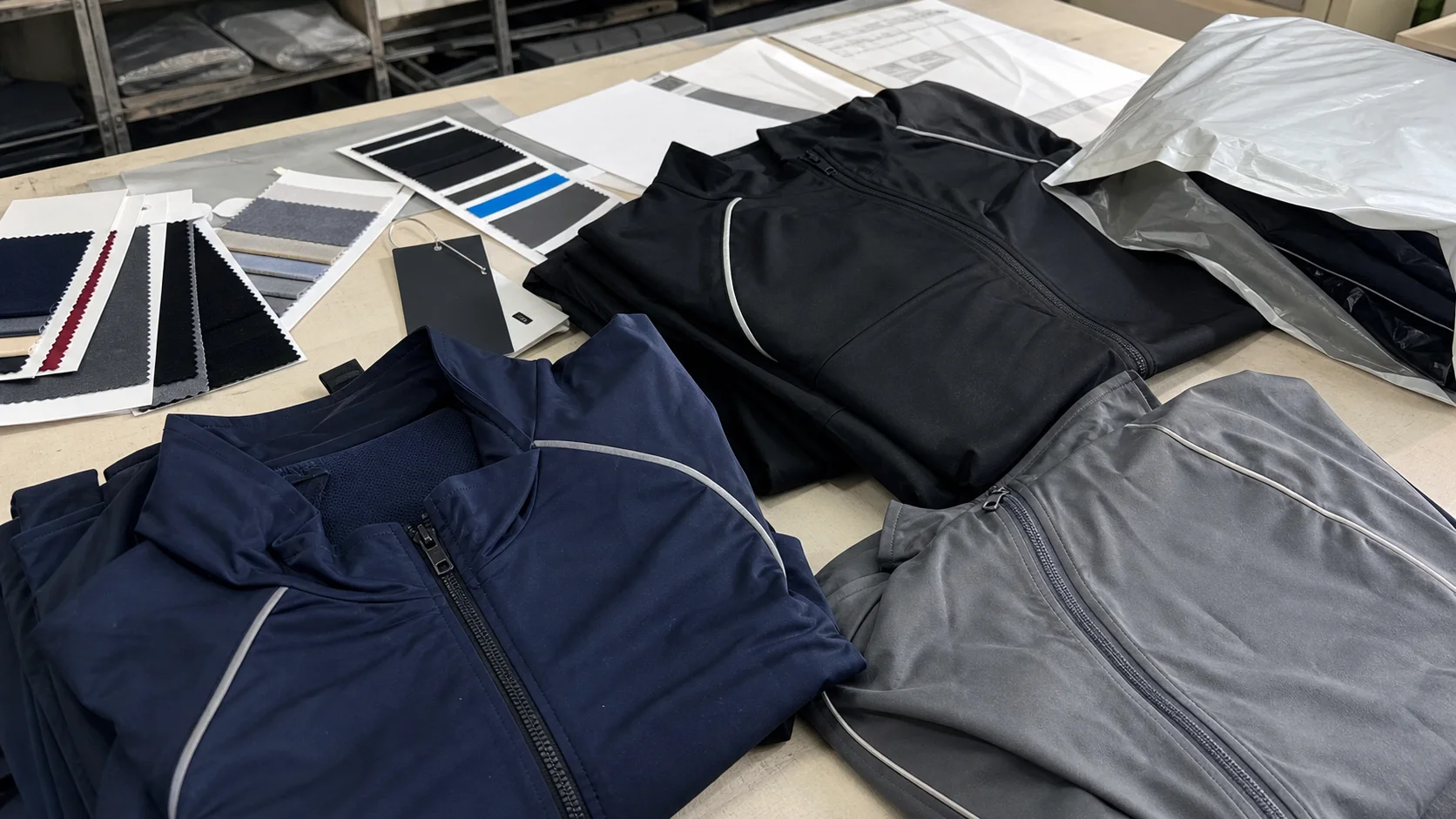
A detailed outline for corporate buyers evaluating private label recycled jackets, with a focus on compliance documentation, traceability, testing records, and production requirements tied to sustainable apparel programs.
Private Label Recycled Jackets with Compliance Docs - Fabrikn production reference
Private label recycled jackets have moved from a niche sustainability project to a practical sourcing category for corporate buyers. Companies now use branded outerwear for staff uniforms, sales teams, field crews, event programs, retail merchandise, and client gifting. In many of those programs, purchasing teams are under pressure to improve sustainability claims while still meeting durability, price, and documentation requirements.
That is where private label recycled jackets with compliance documentation become commercially relevant. A jacket made with recycled polyester or recycled nylon can support a sustainability brief, but the material story alone is not enough for professional procurement. Corporate buyers usually need proof. They need to understand what is recycled, what percentage is verified, how trims are specified, whether restricted substance requirements are covered, and what testing or declarations can be supplied before shipment.
In practical terms, the strongest suppliers are not only offering a recycled fabric option. They are also prepared to support the paperwork that helps a buyer clear internal review. That can include fiber-content declarations, transaction certificates where relevant, test reports, labeling confirmation, and signed compliance statements tied to the finished product or its materials.
For companies buying at scale, this is less about marketing language and more about risk control. A corporate apparel program can stall quickly when the factory can make the garment but cannot organize the documentation package. That is why many sourcing teams now look for suppliers that can handle product development and documentation together through a structured process. Buyers comparing options often start by reviewing the supplier’s production support capabilities through pages such as services and then move into direct specification review.
The phrase sounds straightforward, but it covers several separate sourcing requirements that should be checked one by one.
Those three parts do not always arrive together. Some suppliers offer custom branding but limited recycled material verification. Others can source certified recycled fabrics but only provide mill-level paperwork, not a complete shipment document set. Some can produce the garment well yet struggle with labeling compliance for multiple markets.
Corporate buyers should treat this category as a documentation-led apparel purchase. The jacket design matters, but the sourcing decision should also be based on how clearly the supplier can define material inputs, document claims, and maintain consistency from approved sample to bulk production.
A useful way to frame the purchase is this: you are not only buying a recycled jacket. You are buying a repeatable process that includes design execution, material traceability, quality control, and document readiness.
Corporate procurement teams tend to evaluate private label recycled jackets differently from fashion startups or promotional resellers. They often have internal stakeholders from procurement, legal, CSR, brand, and operations. Each group is looking at a different form of risk.
The jacket has to match the brand standard across colors, logo application, packaging, and labeling. If the order is for uniforms or public-facing staff, color shade consistency and trim matching matter more than many first-time buyers expect.
Corporate outerwear is often worn repeatedly, not once for a campaign photo. Buyers usually need clarity on fabric weight, water resistance, breathability, seam construction, insulation type, zipper grade, and washing performance. A recycled fabric claim does not replace performance requirements.
This is often the deal-breaker. Buyers may need declarations for REACH or other restricted substance standards, country-of-origin information, care label accuracy, carton markings, and recycled material support records. If documents arrive late or are inconsistent, internal approval can slip even if production is on time.
MOQ, color count, size ratio, and replenishment options are important. A factory may quote a good unit price on a 3,000-piece run but be far less competitive at 300 to 800 pieces, which is a common range for many corporate programs.
Lead time for jackets is affected by more variables than simple knit garments. Shell fabric, membrane lamination, insulation booking, logo trims, and packaging all add dependencies. A supplier that maps the critical path clearly is usually safer than one offering an optimistic delivery promise without detail.
In sustainable fashion sourcing, recycled content is often discussed too generally. For jackets, buyers should break down the bill of materials component by component.
Ask for the exact recycled component by percentage and location in the garment. For example, a jacket may be described as recycled even when only the lining is recycled. That is not necessarily a problem, but it changes the value proposition and affects how the product can be presented internally or publicly.
Useful specifications often include:
Recycled materials can perform very well, but they are not interchangeable by default. Some recycled shell fabrics may have a different hand feel, slight shade variation risk, or different abrasion profile compared with a virgin equivalent. Water-repellent finishes also need scrutiny. Buyers aiming for a stronger sustainability profile often ask for more responsible chemistry, but that can affect cost and available mill options.
The practical lesson is to approve fabric on performance, not claim language. A supplier should be able to submit swatches, lab dips, and test references before bulk commitment.
Compliance documentation varies by market, end use, and buyer policy, but several document categories appear regularly in corporate jacket programs.
Buyers should be careful with assumptions here. A fabric mill certificate does not automatically prove that the final finished jacket qualifies for every recycled-content claim the buyer wants to use. The document chain has to match the claim chain. If the buyer’s marketing team intends to say the jacket is made with certified recycled materials, the sourcing team should confirm the exact wording that the available documents support.
The safest buying approach is to lock the claim language after the supplier confirms the document set, not before.
This saves time and reduces the risk of internal corrections late in the project.
For private label recycled jackets, sample approval is where many costly mistakes can still be avoided. Outerwear has more moving parts than basic tees or polos, so a disciplined development flow matters.
The pre-production sample is especially important. It should reflect the actual production standard as closely as possible. If the shell is substituted after sample approval, or the zipper gauge changes in bulk, the approved sample no longer protects the buyer.
Corporate teams managing multiple stakeholders often benefit from consolidating approvals into one signoff sheet. That reduces conflicting comments from branding, procurement, and operations teams. When the supplier has a clear service structure for development support, communication tends to move faster. Buyers can use an initial conversation through contact-us to clarify document expectations and development timelines before requesting samples.
MOQ and lead time for private label recycled jackets depend heavily on the construction type and material availability.
These are working market ranges, not fixed rules. Buyers should confirm whether the MOQ applies per style, per color, or per total order. That distinction affects costing and assortment planning.
A realistic lead time for a custom recycled jacket program can range from 8 to 16 weeks after final approval, sometimes longer when materials are developed from scratch. Buyers should treat any compressed promise carefully unless the supplier explains what is already in stock and what is not.
The cheapest quote is not always the safest one. In this category, a lower price sometimes hides downgraded trim quality, thinner insulation, incomplete testing scope, or weak document support.
Recycled outerwear programs are manageable, but they do carry several recurring quality risks that buyers should address early.
Material substitution risk should be monitored closely. If the approved recycled fabric is not available in time, a supplier may propose an equivalent. That should never be accepted informally. Any substitute needs written approval and, if relevant, updated compliance support.
Branding is another risk point. Heat transfers, reflective prints, and badge adhesives can behave differently depending on shell chemistry and coating. A logo method that looks good on a sample can fail after washing or cold-weather use if it has not been tested properly.
Inspection planning should usually include:
For higher-value outerwear, skipping inspection to save a small amount rarely makes commercial sense. Rework, relabeling, and delayed delivery cost more than the inspection fee in most cases.
Corporate buyers should evaluate suppliers on process quality, not only product photos. A reliable private label recycled jacket supplier should be able to answer detailed sourcing questions without ambiguity.
Buyers should also look at whether the supplier’s positioning aligns with long-term partnership rather than one-off quoting. Background information on production approach and service orientation can often be reviewed through pages like about-us. That is not a substitute for due diligence, but it helps frame the initial conversation.
The best purchasing decision is usually not the one with the broadest sustainability language. It is the one where the supplier can match recycled material goals with accurate claims, commercial feasibility, and reliable compliance handling.
Private label recycled jackets with compliance documentation are now a serious sourcing category for corporate buyers, especially in sustainable fashion programs that need to satisfy both branding and procurement standards. The commercial challenge is not simply finding a jacket factory that can add a logo to a recycled shell. It is finding a supply partner that can manage the full package: material selection, custom development, documentation support, production control, and shipment readiness.
Buyers should approach the category with a structured checklist. Confirm exactly which jacket components are recycled. Match performance needs to the intended use. Validate the compliance documents before locking marketing claims. Review MOQ by style and color. Treat pre-production approval as mandatory. Inspect bulk against the approved standard.
That process may seem detailed, but it is the fastest route to a lower-risk order. In corporate purchasing, a sustainable jacket program succeeds when the product performs in use, the documents support the claim, and the supply process holds up under review.
Get a free quote from Fabrikn — your trusted B2B clothing manufacturer with 10+ years of experience. MOQ as low as 200 pieces.
Get a Free Quote →It usually means custom-branded jackets produced under the buyer’s own label, with some or all garment components made from recycled materials. For corporate buyers, the requirement often extends beyond branding to include compliance documents, labeling accuracy, and consistent production quality.
The shell, lining, and insulation are the most common recycled components. Buyers should confirm the exact percentage and location of recycled content because a jacket described as recycled may only use recycled fiber in one component.
Typical documents include fiber-content declarations, recycled-content support records, restricted substances declarations, test reports when required, care label approval, and shipment documents. The exact list depends on the market, buyer policy, and product claim.
Many programs start around 300 to 800 pieces per style, though padded jackets or custom fabric developments may require 500 to 1,000 pieces or more. Buyers should confirm whether MOQ applies per color or total order.
Custom recycled jacket orders often take about 8 to 16 weeks after final sample and material approval. Lead time depends on fabric availability, trim development, testing requirements, and factory capacity.
One of the biggest risks is mismatch between the approved sustainability claim and the actual documentation available for the finished product. Material substitution, incorrect labeling, and weak trim performance are also frequent issues if the approval process is not controlled carefully.