
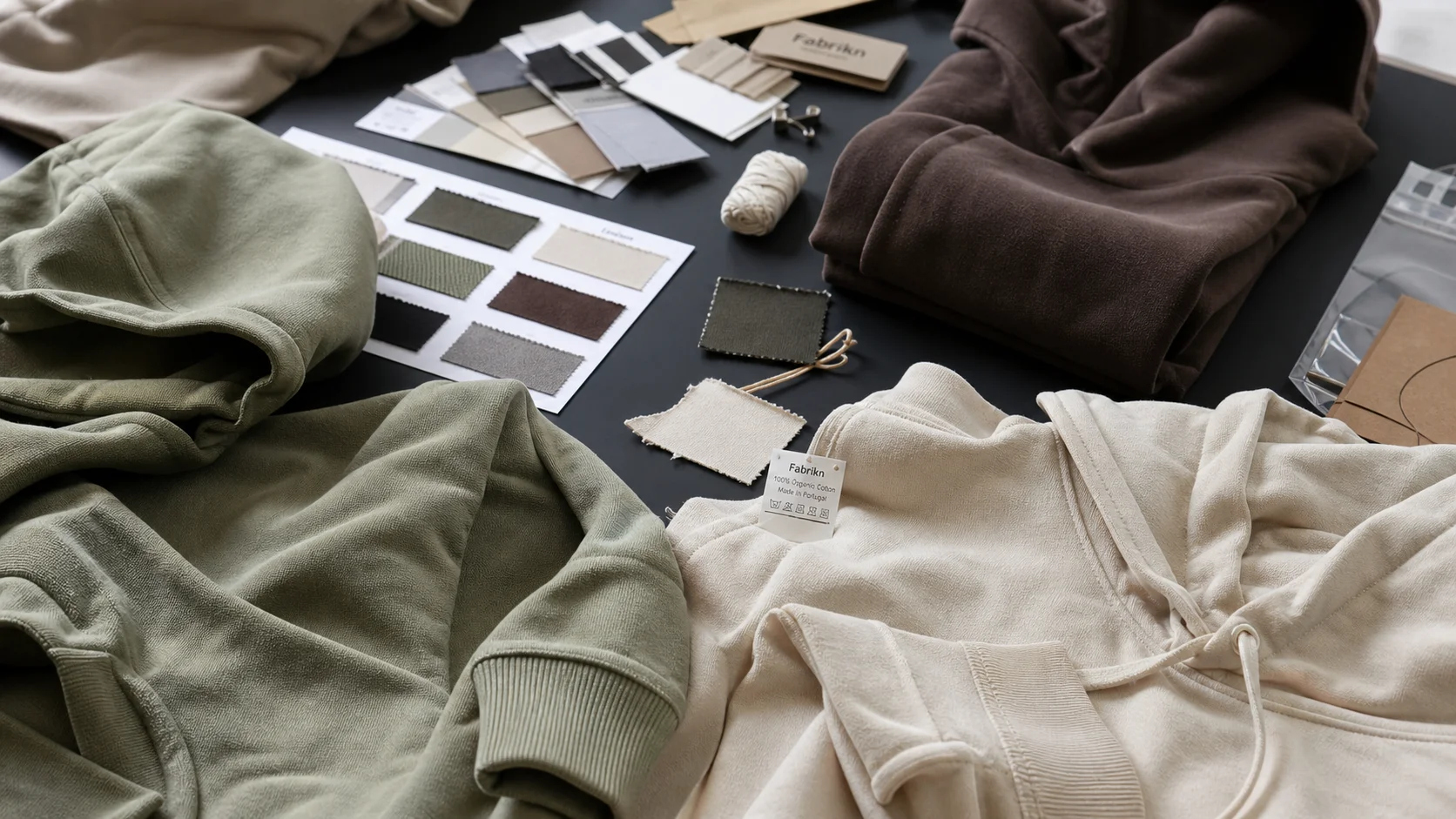
Custom French Terry Hoodie Manufacturer with checks for samples, fit, MOQ, QC evidence, pricing terms, and delivery risk.
Fast answer: Custom French Terry Hoodie Manufacturer: Costs, QA, Lead Times should be judged by production evidence, not by a generic sourcing promise. The buyer needs sample proof, cost breakdowns, QC checkpoints, and delivery buffers in writing.
Ask for recent sample photos, measurement tolerances, fabric or print test assumptions, decoration test notes, packing examples, and a named inspection checkpoint. These details show whether the team can repeat an approved sample at bulk volume.
Separate garment cost, decoration, labels, packaging, sampling, testing, freight, and rush charges. When every cost line is visible, it becomes easier to reduce colorways, adjust size depth, or reserve more time for sampling.
French terry is where premium basics stop pretending and start making money. For brands searching for a custom french terry hoodie manufacturer, it sits neatly between fleece and lightweight jersey, and that middle ground is often the most profitable one. In the wholesale programs I’ve reviewed, hoodies in 280-360 GSM French terry regularly sell at $48-$98 retail, while their factory cost often stays in the $8-$22 range depending on region and trim package. That gap matters. It gives premium basics room to breathe.
Across more than 200 factories in eight countries, French terry keeps showing up in the lines that return the least after wash testing. Compared with brushed fleece, it tends to drape better, trap less heat, and feel less bulky under a jacket. A 320 GSM loopback hoodie can look substantial without turning into a sauna in Miami or a dead weight in Sydney.
Factory visits tell a less flattering story. Two hoodies can share the same spec sheet and still perform wildly differently after five washes. One may shrink 3%-4% in body length and hold its shape. Another may twist at the side seam, lose 7% in width, and come back with pilling at the cuff after a single season. The resale value follows the better garment, not the prettier sample.
Here’s what most people miss: higher GSM does not automatically mean better durability. I’ve seen a 380 GSM hoodie fall apart faster than a 320 GSM version because the yarn was weak and the knit density was loose. Dense loopback construction, ring-spun cotton, and stable shrink control matter more than weight alone. A heavy, sloppy knit is just expensive disappointment.
Premium basics brands favor French terry because it reads expensive without shouting. It holds a clean front, takes pigment dye well, and usually produces fewer fit complaints than brushed fleece styles that feel different after laundering. When a spec looks simple, buyers get lazy. That is where returns creep in, and a 2%-3% return-rate gap can erase a lot of margin.
A custom french terry hoodie manufacturer is not just sewing panels together. The right partner handles sourcing, knitting, cutting, sewing, washing, finishing, inspection, and packaging. If any one of those stages is weak, the hoodie pays for it later in complaints, claims, or markdowns. I’ve seen a $4 fabric mistake create a $14 problem on the sales floor.
Before sample approval, I ask for seven specs every time: GSM range, loopback structure, yarn composition, shrinkage tolerance, colorfastness, pilling grade, and fabric source. A solid French terry program might use 300-340 GSM, 80/20 cotton-poly or 100% cotton, and shrinkage held to 3% or less after a standard wash cycle. If a factory cannot state those numbers, I assume the process is loose.
Construction matters just as much. Rib cuffs should recover after stretch tests. Stitch density should be consistent at 9-11 stitches per inch on the body and 4-needle coverstitch at stress points. Hood panels need symmetry. Drawcord exits need reinforcement. These are the details that separate a clean retail piece from a return waiting to happen.
There is also a structural split that buyers underestimate. Cut-and-sew factories focus on labor and assembly, while full-package suppliers source fabric, trims, labels, wash treatments, and packaging too. That affects cost, but it also changes control. If you need speed and tighter oversight, a partner with cut and sew manufacturing capability can help reduce handoff mistakes, though it rarely fixes bad tech packs.
Factory region changes sizing consistency more than most brands admit. In my audits, regions with stronger inline QA and automated cutting produced tighter tolerances, often within +/-0.5 cm on chest and sleeve measurements. Others drifted to +/-1.5 cm or more after bulk production. That gap looks tiny on paper. On a live e-commerce site, it becomes a 1-star review.
Warning signs are obvious if you ask the right questions. Vague replies about fabric composition. No test reports. Sample variation beyond the agreed tolerance. Unclear wash process. If a supplier cannot show lab data or explain how they handle rework, I move on fast. A good custom hoodie manufacturing partner should sound specific, not hopeful.
Comparing factories by country is lazy. Comparing them by labor cost, MOQ, sampling speed, fabric access, and compliance depth tells you something useful. China often wins on speed and supply-chain breadth, Pakistan can offer stronger fabric value, Turkey and Portugal usually bring tighter short-run control, and Vietnam is often very consistent if the fabric is already available. That last clause matters more than many buyers realize.
For budget runs, I see FOB hoodie prices around $7-$12 when specs stay simple: 280-320 GSM French terry, standard rib, one-color print, and MOQ 500-1,000 pieces. Mid-market programs usually land at $14-$20 FOB once you add thicker fabric, better stitching, woven labels, and washed finishing. Premium programs hit $21-$28, especially with garment dye, heavy embroidery, or low MOQ 100-300 units.
Portugal and Turkey often win for brands placing 150-600 piece orders because they can move fast on sample-to-bulk decisions and keep workmanship tight. In a recent Portugal visit, one factory turned samples in 10-14 days and bulk in 4-6 weeks, with shade variation tightly controlled. Turkey showed a similar pattern, especially for premium basics and private label clothing services where the handfeel has to be right on day one.
Pakistan is compelling when fabric value matters. I’ve seen mills there produce solid French terry at a lower fabric cost than comparable offers elsewhere, especially on cotton-heavy programs. The trade-off is that compliance, buyer communication, and finishing discipline vary widely. You can get excellent value. You can also get a very cheap headache.
Vietnam often delivers good consistency and neat sewing, but many factories rely on imported fabric, which can extend lead times by two to four weeks. If the mill is offshore, shade approvals, lab dips, and fabric booking can stretch a clean seven-week program into 10-12 weeks before bulk even starts. The delays usually happen at lab dip, shade approval, and wash testing, not sewing.
Here is a simple comparison frame I use:
If you need market data to benchmark lead times and trade patterns, the apparel trade tables published by the U.S. International Trade Administration, the fiber sustainability guidance from Textile Exchange, and the certification resources at OEKO-TEX are useful references. I use them to sanity-check factory claims before I book a visit.
Sampling can flatter a factory. Bulk production tells the truth. I’ve watched a perfect proto sample fail because the fabric lot changed, the rib came from a different mill, and the wash formula was adjusted to speed up output. That is why I never approve a French terry hoodie without wash shrinkage, torque, colorfastness, seam slippage, and pilling tests.
A single weak point can sink the whole order. Rib trim that loses recovery leads to sagging hems and cuffs. Drawcords that fray after three washes can trigger returns and bad reviews. Zippers, if used, need smooth operation through at least 20 open-close cycles before bulk. One failure on a hoodie is rarely one failure in the customer’s mind.
During factory visits, I inspect line balance, needle control, defect handling, and the in-line QA records. If operators are waiting for bundles, line flow is poor. If broken needles are logged casually, reject discipline is weak. If the factory cannot show hourly defect counts or rework tickets, I assume problems are being hidden rather than solved.
For standards, I prefer to see methods tied to recognized testing bodies, not vague “pass” language in a PDF. AATCC testing methods for colorfastness and dimensional stability, or comparable lab work, give me real numbers. A good report may show 3% shrinkage, grade 4 color transfer, and pilling at 4 to 5 after five cycles. That is usable. “Excellent quality” is not.
Sustainability and quality are linked here. Fewer defects mean less waste, fewer reworks, and a lower effective cost per sellable unit. If 8% of a 1,000-piece order is downgraded or reworked, the real cost is not the FOB on the invoice. It is labor, freight, time, and lost selling season.
A quote is a stack of small decisions. Fabric is usually the largest line, often 35%-55% of the garment cost. Then come rib, sewing minutes, decoration, labels, packing, and freight. If a supplier gives you only one total number, they are hiding where the money goes. That is a problem because you cannot negotiate blind.
Labor rises fast as construction gets more complex. A basic pullover with a kangaroo pocket and standard hood may take 18-22 sewing minutes. Add a double-layer hood, oversized fit, bar tacks, and specialty wash, and it can jump to 28-35 minutes. That difference can move a factory from $3.50 labor per piece to $6.50 or more, especially in higher-wage regions.
MOQ changes unit economics sharply. At 100 units, setup, patterning, and lab costs are spread across too few garments, so prices can sit 25%-40% above bulk. At 300 units, they usually begin to normalize. At 500 units, factories often hit their comfort zone. At 1,000 units, you may squeeze out another 8%-15% if fabric is standard and the spec does not chase novelty.
Decoration is another fork in the road. Plain stock dye is cheaper and faster than garment dye, which can add $1.50-$3.00 per piece and one to two weeks. Screen print is often more economical than embroidery on larger runs; embroidery can cost $0.80-$2.50 per location, while a simple print may sit at $0.40-$1.20 depending on color count. Each choice changes both margin and MOQ pressure.
Hidden costs show up when the conversation gets fuzzy. Size sets, lab dips, re-sampling, inspection travel, quality claims, and customs fees can all be real money. The cleanest quote is the one that exposes them early. That is how private label clothing services become easier to compare across factories, because the numbers are broken out instead of buried.
I like fewer claims and more proof. Organic cotton, recycled content, OEKO-TEX, GOTS, and wastewater controls are meaningful only when the documents match the fabric batch and the mill can trace the lot. Greenwashing usually starts with a sentence and ends with an empty folder.
Transport is only one piece of the footprint. A hoodie shipped 8,000 kilometers by sea can still be lower impact than a nearby factory using coal-heavy energy and poor dye-house controls. On factory visits, I pay close attention to water use, chemical storage, cutting waste, and boiler efficiency. A tidy showroom tells me nothing. A well-managed effluent system does.
According to the Global Organic Textile Standard, GOTS and related documentation matter because they define traceability and chemical restrictions, not just a feel-good label. In practice, I trust a factory more when it shows me fewer claims backed by stronger paperwork, and a hoodie built to last 30 wears rather than 10.
The fastest way to reduce sample rounds is to build a sharper tech pack. Define fit, target wearer, fabric weight, shrinkage tolerance, measurements, trims, decoration, and wash method before the first sample is cut. I have watched brands save two or three rounds simply by stating sleeve length tolerance at +/-0.5 cm and body length at +/-1 cm.
Shortlist three factories and compare them on the same basis: same fabric weight, same MOQ, same wash, same delivery terms, same inspection standard. Then ask each supplier to quote separately for fabric, labor, decoration, labels, packing, and freight. If one number is 20% lower, find the missing line item before you celebrate.
In the first factory call, I ask five questions: Can you share wash test reports? What is your normal MOQ for 320 GSM French terry? How do you handle shade variation? What is your defect remedy policy? Can I inspect in-line records before bulk? A serious supplier answers directly and sends documents within 24-48 hours.
Contract terms should lock tolerances, inspection standard, payment milestones, and defect remedies. I want sample approval tied to strike-offs, pre-production approval tied to lab dips, and bulk release tied to QC sign-off. If the factory also offers request a custom hoodie quote support, use it to compare apples to apples, not to chase the cheapest headline price.
Send the tech pack, size chart, fabric reference, artwork, and target delivery date. The sample outcome that proves the factory is ready for bulk is boring in the best way: measurements inside tolerance, wash results within spec, stitch quality consistent across three pieces, and no unexplained substitution on fabric or trims. If you want the order to run smoothly, choose the custom french terry hoodie manufacturer that can prove the details before you pay for them.
Budget hoodies usually land around $7-$12 FOB, mid-market pieces around $14-$20, and premium runs around $21-$28. MOQ, fabric weight, decoration, and wash treatment can shift pricing by 20%-40%.
Ask for GSM, shrinkage tolerance, colorfastness, pilling grade, MOQ, lead time, and test reports. Also confirm whether they are cut-and-sew only or full-package, because that changes control and cost.
Sampling often takes 7-21 days. Bulk production usually takes 4-10 weeks after approval, but lab dips, shade approval, and fabric booking can add two to four weeks if the mill is busy.
Yes, but price goes up fast below 300 units. Portugal and Turkey often handle 100-500 units well, while larger Asian factories may prefer 500-1,000 units for cleaner unit economics.
The best factories show test data, keep bulk variation tight, and manage defects in-line. I look for shrinkage under 3%, clear QA records, and consistent sizing within +/-0.5 to +/-1 cm across the order.