
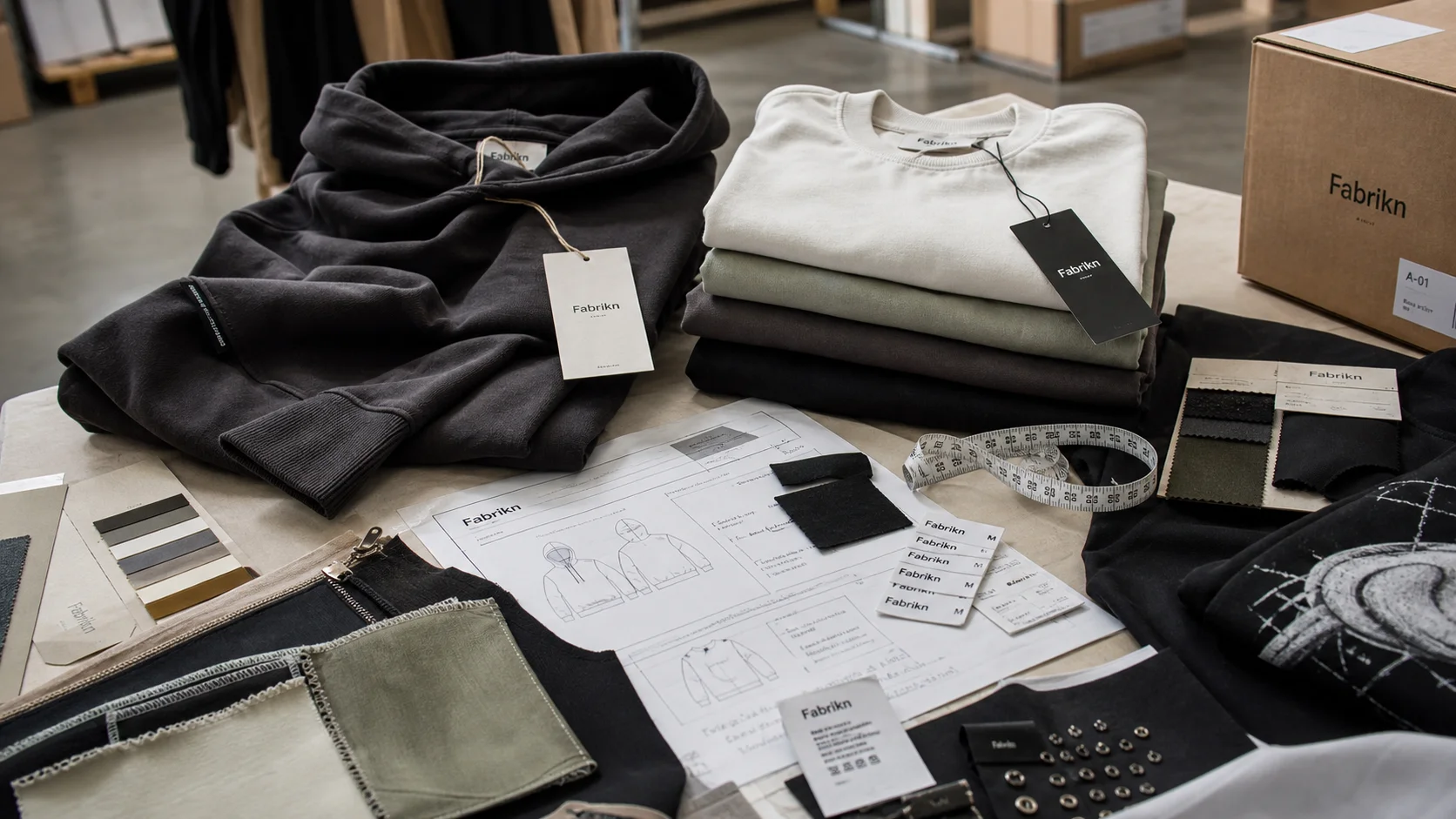
Custom French Terry Hoodie Factory compared by sample evidence, fabric or trim specs, MOQ, AQL terms, cost lines, delivery timing, and rework responsibility.
Fast answer: Custom French Terry Hoodie Factory: Sample Fit, Trim, AQL, and Delivery Risk should be judged by production evidence, not by a generic sourcing promise. The buyer needs sample proof, cost breakdowns, QC checkpoints, and delivery buffers in writing.
Ask for recent sample photos, measurement tolerances, fabric or print test assumptions, decoration test notes, packing examples, and a named inspection checkpoint. These details show whether the team can repeat an approved sample at bulk volume.
Separate garment cost, decoration, labels, packaging, sampling, testing, freight, and rush charges. Clear cost lines make it easier to reduce colorways, adjust size depth, or reserve more time for sampling.
French terry is ordinary. What happens to it in the factory is not. A custom french terry hoodie factory can make the same 320 GSM hoodie feel premium, or strangely cheap, depending on stitch quality, wash control, shrinkage, and how calmly the production line handles the work from sample to bulk. After 200-plus factory visits in eight countries, I’ve seen that same hoodie land at $12 in one plant and $38 in another.
The fabric spec gets the glory, but the sewing floor usually decides the result. A 100 percent cotton loopback at 320 GSM can feel substantial in one plant and limp in another because one mill keeps knitting tension tight while another lets the face yarn relax too much. I’ve inspected hoodies where the rib passed a 5 percent stretch test on paper, then collapsed after two wash cycles because the factory skipped torque control. The buyer blamed the fabric. The factory blamed the brand. Both were partly wrong.
Region matters, just not in the lazy way sourcing decks suggest. A lower-wage factory in South Asia once quoted $4.20 FOB and still ended up more expensive than a nearshore maker at $7.10 after rework, a 14-day delay, and a 9 percent reject rate were counted. In Eastern Europe, a $6.80 unit with 3-week transit can beat a $5.10 unit from Asia if the retail calendar is tight and markdown risk is real. Low labor cost does not mean low total cost.
Small buyers get squeezed hardest. If a factory can’t hold dye lots within a 1.5 Delta E tolerance, or grade from S to XXL without shoulder distortion, your “affordable” hoodie turns into a warehouse problem. Emerging labels have lost 18 to 22 points of gross margin chasing a cheap MOQ 500 offer from a plant that couldn’t keep pocket alignment within 0.7 cm across a 1,200-piece run.
So I treat factory selection as a commercial decision, not a sourcing task. Building a premium line? The right partner may also include custom hoodie manufacturing support, pattern development, and wash testing before bulk fabric is ordered. The wrong partner turns every defect into freight, labor, and brand damage.
The sample stage should feel slow, deliberate, and mildly irritating. Good. A serious custom french terry hoodie factory moves through proto sample, fit sample, size set, and pre-production sample, each with its own approval loop of 3 to 10 days depending on fabric availability and trim complexity. If a plant says it can approve everything in 48 hours, I start checking what it’s hiding.
On fabric approvals, I want more than a “looks fine” email. For loopback French terry, I ask for shrinkage tests after 1, 3, and 5 washes, plus pilling results, colorfastness to wash and rub, torque data, and a hand-feel comparison between the lab dip and bulk lot. A decent result is usually shrinkage under 5 percent, pilling at grade 4 or better, and color shift under a documented tolerance after 30 minutes of crocking. Soft but twisting after wash? Fail.
Fit is where most hoodie projects wobble. Hood depth, neckline opening, rib recovery, shoulder slope, sleeve length, body balance—check all of it in size M and size XL before approving a size curve. One plant in Portugal showed me a hoodie that measured perfectly flat on the table, yet pulled backward on the body because the shoulder angle was 1.2 cm off. A factory in Vietnam fixed the same issue with one pattern change and two days of sampling.
Trim issues are expensive because they hide in plain sight. Zippers that snag, cords that shrink in the washer, labels that fray at the seam, eyelets that corrode after 72 hours of salt spray testing—those little failures can add $0.18 to $0.65 per unit in invisible cost. A logo patch with weak adhesive can wipe out 8 percent of an order if it lifts during final pressing.
The thing nobody tells you: a factory that samples slowly can be safer than one that rushes approvals. I’d rather wait 12 days for a corrected fit sample than ship a 1,000-piece bulk order built on a 3-day guess. For brands building private label clothing services into a hoodie line, that patience protects cash, not just quality.
Buyers often compare quotes like they’re comparing apples. They aren’t. A $6.40 FOB quote can become a $10.20 landed cost once you add freight, duty, 2-color screen printing, woven labels, polybags, and one extra sample round. I build comparisons around six line items: fabric, labor, trims, decoration, freight, and duty. Anything less is theater.
Here’s the framework I use on sourcing calls. Ask every custom french terry hoodie factory for the same spec: 320 GSM French terry, brushed or loopback face stated clearly, 100 percent cotton or cotton-poly ratio, rib at 2x2 with 5 percent elastane, kangaroo pocket, flatlock or overlock seam, and one front print of 20 by 28 cm. Then ask for price at 300, 1,000, and 5,000 pieces. The curve tells you more than the first quote ever will.
Low-MOQ domestic factories usually sit at 50 to 300 pieces per color, with unit costs around $18 to $32 depending on decoration and fabric origin. Mid-tier regional plants often want 300 to 1,500 pieces, landing around $8 to $15. High-volume export factories may start at MOQ 1,000 or 3,000 pieces, and the best pricing shows up only after 5,000 units. Startup brands buy flexibility. Larger labels buy lower unit cost. Promotional programs buy speed and accept standard trims.
Lead time changes by production model. Knit-to-stock programs can move in 2 to 4 weeks if the fabric is already in warehouse. Knit-to-order adds 4 to 8 weeks because yarn, knitting, and dyeing all wait their turn. Fully custom programs, especially with a special shade or enzyme wash, often need 8 to 14 weeks plus transit. Add 7 to 21 days for air or sea freight decisions.
Domestic, regional, and export factories each have a tradeoff. Domestic plants reduce inventory risk and communication friction. Regional plants balance cost and transit. Export factories win on scale, especially for 3,000-piece runs where trims drop sharply. If you need a structured production partner for pattern work and bulk execution, cut and sew manufacturing is the right search path, not generic blank sourcing. And if you want speed on a first quote, get a free quote only after you have your tech pack locked.
The production sequence is simple on paper and messy in practice. Fabric arrives, rolls are inspected, defects are marked, and shrinkage is checked before cutting. Then the marker is laid, panels are cut, bundles are ticketed, and sewing begins. After that comes washing or dyeing if required, followed by finishing, pressing, metal detection, folding, packing, and carton audit. Skip one checkpoint, and you pay for it three steps later.
French terry hoodies fail most often at three points: shrinkage control, rib attachment, and pocket alignment. I’ve watched a 2,400-piece run lose 6 percent of acceptable units because the body and rib shrank at different rates after an enzyme wash. I’ve also seen pocket bags migrate 1 cm left or right because the operator followed the marker but not the grain line. Small errors look cosmetic until they hit returns.
In-line inspections matter because they catch drift early. First-piece approval at the start of each sewing line, then hourly checks on stitch density, seam allowance, and measurement tolerance. Final AQL checks should tie to a documented sampling plan, not a casual glance. If a factory says “we inspect everything,” I ask how many inspectors, how many pieces per hour, and what defect threshold triggers rework.
Better operators often protect quality with fewer automated shortcuts. A skilled mechanic on a 30-year-old overlock machine can beat a rushed line on newer equipment if the floor manager controls bundle flow and needle replacement. That matters for sustainability too. Less rework means less energy, less waste, and fewer cartons sent back through the system. Water use rises fast when a factory repeats wash trials. Chemical management matters just as much, especially if the finish uses enzyme wash instead of stone wash, which can cut abrasion waste but still needs strict dosage control.
Factories that publish data on wastewater treatment, chemical MRSL compliance, and fabric yield usually run tighter operations. I trust numbers more than slogans.
Pricing shifts faster by volume than by geography, but region still sets the floor. A domestic U.S. factory may quote $19 to $28 for a 300-piece run, especially if you want custom drawcords, garment dye, or embroidery. A comparable EU plant often lands in the $16 to $24 range, with lead times of 4 to 6 weeks once fabric is in hand. Asia-based factories can price the same hoodie at $5.50 to $11.50, yet transit, import duty, and forecasting discipline matter more because the order sits farther from your warehouse.
For startup orders, nearshore production often saves money indirectly. If your brand sells 120 hoodies a month, a 250-piece domestic run reduces dead stock, color exposure, and markdown risk. Small brands lose more on unsold inventory than they ever save by chasing a $2.00 unit price difference. Scale changes the math. At 5,000 pieces, Asia’s lower labor and trim cost can cut unit price by 18 to 35 percent, especially on simple decoration and standard rib.
Volume also changes trims and decoration pricing. A woven label might cost $0.28 at 300 pieces and $0.07 at 5,000. Screen printing can drop from $1.40 to $0.42 per piece once screen setup is spread across a larger run. Even packaging gets cheaper when you move from retail-ready individual polybags to carton-only bulk packing. The savings can be meaningful, but only if the factory actually tracks them line by line.
Sustainable materials do carry a premium. Organic cotton French terry or recycled blends often add $0.60 to $2.20 per unit at small volume. At 5,000 pieces, that premium narrows because fiber sourcing and dyehouse allocation become more efficient. GOTS-certified fabric has come in only 12 to 18 percent above conventional cotton once the order passed 3,000 meters. Buyers who assume “eco” always means expensive are usually quoting too little volume.
For brands selling private label clothing services or seasonal capsules, the smartest move is not chasing the lowest sticker price. Match region, transit time, and inventory appetite to the sales forecast.
Red flags usually show up before the first bulk yard is cut. Vague traceability, inconsistent sample measurements, evasive pricing, and weak wash test reporting are the big four. If the factory can’t tell you which mill made the fabric, which dyer processed the lot, and how shrinkage behaved after 3 washes, it’s asking you to fund its learning curve.
Certifications help, but they don’t prove everything. Textile Exchange standards are useful for fiber claims, while OEKO-TEX verifies certain chemical safety criteria for materials. OEKO-TEX and social audit schemes can reduce risk, yet they do not tell you whether a factory is overusing water, reworking 11 percent of output, or paying overtime properly in peak season. That gap matters.
I ask five questions on every sustainability audit. How many liters of water are used per kilogram of dyed fabric. What is the energy mix, and does the plant track kWh per garment. How are wastewater solids treated. What is the average weekly labor hour range during peak orders. Which chemistry tests are run on the final garment, not just the raw fabric. A factory with good documentation usually answers in numbers, not adjectives.
Here’s my view, earned after too many cold factory floors. A factory with fewer claims and better documentation is usually the safer partner. I prefer a plant that says, “We can show you our 2024 wastewater logs and 12-month defect rate,” over one that says “We are green” and produces three glossy brochures. Sustainability should lower commercial risk, not serve as decoration.
Data from the U.S. Trade Administration shows how exposed apparel trade remains to freight volatility and regional disruption. A custom french terry hoodie factory that can document cleaner chemistry, consistent labor hours, and lower reject rates is not only better for the planet. It’s better for your cash flow.
Start with a tech pack that removes guesswork. Measurement specs, graded size chart, construction callouts, stitch type, artwork placement, label artwork, hangtag copy, packaging instructions, target landed price, expected delivery window. Miss one of those pieces and every quote drifts by $1 to $4 per unit. That isn’t a sourcing problem. It’s a briefing problem.
Then request comparable quotes. Keep the fabric constant, keep the decoration constant, and ask every factory for the same reference: 320 GSM French terry hoodie, 1 color body, 1 print, 1 woven label, 1 care label, pack in individual polybag or folded bulk, and state MOQ clearly. Ask for sample cost, bulk cost, lead time, payment terms, and testing charges. A quote without those figures isn’t a quote.
Shortlist three to five factories and score them on sample accuracy, communication speed, compliance documents, defect transparency, and on-time delivery. I give extra weight to sample quality because a factory that nails a prototype at 95 percent of spec usually understands the garment, not just the invoice. Communication matters too. A plant that answers within 24 hours during sampling usually behaves better at bulk stage.
If you’re comparing broader apparel partners, private label clothing services can help you map hoodie production against other categories, which is useful if you’re building a full seasonal line. But for the first order, keep the brief narrow. One hoodie. One target fabric. One wash. One delivery promise.
Before you place production, audit one live line if possible, or at least request a pre-production checklist with dates, sign-offs, and test records. Then negotiate from facts, not hope. The best buyers I know think like operators. They know the first order is not the finish line. It is the start of the standard.
Prices usually range from $5.50 to $28 per piece depending on region, order size, fabric weight, and decoration. Small domestic runs of 250 to 300 pieces often cost the most per unit, while 5,000-piece export orders can cut unit cost by 20 to 35 percent.
A proper sample set should include a proto sample, fit sample, size set, and pre-production sample. Each stage should confirm shrinkage, rib recovery, shoulder balance, sleeve length, hood depth, and trim performance before bulk approval.
Lead time is often 2 to 4 weeks for knit-to-stock programs, 4 to 8 weeks for knit-to-order, and 8 to 14 weeks for fully custom production. Add 7 to 21 days for freight depending on air or sea shipping.
MOQ depends on the factory type and region. Many domestic factories accept 50 to 300 pieces, while regional factories may start near 300 to 1,500 pieces. Export factories usually need 1,000 pieces or more to price aggressively.
Compare sample accuracy, price transparency, compliance documentation, and on-time delivery history. Ask for fabric test results, defect rates, and clear line-item quotes so you can compare factories on total landed cost, not just FOB price.