
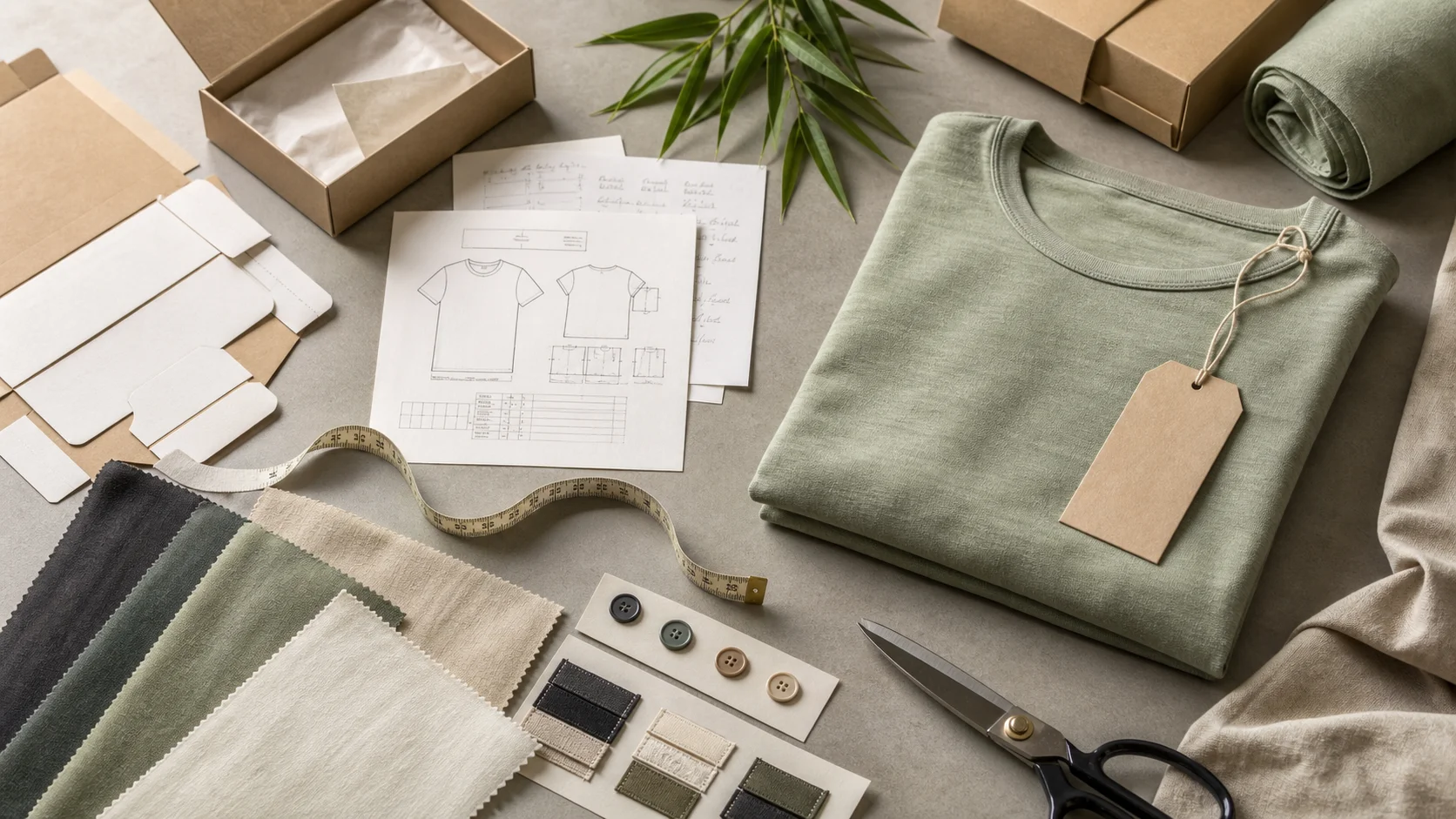
Custom Garment Bags with Logo with checks for samples, fit, MOQ, QC evidence, pricing terms, and delivery risk.
Fast answer: Custom Garment Bags with Logo: Costs, Materials, ROI should be judged by production evidence, not by a generic sourcing promise. The buyer needs sample proof, cost breakdowns, QC checkpoints, and delivery buffers in writing.
Ask for recent sample photos, measurement tolerances, fabric or print test assumptions, decoration test notes, packing examples, and a named inspection checkpoint. These details show whether the team can repeat an approved sample at bulk volume.
Separate garment cost, decoration, labels, packaging, sampling, testing, freight, and rush charges. When every cost line is visible, it becomes easier to reduce colorways, adjust size depth, or reserve more time for sampling.
A garment bag can make a suit look expensive before anyone touches the fabric. That is why custom garment bags with logo matter so much in retail, wholesale, and travel. I have watched a $1,200 suit land in a $0.18 bag and get treated like clearance stock, while a $260 blazer in a structured, logoed cover was handled like a special order. That split-second judgment matters in stores, on sales floors, and at hotel check-in counters where presentation does most of the selling.
On factory visits in Vietnam, Turkey, and Mexico, I kept seeing the same pattern: well-made custom garment bags with logo reduced visible scuffing, dust ingress, and hanger friction after repeated handling. Buyers told me that bags with reinforced zippers and 80-120 GSM non-woven material cut returns from packaging damage by 12-18% on certain outerwear programs. Reusable covers also improved brand recall. In one bridal line, 6 of 10 customers brought the bag back for alterations, storage, or travel because the logo felt worth keeping.
The price tier changes the story. Premium brands usually choose heavier fabric, smoother zipper tape, and a cleaner logo application, so the bag feels like part of the product. Mid-market brands need the bag to work hard: protect the garment, carry the brand, survive 10-15 uses, and not add more than $0.40-$0.90 to landed cost. Budget labels often cut corners in stitch density, zipper gauge, and seam finish, then wonder why the bag splits at the shoulder after two trips.
That is where the ugly part shows up. Cheaper bags hide weakness in details buyers rarely inspect: a 3-thread overlock instead of a tighter seam, zipper pulls that fail after 30-40 openings, and thin film panels that cloud or crack in dry storage. A logo printed on a failing bag still advertises, but not in the way a brand wants. It announces cheapness every time the zipper jams.
For travel, the value is even more practical. Uniform suppliers, bridal houses, and luxury retailers all rely on packaging that survives trunks, overhead bins, and freight cartons. A branded cover becomes both armor and mobile signage. If your broader packaging system needs to work together, I often point clients to clothing packaging solutions that align garment bags with tissue, labels, and outer cartons.
Buyers read a garment bag in seconds. Logo placement, print method, and the silhouette of the bag all signal whether the product inside is luxury, uniform, bridal, or mass market. A centered woven label on a matte black bag suggests restraint and margin. A large silk-screened logo on translucent PEVA feels more utilitarian, which can be perfect for uniforms but weak for premium tailoring.
In luxury, the bag often behaves like a silent sales associate. I have seen brands use tonal embroidery, hidden zippers, and narrow handles to keep the garment bag understated, because the message is exclusivity. Bridal buyers want the opposite balance: visible branding, enough clarity to identify the gown through a window, and gussets wide enough for veils or layered skirts. Corporate buyers care about employee consistency, so a 1,000-piece uniform program usually prioritizes repeatable color matching, durable closures, and fast reorders over visual drama.
Here is what most people miss: some expensive bags fail faster than mid-priced ones because the material looks premium but behaves badly. I saw a $3.20 recycled PET cover with a beautiful hand feel crack at the window seam after 20 flex cycles, while a $1.45 non-woven bag with better reinforcement held up for 60. Price alone does not predict durability. Construction does.
Consistency sells. When a wholesale buyer sees the same bag quality in a second and third order, confidence rises faster than any sales deck can manage.
Typography matters too. Thin serif type can look elegant, but on textured fabric it may blur if the print area is too small. Sans serif logos usually reproduce more cleanly on 70-90 GSM non-woven and on PEVA, especially when the printer is matching Pantone 432 C or 877 C. Handles, gussets, and closure systems should reinforce the category, not fight it. A suit cover with a poor hanger opening and no proper top reinforcement advertises cost-cutting immediately.
Brands also use garment bags differently by channel. Direct-to-consumer labels want an unboxing moment; wholesale buyers want stackability and low damage claims; rental and uniform programs want function first. That is why I often separate packaging strategy from apparel strategy. If the garment line itself is being developed in parallel, cut and sew manufacturing can be planned alongside packaging so the bag dimensions match the product from the start.
Material choice decides most of the performance, and it also shapes cost, weight, recyclability, and print quality. Non-woven polypropylene is the workhorse for custom garment bags with logo. At 80-120 GSM, it offers a dry hand feel, low cost, and decent breathability, which matters for suits and seasonal coats. PEVA gives better water resistance and clearer visibility, but in humid warehouses it can trap odor if the zipper seal is too tight. Cotton feels premium and stores well, though it wrinkles, weighs more, and is usually the most expensive per unit. Recycled polyester sits between non-woven and cotton in structure, especially for programs that want a polished finish with stronger abrasion resistance.
Factories in Guangzhou, Ho Chi Minh City, and western India showed me the same failure points again and again. Seam strength is usually the first weakness. A good bag should hold at least 8-12 kg at the hanging point without tearing, and the stitch line around the hanger opening should not snake under load. Zipper life is the second test. Lower-grade coil zippers often fail after 25-50 cycles, while a better #5 zipper can run well beyond 100 openings if the tape is properly stitched and the pull is metal rather than thin alloy. That difference matters when a wedding gown bag is opened and closed across fittings for 3-4 months.
Printing compatibility varies by substrate. Non-woven takes screen print well, while PEVA prefers simpler artwork and careful ink selection. Cotton handles embroidery beautifully, though not every logo scales down cleanly. For recycled polyester, heat transfer can work, but only if the surface treatment is consistent; otherwise the image can lift at the edges. According to Textile Exchange, recycled fiber demand continues to rise, which has pushed more brands to ask for proof of material content and traceability.
Climate changes the equation. In humid markets such as Singapore or coastal southern China, breathable non-woven and vented designs outperform fully sealed plastic covers because moisture management matters more than absolute waterproofing. In dry inland warehouses, static buildup and surface abrasion become bigger issues, so thicker film or brushed fabric can be safer. For long-haul shipping, I usually want a gusset of 8-12 cm, reinforced side seams, and a hanging loop bar-tacked at four points.
Suit covers and wedding gown bags need more structure around the shoulders and hem. Uniform bags benefit from a clear window, which reduces opening time during issue and return cycles. Seasonal outerwear needs enough room for padded silhouettes, especially if the coat includes heavy quilting or down fill. Cleaning also matters. Cotton can be laundered, while PEVA and non-woven need wipe-clean care. If a supplier cannot explain GSM, seam type, zipper gauge, and print method in one call, I move on fast. The numbers should be on the spec sheet, not buried in sales language. For buyers who want verified textile standards, OEKO-TEX Standard 100 and Global Recycled Standard accreditation provide transparency on chemical safety and recycled content.
In addition to OEKO-TEX Standard 100 and GRS, I push clients to evaluate factory certifications like WRAP for ethical production, BSCI for social compliance, and GOTS for organic cotton programs. A well-run line in Dhaka or Istanbul will pair these credentials with documented dye lots and print proofs so you can trace every batch of ink and yarn back to a certified mill.
The machines matter as well. Automatic zipper insertion machines and flatlock stitchers keep seam allowance consistent, while ultrasonic welding tables create clear windows without sewing when you need a transparent identification panel. Heat-transfer presses, rotary screen printers, and automated embroidery heads each require different pre-press files, so confirm that the factory’s CAD/CAM system handles your requested Pantone palette and stitch count before you sign off.
Because garment bags are a secondary cost, the numbers need to stay in context. Here is a quick breakdown that I share with sourcing teams:
These costs assume a 1-2% print rejection rate and include basic packaging into bundles of 50 per carton. Adding custom inner labels, laser-etched metal plates, or multi-pane windows can push the price up $0.40-$0.85, so scope those additions before finalizing the spec sheet.
Freight and logistics add to the picture. For a 500-piece batch from Guangzhou, expect roughly 18-22 business days for production plus another 3-5 for air consolidation if you need it fast. Ocean shipments from Ho Chi Minh City or Istanbul may add 7-10 days to your door, so align your garment delivery schedule accordingly. Always ask for a pre-shipment inspection from a third-party lab in the manufacturing hub to verify zipper cycle counts, seam density, and print accuracy before the containers leave.
Begin with the garment. A structured tuxedo jacket needs a bag with shoulder shaping and 50 cm length; a slim bridesmaid dress usually fits comfortably in a 120 cm gown bag with a 10 cm gusset. Use tech packs that include flat sketches, measurement points, and a sample bag from previous collections. Mark the logo placement with millimeter precision—center horizontally at 77 cm from the top edge or align with the zipper placket depending on your aesthetic.
In the spec, define the materials, certifications, and finishings. Example language: “Logo: 3-color screen print, PMS 877 C, 120×45 mm on 100 GSM spunbonded polypropylene (OEKO-TEX Standard 100 certified). Zipper: #5 coil, 360° metal pull with 3 mm reinforcement at the slider opening. Ink: PVC-free, cured to 180°C.”
Include tolerances: allow ±3 mm on gusset width, ±2 mm on handle placement, and ±0.2 mm on print registration. Be explicit about testing standards. “Seam strength: 300 N pull test per ASTM D1683; zipper life: 100 cycles with no teeth gap.”
For machines and processes, note that you prefer automated zipper insertion for consistency, ultrasonic bond for top windows, and computerized embroidery heads for metallic thread logos. Add that heat transfer must be run on a calendar heat press with pressure at 3-4 bar for 6 seconds for recycled polyester surfaces.
Q: How many colors can I print? A: Screen printing on woven badges and non-woven fabrics allows up to four colors per pass with Pantone matching; consider heat transfer or embroidery for gradients.
Q: What’s the minimum order size? A: In Guangzhou or Ho Chi Minh City, 300-500 pieces is common. For recycled materials or GOTS cotton, suppliers often ask for 1,000 units due to dye lot management.
Q: Are there alternatives to traditional zippers? A: Yes—some Istanbul-based workshops use magnetic closures or snap tape; others use WRAP-certified buckles for uniform programs.
Q: How do I ensure the logo doesn’t fade? A: Test the print method based on the material: screen print on non-woven, embroidery on cotton, and heat transfer on recycled polyester, each with abrasion and wash tests.
Buying garment bags is often shuffled to the bottom of the priority list, but in retail and travel it influences perceptions, returns, and protection. With the detailed specs above, you can partner with certified factories from Guangzhou to Istanbul, select the right materials, understand true cost impacts, and keep the lead time at 18-22 business days without sacrificing quality.