
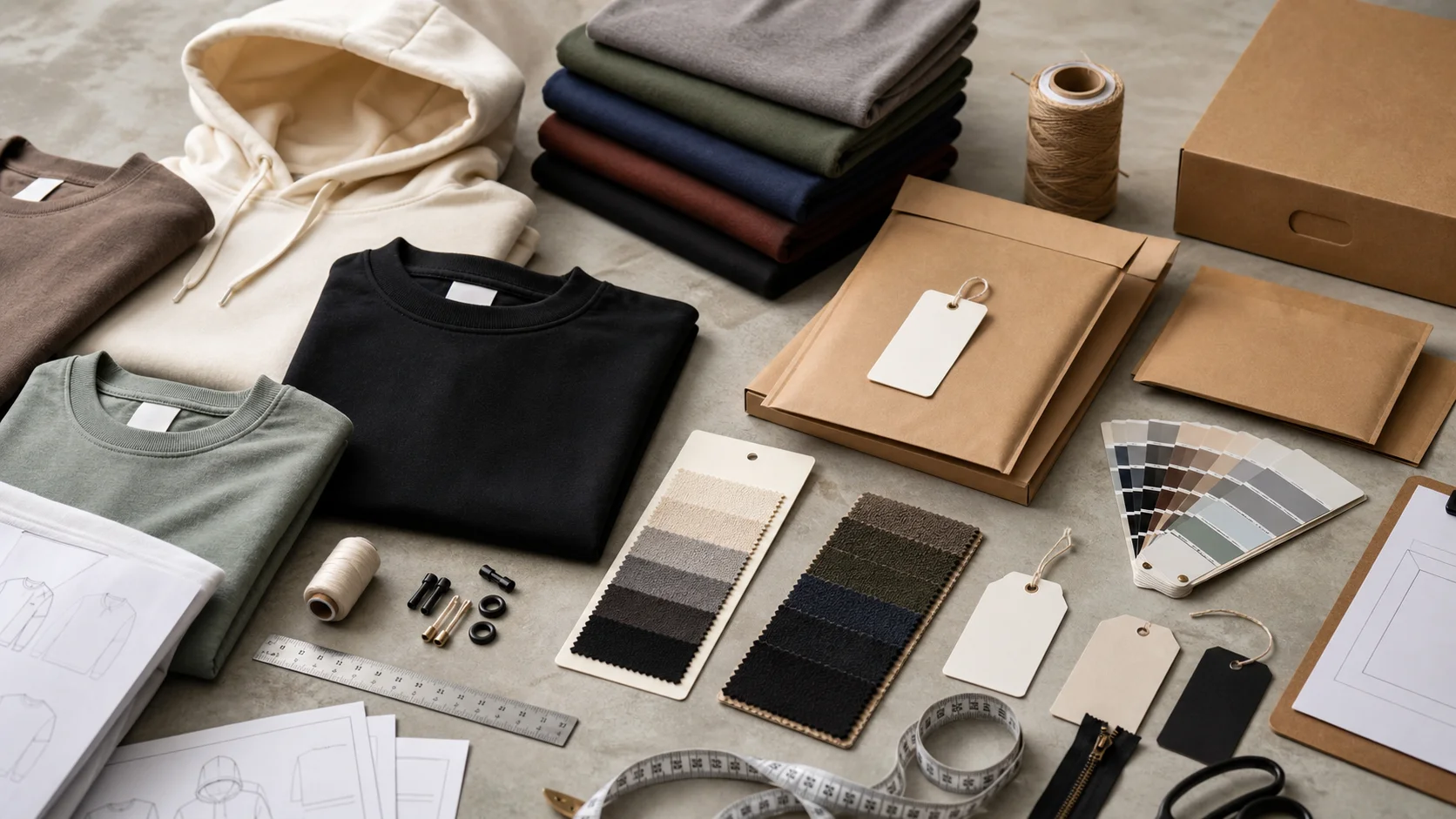
Logo Garment Bags for Retail with checks for samples, fit, MOQ, QC evidence, pricing terms, and delivery risk.
Fast answer: Logo Garment Bags for Retail: Material, Zipper, Print, and Display should be judged by production evidence, not by a generic sourcing promise. The buyer needs sample proof, cost breakdowns, QC checkpoints, and delivery buffers in writing.
Ask for recent sample photos, measurement tolerances, fabric or print test assumptions, decoration test notes, packing examples, and a named inspection checkpoint. These details show whether the team can repeat an approved sample at bulk volume.
Separate garment cost, decoration, labels, packaging, sampling, testing, freight, and rush charges. When every cost line is visible, it becomes easier to reduce colorways, adjust size depth, or reserve more time for sampling.
I watched a $68 blazer leave a fitting room looking like a $180 purchase because it went home in a clean branded garment bag. London department store. Straight lesson. Presentation often moves first, long before fabric gets a chance to speak. Across 8 countries and more than 200 factory visits, I have seen custom garment bags with logo for retail shape perceived value in the first 10 seconds, before a shopper studies stitching or checks the drape.
Retailers sometimes treat garment bags as backstage equipment. Bad call. The bag touches the garment during storage, shipment, alterations, and handoff. It also protects margin. A bag that reduces dust, wrinkling, and floor damage can cut rework and returns, especially in categories with high handling rates such as tailored jackets, occasionwear, and outerwear. I have seen return rates fall by 2-4 points in stores that used consistent packaging across fitting rooms and pickup counters.
Retail logic changes by tier. Luxury labels fold garment bags into the service ritual. Mid-market brands use them to make a $120 coat feel controlled and premium. Promotional retail may use them to protect lower-priced goods that move in volume, because a 1.5% damage rate on 20,000 units is not small. Lower-priced goods often benefit most from upgraded packaging; they are handled roughly and get the least special treatment.
A logo on the bag turns a storage item into repeated exposure. The bag is seen in the store, in transit, at the dry cleaner, and often in a closet for 1-3 years. Long cycle. A packaging line item may cost $0.42 to $2.80 per unit depending on material and finish. Related programs such as clothing packaging solutions help keep hangers, tissue, and outer bags visually aligned.
The sustainability tension is real. Reusable packaging can reduce disposable carry bags, but only if the material survives enough cycles to justify itself. A flimsy PET non-woven bag that tears after 3 uses is not a green story. A better-constructed cotton or recycled polyester bag with reinforced seams and a decent zipper can survive 20-40 uses, and that changes the math completely. For brands that want verified material standards, OEKO-TEX is a useful reference point.
Material choice decides almost everything: hand feel, protection, print quality, and whether the bag reads as cheap storage or controlled retail equipment. Polyester is the workhorse. It resists moisture, holds shape well, and is usually priced around $0.65-1.40 for basic runs in 5,000-unit quantities. Non-woven polypropylene is lighter and cheaper, often $0.28-0.75, but it can feel stiff and thin unless the GSM is strong and the binding is clean. Cotton sits higher, usually $1.40-3.20, and feels premium in a way that customers notice immediately.
Recycled options complicate the picture. Recycled polyester can be excellent if the yarn is clean and the weave is consistent, but vague claims are common. Data from Textile Exchange shows recycled fiber demand continues to grow, yet factory reality is uneven: some mills document chain of custody, others only describe the blend verbally. That gap matters when a buyer needs to support a sustainability claim with invoices and test reports. If your brand is tied to cut and sew manufacturing, ask how the bag specification fits the rest of the production plan, not just the packaging line. A good manufacturer should be able to explain the full production workflow clearly.
Details decide whether the bag feels durable. A 10-12 gauge zipper can outlast a lighter coil zipper by a wide margin. Double-stitched side seams, a 2.5-4 cm gusset, and a properly bound hanger opening can stop early failure. I have seen a mid-grade polyester bag look better than a more expensive cotton version because the print sat exactly 4 cm below the top seam, the zipper pull was metal, and the hem was finished with discipline. Cheap does not always look cheap. Sloppy does.
For branding, screen print is the most common choice, especially for one- or two-color logos. Heat transfer works for detailed art but can crack if the substrate flexes too much. Embroidery adds texture and authority, though it increases cost by $0.40-1.20 per unit. Woven labels are discreet and durable, especially on darker bags. A bag can look premium even at a lower price point if the logo placement, zipper color, and seam finishing are controlled with brutal consistency. I have seen this in Vietnam and Turkey on runs under MOQ 1,000 from a qualified factory.
There is a catch. If a product line pushes recyclability, check whether the zipper, mesh window, and coated trim break the claim. Mixed-material bags are hard to recycle in practice. In my experience, the average garment bag in retail survives 8-15 real cycles before wear becomes visible, so the best material is the one that matches your actual use, not your brochure language. If you need sourcing support at scale, a dependable supplier can help balance quality, bulk pricing, and lead times from China or other production hubs.
In boutiques, the bag is part of the performance. Staff hand it over like a final signature, often with a folded tissue insert and a hangtag that mirrors the bag color. In premium stores, I have seen this ritual add 5-8 minutes to the purchase process, which sounds expensive until you compare it with the cost of losing a loyal customer. A well-executed bag can help a $250 dress feel like a considered purchase rather than an impulse buy.
Mid-tier brands use garment bags differently. Consistency matters more than ceremony. When stores in Berlin and Chicago used the same black bag with a white logo, a 3 cm gusset, and a clear size label, staff handling became more orderly and returns arrived with fewer abrasion marks. Outlet channels use the bag more pragmatically. Damage control. Clean transport. Fewer creased garments going back into stock.
Logo size and contrast matter more than brands like to admit. A 40 mm logo on a navy bag may disappear in a crowded backroom, while a 70 mm mark in white or silver stays visible in transit. Bag shape matters too. A structured shoulder line communicates tailoring; a soft tube bag reads as utility. North American buyers often want bigger branding and more visible color contrast. European buyers usually accept quieter marks and tighter proportions. In parts of Asia, especially Tokyo and Seoul, a restrained logo with precise construction often signals more status than bold print.
Consistency is the glue. The bag should match the hangtags, labels, tissue, and invoice insert so the customer sees one coherent brand story. If the bag says one thing and the label says another, the retail experience breaks. That is why I often tell brands to align packaging with private label clothing services before they finalize the line. The packaging is not an afterthought. It is a retail signal, and it travels farther than the shop floor. For retailers comparing custom garment bags with logo for retail programs, the best results come from matching brand tone to the customer journey.
Buyers often fixate on unit price and ignore the variables they can actually control. Material weight is one. A 70 GSM non-woven bag may land near $0.32-0.48 at 10,000 units, while a 120 GSM version can move to $0.55-0.85. Bag size is another. A 60 cm suit bag uses less fabric than a 110 cm coat bag, and the difference is not trivial when you are buying 8,000 pieces. Zipper type also matters. Nylon coil is cheaper; molded plastic or metal pullers raise the line by a few cents, sometimes more if the hardware is branded.
MOQ changes the economics sharply. A 1,000-unit order often carries setup fees, higher labor allocation, and less favorable print pricing. I have seen the same bag quoted at $1.20 in a 1,000-piece run and $0.62 in a 10,000-piece run, with identical materials. A factory can amortize plate making, print screens, and cutting efficiency only when the run is large enough. For a buyer, that means the real comparison is not just unit price. It is cost per sellable bag after defects, replacements, and freight.
Decoration style shifts the band. Budget options usually sit at $0.28-0.75 for non-woven with one-color screen print and basic zippering. Mid-range products land around $0.75-1.80 for polyester or recycled polyester with cleaner seams, better gussets, and a stronger zipper. Premium cotton or brushed poly bags with embroidery, woven labels, or multi-color transfer printing can reach $2.50-4.50, especially in smaller quantities. A buyer who needs 2,000 units for a seasonal launch will pay more than a replenishment program running 20,000 units across 6 months.
Hidden costs are where budgets slip. Sample rounds can add $80-250 each, freight can swing from $0.08 to $0.60 per unit depending on mode, and warehousing matters if the bags arrive 6-8 weeks before the garments do. Defect tolerance also has a price. If your acceptable failure rate is 2%, you need that written into the quote, or a supplier may underprice the job and overpromise on quality. I have seen one brand save 12% on unit cost and lose more than that in replacements because the zipper track was inconsistent.
There is a smarter way to think about spend. A bag that costs $0.18 more but cuts damage, returns, or re-order frequency can lower total program cost. That is not theory. It shows up in store audits, especially where garments are handled 4-5 times before the customer takes them home. For large-volume custom garment bags with logo for retail orders, wholesale pricing and bulk planning usually matter more than the lowest quote.
I never approve a bag based on a photo sheet alone. The sample has to tell the truth. Check zipper glide first. It should run smoothly for at least 10 open-close cycles without catching. Then inspect seam strength, odor, color consistency, logo alignment, and the actual GSM of the fabric. If the supplier says 100 GSM but the hand feel suggests 80, ask for test data or a third-party report. Standards bodies like ASTM and certification groups such as Global Organic Textile Standard can help frame what credible documentation looks like, even for packaging-adjacent textiles. Trade guidance from Trade.gov can also help buyers understand import and sourcing risk.
Review both the pre-production sample and the first-article sample. The first sample proves design intent. The pre-production sample proves factory execution with the actual bulk materials, zipper, print, and trim. I have rejected orders after finding 6 mm logo drift, 1.5 cm size variance, and a synthetic odor that lingered after 24 hours of airing. Those are not cosmetic issues. They are signals that the factory is not controlling inputs tightly enough.
Red flags usually arrive early. Vague fabric descriptions, refusal to share test data, and inconsistent measurements are the obvious ones. Less obvious: the factory avoids discussing seam failure points or cannot explain how the print cures at high humidity. In Europe, QA paperwork is often more complete. In parts of South Asia, turnaround can be faster, but documentation varies widely from plant to plant. I care less about geography than discipline. A serious supplier should explain how a bag fails before production starts, not after complaints arrive. The best factory teams build quality checks into production, not after the shipment is packed.
A realistic timeline starts with artwork and ends with freight in the warehouse. Design approval usually takes 2-5 days. Sampling takes 5-12 days for domestic production and 10-20 days overseas. Revisions can add another 3-7 days if the logo, size, or zipper color changes. Mass production for 2,000-10,000 units often runs 15-30 days, followed by inspection and packing. Ocean freight may add 18-35 days. Air freight cuts that sharply, but the invoice jumps fast.
Complexity stretches the schedule. A simple non-woven bag with one-color print and standard zip may move in 3-4 weeks total if the factory is already set up. A brushed recycled polyester bag with embroidery, custom label, and gusseted shape can easily take 6-9 weeks. Seasonal retail drops need more cushion. If a store opening is fixed for September 15, I would want final artwork locked by July 1 and samples approved by July 15.
The delays I see most often are avoidable. Late artwork. Color changes after sampling. Unclear sizing. Logo approvals that bounce between marketing and retail for 2 weeks. Fast orders usually cost more because they trigger rush production or air freight, which can add 15-40% to landed cost. Buffer time protects the launch date and gives room for an inspection finding that needs correction before the whole shipment moves. Good planning matters especially when custom garment bags with logo for retail are part of a broader merchandising rollout.
Start with use case. Is the bag for in-store carryout, warehouse storage, premium delivery, or alterations? Then set a target price, choose fabric, confirm size, approve artwork, request samples, and compare quotes on the same basis. A good spec sheet should include dimensions, material GSM, zipper type, print method, logo placement in millimeters, color references, and packing format. If those details are missing, suppliers will quote six different versions of the same idea.
I ask buyers to compare offers across four columns: price, quality, lead time, and sustainability claims. If one supplier says recycled polyester, ask for the percentage, the certificate, and the batch traceability. If another is 8% cheaper but cannot state seam construction or defect tolerance, treat that quote with skepticism. Before a large order, place a pilot run of 300-500 units in one market or one store cluster. That reveals handling problems, customer feedback, and whether the bag survives real use.
Then watch the data. Packaging complaints, return reasons, and store staff feedback should shape the next order. I have seen a brand reduce re-order frequency by 18% simply by moving from a flimsy zipper to a heavier coil and adjusting the gusset by 3 cm. Small changes matter. If you are ready to test a production run or refine a current spec, contact Fabrikn for a custom garment bag quote and ask suppliers to price the exact same brief, not their favorite version of it. For many retailers, the smartest path is a custom, wholesale, bulk order built around proven quality rather than guesswork.
They protect apparel during storage, transport, and customer handoff while reinforcing brand identity. Retailers use them for suits, dresses, coats, and alteration returns. A well-made bag can survive 8-20 uses depending on material and construction.
Basic non-woven bags often run $0.28-0.75 per unit at higher MOQs, while polyester and recycled polyester versions usually sit around $0.65-1.80. Premium cotton or embroidered styles can reach $2.50-4.50. Sampling, freight, and setup fees are extra.
Domestic orders can take 3-5 weeks, while overseas production often needs 5-9 weeks before freight. Add 5-12 days for sampling and revisions if artwork changes. Ocean shipping can add another 18-35 days.
Yes, but pricing is usually higher at 500-1,000 units because setup costs are spread across fewer pieces. Small runs work well for pilot programs, new store openings, and seasonal tests. Expect fewer decoration options and tighter approval schedules.
Inspect zipper glide, seam strength, odor, color consistency, logo alignment, and fabric GSM. Ask for pre-production and first-article samples, plus measurements in millimeters. A supplier that cannot explain failure points or share test data is a risk.