
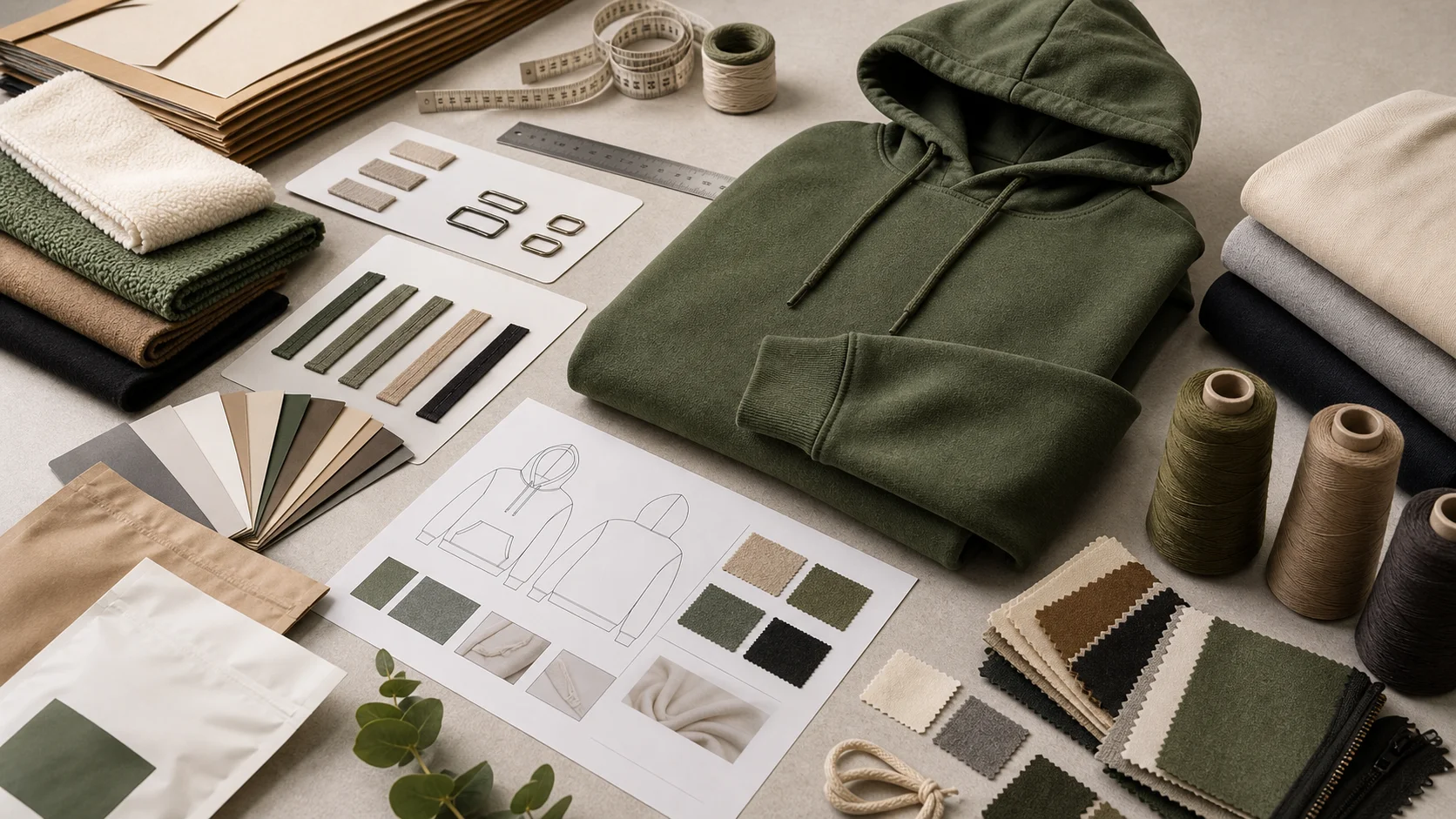
Custom Garment Bags with Logo Printing compared by sample evidence, fabric or trim specs, MOQ, AQL terms, cost lines, delivery timing, and rework...
Fast answer: Custom Garment Bags with Logo Printing: Material, Print, MOQ, and QC Terms should be judged by production evidence, not by a generic sourcing promise. The buyer needs sample proof, cost breakdowns, QC checkpoints, and delivery buffers in writing.
Ask for recent sample photos, measurement tolerances, fabric or print test assumptions, decoration test notes, packing examples, and a named inspection checkpoint. These details show whether the team can repeat an approved sample at bulk volume.
Separate garment cost, decoration, labels, packaging, sampling, testing, freight, and rush charges. Clear cost lines make it easier to reduce colorways, adjust size depth, or reserve more time for sampling.
A wrinkled suit, a creased bridesmaid dress, and a wholesale rack of jackets shipped in dusty poly bags all point to the same expensive truth: bad packing becomes a brand problem fast. Custom garment bags with logo printing sit right where protection meets presentation, which is exactly why brands tend to underestimate them until a complaint lands in their inbox.
In factory visits, the numbers were blunt. Poor packing can trigger 2% to 7% damage or rework on certain e-commerce and wholesale shipments, while a better bag often adds less than $0.40 to $2.10 per unit depending on material and order size. That gap matters. On a 1,000-piece order, replacing even 25 damaged units at $18 to $65 each wipes out any savings from a cheap bag.
Luxury labels know this instinctively. Garment bags become part of the promise, sometimes paired with a branded dust cover, a satin hanger, and a rigid shipping carton. Value retailers use them differently. For them, the bag is a handling tool that lowers return rates, keeps bulk shipments cleaner, and cuts down time spent steaming or re-folding at store level. Same object. Two business models.
Plenty of low-cost suppliers can print a logo cleanly, especially with screen printing services for custom garment bags on non-woven fabric, yet they miss the details that decide whether a bag survives transit: zipper teeth that split after 20 cycles, seams with 6 mm allowance instead of 10 mm, weak stitching at the hanger opening, or a plastic odor customers notice the moment they unzip it. A bag can look premium in a sample photo and fail on the warehouse floor.
The buyer’s real question is not which bag costs least. It is which one preserves margin, protects the garment, and still looks credible when it reaches a client, buyer, or bridal party.
Material choice changes everything. Non-woven polypropylene usually sits at the entry price tier, often around 80 to 120 GSM, and works well for suits, uniforms, and short-haul retail use. PEVA adds water resistance and a smoother hand feel, but some low-grade versions carry a vinyl smell that becomes obvious in enclosed storage. Polyester, especially 210D or 300D, handles repeated travel better and prints more sharply. Cotton feels premium and breathes well, though it wrinkles and costs more to sew. TPU is the most technical option here, with better clarity and flexibility than rigid PVC-like films, but buyers should ask carefully about recycling claims and confirmed material composition.
Use case matters more than trend. Bridalwear often needs full-length protection, a central zipper, and a generous gusset of 4 to 8 cm for volume. Suits can work with slimmer profiles and a hanger opening that stays neat after repeated use. Outerwear needs more structure because coats are heavier and may require stronger seams and reinforced handles. Uniform programs usually care about fold-flat shipping and fast distribution, while travel retail programs care about abrasion resistance and a bag that still looks respectable after 10 to 15 trips.
Print compatibility varies by surface. Flat non-woven panels accept simple logos well, while woven labels or embossed patches can raise the perceived value without flooding the surface with ink. Heat transfer works on smoother fabrics, but poor adhesive choice can crack after repeated folding. Digital print is useful for complex artwork, though it is not always the cheapest route for 500 to 2,000 units. If your artwork is multicolor and the order is moderate, this is where sublimation printing services for polyester garment bags may make sense on polyester-based bags.
Regional manufacturing patterns are visible. Several Asia-based factories specialize in budget non-woven bags at high output, often 10,000 to 50,000 units per month. Many European suppliers push recycled fabrics, tighter chemical controls, and finishing that tolerates closer inspection, but their pricing can run 15% to 40% higher. The details buyers miss are boring until they are expensive: seam allowance, closure length, whether the bag folds to A4 size for shipping, and whether the material smells like low-grade PVC when it is opened from the carton.
I have watched a buyer at a department store run two fingers over a sample bag before ever checking the logo. That tactile pause told me more than the logo did. A chest-level mark in matte ink suggests restraint. A huge glossy print suggests cost pressure. A tonal logo near the zipper reads as careful, sometimes even expensive. Zipper pulls with engraved branding can lift the perception of a $9 bag more effectively than a loud front panel, because the hand touches those details first.
Different channels judge differently. A bridal boutique wants the dress to arrive ready for the fitting, with no odor, no stains, and a bag customers keep for storage after the wedding. A corporate uniform program cares about inventory control and whether staff can return items in the same pack. A department store buyer wants consistency across 300 to 5,000 units, plus a pack size that fits back-of-house shelving. The same garment bag solves each problem in a slightly different way.
Repeat orders improve when packaging feels useful, not ornamental. In my experience, a customer who reuses a bag for 6 months sees the logo 20 to 40 times, which is far more valuable than one dramatic unboxing moment. A clean print and sturdy zip can support referral behavior too, especially for bridal and premium tailoring. That is why brands that invest in clothing packaging solutions for premium apparel often see packaging ripple into retention, not just presentation.
The thing nobody tells you: a larger logo can make the bag look cheaper if the hand feel is weak. Buyers forgive a modest mark on 300D polyester far more readily than a loud print on thin, noisy material.
When I visited factories in Vietnam and Turkey, I saw the same mistake repeat. Teams obsessed over artwork placement, then ignored the zipper tape, the edge binding, and the way the bag draped when loaded with a wool blazer. Customers remember friction. They remember snagging a collar on a rough seam. They remember a bag that zips smoothly after 12 uses. Branding has to travel with the garment, store well in a closet, and survive more than one season.
Pricing is where many buyers lose discipline. For 100 units, a simple non-woven bag with one-color print may land around $2.20 to $4.80 each, while a 300D polyester version can sit closer to $4.50 to $8.50 depending on zipper grade, gusset depth, and packaging. At 1,000 units, those numbers often fall to $1.10 to $2.90 for non-woven and $2.80 to $5.90 for polyester. By 10,000 units, bulk economics can cut another 20% to 35% if the spec stays stable.
The cost matrix changes fast with print complexity. One-color screen print is usually the cheapest branded option. Full-panel digital print costs more because of setup, color control, and waste. Embroidery or woven patches raise labor, but they can make a bag feel more durable and less promotional. A metal zipper pull or custom label may add only $0.08 to $0.35, yet it can change how the bag is judged during buying meetings.
Hidden costs are where landed price gets ugly. Artwork prep can add $25 to $120. Sampling may cost $30 to $180 per round, with 2 rounds common for new programs. Color matching on black or dark navy fabric can slow approval by 3 to 7 days. Freight matters too. Sea freight is cheaper on large replenishment orders, while air freight can double logistics cost on urgent launches. Inspection and carton labeling may add another $0.05 to $0.22 per unit. The quote you first receive is rarely the quote you pay.
Here is a useful comparison. Vietnam often prices 5% to 15% above China on like-for-like orders, but some buyers accept that for stronger compliance records and lower rework. India can be competitive on labor-intensive sewing, sometimes 10% to 20% below Vietnam depending on fabric availability. Turkey often sits higher than both on labor, yet regional lead times to Europe can shrink total delivery cost. Across these markets, differences of 10% to 35% are normal once fabric sourcing, compliance testing, and shipping are included.
The cheap option fails when failure rates rise. If 3% of 2,000 bags tear at the zipper seam, a replacement run plus client complaints can cost more than upgrading the original spec by $0.60 each. That is why a sensible buyer balances unit price, defect rate, and rework risk. private label clothing services for brands often use the same logic: a slightly better component can protect the whole margin story.
A supplier should answer practical questions without dodging. Ask about monthly capacity, real lead times, sample policy, print tolerance, and in-line quality control. If a factory says it can produce 50,000 units a month, ask how many sewing lines are actually dedicated to bag construction and how many QC staff inspect zippers, seams, and folds. A polished PDF does not tell you that.
Evidence beats claims. Request recent test reports, not expired certificates. Ask for client references from the last 6 to 12 months. Ask for unedited production photos showing panels before printing, after sewing, and before carton packing. When I visited factories, weak suppliers often shared catalog images but hesitated when asked for in-process shots or defect logs. That hesitation is data.
Trading companies can be useful if speed and coordination matter more than direct factory control. They often quote faster and can source multiple components. Direct factories usually give better visibility into fabric sourcing, labor allocation, and line capacity. I prefer direct factories for repeat orders above 1,000 units, especially when the bag must match other packaging or uniforms from the same program.
Watch for red flags. Inconsistent stitching across three samples. Prints that fade after a folding test. Polybags with a strong odor after unpacking. A zipper that catches at the final 2 cm. Those defects may not sound dramatic, but they are exactly what creates returns and internal complaints. Ask for a pre-production sample and a final random inspection before shipment, especially above 1,000 units. If a supplier resists that, I move on.
For logo consistency, many buyers still rely on screen printing services for custom garment bags because the method is predictable on non-woven and coated surfaces. The key is not the print method alone; it is whether the factory has documented tolerance for registration, wash testing, and fold resistance after packing 20 to 30 times.
The production clock usually starts with artwork approval. From there, a sample can take 5 to 12 days, revisions another 3 to 7 days, and mass production 15 to 30 days for standard orders. Complex programs with recycled polyester, custom zippers, or multiple print hits can stretch to 35 to 50 days before freight. Packing and QC typically add 2 to 4 days. If you are buying 5,000 units or more, build time for carton labeling and palletizing.
Delays most often come from the buyer side. Slow approvals, missing Pantone references, and vague specs can stall a line for a week. Unavailable trims are another trap. A zipper color that looks easy in a render may not exist in the factory’s inventory, which means waiting 10 to 14 days for a dyed run. Clear tech packs prevent that.
Shipping choice depends on urgency and margin. Air freight can deliver in 3 to 8 days and rescue a retail launch or bridal peak season, but it can add $1.80 to $6.50 per unit on smaller cartons. Sea freight may take 18 to 35 days port to port, yet it is often the only rational option for 3,000 to 10,000 units. I advise buffer time of 2 to 3 weeks for wedding programs and at least 4 weeks for seasonal retail because missed windows erase the value of cheap production.
For premium orders, the bag should be packed inside a clean poly sleeve, then nested in a carton that survives compression without crushing the zipper teeth. Good factories know how to prevent edge marks and odor transfer. If they do not, ask why. The answer usually explains the rest of the quote.
A brief should remove guesswork. Start with bag size, garment length, material, print area, logo file type, zipper color, handle style, hanging loop, and quantity. If the bag is for a 48-inch dress, say so. If it must fit a 44 regular suit with a 2-inch shoulder pad, say that too. Vague briefs create quote inflation because suppliers pad their numbers to cover unknowns.
Include control points. State whether the logo must match Pantone 286 C or a measured swatch. Provide vector files in AI, EPS, or high-resolution PDF. Confirm whether the print should sit 60 mm below the top seam or centered on the chest panel. If you need recycled content, specify the minimum percentage and ask for supporting documentation. If PVC-free matters, say it in writing.
Packaging standards matter too. If bags must fold flat for distribution, give the folded dimensions and carton pack count. If the shipment crosses borders, check fiber content labeling and country-specific rules. According to the OEKO-TEX guidance and other industry standards, chemical compliance and material declarations are easier to manage when the spec is explicit from day one. Buyers who skip this step often pay for redesign later.
Here is the quickest path from research to RFQ: list the garment type, set the quantity, attach artwork, define the material, request 2 sample options, and ask for a landed price at 500, 1,000, and 5,000 units. If you are comparing packaging to apparel programs, the same discipline used in private label clothing services for custom programs applies here. The cleaner the brief, the faster the quote.
My advice is simple. Put every decision on paper before you ask for pricing. That single habit cuts revision cycles, protects your timeline, and reduces the odds of a bag that looks right only in a mockup.
When comparing a manufacturer, factory, or supplier, focus on production transparency, not just sales language. A strong China factory will show sewing capacity, printing methods, quality checkpoints, and actual monthly output. Ask how the production line handles custom packaging, bulk orders, and wholesale replenishment. That is where you learn whether a partner can support repeat programs or just one-off samples.
MOQ also matters. For custom garment bags with logo printing, low MOQs can look attractive, but they often come with higher unit costs and tighter material choices. Larger bulk orders usually improve pricing and allow more consistent quality control. If the supplier offers flexible MOQ, confirm whether that applies to the same material, print method, and construction you want.
China remains a major sourcing base because it combines material access, print capability, and fast production for standard garment bag programs. Still, buyers should compare factory reports, not geography alone. For example, a smaller specialist factory with stronger quality systems can outperform a larger wholesale supplier that only prioritizes speed.
Wholesale and bulk buying works best when the spec is stable. If you are ordering custom garment bags with logo printing in large quantities, lock the fabric, zipper, print method, and carton pack before requesting final pricing. This helps the supplier quote accurately and reduces change fees later.
Ask for tiered pricing at 500, 1,000, 5,000, and 10,000 units. That makes it easier to see where the real break point is. A slightly higher unit price at a lower MOQ can still be the better decision if quality, lead time, and rework risk are stronger.
For sustainability or compliance checks, reference independent standards from trusted industry bodies such as Textile Exchange, Trade.gov, and OEKO-TEX. These resources can help buyers compare recycled content claims, trade basics, and material compliance expectations before placing a bulk order.
For 100 units, expect roughly $2.20 to $8.50 each depending on material, print method, and zipper quality. At 1,000 units, many buyers land between $1.10 and $5.90 per bag, with freight and sampling extra. The biggest price swing usually comes from fabric choice and closure style.
Many factories quote 100 to 500 units as a minimum, but 1,000 units often gives better pricing and more stable QC. Some non-woven suppliers will accept 300 pieces if the print is simple. Recycled or custom-fabric programs can require 2,000 units or more.
Simple orders can be ready in 20 to 30 days after artwork approval. More complex bags with custom zippers, recycled polyester, or multiple print hits often need 35 to 50 days before shipping. Add 3 to 8 days for air freight or 18 to 35 days for sea freight.
Yes, if the spec is built for it. A 210D or 300D polyester bag with reinforced seams and a quality zipper can handle 10 to 20 reuse cycles or more. Thin non-woven bags work for light duty, but they are not ideal for frequent travel or heavy outerwear.
Send garment dimensions, bag size, material preference, logo artwork, print placement, quantity, zipper color, and delivery target. Include Pantone references and ask for pricing at 500, 1,000, and 5,000 units. Clear briefs reduce sampling delays and make comparisons far more accurate.
If you want the quote to be useful, not decorative, start with a precise brief and ask suppliers to price the same spec side by side. That is the fastest way to see which custom garment bags with logo printing partner can actually protect your product, your timeline, and your margin.