
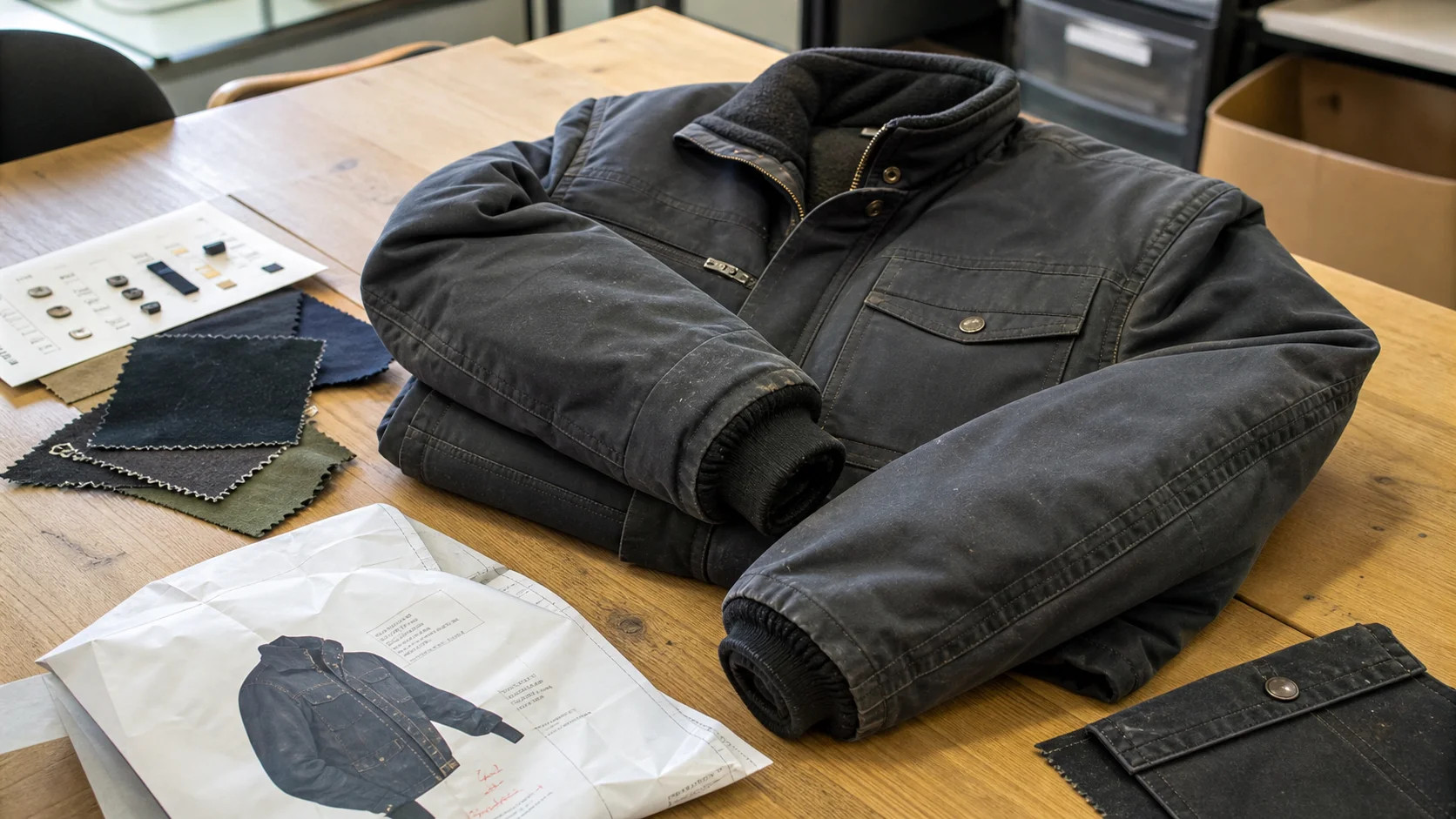
A focused outline for startup apparel teams planning custom jacket production, covering size grading specs, fit standards, sample approval, and production-ready grading decisions.
Custom Jacket Size Grading for Brand Production - Fabrikn production reference
Custom jacket size grading is one of the least glamorous parts of apparel development, but it has an outsized effect on whether a startup brand can scale without fit complaints, costly remakes, or inconsistent customer reviews. For new brands entering outerwear, grading is not just a technical pattern step. It is a commercial decision that affects sample cost, return rates, production efficiency, and how well the product performs across a full size run.
In simple terms, size grading is the process of increasing or decreasing a base jacket pattern into other sizes while preserving the intended fit, balance, and proportions. A good grade keeps the jacket looking like the same product in every size. A poor grade creates distorted sleeves, narrow biceps in larger sizes, oversized necklines in smaller sizes, or pocket placements that look visibly off.
Startup brands often underestimate this stage because they are focused on silhouette, fabric, branding, and decoration. That is understandable. Yet in jacket production, grading problems become expensive fast. Outerwear usually has more construction variables than a basic T-shirt: facings, interlinings, zippers, rib trims, linings, insulation, snaps, elastic, and multiple panels. Every one of those components can amplify fit problems if grade rules are rushed or copied from an unrelated style.
For brands sourcing custom jackets, the safer approach is to treat grading as part of product engineering rather than as a minor back-office task. If you are developing a bomber, varsity jacket, coach jacket, puffer, softshell, or workwear-inspired style, the size strategy should be defined before bulk fabric is booked. That is especially true if you plan to add embroidery, screen printing, heat transfers, patches, or mixed decoration methods.
A startup that gets grading right early is in a much better position to place repeat orders, expand size ranges, and control quality. If you are still comparing development options, pages such as /services/ and /about-us/ can help frame what support to ask for during jacket sourcing.
Custom jacket size grading refers to creating a size range from a brand’s own approved base pattern rather than relying on a generic house block with minimal adjustments. That distinction matters. Many factories can grade patterns. Fewer will challenge whether the starting block matches your brand’s target fit, customer body type, layering allowance, and intended use case.
For startup brand production, grading usually begins with one approved sample size, often called the base size or fit sample size. In many markets, that is a men’s medium or women’s small, though the best base size depends on your target customer and jacket type. Once that base sample is approved, a grader applies incremental measurement changes to create adjacent sizes such as XS, S, M, L, and XL.
Those incremental changes are called grade rules. They are not limited to chest width. A proper jacket grade may include adjustments across:
The key point is that jackets cannot be graded well by simply adding equal width and length everywhere. That shortcut often causes proportional drift. A relaxed-fit bomber and a tailored uniform-style jacket may share a chest measurement in one size, yet require very different grade rules for shoulder slope, sleeve cap, hem sweep, or collar stand. That is why custom grading should be matched to the actual style, not copied from a random previous order.
Established brands often have years of fit data, return analysis, and customer feedback to refine their grading. Startups do not. That means early production runs carry more uncertainty, and grading decisions need to be more deliberate.
A custom grading plan helps a startup in several ways. First, it keeps the fit identity consistent. If your brand positions itself as oversized, cropped, utility-driven, or streetwear-inspired, the grade should protect that look across sizes. Second, it reduces the risk of accidental exclusion, where smaller or larger sizes feel like different garments altogether. Third, it supports repeatability. Reorders become easier when the size spec and grade rules are documented clearly.
There is also a practical sourcing angle. Factories frequently ask startups to simplify development by using standard grading increments. That can be acceptable for entry-level styles, but it is not always right for structured outerwear. A startup should be careful when the manufacturer’s default answer is “we will follow our standard size set.” Standard for whom, and based on which market, is the question that matters.
Brand owners should also consider the commercial downside of underdeveloped grading. If a launch quantity is small, the temptation is to rush from fit sample to production. That saves time in the short term, but the first bulk order can become your most expensive fit test. For jackets, that is a risky place to learn.
The base size is the anchor of the entire grade. If the base fit is wrong, the rest of the size range usually inherits that problem. Startup brands should spend time here rather than trying to fix fit issues later through wider grading jumps.
Most suppliers will recommend a standard sample size because it simplifies pattern work and sample room planning. That is reasonable. Still, the right base size should be selected using the brand’s customer profile, not just factory convenience. A unisex oversized jacket may need a different development logic than a fitted women’s cropped jacket or a men’s insulated work jacket designed for layering over sweatshirts.
Base size selection should account for:
In purchasing terms, it is usually smarter to approve one fit decisively before asking for a full graded set. If the startup still has doubts about silhouette, ordering multiple size-set samples too early adds cost without solving the core fit question. First lock the identity of the style. Then test the grade.
Some measurement points carry far more fit risk than others. Startups should know where to focus when reviewing specs and samples.
These measurements shape the overall body volume of the jacket. Chest is usually the primary control point, but waist and sweep often determine whether the garment looks balanced. A jacket can measure correctly at chest and still feel restrictive if sweep is underbuilt for layering or movement.
Shoulder width is critical for visual balance. Across-back measurements matter even more in structured outerwear or styles designed for mobility. Larger sizes often need proportionally thoughtful back expansion, not just wider fronts.
Sleeve grading is a common failure point. Bicep width, sleeve cap shape, elbow room, and cuff opening all influence comfort. Startups should pay close attention here, especially for lined jackets or styles with batting, because internal bulk reduces available ease.
Length grading sounds simple, but jackets are judged visually. Too much length added from size to size can distort a cropped silhouette. Too little can make larger sizes look short or tight. The front-to-back balance also matters in jackets with dropped shoulders, hoods, or heavy trims.
Neck opening, collar height, hood depth, and placket length affect comfort and appearance. These details are often overlooked until wear testing reveals practical issues such as choking at the neck or poor hood coverage.
Once the base sample is approved, the manufacturer or pattern team applies grade rules to the digital pattern. In startup production, this is usually done in CAD software, though the process still depends on human judgment. The software can move points accurately. It does not decide whether the rule is commercially sensible.
A typical workflow looks like this:
In many startup projects, the most efficient compromise is not a full pre-production sample in every size. It is usually enough to review the base size plus one smaller and one larger size, especially if the range is limited to five sizes. That said, if the jacket has strong shaping, heavy padding, or complex decoration placement, a broader size-set review becomes more valuable.
Direct buying judgment: if a factory wants to skip graded sample verification on a complex jacket because the MOQ is small, that is a cost-saving move for the supplier, not necessarily a safe move for the brand.
Jacket grading cannot be separated from material choice. Fabric weight, stretch, recovery, loft, and internal structure all influence how a graded size will behave in wear.
For example, a lightweight nylon coach jacket with mesh lining may tolerate tighter grading tolerances than a padded twill work jacket with quilted lining. A bonded softshell responds differently than a heavyweight wool blend or a cotton canvas with fused placket. If the startup changes material after fit approval, the grade may need review. Many fit issues blamed on production sewing are really a mismatch between approved pattern assumptions and actual bulk fabric behavior.
Material-related factors to review include:
Decoration also changes the hand feel of a jacket panel. A large embroidery with heavy backing or a dense screen print can reduce drape and alter how the garment hangs in certain sizes. That effect is more noticeable on lighter shells. Startups should not approve grading in isolation from final decoration specifications.
Since this topic sits within Decoration & Printing, it is worth being direct: many jacket fit and appearance issues start when artwork placement is approved without considering graded sizing.
A chest logo may scale acceptably across sizes without changing art dimensions, but a large back print or applique patch often creates visual imbalance if placed at a fixed distance from the neck on every size. Larger jackets can make the artwork look too high and undersized. Smaller jackets can make the same artwork feel crowded or oversized.
Brands producing custom jackets with screen printing, DTF transfers, embroidery, chenille patches, woven badges, or heat-seal emblems should define:
There is no universal rule. A premium brand may prefer fixed logo dimensions for identity consistency. A fashion-driven startup may prefer slight scaling to preserve visual proportion. The right answer depends on design intent, garment size range, and production capability.
Placement should be documented from clear reference points such as high point shoulder, center front, or pocket edge. Verbal instructions like “print slightly lower on bigger sizes” are not production instructions. They are invitations for inconsistent bulk output.
Startups comparing decoration suppliers should also ask whether prints or patches are applied before or after panel assembly. Placement accuracy can shift depending on process order. That choice affects not only aesthetics but also grading consistency and inspection tolerances.
For startup jacket production, a disciplined sample approval path matters more than speed. Jackets tend to combine enough variables that skipping stages often creates confusion later.
A practical sample sequence may include:
Not every project needs every stage repeated multiple times, but startups should be realistic about what each step is designed to confirm. A fit sample in substitute fabric does not fully validate a padded winter jacket. A pre-production sample in only one size does not guarantee the XXL sleeve works properly. The more complex the garment, the less useful it is to treat approvals as paperwork.
When reviewing samples, brands should check:
If development support is needed, a direct inquiry through /contact-us/ is the practical next step for clarifying sampling workflow, file requirements, and production readiness questions.
Startup brands usually operate under tighter budget and inventory constraints, so grading strategy should be matched to MOQ and lead-time realities.
For custom jackets, sample MOQs are typically low, but bulk MOQs often start around 100 to 300 pieces per style depending on complexity, fabric sourcing, and decoration method. Some suppliers may quote lower entry MOQs for simple unlined jackets, while insulated or highly customized styles often need stronger volume to price efficiently. Size ratios also matter. A supplier may accept 150 pieces total but become less flexible if the size break requires very small quantities in several sizes.
Lead times vary by season, raw material readiness, and development status. As a rough planning range:
Stage Typical Range Main Dependency Proto or fit sample 7-21 days Pattern clarity, fabric availability, trim sourcing Revised sample 7-14 days Comment complexity and sample room capacity PP sample 10-21 days Bulk materials in hand, approved artwork and labels Bulk production 30-75 days Order volume, fabric mill lead time, decoration workloadThose numbers are planning references, not guarantees. A startup should be cautious if a supplier promises aggressive timelines before confirming fabric and trim readiness. Jackets are less forgiving than simple cut-and-sew basics.
Cost tradeoffs are also worth stating plainly. Custom grading and cross-size sampling increase development cost, but that cost often protects a small brand from bulk errors that are much harder to absorb. If the budget is tight, it usually makes more sense to reduce the number of styles than to compress fit validation on a complicated jacket.
Inspection problems in jacket production often show up more clearly at the size extremes. A medium may look acceptable while XS and XXL reveal where grade rules were weak or where sewing execution drifted.
Common risks include:
Brands should establish tolerances in the measurement chart and make sure the inspection method is consistent. Flat measurement technique matters. One team measuring a padded jacket with compression and another measuring without it will produce different results even if the garment is sewn correctly.
For startups, a smart precaution is to request inspection coverage across several sizes rather than allowing checks to cluster only around the central size. If the order volume is small, at least ensure the largest and smallest sizes are visually reviewed and measured against approved specs.
The right questions can save weeks of revision. Before confirming a custom jacket order, startup brands should ask the supplier:
These are not abstract technical questions. They indicate whether the supplier manages jackets as engineered products or as simple volume garments. That difference becomes obvious once revisions begin.
Custom jacket size grading for startup brand production should be treated as a core fit-and-quality discipline, not a box-ticking step between sampling and bulk. The jacket category is too construction-heavy, and too sensitive to fabric and decoration changes, for generic grading assumptions to be safe.
The strongest purchasing approach is usually straightforward: define the target fit clearly, approve the right base size, document grade rules, review at least selected cross-size samples, and confirm decoration placement with size logic in mind. That method costs more time upfront, yet it reduces the odds of expensive fit inconsistency later.
If a startup is forced to choose where to spend limited development money, fit validation and grading control deserve priority over cosmetic extras. Customers may forgive a simple trim package. They rarely forgive a jacket that fits unpredictably from one size to the next.
For brands building a reliable outerwear supply chain, custom grading is part of commercial discipline. It protects the product, the launch, and the reputation of the label.
Get a free quote from Fabrikn — your trusted B2B clothing manufacturer with 10+ years of experience. MOQ as low as 200 pieces.
Get a Free Quote →Custom jacket size grading is the process of creating a full size range from a brand’s approved base jacket pattern using size-specific grade rules. It is different from using a generic factory size chart because it aims to preserve the intended fit and proportions of the actual style.
It helps startups avoid inconsistent fit across sizes, reduces return risk, and improves repeat production accuracy. In jackets, where construction is more complex than basic knitwear, poor grading often leads to visible fit problems and higher correction costs.
Typical bulk MOQs often range from 100 to 300 pieces per style, though exact requirements depend on fabric type, decoration complexity, and whether the jacket is lined or insulated. Some simple styles may be lower, but startups should confirm size breakdown flexibility early.
Most startup jacket projects need at least a proto or fit sample, a corrected fit sample if necessary, and a pre-production sample. If grading risk is meaningful, a size-set sample or selected cross-size sample review is a sensible safeguard.
Yes. Embroidery, patches, screen prints, and heat-applied graphics can affect placement balance, panel drape, and visual proportion across sizes. Decoration should be reviewed alongside graded sizing, not as a separate late-stage step.
Chest, shoulder width, across back, armhole, bicep, sleeve length, sweep, body length, and collar or hood dimensions are usually the highest-risk points. The exact priorities depend on the jacket style and intended fit.
Not always. For many projects, reviewing the base size plus one smaller and one larger size is a practical compromise. More complex jackets or broader size ranges may justify a larger size-set review before bulk approval.
Sample development can take 1 to 3 weeks per round, while bulk production often takes 30 to 75 days after approvals and materials are ready. Fabric sourcing, trims, decoration method, and seasonal capacity all affect the final timeline.