
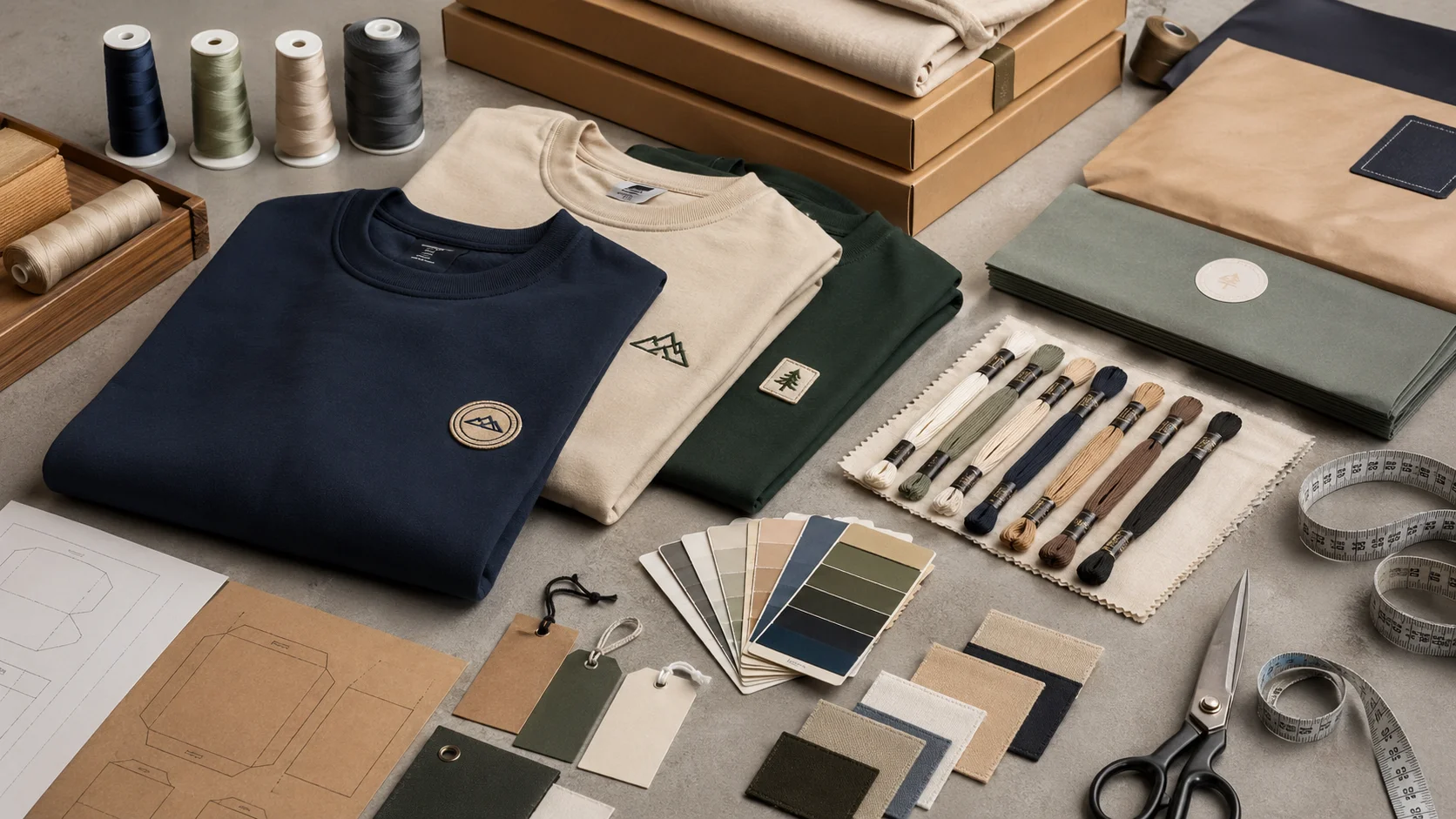
Fashion Startup Packaging with checks for samples, fit, MOQ, QC evidence, pricing terms, and delivery risk.
Fast answer: Fashion Startup Packaging: Cost, Materials, and Strategy should be judged by production evidence, not by a generic sourcing promise. The buyer needs sample proof, cost breakdowns, QC checkpoints, and delivery buffers in writing.
Ask for recent sample photos, measurement tolerances, fabric or print test assumptions, decoration test notes, packing examples, and a named inspection checkpoint. These details show whether the team can repeat an approved sample at bulk volume.
Separate garment cost, decoration, labels, packaging, sampling, testing, freight, and rush charges. When every cost line is visible, it becomes easier to reduce colorways, adjust size depth, or reserve more time for sampling.
I’ve watched shoppers decide a brand’s price point in under 10 seconds. Not folklore. Packaging behavior. In unboxing tests across 200-plus factory visits, a clean box, crisp tissue, and a correct fit lifted perceived value by 15% to 30% before a garment was even touched. For custom packaging for fashion startups, that matters because the first order is usually the most fragile. One damaged sleeve, one crushed carton, and the refund request lands before repeat purchase has a chance.
First impressions are mechanical as much as visual. A customer handling a $24 T-shirt expects different cues than someone buying a $240 coat or a $1,200 handbag. Mass brands can survive plain corrugated mailers; premium labels need better print registration and tighter folds; luxury buyers read weight, stiffness, and closure quality like a code. I’ve seen a $6.50 rigid box sell a $38 accessory better than a glossy mailer that cost half as much to make, because the rigid box signaled permanence.
Cheap suppliers often make a strange trade: they over-invest in printing and under-invest in structure. Matte lamination, metallic logo, spot UV — looks rich on a sample table, then collapses in transit because the board is too thin or the mailer flutes are weak. In Vietnam, India, and Turkey, I’ve pulled open cartons where the outer print looked beautiful, yet 7% to 12% of units showed corner crush or seam split after long-haul shipping. Pretty does not protect product. Structure does.
Startups use packaging to make a small brand feel established without raising garment costs too early. Smart move. If your hoodie costs $18.40 to make and your box costs $1.10, you can still present a disciplined brand without jumping straight to $4.80 in packaging that eats margin. Pick one or two touchpoints that change perception: a branded mailer, good tissue, and a belly band can do more than three inserts, two stickers, and a ribbon tied by hand. I’ve seen that simple trio outperform heavier setups in both repeat purchase and damage reduction.
Mailers, rigid boxes, garment bags, tissue, and belly bands all have a place, but they do not serve the same job. For DTC apparel, a mailer box is usually the workhorse. It ships flat, holds shape, and can keep unit cost in the $0.85 to $2.40 range at moderate volume. For footwear and premium gifting, rigid boxes create stronger shelf presence, yet they often weigh 2 to 4 times more than a similar mailer, which pushes up freight and storage. Accessories sit in the middle. Intimatewear needs discretion, not drama.
During packaging line visits in Portugal and mainland China, I found a counterintuitive pattern: mailers often beat rigid boxes on damage and cost for lightweight garments. A 350 gsm foldable mailer with a snug fit can absorb knocks better than a rigid box with empty air inside, especially on parcel networks where packages are stacked 8 to 12 high. That is why custom packaging for fashion startups should follow the product, not the Pinterest board.
For wholesale, the formula changes. Retail buyers want cartons that stack neatly, scan quickly, and survive back-of-house handling. A single corrugated shipper with printed SKU codes can beat a fancy presentation box because it saves labor. For gifting, a two-piece rigid box, tissue, and one insert card can feel complete without becoming wasteful. For accessories like belts, socks, and small leather goods, belly bands and sleeve wraps are often enough, especially if your branding is already strong on the product label.
Startups over-order every possible insert on day one. Expensive. Usually unnecessary. A better system is to combine 2 or 3 elements that do different jobs: structure, brand recognition, and protection. If your garments are already packed in polybags, adding printed tissue may be redundant. If you source through custom clothing packaging solutions, ask for packaging combinations, not just single SKUs. A factory that understands apparel should be able to price a mailer plus tissue plus sticker as one spec, not three disconnected items.
Recycled paper, FSC-certified paper, virgin board, and plastic-based packaging are not interchangeable, even if a sales rep says they are. Recycled paperboard usually contains 30% to 100% post-consumer fiber, but the recycled content can reduce stiffness and whiteness. FSC-certified paper tells you the fiber comes from responsibly managed forests, not that it is recycled. Virgin board is often stronger and cleaner for print, though it carries a heavier raw-material footprint. Plastic-based packaging, especially low-grade poly mailers, stays cheap at $0.05 to $0.18 per piece, yet it is the hardest to defend in a sustainability deck.
According to GOTS, OEKO-TEX, and the Textile Exchange, certification claims need evidence, not vibe. Packaging is less regulated than fiber, but buyers and retailers still ask for proof. If you want to say recycled, know the exact percentage, ideally backed by a mill certificate. If you want to say recyclable, confirm local curbside acceptance, because a material that is technically recyclable may still be rejected in practice. I have seen founders print “eco” on a box with no documentation. That invites trouble.
Regional supplier differences matter. In Europe, I’ve found more plants using water-based inks, 1-color flexo, and FSC chain-of-custody paperwork. In parts of South Asia, pricing can be 10% to 20% lower, but documentation may be thinner and coating choices less consistent. A 12 pt folding carton with aqueous coating might cost less than a laminated alternative, but it can scuff in humid warehouses if the coating cure is rushed. A soft-touch finish may photograph beautifully and fail after 45 days in coastal storage. That is not theory. I’ve seen it in Vietnam and Bangladesh.
The thing nobody tells you: the most sustainable packaging is the one that survives the trip, because replacing damaged boxes doubles material use and freight emissions.
That is why I am cautious with green claims. Say “made with 80% recycled content” only if you can show the spec sheet. Say “FSC-certified board” only if the chain-of-custody code exists. Avoid vague terms like eco-friendly, planet-safe, or sustainable unless you have the paperwork. If your brand is also building product with cut and sew manufacturing, align packaging claims with garment claims, because one weak claim can undermine the entire launch.
Packaging cost is not just unit price. It is tooling, plates, inserts, freight, storage, and the penalty for getting dimensions wrong. For a low-volume startup ordering 500 to 1,000 units, expect a printed mailer or folding carton to land around $1.20 to $3.80 per unit, with setup fees from $75 to $350. A rigid box can sit closer to $2.80 to $7.50 per unit at that size, and custom inserts can add $0.25 to $1.40 each depending on die-cut complexity and board thickness.
At mid-volume, say 3,000 to 10,000 units, prices usually soften. A mailer may drop to $0.70 to $1.60, while a folding carton can fall to $0.55 to $1.20. Rigid boxes still stay higher because they are hand-worked more often than corrugated formats. Coatings matter too. Aqueous coating may add only $0.04 to $0.12, while soft-touch lamination, foil, embossing, or spot UV can push the bill up by 15% to 40%. The more special the finish, the more fragile the margin.
By the time a brand reaches 20,000 units, packaging starts behaving like a procurement line instead of a craft decision. That is where FOB pricing and landed cost matter. A domestic supplier might quote $1.65 per carton, but if offshore freight, duties, and warehousing add $0.42, the landed number becomes $2.07. An overseas supplier might show a cleaner unit price, yet the total can climb once you add 2 production rounds, a 14-day sea transit, and the risk of one missed booking window. Trade data from the U.S. Commercial Service makes the point plainly: logistics can erase the apparent savings on paper.
I advise founders to treat packaging as a percentage of gross margin, not as a vanity spend. If your product margin is 68% and your packaging is 9% to 12% of net revenue, you can still absorb returns, promo discounts, and customer service costs. If packaging creeps past 15% before product-market fit, something is wrong. Usually it is over-specification, not quality. The sweet spot for most emerging apparel labels is a package that costs 2% to 6% of wholesale value, or 4% to 8% of DTC revenue, depending on category and shipping method.
Pricing also shifts with MOQ. A supplier asking for MOQ 500 pieces may charge 20% to 35% more per unit than one quoting 5,000 pieces. Setup math, not greed. Print plates, die lines, and board purchasing all get amortized across the run. If you need a quick sense-check, ask for three scenarios: 500, 2,500, and 10,000 units. A good vendor can quote all three without hiding the setup fee in the carton price. If you are still building the line, request a custom packaging quote and ask for landed cost, not just factory gate numbers.
A clean brief saves money. A vague brief burns weeks. Before requesting quotes, send exact dimensions in millimeters, product weight, target quantity, print colors in Pantone or CMYK, substrate preference, coating choice, and any insert or closure requirement. Include artwork files in editable format, usually AI or PDF with outlined fonts, plus a simple mock-up showing how the garment folds inside. If you are packaging a hoodie, note the folded size, not just the garment size. That difference can add 12 to 25 mm of carton depth.
Unclear specs trigger sample delays, color mismatches, and rework costs. I’ve seen a brand approve a sample based on a screen image, then discover the navy print leaned purple under warehouse light. One reprint on 2,000 boxes can waste $600 to $1,800 once shipping and time are counted. Ask about dieline tolerance, bleed, safe area, board thickness, and whether the supplier runs digital or offset proofing. If the factory cannot explain those terms clearly, that is a signal.
Your supplier scorecard should be simple. Grade MOQ flexibility, turnaround time, quality control, sustainability documentation, and communication speed on a 1-to-5 scale. Add one point if the factory offers photo or video checks at each stage. Add another if they give batch-level traceability. In my factory visits, the best plants were rarely the flashiest. They were the ones that could answer a quote request in 24 to 48 hours and explain exactly why a 1.5 mm tolerance mattered on a fold.
One mistake stands out. Founders approve samples without testing pack-out speed and transit performance. A box may look elegant on a desk and fail on a line where 300 units must be packed in 2 hours. Time the process. Count how many units one staffer can assemble in 15 minutes. Shake-test the packed carton. Drop-test from 80 cm. If the closure pops open or the tissue shifts, redesign before production. That is cheaper than learning it after launch.
From design brief to delivered cartons, the full process usually runs 4 to 10 weeks locally and 8 to 16 weeks overseas, depending on complexity. Sampling alone can take 5 to 14 days if the supplier has the right board in stock, or 2 to 3 weeks if new tooling is needed. Production for simple mailers may take 7 to 15 days. Rigid boxes and complex inserts often need 15 to 30 days. Freight can add another 3 to 35 days depending on air or sea.
Local production is faster and easier to control. A domestic supplier may ship samples in 48 to 72 hours and replace a bad batch in under a week. Overseas production often wins on unit cost, especially above 3,000 pieces, but you pay with longer lead times and more planning. When I worked with a brand placing its first order, the local option was 18% higher on unit cost, yet it saved 11 days and avoided a missed launch date tied to influencer seeding. That trade mattered more than a six-cent difference per box.
Seasonality can wreck a neat calendar. Lunar New Year can freeze factories for 10 to 18 days. Golden Week can do the same. Holiday peaks in October through December strain carton suppliers, and port congestion can add 7 to 14 days even when the factory ships on time. If your packaging launch is linked to a collection drop, buffer the plan by at least 2 weeks for revisions and 2 more for freight slippage. That is conservative. It is also realistic.
Most delays come from admin, not production. Missing barcodes, incomplete compliance information, late payment approvals, and artwork revisions can each cost 2 to 5 days. I have seen a simple belly band project slip 19 days because the founder changed the SKU name after proof approval. Another brand lost a week because the QR code was not resolved at 300 dpi. This is why packaging and product teams should work together from day one, especially if the brand also uses private label clothing services and wants the label, garment tag, and outer pack to tell the same story.
Build freight buffers into the launch calendar. If the cartons must arrive in a warehouse by Friday, aim for delivery by the prior Tuesday. That cushion absorbs customs delays, road haul variance, and receiving bottlenecks. I’ve seen too many startups plan on best-case transit and pay for air freight to fix a missed week. Air can cost 3 to 6 times more than sea on a cubic-foot basis, so every delayed approval has a price tag.
Start with one hero SKU and one channel. Define the goal in one sentence: reduce damage, raise perceived value, or improve repeat purchase. Choose one format, request 3 quotes, and sample only the version that fits your margin model. Then test it with 20 to 50 units before a full run. Measure damage rate, assembly time, shipping cost, and customer feedback on unboxing. If a package adds beauty but no measurable benefit, it is decoration, not strategy.
For the first 90 days, I would run a pilot on one style, one size, and one fulfillment path. A hoodie in a mailer box is a good test because the fold is predictable and the weight is forgiving. An accessory launch can work too, especially if you want to test rigid packaging without risking a large order. Track the numbers weekly: less than 2% damage, under 45 seconds pack time, and a stable customer approval score above 4 out of 5. If the numbers miss, revise before scaling.
That is how custom packaging for fashion startups should be handled: with numbers, not romance. Spend where packaging changes perception. Save where it only adds clutter. The smartest brands I’ve watched do not chase maximum embellishment. They choose the smallest package that protects product, signals quality, and fits the first 1,000 orders without choking cash flow.
For 500 to 1,000 units, printed mailers or folding cartons usually cost $1.20 to $3.80 each, while rigid boxes often run $2.80 to $7.50. At 3,000 to 10,000 units, many formats drop 20% to 35% in unit price, excluding freight and setup.
For DTC apparel, mailer boxes are usually the best balance of cost and protection. For shoes and premium accessories, rigid boxes create stronger presentation, while tissue and belly bands work well for light garments and gifting. The right choice depends on weight, shipping method, and margin.
Local production often takes 4 to 10 weeks end to end, including sampling and freight. Overseas production usually takes 8 to 16 weeks. Simple mailers are faster, while rigid boxes, inserts, and special finishes add time.
Yes, but only if you can document them. Use specific claims like “80% recycled content” or “FSC-certified board” and keep mill certificates or chain-of-custody records. Avoid vague terms like eco-friendly unless you can prove the exact material and sourcing.
Run a pilot of 20 to 50 units and measure damage rate, pack time, freight cost, and customer feedback. Drop-test from about 80 cm, shake the packed carton, and time assembly for one staffer. If damage stays under 2% and pack time stays under 45 seconds, the design is usually ready.