
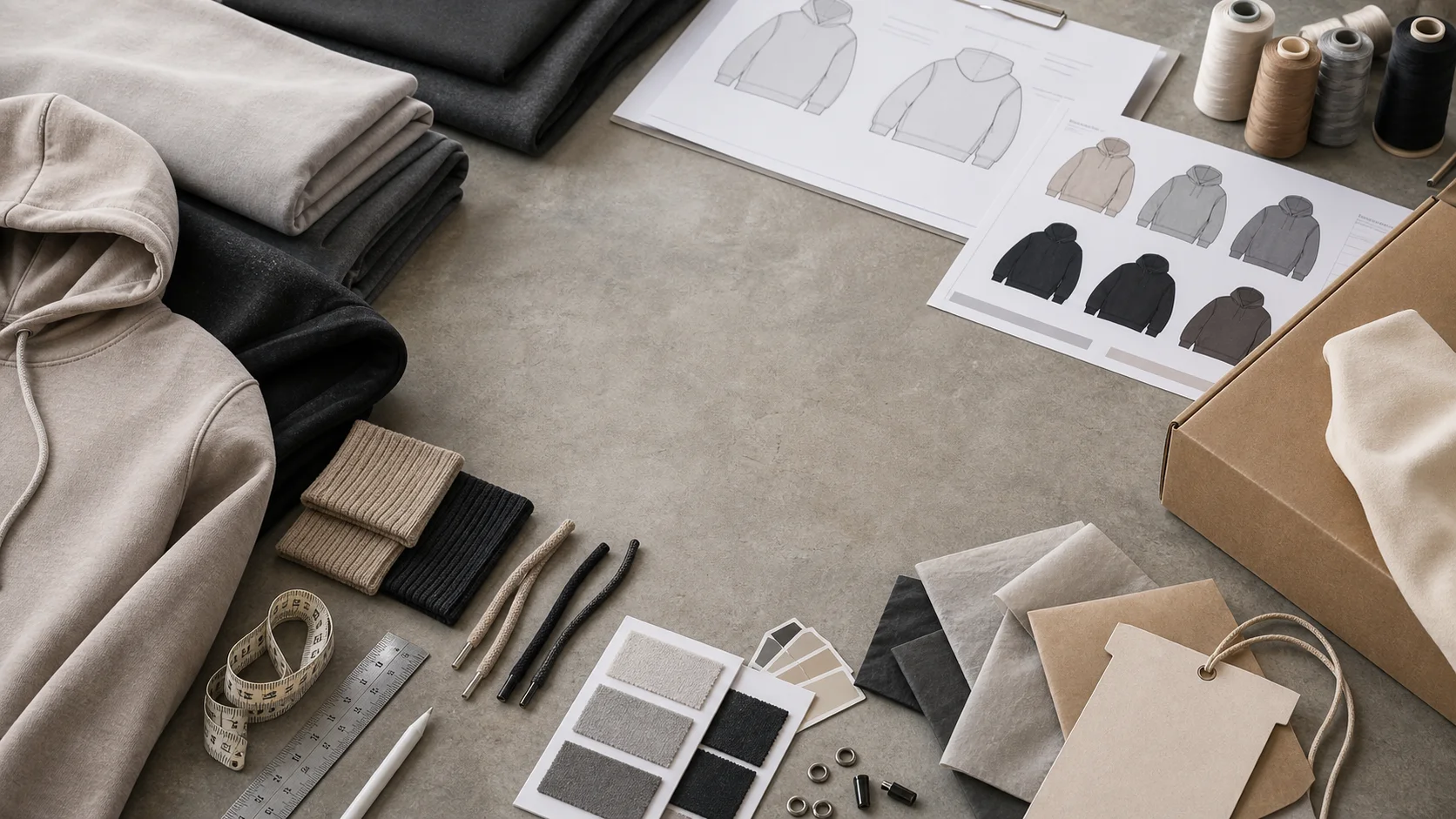
Premium Box Packaging for Fashion Startups with checks for samples, fit, MOQ, QC evidence, pricing terms, and delivery risk.
Fast answer: Premium Box Packaging for Fashion Startups: Cost, Design, Impact should be judged by production evidence, not by a generic sourcing promise. The buyer needs sample proof, cost breakdowns, QC checkpoints, and delivery buffers in writing.
Ask for recent sample photos, measurement tolerances, fabric or print test assumptions, decoration test notes, packing examples, and a named inspection checkpoint. These details show whether the team can repeat an approved sample at bulk volume.
Separate garment cost, decoration, labels, packaging, sampling, testing, freight, and rush charges. When every cost line is visible, it becomes easier to reduce colorways, adjust size depth, or reserve more time for sampling.
The box speaks before the garment does, and in fashion, that first line matters. Premium box packaging for fashion startups can turn a $38 tee into something that feels giftable and a $240 knit into something that arrives with authority. Before a customer checks the stitching or judges the drape, the package has already set the tone.
I’ve watched a flimsy mailer make an expensive sweater look ordinary, and a rigid box make a simple tee feel considered. In factories in Shenzhen, Porto, and Los Angeles, the same truth kept showing up: the labels that looked expensive were not always spending the most. Premium box packaging for fashion startups is less about excess than about control.
A clean folding carton with 350 gsm FSC board, tight creases, and sharp water-based print often beats a glittery box with weak structure. Consumers read signals fast. Heavy stock says substance. Precise folds say discipline.
Luxury buyers want ceremony. Mid-market shoppers want competence. DTC customers want proof that the brand has taste and the production is under control. Across fit sessions and warehouse pack-outs in eight countries, the gap between expectation and execution has been brutal.
In one Milan showroom, buyers handled a two-piece rigid set with soft-touch coating and called it luxury. In a Bangkok factory, a simpler tuck-end box impressed more because the print registration held within 0.5 mm and the corners stayed intact in transit. Price tags do not always predict perceived value.
A $12 box can feel better than a $4.50 box when the board is stiffer, the closure aligns cleanly, and the insert keeps the garment from moving. The unboxing moment is not decoration. It is product performance.
A blouse that arrives wrinkled in a weak carton creates a higher chance of dissatisfaction, while a structured box protects shape and reduces complaint emails. It also helps gifting and social sharing, which is why small brands can sometimes earn more attention from 500 well-packed units than from 5,000 careless ones.
Rigid boxes telegraph luxury. Folding cartons signal efficiency and control. Mailer boxes sit between those poles, which is why they dominate many DTC apparel shipments at 1,000-unit and 3,000-unit runs. A rigid box with 1.5 to 2.0 mm greyboard, wrapped in printed paper, feels like a premium purchase the moment it’s lifted.
A folding carton in 300 to 350 gsm board is lighter, cheaper to ship, and often better for units under $120 retail. Mailers are practical, but they usually need strong graphics or an insert to avoid feeling like shipping infrastructure. The right format depends on price point, product weight, and how much ceremony you want the customer to feel.
Paper stock changes the message. Recycled paperboard says restraint and environmental discipline. Virgin board communicates crispness and brightness, especially with white garments. FSC-certified stock gives buyers a traceable sourcing story, which matters when brands are selling sustainability alongside style.
Specialty wraps, such as dyed paper or linen-texture wrap, can look rich, but the finish has to stay consistent across 1,000 or more boxes or the line reads amateur. I’ve seen brands waste money on exotic wrap when a 400 gsm board and disciplined color management would have done the job for less. For broader sustainability context, buyers often reference OEKO-TEX materials standards and Textile Exchange guidance when discussing responsible sourcing.
Finishes are where founders often overspend. Soft-touch lamination looks expensive, yet it can scuff in fulfillment if the surface is too matte and the ink density is high. Foil stamping looks sharp on a logo block, but it can get busy if used on every panel. Premium box packaging for fashion startups works best when the finish earns its keep.
Embossing adds tactile depth, though the die cost can run $150 to $400 depending on size. Magnet closures impress in a sample room and disappoint in a landfill conversation. If the box also uses plastic lamination, mixed materials make recycling harder, which matters when buyers ask about packaging waste.
According to Global Organic Textile Standard, material transparency and chemical control are now part of brand trust, not just back-of-house compliance. Packaging follows the same logic. A finish that looks rich but cracks on the third open is false economy.
Factory reality is less romantic. Many manufacturers want 1,000 to 3,000 units minimum for custom structures, and finish failure rates rise when artwork has dense coverage, delicate foil lines, or poorly specified tolerances. I’ve seen 7% of a first run reject because a magnet pocket was cut 1.5 mm off-center.
The thing nobody tells you: a cleaner structure with fewer finishes often reads more premium than a box crowded with foil, emboss, ribbon, and magnets. At 500 units, simplicity usually wins on both appearance and yield.
At 500 units, a simple premium mailer or folding carton may land at $2.50 to $4.00 per box, before freight. At 1,000 units, the same spec often falls to $1.70 to $3.20. By 5,000 units, pricing can drop into the $1.10 to $2.40 range, while 10,000-unit orders sometimes reach $0.85 to $1.75 depending on the board, finish, and location. The price curve is real. It punishes tiny runs and rewards repeatable specs.
The drivers are predictable. Board weight adds cost. A 300 gsm carton is cheaper than 400 gsm, though it may need better scoring to avoid cracking. Print method matters too. Offset printing brings cleaner color at scale, while digital can be faster for 500 to 1,000 units but more expensive per box.
Embossing, foil, custom inserts, and dust sleeves all push unit cost upward. Freight can be the hidden thief. A box that saves $0.20 in production but weighs 80 grams more may cost more in air shipping than it saved in the factory. In China, many suppliers can quote custom and wholesale options for both rigid and folding structures, but production details still decide the final landed cost.
I break packaging spend against retail price, because that is where founders feel it. For a $45 top, a $3.50 box eats nearly 8% of the product price before shipping and labor. For a $180 dress, a $4.20 box is just over 2%. For a $320 outerwear piece, a $6.50 rigid set may be acceptable if the customer is expected to gift it or keep the box.
The ratio matters more than the absolute number. A premium box on a low-priced tee can destroy margin quickly. Factory planning also affects cost: better quality control, stable MOQ planning, and consistent dielines reduce waste and rework. If your line includes custom neck labels and hangtags, you can coordinate packaging with clothing packaging solutions so one supplier brief covers the full presentation system.
That keeps print colors aligned, reduces sampling rounds from 3 to 2, and helps prevent a logo appearing slightly different across box, insert, and garment trim. When evaluating a supplier or manufacturer, ask for mockups, board samples, and finished prototypes before you approve bulk production.
Factories save money by standardizing board sizes, reducing print passes, and using stock inserts instead of custom molded pulp. Founders overspend by changing dimensions for every style, approving too many finishes, or asking for a luxury structure when the garment does not need it.
Last year I worked with a brand that cut packaging cost by 18% simply by moving from five box sizes to three and replacing a magnetic closure with a precision tuck flap. The box still looked elevated. The quote dropped from $9,800 to $8,036 on 2,000 units.
Box dimensions are not cosmetic. They affect dimensional weight, warehouse stacking, and damage rates. A box that is 3 cm too tall can move a parcel into a higher shipping bracket, adding $1.20 to $4.80 per order depending on carrier and zone. I’ve seen startups pay more for air than for the board itself.
In one New York fulfillment center, a 34 x 26 x 8 cm box cost less to make than a smaller custom structure because the larger die was already in stock. Shipping, however, was 14% higher across 600 orders. That is why premium box packaging for fashion startups should be designed around logistics as much as aesthetics.
Modular sizing protects margin. Tees and tops can share one flat carton. Dresses need more depth, but the same width and length can work with a different height. Knitwear often benefits from a slightly larger footprint to reduce compression lines, especially on 320 GSM French terry or chunky rib.
Accessories such as belts and scarves can ride in narrow sleeves or shallow rigid boxes. The best packaging systems use three core sizes, not nine. That keeps inventory sane and makes reordering easier when the season turns. It also helps a supplier or factory keep production simpler and quality more consistent.
Brand systems also matter across drops. A startup that reuses a lid, insert, and outer wrap can shift graphics by season without changing the structure. I prefer that approach because it reduces sample churn and keeps your factory from rebuilding the same tool set every quarter. If you are already working with cut and sew manufacturing, the packaging brief should sit next to the product brief.
One informs the other. A cropped jacket packed flat needs different support than a satin dress folded with tissue and a belly band. Here is what most people miss: a bigger box can cost less to produce yet more to ship, and the savings can disappear in the first fulfillment week.
I saw a label save $0.18 per unit by moving to a larger standard carton, then lose $1.03 per shipment in dimensional charges and 6% more damage claims because the garment shifted during transit. A slightly smaller insert would have fixed both problems. Design decisions should protect resale value too.
A box that keeps a return looking pristine improves recommerce potential and keeps customer trust alive on the second order. When packaging, product presentation, and production planning align, the margin is safer and the brand looks more premium.
Domestic suppliers usually win on speed and communication. In the United States and Europe, I see artwork approval to delivery in 2 to 5 weeks for simple folding cartons, and 4 to 8 weeks for rigid boxes. Overseas factories in China, Vietnam, and India often need 5 to 10 weeks, but unit pricing can be 20% to 45% lower on orders above 3,000 units.
That gap narrows once you add freight, duties, and extra sample rounds. A low factory price is not the final price. If you are comparing a local supplier to an overseas manufacturer, ask for landed cost, not just ex-works pricing. Industry and trade requirements can also affect sourcing decisions, especially when brands want to understand import rules and supplier documentation from resources like the U.S. International Trade Administration.
Sample rounds are where quality is revealed. Local suppliers often deliver one to two rounds before approval. Some overseas teams need two to four rounds because color correction, board thickness, and insert fit all have to be confirmed across time zones. Communication gaps are expensive.
A tiny translation miss can turn “matte” into “soft-touch” or swap a black insert for dark charcoal. Defect rates are usually lower with suppliers that offer immediate photo proofs and live feedback. I’ve seen 2% defect rates with a disciplined European shop and 8% with a rushed offshore run that skipped pre-production checks.
Asia tends to offer scale, intricate finishes, and lower board costs, especially when MOQ starts at 1,000 or 3,000 pieces. Europe often excels at controlled color, recycled stock, and smaller premium runs. North America is strong for fast turnaround, branded e-commerce boxes, and niche labels that need 500 to 2,000 units without waiting for a factory schedule to open.
The best buyer criteria are brutally practical: Can the supplier hit Pantone within Delta E 2.0? Can they maintain crease accuracy within 1 mm? Can they ship a reprint within 10 days if the first batch fails? Also confirm whether the supplier offers quality checks in production and final inspection before bulk shipment.
Local sourcing beats lower unit prices abroad when your launch is time-sensitive, your cash is tied to small batches, or you are testing three box variants before a seasonal buy. I recommend local production for pilot runs under 1,000 units and overseas for stable replenishment above 5,000.
If your label needs private labeling support for garment presentation, private label clothing services can help align tags, labels, and packaging so the customer sees one coherent brand story rather than three disconnected parts. For a fashion startup, the right supplier setup is often a balance of speed, quality, and MOQ flexibility.
Transit is where good packaging becomes honest. A beautiful box that buckles in compression is not premium. Drop tests from 60 to 90 cm, crush tests at 5 to 7 kg, rub tests for print transfer, and humidity checks at 80% relative humidity reveal whether your choice survives the trip from factory to doorstep.
I ask for all four before approving production. If the structure fails one, I do not care how elegant the foil looks. Premium box packaging for fashion startups must survive courier handling, pallet pressure, and warehouse stacking without losing its shape.
Matte lamination hides fingerprints but can show scuffing on sharp corners. Aqueous coating is lighter and more recyclable, yet it may not deliver the deep color saturation some brands want. Uncoated wraps have a natural feel, though they need a controlled warehouse environment because moisture can wave the paper edge.
Luxury finishes fail fastest when the carton is weak. A rigid box with poor glue lines will crush at the corners; a glossy mailer with thin board will dent under stacked pallets. For e-commerce, I prefer a structure that passes a one-meter drop from three angles and holds shape after 24 hours in humidity.
For wholesale, the carton has to survive pallet wrap, not just courier handling. Gifting programs need the strongest visual protection because the first reveal happens in front of someone else. Keeping damage claims down does not require overbuilding.
It requires matching board, closure, and insert to the garment weight, then checking that the lid does not shift by more than 2 mm during vibration. A quality-minded supplier or factory should be able to prove this in samples and pre-production testing. Strong production discipline is what keeps premium box packaging for fashion startups looking premium after shipping.
Start with a brief, not a quote. By day 1, define box type, target quantity, retail price, garment category, and shipping method. By day 7, request two or three prototypes with exact dimensions, board weight, print method, finish, and insert type.
By day 14, review structure and print under natural light and warehouse light. By day 21, confirm freight, lead time, and minimum order. By day 30, place the run or revise the spec. If you want faster quoting, you can get a free quote after you have the measurements and finish choices locked.
Before you contact suppliers, define these specs:
Request comparable quotes by asking each supplier to price the same 500, 1,000, 5,000, and 10,000 unit scenarios, with freight excluded and included. That reveals who is hiding costs inside transport or tooling. Review samples with a checklist: color accuracy, corner sharpness, glue consistency, lid fit, surface scuffing, and how the box feels after three open-close cycles.
I judge packaging on whether it protects the garment, supports the margin, and matches the brand’s real position. If it looks luxurious but breaks the economics, it is the wrong box. Premium box packaging for fashion startups works best when custom details, bulk planning, and production discipline all point in the same direction.
At 500 units, expect roughly $2.50 to $4.00 per box for a simple premium mailer or folding carton, before freight. At 5,000 units, many brands see $1.10 to $2.40 per box, depending on board weight, print, and finishes. Rigid boxes with magnets or foil can run higher.
Simple folding cartons can move from artwork approval to delivery in 2 to 5 weeks with a domestic supplier, while rigid boxes often take 4 to 8 weeks. Overseas production usually needs 5 to 10 weeks, plus 1 to 4 weeks for ocean freight if you are not air shipping.
For most apparel launches, 300 to 400 gsm folding cartons or 1.5 to 2.0 mm rigid board are the most practical options. FSC-certified stock, recycled paperboard, and water-based coatings are strong choices if you want premium presentation without plastic lamination or mixed-material closures.
Yes, if the structure protects shape and keeps garments from moving. A better box lowers wrinkling, scuffing, and crush damage, which can reduce complaint emails and replacement shipments. I’ve seen brands cut damage-related issues by 10% to 15% after switching to a properly sized insert and sturdier board.
Local suppliers suit pilot runs under 1,000 units, fast launches, and brands that need tighter communication. Overseas suppliers usually make sense once your design is stable and volume reaches 3,000 to 5,000 units or more. Compare freight, samples, and defect rates before you choose on unit price alone.