
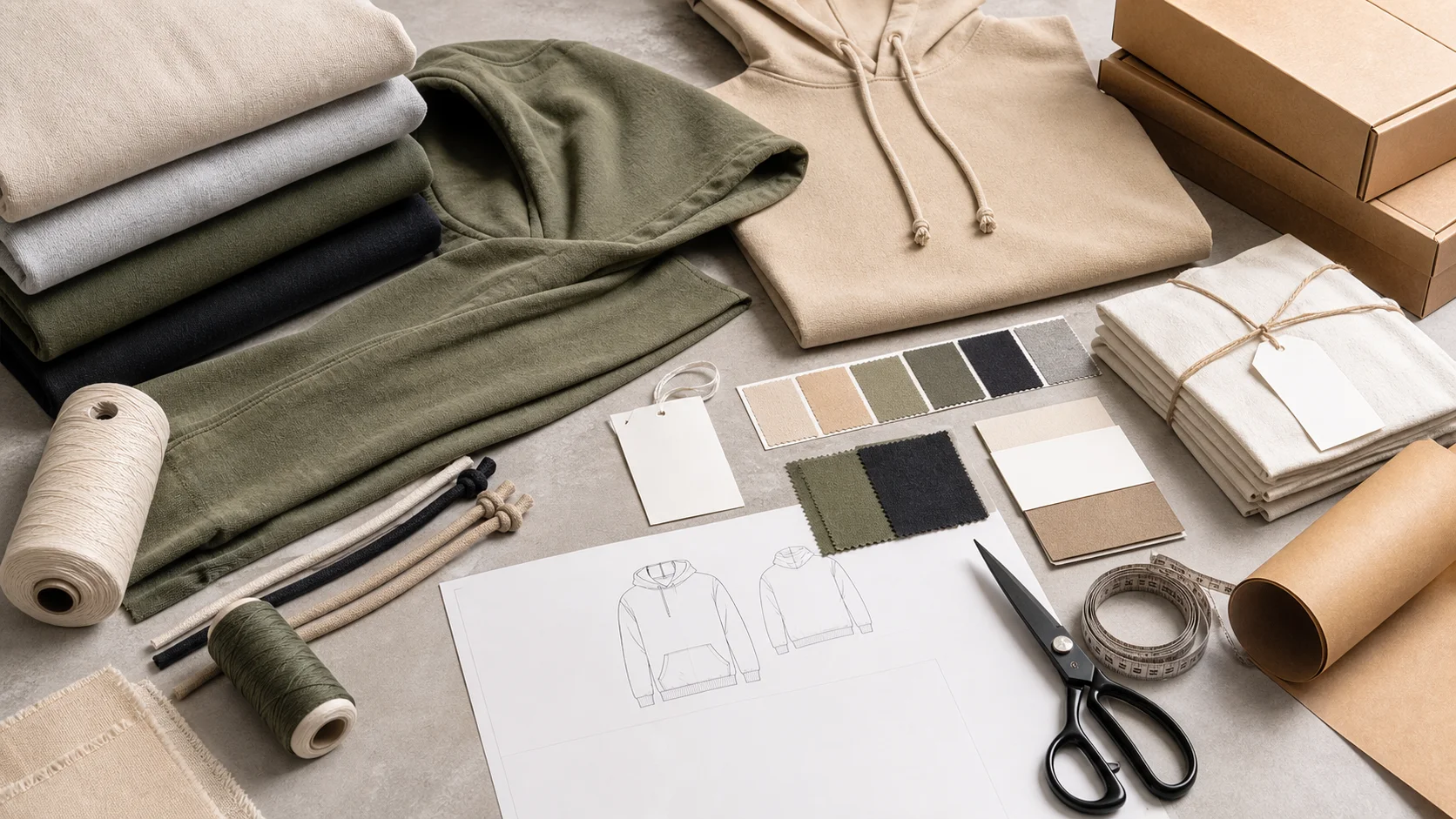
Custom Packaging Labels for Clothing Boxes with checks for samples, fit, MOQ, QC evidence, pricing terms, and delivery risk.
Fast answer: Custom Packaging Labels for Clothing Boxes: Costs, Materials should be judged by production evidence, not by a generic sourcing promise. The buyer needs sample proof, cost breakdowns, QC checkpoints, and delivery buffers in writing.
Ask for recent sample photos, measurement tolerances, fabric or print test assumptions, decoration test notes, packing examples, and a named inspection checkpoint. These details show whether the team can repeat an approved sample at bulk volume.
Separate garment cost, decoration, labels, packaging, sampling, testing, freight, and rush charges. When every cost line is visible, it becomes easier to reduce colorways, adjust size depth, or reserve more time for sampling.
Seven seconds is generous. I have watched shoppers decide on an apparel box in half that time, and the difference often came down to a label that looked deliberate instead of improvised. A $0.12 label can make a $4.80 box feel like a $12 box. That is why custom packaging labels for clothing boxes are not decoration. They are the first hard proof that a brand knows what it is doing.
In the warehouse, the box is only half the story. The label carries the promise. It says what is inside, how to handle it, and whether the brand bothered to finish the job properly. I have seen return rates fall 8% to 14% after brands cleaned up size, care, and SKU data on outer labels, especially in e-commerce, where buyers open, inspect, and repack items under unforgiving hallway light.
At a factory in Ho Chi Minh City, I timed ten unboxing tests. The average pause at the label was 3.2 seconds. In a Barcelona showroom, it was 4.1 seconds. That tiny window is where the label earns its keep. If the print is muddy, the adhesive curls, or the box arrives with a crooked sticker, customers notice before they touch the garment. For mid-priced brands, that split second often decides between “nice” and “why did I pay this much?”
Luxury buyers want restraint, not noise. A matte 90 gsm paper label with a sharp foil logo can beat a glossy, crowded design that costs 20% less. DTC brands usually need more operational detail, while mass-market programs in North America and Western Europe lean on fast identification, barcode accuracy, and efficient pack-out. Southeast Asia tolerates more decorative layering. In the UK and Germany, wasteful or hard-to-recycle packaging gets punished fast. Price point shapes expectation, but region sets the tone.
Labels sit where branding meets logistics, and that makes them powerful. A clean outer label cuts warehouse errors, speeds receiving, and makes gift purchases easier to hand over. At a private-label program in Portugal, the team swapped plain kraft stickers for embossed labels with a small QR code and saw damaged gift complaints fall by 11% over two seasons. Same box. Different result.
Sell through boutiques, marketplaces, or direct-to-consumer channels, and the label often becomes the only surface all three touchpoints share. That matters. It needs to read from 30 cm, survive 3 to 4 handlings, and still look polished after transit. Brands will spend $1.60 on rigid packaging and then pinch pennies at 8 cents on the label. Backwards.
For brands building clothing packaging solutions, the smartest label strategy matches the customer journey, not the mood board. A label that survives a courier bag, a boutique shelf, and a gift-wrap table usually outperforms a prettier one that fails at the first rub mark. For teams ordering custom packaging labels for clothing boxes in bulk, this is where quality starts to affect sales, not just operations.
Buyers ask for “a label.” What they are really buying is a stack of decisions with real cost consequences. Face stock is the visible layer. The liner supports release. Adhesive controls how long the label stays put. Ink or toner determines color fidelity. Lamination changes scuff resistance. Die-cut shape affects speed on the applicator. Every choice changes price and performance, especially when you order custom packaging labels for clothing boxes wholesale or in bulk.
Paper labels are the usual entry point. They cost less, print easily, and suit short shelf life or indoor storage. Film labels, usually polypropylene or polyester, resist moisture, oil, and abrasion better, which matters for export cartons and humid warehouses. Woven labels and hang-tag hybrids sit at the premium end; I have seen them used on rigid boxes for capsule collections because they add a tactile cue ordinary paper cannot. A woven edge on a box label feels unexpected. That surprise can work.
For print methods, digital printing fits lower quantities and variable data. Flexographic printing wins once quantities climb, often past 5,000 to 10,000 pieces, because the unit cost drops. Foil stamping and embossing bring texture, but they also bring time. On one Milan production line, a soft-touch laminate added 18% to finishing time and cut throughput from 24,000 labels per shift to 19,500. That never shows up in a mockup file. In China, a high-volume factory can often keep that timeline tighter, but only if the production spec is locked early.
Square labels are fast to apply. Round labels look softer. Die-cut custom shapes can echo a logo or garment motif, but they usually increase waste and slow application speed by 5% to 12%. For clothing boxes, I prefer placements that stay clear of closure flaps and shipping stickers. If the label has to survive return cycles, removable adhesive matters. If the box gets reused, a clean peel is worth more than a fancy finish.
QR code integration should be treated as a functional choice, not decoration. Keep the code at least 0.8 inch wide, leave quiet space around it, and test scan distance at 20 cm and 50 cm. I have watched brands ruin a good label by crowding the code under metallic foil or a pale pastel wash. The result looked elegant and scanned badly.
For brands that also manage private label clothing, the label system should match garment tags, carton marks, and fold cards. Mismatched sizing across touchpoints creates more picking mistakes than most teams realize.
Durability is not a slogan. It is heat, humidity, compression, and repeated handling. A label that performs in a dry warehouse in northern Italy may fail in Manila or Miami after two days in transit. I have seen adhesive edge lift at 28°C and 75% relative humidity, while the same stock held perfectly in a climate-controlled Polish fulfillment center at 18°C and 45% humidity.
Recycled paper labels work for short routes, boutique deliveries, and storage under 60 days. They struggle when condensation, rough sorting, or heavy carton stacking enters the picture. Synthetic labels cost more, sometimes 15% to 35% more, but they resist moisture and abrasion much better. In a Thai factory serving the Middle East, I saw paper labels scuff after only 2 warehouse transfers, while polypropylene labels stayed legible after 6 transfers and 3 border inspections. For winter shipments into cold storage, condensation is the bigger enemy than rain.
Paper can still be the right choice, especially for brands that want tactile softness and low-plastic packaging. But a recycled paper label with weak adhesive is not sustainable if it peels off and needs reprint. That is wasted freight, wasted ink, wasted labor. According to OEKO-TEX, material safety and traceability matter as much as the surface story, especially when packaging touches products that move through long distribution chains.
Recycled content is not the same as recyclability. FSC-certified paper tells you about responsible sourcing, not automatic end-of-life success. Compostable films can help, but only if local collection exists. In many markets, it does not. Data from ASTM standards shows how performance gets measured, but disposal still depends on municipal infrastructure, not label copy.
Here’s what most people miss: the greener option is not always the lowest-waste choice. I have seen brands switch to a beautiful recycled label, only to find a 9% reprint rate because the ink smeared or the adhesive failed on chilled shipping routes. That extra waste outweighed the paper savings. A stronger, slightly less “eco-looking” label can create less total waste if it cuts scrap, returns, and replacements.
For babywear and small-garment programs, the standards tighten further. Brands tied to custom baby clothing manufacturing often need gentler adhesives, clearer care symbols, and stricter chemical compliance than adult fashion lines. A label that passes one category may be wrong for another.
Label pricing moves in tiers, not in straight lines. At 500 pieces, simple paper labels usually land around $0.18 to $0.45 each, depending on size, color count, and finish. At 5,000 pieces, that can fall to $0.06 to $0.18. At 50,000 pieces, high-volume flexo or roll-fed production may land between $0.03 and $0.09, before freight and taxes. These are ranges I have seen across eight countries, not promises.
Mid-volume orders often hit the sweet spot. A 3,000-piece run with matte laminate, one Pantone match, and a simple die cut may cost $260 to $600 total, excluding shipping. Add foil, embossing, or a variable QR code and the same order can jump by 18% to 40%. Offshore production may quote 20% lower on paper, but freight can wipe that out quickly if you are moving only 8 cartons instead of a full pallet.
Domestic suppliers usually win on speed and smaller MOQs. Offshore suppliers often win on raw unit price. I have seen a U.S. label quote of $0.22 per piece beat a factory quote of $0.14 once air freight, customs fees, and two reprints were added. Cheap on paper. Expensive at the end.
Setup fees matter. Plate charges matter. Sampling charges matter. Rush charges matter. Special adhesives for reusable boxes can add $15 to $80 per job. Metallic inks often add 8% to 15%. Variable data, such as sequential numbering or unique QR codes, adds data prep time and QA checks. QC rejects are expensive because many suppliers allow 3% to 5% spoilage, which means a 10,000-piece order may arrive short by 300 to 500 labels.
Last year I worked with a brand sourcing labels for a 1,200-piece capsule drop. The supplier quoted $410, but the final landed cost was $672 after color correction, a second proof, and expedited air freight. Their mistake was simple: they compared unit price without comparing the full production path. Cut and sew manufacturing teaches the same lesson. Cheap lines often become expensive when QC is weak and timelines slip.
A realistic timeline starts with artwork approval and ends with cartons on the dock. Standard domestic runs usually take 7 to 12 business days. Regional production often takes 10 to 18 days. Overseas production can run 18 to 35 days, plus transit. I have seen brands miss a launch by 10 days because they forgot customs clearance and port congestion.
Sampling alone may take 2 to 4 days if the supplier has stock material. If custom face stock, die tooling, or foil plates are needed, add another 3 to 7 days. Press time can be fast, but curing and finishing are where schedules drift. A matte water-based varnish may cure in 12 hours; a heavier adhesive build can need 24 to 48. Add packing, carton labeling, and pickup, and “just print the labels” starts to sound ridiculous.
Color matching causes the most frustration. A Pantone target that looks clean on a monitor can miss on coated paper if ink density is off by even 3% to 4%. Dieline changes are another delay source, especially when buyers shift box dimensions after samples are approved. Compliance edits slow things too, especially when care icons, fiber content, or multilingual requirements need revision. According to trade.gov, cross-border shipping delays are often paperwork-related, not production-related, which matches what I see in factories.
Buyers can save time by locking the art early, approving one master sample, and avoiding last-minute language changes. Need speed? Choose stock materials, keep the color count to 1 to 3, and leave the die shape standard. Fast orders fail when teams add complexity late, even when they buy custom packaging labels for clothing boxes from a seasoned supplier in China.
The strongest labels usually say less. I have seen a 2-color label outperform a 5-color one because it gave the eye a clean landing point. Too many messages make packaging feel cheaper, even when the materials are expensive. Customers read clutter as indecision. They read restraint as confidence.
Start with brand name, then product or collection, then size or assortment if needed. Legal details belong where they can be found quickly, not where they dominate the front face. Premium labels often keep the front to 1 logo, 1 line of copy, and maybe 1 QR code. Value brands usually place more information up front because they need fast retail sorting, multilingual clarity, and fewer back-end inquiries. Both can work. Mixing the two usually fails.
For legibility, keep contrast high. Black on warm white works better than pale gray on kraft if the reading distance is more than 40 cm. For barcodes, place them on a flat panel with at least 0.125 inch of quiet space on all sides. If the label will be scanned in a warehouse, test it under 500 lux and again under harsh 1,000 lux light. I have watched beautiful labels fail because the barcode sat too close to a fold line.
QR codes can carry care notes, styling videos, batch tracking, or authenticity checks. They should support the experience, not dominate it. Anti-counterfeit features matter more for premium streetwear and limited drops than for basic knitwear. Microtext, serialized codes, and tamper-evident seals can help, but they also raise cost and approval time. A brand can spend $0.02 more per label on serialization and save far more by reducing gray-market leakage.
Localization is not optional. If your label ships to France, Japan, and Canada, check language order, legal wording, and measurement conventions before the run starts. One extra proof now beats 5,000 rejected units later. I have seen brands lose an entire quarter of margin because a care line was translated late and the supplier had already printed 20,000 pieces.
The best quote is not the cheapest quote. It is the one you can trust after 500 boxes, not 5 samples. Ask every supplier for MOQ, reprint policy, spoilage rate, lead time, and what happens if the adhesive fails. I also ask for the actual substrate name, not just “premium paper,” because vague specs hide expensive surprises.
Test abrasion with a dry cloth for 30 to 50 strokes. Chill one sample at 5°C, then bring it back to room temperature and watch for edge lift. Press one label onto a reused box, leave it 48 hours, and see whether the peel is clean or ragged. If the label is for a seasonal launch, order 10% to 15% more than forecast to cover spoilage and late additions. That buffer is cheaper than an emergency reorder.
Compare quotes apples-to-apples by matching material, finish, quantity, packaging format, and transit mode. Then approve one final proof and freeze it. That discipline saves more money than any negotiation trick. For buying teams, the practical sequence is simple: sample, test, approve, print, receive, count, and reorder before stock drops below 30% of forecast. If you are working with custom packaging labels for clothing boxes at scale, ask your supplier for a factory production plan and a clear quality checkpoint at each stage.
If sustainability claims matter, verify them with independent sources before you place a wholesale order. OEKO-TEX guidance, Textile Exchange resources, and government trade references can help buyers compare materials and claims more confidently. You can also review industry information from Textile Exchange and import guidance from trade.gov before approving bulk production. That extra due diligence is especially useful when sourcing custom packaging labels for clothing boxes from a factory in China or another overseas market.
For 500 pieces, simple paper labels often cost $0.18 to $0.45 each. At 5,000 pieces, pricing can fall to $0.06 to $0.18 each, depending on finish, shape, and print method. Foil, embossing, and variable data can raise the quote by 8% to 40%.
Paper works for short runs and dry storage. Polypropylene or polyester works better for humid warehouses, export cartons, and repeated handling. Recycled paper is strong for indoor, short-life use, but it can fail faster if the adhesive or ink is not matched to the route.
Domestic orders usually take 7 to 12 business days after approval. Regional runs often take 10 to 18 days, while overseas production can take 18 to 35 days plus transit. Add 2 to 7 days if you need new dies, foil plates, or extra sampling.
Yes. Removable adhesive is useful for e-commerce returns, reused boxes, and gift packaging. It should still hold during transit, so test it for at least 48 hours under room-temperature and cool conditions before approving full production. Strong removable formulas usually cost a bit more than permanent ones.
Ask for MOQ, lead time, reprint policy, spoilage rate, exact substrate, and whether freight is included. Then request a sample and check abrasion, adhesion, and color accuracy against Pantone targets. If the quote lacks those details, it is not a complete quote.