
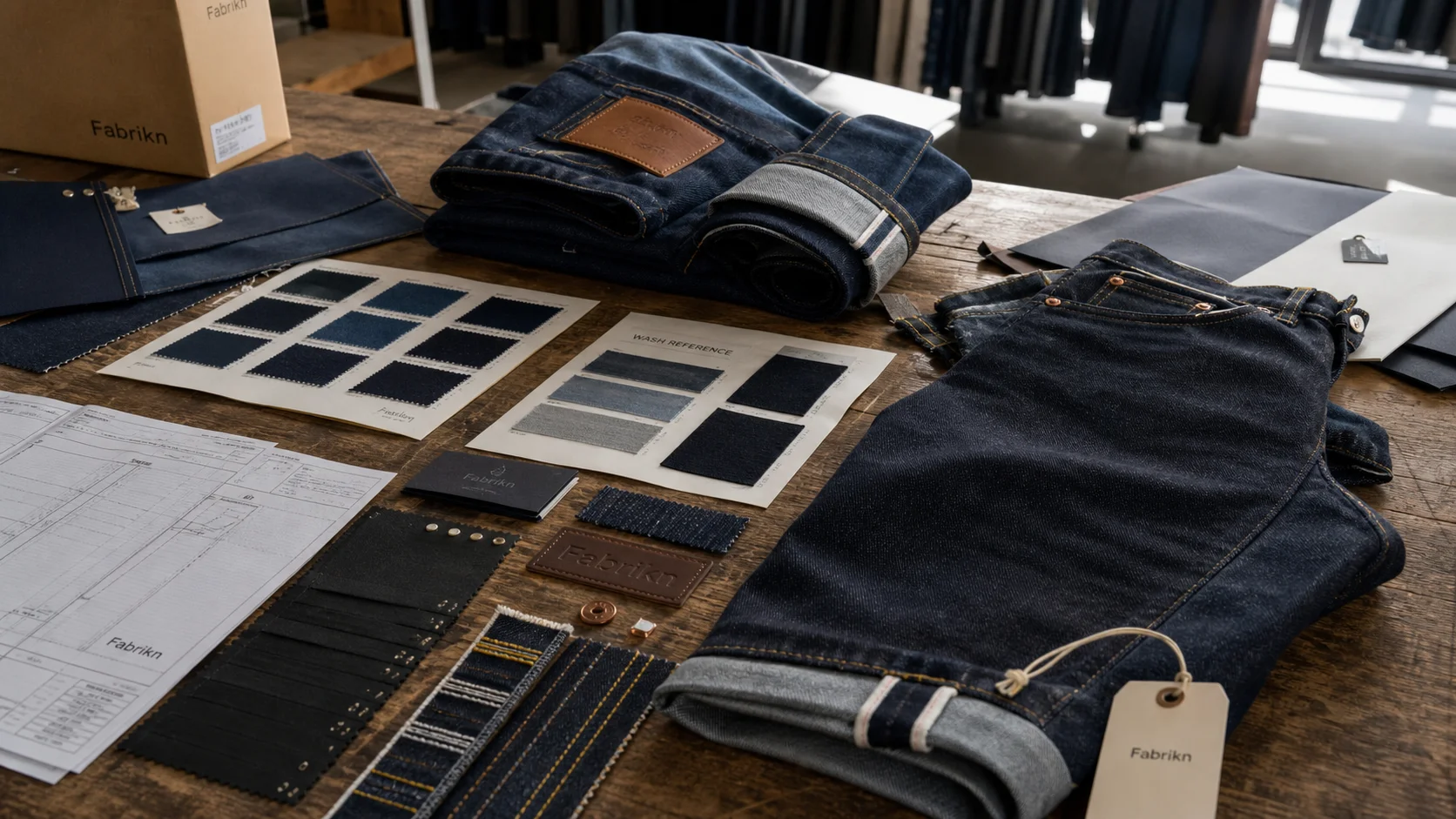
China Clothing Box Sticker Labels with checks for samples, fit, MOQ, QC evidence, pricing terms, and delivery risk.
Fast answer: China Clothing Box Sticker Labels: Adhesive, Finish, Print, and MOQ should be judged by production evidence, not by a generic sourcing promise. The buyer needs sample proof, cost breakdowns, QC checkpoints, and delivery buffers in writing.
Ask for recent sample photos, measurement tolerances, fabric or print test assumptions, decoration test notes, packing examples, and a named inspection checkpoint. These details show whether the team can repeat an approved sample at bulk volume.
Separate garment cost, decoration, labels, packaging, sampling, testing, freight, and rush charges. When every cost line is visible, it becomes easier to reduce colorways, adjust size depth, or reserve more time for sampling.
A label can turn a polished shirt box into a bargain-bin signal in under three seconds. I have watched the edge wrinkle, seen the blue drift toward gray, and then a $12 tee suddenly looked like clearance. That is the real job of custom sticker labels for clothing boxes china: they do not decorate the box, they set the price story before the lid opens.
Buyers miss how fast that judgment happens. For a mass-market basic, a label with 92% adhesion consistency may be enough. Boutique apparel wants 97% or better, because a lifted corner or off-register logo reads as weak QC, not a tiny defect. Direct-to-consumer unboxing is harsher still. Shift the color by 3 Delta E points and complaints start; complaints hurt repeat purchase rates far more than most teams model.
Guangdong and Zhejiang plants showed me the gap clearly. One coastal supplier ran 5,000 labels with near-perfect die alignment, while a smaller inland factory struggled with the same artwork because print control was looser by half a millimeter. That difference matters. Chinese suppliers often win on tooling speed, with sample turnaround in 2-4 days and print options across matte, gloss, foil, and soft-touch finishes. Quality, though, swings by region and factory tier. A trading company can quote fast. A serious manufacturer can hold color tighter.
Here is the comparison I keep giving brands. Mass-market basics tolerate simple paper labels at $0.02-$0.05 each, because the box sits inside a broader value equation. Boutique apparel can justify $0.08-$0.18 each for cleaner print, better adhesive, and tighter cut tolerance. Direct-to-consumer gifting programs may spend $0.12-$0.30 each, because the label becomes part of the unboxing script and the social media photo. The label is small. The margin impact is not.
According to WTO trade data, packaging and finished goods move through long cross-border chains with plenty of room for error. I have seen factories with excellent sewing teams still fail on custom sticker labels for clothing boxes china because they treat them as a low-value add-on. That mistake costs repeat orders. It also costs trust.
The material list is shorter than most quote sheets suggest. Coated paper, kraft-look paper, BOPP, PET, and removable films cover most orders for clothing box labels. The differences are practical, not theoretical. Coated paper prints sharply and usually costs $0.01-$0.03 less per label than film. BOPP handles moisture better. PET resists scuffing. Removable films matter when the label must come off cleanly without tearing recycled paper fibers.
For matte rigid boxes, I prefer coated paper with a matte varnish when the box surface is smooth and the brand wants a quiet finish. On folding cartons, BOPP can be stronger because the folds stress the edges less. Corrugated mailers need more forgiving adhesive, especially on rough liners where the surface energy is uneven. Recycled paper packaging is the hardest test. The fibers drink adhesive irregularly, so a label that looked perfect on a sample board may lift within 48 hours on actual stock.
Counterintuitively, some lower-cost papers outperform glossy films on textured boxes because edge lift is lower. I saw this in a Ningbo plant where a kraft-look paper label at $0.018 beat a BOPP version at $0.026 on a recycled mailer after 72 hours at 85% humidity. The film stayed visually sharper, but the paper hugged the substrate better. That matters more than shine if the corner peels.
Suppliers will talk about recycled content. Ask for proof. FSC paperwork is useful for the paper chain, but it does not prove the adhesive is recycled or low-migration. For apparel brands that also buy private label clothing, the safest path is to match label stock to the box substrate first, then check certificates second. If a factory claims eco performance, ask whether they can show ISO-based process documentation, material declarations, and test records, not just a marketing PDF.
According to OEKO-TEX, material verification and chemical compliance are separate from appearance. That distinction is where many buyers stumble. A pretty label can still fail on odor, residue, or adhesive bleed. I have seen labels with excellent color density fail a basic rub test after 20 cycles, while a plainer matte stock held up for 60 cycles. Pretty does not equal durable.
Pricing begins long before the first sheet is printed. Setup fees, plate or die costs, material cost, adhesive upgrades, varnish, lamination, and freight can all sit on the same quote line if you do not force transparency. A simple digital label run might show no plate fee, but the unit price carries the burden. A flexo job may add $60-$180 in setup, then win on volume. Die costs often sit at $25-$90 depending on shape and complexity.
Here is the pattern I have seen again and again for standard apparel box labels. At 1,000 pieces, digital short runs often land around $0.10-$0.22 each. At 5,000 pieces, flexo or offset may drop to $0.05-$0.12. At 10,000 pieces, the same project can fall to $0.035-$0.08. At 50,000 pieces, efficient factories can push below $0.03 for simple coated paper labels, though specialty finishes raise that quickly. Digital short runs can cost 2x to 4x more per label than flexo or offset at higher volumes, but they save tooling and let you test a seasonal colorway.
Inland China factories usually price lower on labor, sometimes by 8% to 15%, but export timing can be slower because freight to the port adds a day or two. Coastal export suppliers charge more, yet they are often better at pack-out discipline and document handling. Trading companies sit in the middle. They hide margin in the quote, then charge again on “sample express,” “color correction,” or split shipment fees. I have seen sample costs of $40-$120 turn into $180 after revisions.
Hidden charges show up in three places. First, color matching. Pantone alignment for a metallic logo can add $15-$50. Second, premium proofing. A 3D mock-up or press proof may add $25-$80. Third, freight assumptions. If a supplier quotes ex-works and your team thinks it includes delivery, the landed price will blow up by 6% to 18%. That gap is common on labels because they seem too small to cause trouble. They do.
I have worked with teams sourcing labels alongside custom baby clothing manufacturing, and the same rule held every time: small components deserve the same cost discipline as knitwear. Demand a breakdown in RMB and USD, ask for MOQ 500 pieces or 1,000 pieces explicitly, and make freight terms part of the quote, not a later surprise.
Labels fail in boring ways. They lift in humidity, rub off in transit, or drift out of register by just enough to look careless. I ask factories for five tests every time: peel test, rub test, temperature exposure, humidity check, and carton compression check. A peel test should show stable removal force across at least 10 samples. A rub test should hold print after 30-60 strokes. Temperature checks matter because adhesive behaves differently at 5°C than at 35°C.
Do not approve a label from a smooth sample board alone. A recycled kraft box with visible fibers can reduce effective adhesion by 20% or more. I have watched premium labels pass on white SBS board, then fail on a rough mailer after only 24 hours in a warehouse at 70% humidity. The substrate is part of the spec, not an afterthought.
For premium fashion packaging, I expect tighter tolerances: color variance within Delta E 2-3, registration within 0.3 mm, and barcode readability at 99% scan success in a small batch. For discount basics, a Delta E of 4 and registration of 0.5 mm may be acceptable if the label is simple and flat. Foil alignment should stay clean at the edges, with no ghosting. Adhesive should not bleed beyond the cut line. If it does, the label will collect dust and lift faster.
Ask a supplier where QC happens. If the answer is vague, be cautious. A real factory can show in-house inspection stations, rejection logs, and AQL sampling sheets. A broker often cannot. I also ask whether they run barcode tests on site or outsource them. A factory that outsources every test may still be competent, but lead time becomes less predictable. For cut-and-sew buyers who already manage pattern approvals through cut and sew manufacturing, this kind of control will feel familiar. It should.
A realistic timeline starts with artwork approval, not with printing. Expect 2-4 days for sampling, 1-2 days for proofing, 5-10 days for production on digital short runs, and 7-14 days for flexo or mixed-finishing projects. Freight changes the whole equation. Courier shipping can take 3-5 days. Air freight often lands in 5-8 days door to door. Ocean freight can stretch to 20-35 days depending on port congestion and customs.
Guangdong suppliers often move faster on export paperwork because they do it all week. Zhejiang plants can be highly efficient on print quality, especially for retail packaging. Inland factories may need an extra 2-4 days to reach the port, and that matters when a seasonal launch is fixed. Most delays are not caused by printing. They come from artwork fixes, missing material specs, and customs documents that get corrected at the last minute.
If the order includes metallic foil, soft-touch lamination, or multiple SKUs, add 3-5 days. Mixed-finish work is beautiful, but it is slower. I have seen buyers blame production when the real delay came from approving the wrong dieline on day four. For fast fashion drops, that mistake can kill a launch window. For slow collections, it just burns money.
My advice is to plan backward from delivery, not forward from the PO. If the box ships in week 9, place label approval in week 5, not week 7. Brands that coordinate labels with packing inserts and request a custom packaging quote requests early usually save 1-2 emergency freight moves per season. That alone can protect several hundred dollars on a small run.
The easiest mistake is assuming a good garment factory also knows packaging. Sometimes it does. Often it does not. A factory can be excellent at neck labels and wash care tags, then weak on sticker labels for rigid boxes because the substrate, adhesive, and print control are different. I have seen sewing plants with spotless audits miss basic box-label adhesion because they only produced textile labels.
Verify the supplier like an investigator. Ask for a business license, audit report, production photos, and a live video tour of the printing line. Then ask them to place the same label on coated board, kraft board, and corrugated stock during the call. A real manufacturer will not panic. A broker often will. Factory-direct pricing usually gives better transparency, while trading companies may add 12% to 25% margin and still offer helpful coordination. The trade-off is control.
Red flags are easy to spot once you know them. Vague material specs. No adhesive details. Sample colors that change from one round to the next. Quotes that ignore freight assumptions or hide them under “to be confirmed.” If the supplier cannot tell you the label face stock in grams per square meter, keep moving. If they cannot tell you the minimum order quantity for a special finish, keep moving faster.
One more filter matters. Ask whether the factory has label-specific equipment or only general print machines. Sticker labels need consistent die cutting, controlled tension, and clean rewind. A plant that handles only cartons may still quote well, but the output will tell the truth. Buyers who handle apparel production through custom baby clothing manufacturing or other soft goods projects usually understand why specialization matters. The same logic applies here.
Start with a one-page spec sheet. Define the box substrate, label size, finish, adhesive, color targets, barcode needs, and annual volume before you ask for quotes. If you leave those details open, every supplier will fill the blanks differently, and you will waste a week comparing apples to pears. Include your target MOQ, even if it is only 500 pieces, so the factory can quote the right print method.
Then request a pre-production sample and a golden sample. Reject anything with edge lift, color drift beyond your tolerance, fuzzy text, or adhesive bleed. Approve the golden sample only after it survives your own box test for 48 hours. Keep one reference copy signed and dated. That sample becomes your standard for reorder work.
For seasonal fashion drops, keep safety stock equal to at least 15% of the first run. If the line is fast-moving, 20% is safer. That buffer avoids rush fees, which I have seen add 18% to 30% on small emergency orders. Small packaging decisions shape margin, unboxing, and return rates. In my experience, that is where apparel brands quietly win or lose with custom sticker labels for clothing boxes china.
Most simple labels cost $0.02-$0.08 each at 5,000-10,000 pieces, depending on stock and finish. Digital short runs at 1,000 pieces often land at $0.10-$0.22 each, especially if you add foil or lamination.
Sampling usually takes 2-4 days, and production takes 5-14 days depending on print method and finishing. Shipping adds 3-5 days by courier, 5-8 days by air, or 20-35 days by sea.
Yes, but you need an adhesive that grips textured fibers and a stock that resists edge lift. Test on the actual box, not just a sample board, because rough kraft can reduce adhesion by 20% or more.
Coated paper works well for smooth matte boxes, BOPP suits moisture-prone mailers, and PET handles scuffing better. Removable films are best when you need clean removal without tearing the box surface.
You can request pricing directly from a factory or sourcing team with your box size, label size, finish, and annual volume ready. A complete spec sheet usually cuts quote revision time by 1-2 rounds and helps suppliers price freight correctly.