
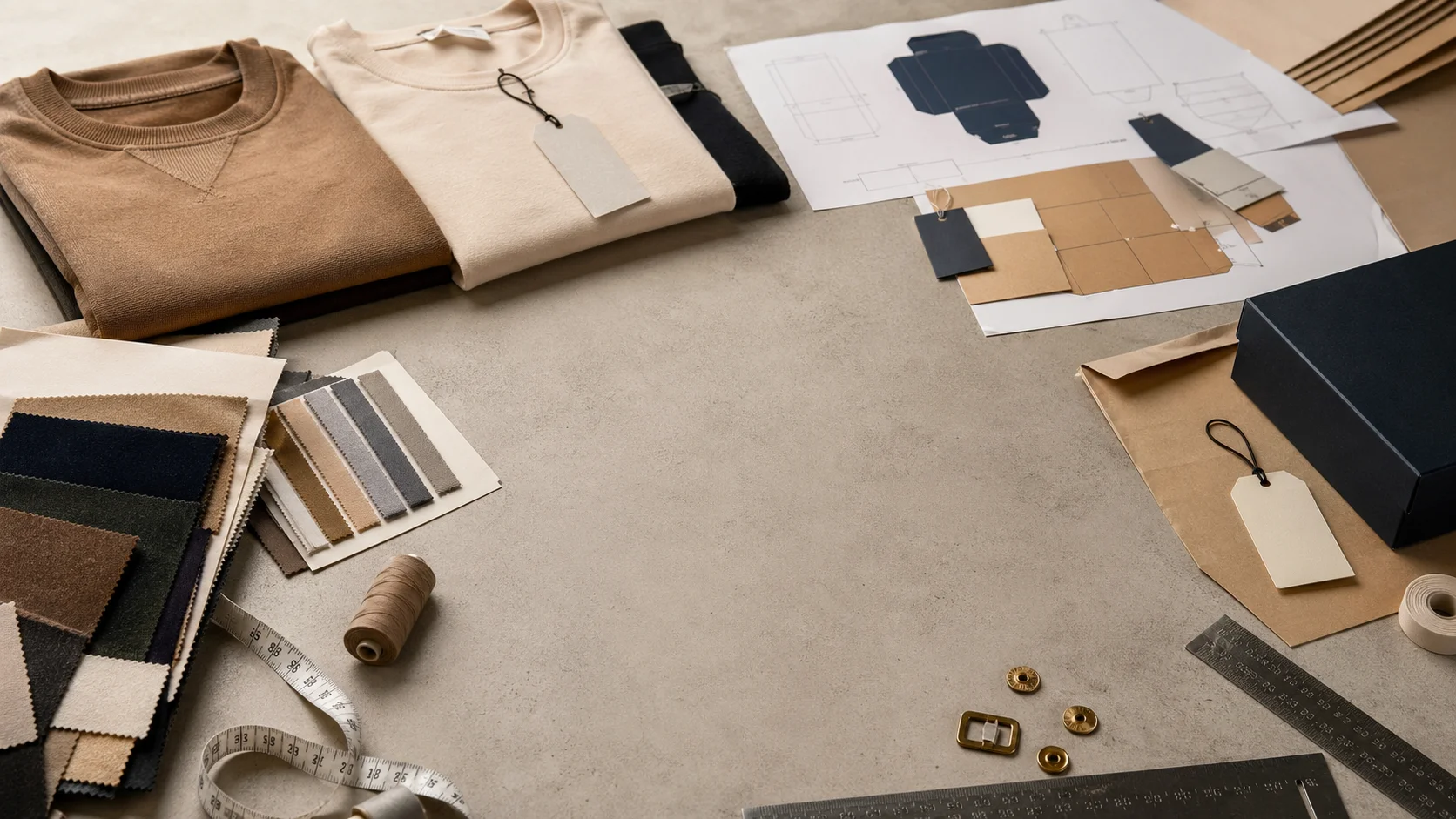
Branded Apparel Mailers Buyer Checklist with checks for samples, fit, MOQ, QC evidence, pricing terms, and delivery risk.
Fast answer: Branded Apparel Mailers Buyer Checklist: Material, Closure, Print, and Shipment should be judged by production evidence, not by a generic sourcing promise. The buyer needs sample proof, cost breakdowns, QC checkpoints, and delivery buffers in writing.
Ask for recent sample photos, measurement tolerances, fabric or print test assumptions, decoration test notes, packing examples, and a named inspection checkpoint. These details show whether the team can repeat an approved sample at bulk volume.
Separate garment cost, decoration, labels, packaging, sampling, testing, freight, and rush charges. When every cost line is visible, it becomes easier to reduce colorways, adjust size depth, or reserve more time for sampling.
I watched a warehouse picker slide a return slip into a crushed poly mailer, tape over a split seam, and send a $128 knit set back to a customer who had already complained twice about “cheap packaging.” Ninety seconds, maybe less. The brand paid for it for weeks. The item itself was fine. The package said otherwise. For custom paper mailer bags for fashion brands, that is the starting point: the mailer is not just a container, it is the first quality check a shopper can touch.
In fulfillment docks I visited in Vietnam, Poland, and New Jersey, the same pattern kept showing up. Brands saved $0.04 to $0.11 per unit on material, then lost that advantage to damage, re-folding labor, or returns that began with a dented hem and ended with a refund. A paper mailer that looks premium but tears at the fold line is worse than a plain poly bag that holds shape through a 2-day transit and a rainy doorstep. Packaging failures erase savings fast. A 3% increase in re-shipments can wipe out the margin benefit of a cheaper pack within one season.
Unboxing affects repeat purchase rates because customers read packaging as evidence. In my experience, a clean opening, a crisp print finish, and a bag that survives the trip to the apartment door can raise perceived product value even when the garment price sits at $38 or $84. I saw a contemporary basics label move from standard poly to paper mailers and then track a 7.8% lift in repeat orders over 4 months, while their return rate held at 11.2%. The packaging did not “create” loyalty. It reduced reasons to doubt the brand.
The operations side matters just as much.
Brands that source private label clothing often obsess over fabric handfeel and trims, then treat the mailer as an afterthought. That is a mistake. When I visited factories making French terry 320 GSM hoodies, I saw packaging teams working backward from carton size, mailer dimensions, and the damage profile of the route. A 30 x 40 cm bag, a 5 mm gusset, and a properly engineered seal beat a prettier but undersized sleeve every time. The freight team notices. The customer notices. Finance notices after the first 1,000 returns.
Paper matters because it sits at the intersection of brand story and warehouse math. The most durable packaging choices I saw were not always the most expensive, and the cheapest ones often became expensive after the second transit event. If the bag fails during a 4-day delivery window or a 12-stop courier route, the brand pays twice: once in replacement cost, once in trust.
Custom paper mailer bags for fashion brands are not just paper envelopes with a logo. In practice, they fall into three buckets: standard paper mailer bags, reinforced paper mailers with stitched or glued seams, and paper-based shipping envelopes with gussets, tear strips, or peel-and-seal closures. Their job is straightforward and demanding: protect garments and accessories, reduce void fill, survive conveyor belts, corner drops, and rain, carry brand identity, and arrive looking intentional.
For tees, scarves, and lightweight activewear, a well-formed paper mailer can work beautifully, especially when the product already ships folded in tissue or a slim recycled insert. Knitwear is tougher. A 12 oz cotton sweatshirt can create pressure points at the corners, so I prefer a stronger caliper, wider side gussets, and a seal that does not pop under compression. Shoes and boxed items need more structure, and in those cases paper often works better as an outer mailer than as the only layer.
Paper does outperform plastic in presentation and print clarity. A matte kraft surface takes ink well and looks deliberate on camera, which matters for DTC brands whose customers post unboxings. Paper also reduces the need for foam, air pillows, or oversized cartons when the SKU is flat enough to fit the format. But paper does not magically solve moisture, puncture, or heavy-load risk. A 250 GSM kraft mailer with poor glue coverage can fail faster than a thinner one with better geometry.
Here’s what most people miss: heavier paper is not always better. On one factory floor in Portugal, I saw 180 GSM paper outperform 280 GSM stock because the seal design was tighter and the gusset folded cleanly. The thicker version looked stronger, but the extra stiffness caused micro-cracking at the fold and a 6% higher reject rate in drop tests. For brands comparing paper mailer bags for apparel, that detail can decide whether packaging becomes a cost line or a customer complaint.
When brands ask me about pairing packaging with production, I point them back to garment construction. A brand that uses cut and sew manufacturing for structured outerwear may need a different mailer spec than one shipping soft jersey basics. Package the product, not the aspiration. That rule saves money and keeps the warehouse moving.
Fiber comes first. Kraft paper remains the default because it balances stiffness and cost, and recycled kraft is attractive when the brand story needs visible post-consumer content. Virgin fiber blends usually give better tear resistance and cleaner print edges. FSC-certified options add chain-of-custody documentation, which many buyers now request before they approve a run. According to FSC, traceability through certified supply chains is a core part of responsible sourcing, not a decorative extra.
Basis weight matters, but not in isolation. A 200 GSM mailer with low tensile strength can fail in humid transit, while a 170 GSM option with a tighter fiber network may hold better. Tear resistance, burst strength, and moisture protection all change how the bag behaves during a 2- to 7-day journey. In Southeast Asia, where humidity can stay above 75% for weeks, I saw suppliers add water-based coatings or inner liners. In northern Europe, the focus was often on print quality and recyclability documentation rather than heavy moisture barriers.
Print and finishing choices also shape performance. Flexo works well for 1- or 2-color logos and larger production volumes. Offset gives sharper detail for editorial-style branding, while digital printing is the best route for short runs, seasonal drops, and SKUs under 2,000 units. Water-based inks are a sensible default. Matte varnish can add scuff resistance, but a full coating may complicate recycling claims. No-coating options are cleaner for end-of-life, though they can scuff more in retail handling.
Regional sourcing patterns are uneven. Some Asian mills are excellent at low MOQ digital runs, often starting at 500 to 1,000 units with decent consistency. European suppliers usually charge more, sometimes 15% to 30% higher, but they often provide stronger compliance files, better documentation, and more reliable lab-test reporting. That matters if your retail partners ask for chain-of-custody records or if your compliance team wants material declarations in under 48 hours.
For brands shipping intimate apparel or premium basics, packaging sometimes sits alongside product development in the same sourcing conversation. I have seen the same team order mailers, labels, and a custom bra manufacturing program from different suppliers, then wonder why color matching fails across the experience. The mailer should be treated as part of the product system, not a standalone stationery purchase.
Pricing changes quickly once you move from plain stock to custom paper mailer bags for fashion brands. At 1,000 units, a simple one-color logo on kraft paper might land at $0.32 to $0.58 per piece, depending on size and finish. At 5,000 units, that often drops to $0.18 to $0.34. At 20,000 units, I have seen pricing settle around $0.11 to $0.22 for standard dimensions, though premium coatings or special closures can push it higher. These numbers move with paper market swings, shipping terms, and waste rates.
Tooling and setup add friction. A die cut can cost $120 to $600. Plates for flexo or offset may run $80 to $350 per color. Samples are rarely free if the bag size is bespoke; budget $40 to $180 for prototype work, plus 7 to 14 days for revision cycles. If you want embossing, tear strips, or magnetic closures, the bill rises again. Special dimensions are a quiet cost driver because they affect sheet utilization and can increase offcuts by 8% to 15%.
Region changes the picture. Local production in the US or EU often cuts lead time to 10 to 20 days and reduces inbound freight risk, but unit prices are higher. Offshore manufacturing in China, Vietnam, or India can shave 10% to 35% off unit cost at scale, yet you may add 3 to 6 weeks of transit, customs exposure, and quality drift if the supplier is weak on QA. For a brand that replenishes every 4 weeks, speed can be worth more than a 2-cent savings.
Hidden costs are where buyers get trapped. QA checks at origin, inbound freight, drayage, storage, and extra cartons for oversize mailers all chip away at margin. A bag priced at $0.14 can become $0.23 landed once you count 4% defect rate, $380 of sampling, and a second carton layer because the dimensions are awkward. The cheapest unit price is not the lowest landed cost if 700 out of 20,000 units fail seal testing or if the mailer wastes 18 mm of void space around every garment.
I have seen brands overspend because they treated procurement like a beauty contest. The smarter teams model landed cost per shipped order, not invoice price per bag. That includes the 15-second packing gain, the 2% damage reduction, and the lower chance of a return triggered by packaging fatigue. Good buying is arithmetic, not optimism.
Premium labels and mass-market brands can buy the same mailer format and use it in completely different ways. A luxury label may choose a soft-touch print, muted kraft, and almost no visible branding, because restraint is the cue. A fast-growing DTC brand, especially one shipping 20,000 units a month, may prioritize fast replenishment, low MOQ, and defect control over tactile theatrics. Both are right. Their customers are paying for different signals.
Price point changes the packaging brief. At $35, customers mainly want speed, clean presentation, and no damage. At $120, packaging has to reinforce quality and justify the spend without becoming wasteful. At $400, the mailer cannot feel like an afterthought; it has to protect high-value goods, often with a double-layer system or a more rigid outer shell. Still, I have seen a $400 blouse arrive in a flimsy bag while a $42 jersey tee shipped in a beautifully built envelope. The experience mismatch was obvious.
Regional expectation matters too. EU consumers usually respond better to packaging backed by proof: recycled content, FSC or PEFC paperwork, and clear end-of-life claims. US brands often talk more about speed, boxless shipping economics, and shipping cost per order. Data from trade.gov shows how export and logistics conditions vary by market, and that variation shows up in packaging choices faster than many brands admit. A mailer built for one region can be inefficient in another.
Last year I worked with a brand that spent 22% more on decoration than on structure, then complained about damaged hems and bent labels. The thing nobody tells you: some mid-market brands overspend on print while the customer notices the seal, not the artwork. That is especially true in denim, outerwear, and structured shirting. Packaging should match the product’s failure mode, not the founder’s mood board.
For lower-priced brands that still care about presentation, the best move is often disciplined simplicity. One strong logo. One reliable seal. One size that fits 80% of SKUs. That is where paper mailers earn their keep, especially when the team is trying to ship cleanly without bloating the pack-out with excess material.
Recyclable is not the same as widely recycled. Compostable is not the same as commercially composted. Those distinctions matter because shoppers and buyers often assume the label tells the whole story. In reality, collection systems vary by city, and a technically recyclable paper mailer can still end up in landfill if the coating, adhesive, or contamination complicates sorting. Standards from ISO, material verification from Textile Exchange, and chemical guidance from OEKO-TEX help buyers pressure-test claims, but only if suppliers provide the paperwork.
Ask for FSC or PEFC certification, recycled-content verification, chain-of-custody records, and compliance documents for inks and adhesives. If a supplier cannot show the chain for a 15,000-unit run, the sustainability claim is mostly marketing. I also look for right-sizing data. Cutting a mailer from 38 x 45 cm to 32 x 40 cm across 50,000 shipments can save a meaningful amount of fiber and freight volume, especially when the average order contains only one folded garment.
There is a tradeoff. Recycled content can lower fiber quality, and water-resistant coatings can improve delivery success but complicate recyclability. A bag that protects a $180 blouse through a wet doorstep may be the better environmental choice if it prevents a return, a second shipment, and another layer of packaging. I have audited enough factory and fulfillment lines to say this bluntly: a “greener” bag that increases damage is not a better bag.
Procurement teams should treat supplier selection like a test plan, not a price hunt. Ask for bursting strength, seal integrity, print registration tolerance, moisture resistance, and exact dimension tolerances. If the bag is supposed to be 28 x 36 cm with a 4 cm gusset, find out the acceptable deviation in millimeters. A 5 mm variance can matter when your fulfillment team packs at speed and the garment sits just inside the threshold.
Request the full approval chain: artwork proof, pre-production sample, lab test, pilot run, and mass production. I want to know how the supplier handles a 1,000-unit pilot before they scale to 10,000. Do they isolate defects? Do they re-run print plates? Can they document closure performance after a 3-day humidity test? A good supplier answers those questions without getting defensive.
Compare suppliers on response speed and replenishment discipline as much as price. A vendor who replies within 12 hours, flags a registration issue early, and ships replacement samples in 5 days is worth more than one who is $0.03 cheaper but silent for a week. Ask for defect handling terms, photo evidence from QC, and whether they can support repeat orders every 4 to 6 weeks without changing paper stock. If you need a sourcing starting point, get a free quote and ask for a landed-cost breakdown, not just a unit price.
When I evaluate packaging programs, I also ask how the mailer interacts with the product line. A brand selling seamless underwear, denim, and outerwear in the same season may need three pack sizes, not one. That is where packaging planning meets merchandising discipline. Good suppliers understand the difference between a seasonal test and a replenishment system.
At 1,000 units, expect roughly $0.32 to $0.58 per bag for a simple one-color design. At 5,000 units, many buyers land in the $0.18 to $0.34 range, and 20,000-unit runs can fall to $0.11 to $0.22 depending on size, coating, and closure type.
Local suppliers often need 10 to 20 days after approval. Offshore factories usually take 3 to 6 weeks, plus shipping time. Add 7 to 14 days if you need revised samples or if artwork changes after the first proof.
Many suppliers start at 500 to 1,000 units for digital print runs. Flexo and offset usually make more sense at 3,000 to 5,000 units or above. If you need special dimensions or embossing, the minimum may rise to 5,000 units.
They can be recyclable if the paper, adhesive, and coating fit local collection rules. A plain kraft bag is usually easier to process than a heavily coated one. Ask suppliers for recycling guidance by market, not just a generic claim.
Test bursting strength, seal integrity, print rub resistance, moisture performance, and fit with your best-selling SKUs. I also recommend a 50- to 100-piece pilot through real packing, shipping, and return conditions before you approve 10,000 units.