
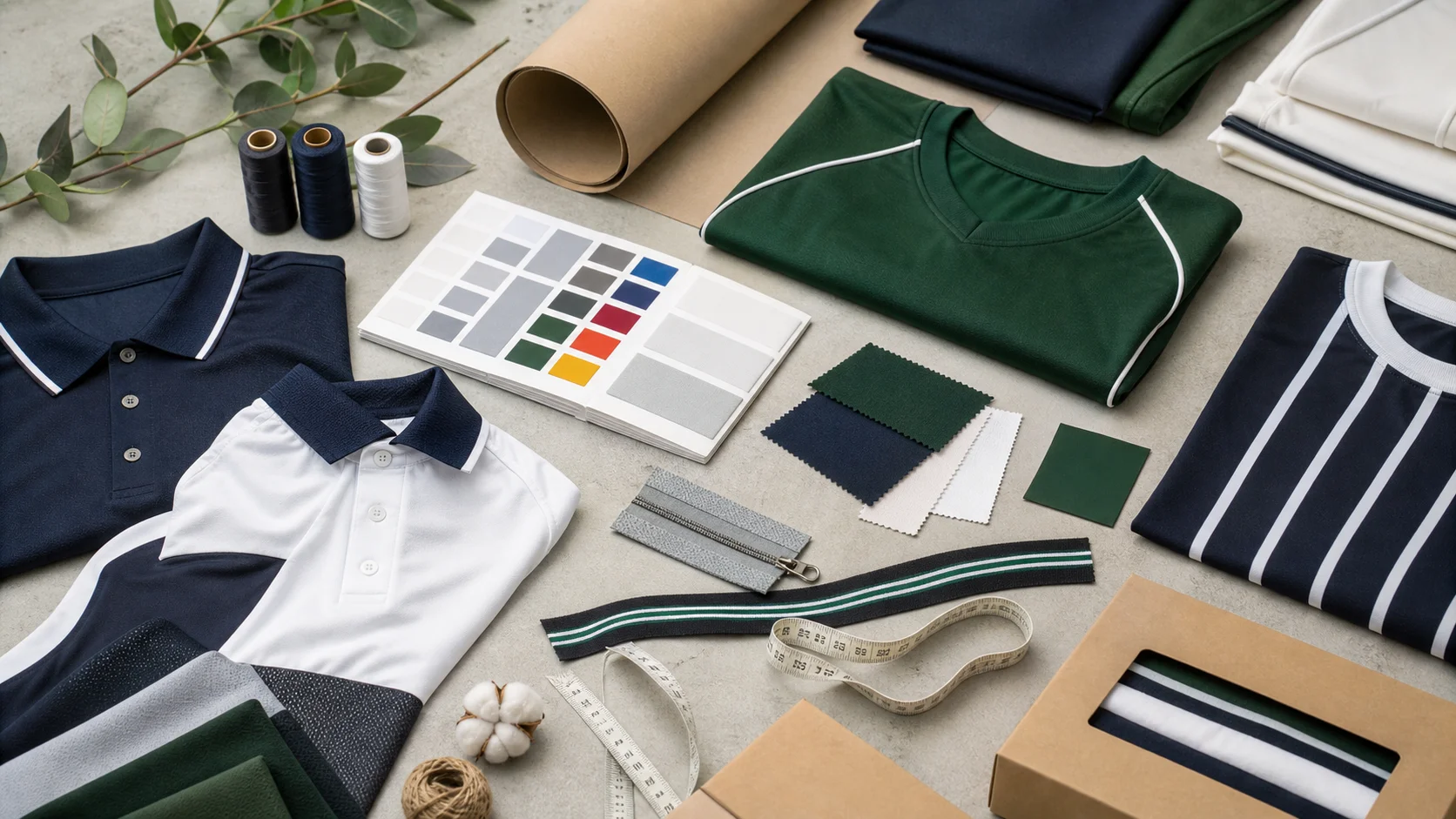
Custom Polo Shirt Manufacturer China compared by sample evidence, fabric or trim specs, MOQ, AQL terms, cost lines, delivery timing, and rework responsibility.
Fast answer: Custom Polo Shirt Manufacturer China: Sample Fit, Trim, AQL, and Delivery Risk should be judged by production evidence, not by a generic sourcing promise. The buyer needs sample proof, cost breakdowns, QC checkpoints, and delivery buffers in writing.
Ask for recent sample photos, measurement tolerances, fabric or print test assumptions, decoration test notes, packing examples, and a named inspection checkpoint. These details show whether the team can repeat an approved sample at bulk volume.
Separate garment cost, decoration, labels, packaging, sampling, testing, freight, and rush charges. Clear cost lines make it easier to reduce colorways, adjust size depth, or reserve more time for sampling.
The first mistake buyers make is assuming a polo is simple. It isn’t. Under that neat collar sits a small stack of decisions—fabric, knit, trim, stitching, finish—and every one of them can tilt an order from profitable to annoying in a hurry.
If you are sourcing a custom polo shirt manufacturer china, it helps to understand why China still leads private label polo production. China still owns a huge slice of global apparel exports, and polos sit squarely in that flow because the garment looks simple while hiding a dozen moving parts: knit fabric, collar, placket, trim, and finish.
In factory after factory, the same scene repeats. Buyers stare at the quote sheet and chase pennies, then the real cost shows up in fabric access, knitting capacity, dye consistency, and whether the collar survives 20 washes without sagging.
That is why a custom polo shirt manufacturer china order keeps landing on sourcing calendars even after labor costs climbed in coastal provinces. China is not the bargain bin it was ten years ago. Still, it has something many sourcing countries never quite match at scale: dense trim networks, quick material swaps, and production teams that know how to handle a 220 GSM pique polo with chest embroidery and contrast tipping without turning the job into a rescue mission.
According to WTO trade data, China remains one of the largest apparel exporters by value, and that concentration matters when repeatability is the goal. A factory can source mother-of-pearl buttons, rib collars, and matching tapes within 24 to 72 hours in Guangdong or Zhejiang. In Vietnam or Bangladesh, those same trims may take 7 to 14 days. That delay changes the whole calendar.
The factory floor tells a less glamorous story than the sales quote. A $4.10 polo and a $5.60 polo can roll off the same street in the same city with the same yarn count, yet the higher price may only reflect tighter process control. I’ve walked lines where the cheapest quote hid a 6% defect rate in the first 300 pieces, while the mid-priced factory stayed under 2% because it ran a separate inspection step before embroidery. Cheap is not always expensive. Sometimes it is just noisy.
The thing nobody tells you: the lowest quote often wins because it ignores rework, and rework is where margins vanish. One factory I audited quoted $2.85 per polo, then burned nearly $0.40 per unit on repairs, trim replacement, and overtime just to catch up.
Premium pricing also does not guarantee better quality. I’ve inspected $8.50 retail polos with collar curl, weak side seams, and embroidery puckering, while a $4.75 factory sample held its shape beautifully after enzyme wash. The buyer’s real decision framework is not “cheap versus expensive.” It is price, consistency, and repeatability. If the factory can hold shade variation within Delta E 1.5, keep shrinkage under 3%, and ship 5,000 pieces without mixed labels, you are buying predictability. That is what protects sell-through.
Not every region in China makes the same polo. Guangdong still runs like an export machine, especially around Guangzhou, Dongguan, and Foshan, where sample rooms move fast and most factories are used to FOB timelines of 25 to 35 days for repeat work. Zhejiang, especially around Shaoxing and Ningbo, is strong in fabric sourcing and knitted construction, while Jiangsu brings more discipline to finishing and higher-end garment execution. Inland provinces can be friendlier on cost, but they usually trade that savings for slower fabric access and fewer decoration vendors.
In Guangdong, I’ve seen sample turnaround in 3 to 5 days for a basic pique polo and 7 to 10 days for a more complex style with jacquard knit or contrast collar. Zhejiang factories often quote labor costs 5% to 12% above inland offers, yet they can source fabric faster because mills, dye houses, and garment plants sit closer together. Jiangsu lands in the middle on price, and many buyers like it for cleaner documentation and steadier line management.
Regional differences show up in the tiny details that shape the carton. Embroidery in coastal hubs usually moves faster because digitizing teams and machine operators are nearby. Packaging is more flexible in ports like Shenzhen and Ningbo, where factories handle retail-ready folding, polybagging, and barcode labeling every day. Inland factories may look cheaper on paper, but freight to port can add $0.08 to $0.22 per piece, and that number bites once the order hits 3,000 or 8,000 units.
Budget polos for promotions often land around $2.20 to $3.40 ex-factory in inland areas if the fabric is 180 to 200 GSM and decoration is a simple left-chest print. Mid-market polos usually sit between $4.20 and $6.50 when the buyer wants 220 to 240 GSM pique, dyed-to-match buttons, and embroidery. Premium polos with mercerized cotton, rib-knit collars, or enzyme wash can climb to $7.80 to $11.00 depending on MOQ and trim choice.
Startups usually benefit from coastal suppliers because they need fast sampling, one or two revision rounds, and better communication. Chain accounts and promotional programs can often save money inland if they can live with a 35 to 50 day production window and less flexibility on rush orders. If your order relies on matching across six shades, or if you need printing plus embroidery plus special labels, coastal provinces still have the deepest bench.
A factory quote for polos usually breaks into fabric, labor, trims, decoration, packing, and overhead, but many buyers compare only the headline number. Bad move. A 220 GSM combed cotton pique polo with a flat knit collar is priced differently from a 180 GSM poly-cotton jersey polo, even before embroidery enters the picture. The first may use $2.10 to $2.70 in fabric alone; the second may use $1.05 to $1.55. Labor can run from $0.55 to $1.35 depending on construction complexity and line efficiency.
At 300 units, a typical quote may land at $6.20 to $9.50 per piece because setup costs get spread across a small run. At 1,000 units, the same style can fall to $4.10 to $6.80. At 5,000 units, efficient factories can reach $2.95 to $5.20 if decoration stays simple and the fabric is in stock. Add a 4-color chest embroidery, woven neck label, or custom sleeve patch, and those numbers move again.
MOQ changes the factory’s risk. A low MOQ of 200 to 300 pieces usually means you are paying for flexibility, not efficiency. Many factories want 500 pieces per color and 1,000 pieces per style because that is where cutting loss, knitting yield, and labor setup become manageable. If a supplier accepts 100 pieces without blinking, I ask how they are making the math work. Usually, the answer shows up later in inconsistencies.
Hidden fees are where buyers get surprised. Lab dips may cost $35 to $80 per color. Strike-offs for embroidery or print can add $18 to $50 each. Sampling may run $25 to $120 depending on complexity, and revisions can stack up if you change placket shape, button placement, or collar width after approval. Carton upgrades, silica gel packs, hangtags, and individual polybag inserts can add another $0.12 to $0.45 per unit.
There is room to negotiate on trims, packaging, and order timing. There is far less room on fabric quality and collar construction. Cutting cost on rib knit or button placket reinforcement backfires fast because those are the details customers touch first. If your polo is for retail, the hem, collar, and placket must survive shelf handling and 15 to 20 wear cycles. If it is for uniforms or promotions, you can simplify, but you still need stable stitching and color consistency.
I often tell buyers to ask for a complete cost split before signing. That is the point where a factory shows whether it understands real costing or just sales quoting. If you need a deeper private label plan, our private label clothing services page explains how branding, packaging, and product development fit together without inflating avoidable fees.
QC for polos should begin before the first bulk meter is cut. I want measurable standards: AQL 2.5 for major defects, shrinkage under 3% after wash, color fastness at least grade 4 for rubbing and 4-5 for wash, and stitch density that holds at 10 to 12 stitches per inch on key seams. Without numbers, a factory can promise anything and hide the truth in the carton.
During an audit, I look at fabric test reports, not just hand feel. A knit may feel soft on the cutting table, but pilling after 5 washes can destroy repeat orders. Collar curl is another silent problem. I’ve watched a factory pass visual inspection while 30% of the collars twisted slightly after washing because the interlining was too weak for the fabric weight. Button strength matters too. A weak 4-hole button that fails under 3 kilograms of pull is a liability on a men’s polo sold at retail.
According to AATCC testing standards, buyers should ask for repeatable methods on colorfastness, dimensional stability, and pilling. If a supplier cannot tell you which test method they use, I treat that as a warning sign. In one Guangdong plant, the manager showed me a “QC report” that looked polished, but the actual in-line board had no defect tracking beyond a handwritten tally. The report was theatre. The line was not.
Common failure points differ by price tier. Budget polos often fail at collar symmetry, skipped stitches, and inconsistent button spacing. Mid-market polos usually fail at embroidery puckering and shade variation. Premium polos can fail more subtly: a beautiful surface with bad shrinkage after wash or a crisp collar that collapses after the fifth laundering. Returns on polos are often not dramatic, but even a 2% return rate can wipe out profit on a 2,000-piece order once freight and handling are counted.
My inspection checklist is simple and it works.
If the style uses cut and sew panels, structured collars, or mixed fabrics, a dedicated cut and sew manufacturing process gives you more control over fit and finishing than a generic polo line.
For brands that want safer sourcing, third-party certification can help validate materials and chemical compliance. Textile Exchange offers useful context on preferred fibers and responsible sourcing practices at textileexchange.org.
China usually wins on unit price, but not always on speed. A sample from a good coastal factory may take 5 to 8 days, while a local supplier might turn it in 2 to 4 days. Bulk production for 1,000 polos in China typically runs 25 to 40 days, then freight adds 7 to 18 days depending on sea or air. A local vendor can often produce in 10 to 20 days and truck the goods in 1 to 5 days. That difference becomes critical for promotional deadlines.
On landed cost, the gap is narrower than many buyers expect. A Chinese factory might quote $4.30 ex-factory for a mid-market polo, but freight, duty, inspection, and banking fees can lift landed cost to $5.20 or more. A local supplier might quote $5.80 ex-factory and land at $5.95 if transport is short and duties are simpler. For a 500-piece campaign order, the local option can look expensive on paper but save two weeks and prevent stockouts.
I’ve worked with brands that chose local sourcing for a 600-piece event run, paid 12% more, and still came out ahead because they avoided air freight, rush approvals, and missed launch dates. On the other hand, a 4,000-piece retail program often belongs in China because the savings scale. A $1.10 per unit difference becomes $4,400 on a single colorway, which matters when you are carrying multiple sizes and multiple markets.
Here’s what most people miss: a local supplier may cost more yet deliver fewer defects, especially on very short runs where the factory can watch each bundle closely. In my experience, a 300-piece local order often sees defect rates below 1.5%, while a rushed offshore order can drift to 4% if pre-production approvals are sloppy. That is why price has to be weighed against rejection rates, not just unit cost.
Promotional polos with simple print, 160 to 180 GSM fabric, and no retail packaging can work well locally if the buyer needs one or two colors and a fixed event date. Retail programs with 3,000 to 10,000 units, multiple sizes, and branded labels usually still favor China. If you need more context on assortment planning and product categories, you can browse our product catalog to compare how different knit styles and finishes are organized before requesting samples.
For sourcing teams comparing global suppliers, U.S. trade guidance can also help you plan landed cost, customs, and compliance more accurately. The International Trade Administration at trade.gov is a useful reference before you finalize any import strategy.
A factory built for scale behaves differently from a factory built to win one order. First sign: communication. A serious supplier answers in specifics: fabric composition, lead time by color, target shrinkage, and how many machines sit on the polo line. A weak supplier answers with adjectives. I have seen factories promise “good quality” on Monday and still fail to produce a spec sheet by Thursday.
Capacity planning matters more than charm. A stable polo factory should be able to tell you its monthly output, often 30,000 to 80,000 pieces depending on line count, and how it handles 3 to 5 style changes in a month without losing efficiency. Ask how many sewing lines are dedicated to knitwear, how many QC staff inspect at end line, and whether sample approval is tied to actual bulk materials or showroom fabric. If those answers feel fuzzy, repeat orders will hurt.
Red flags show up early. If the quoting changes after every email, if the sample arrives in 2 days but the bulk ETA keeps sliding, or if two samples of the same style differ by 1.5 cm in collar width, you are dealing with a process problem. Certification claims deserve scrutiny too. Ask for ISO records, social compliance audit dates, and testing documents from the last 12 months, not a logo on a PDF.
According to OEKO-TEX, chemical safety and restricted substance testing should be documented, not assumed. For repeat orders, I want a supplier to show how it stores approved standards, how it labels bulk lots, and how it tracks revisions. One factory in Jiangsu impressed me with a simple control board listing style code, color, order quantity, target shipment date, and responsible line manager. No drama. Just order discipline.
I use a scorecard with five categories: communication, sampling accuracy, pricing transparency, production discipline, and compliance. Score each supplier from 1 to 5. Shortlist 3 to 5 factories, then compare their response speed, fabric options, and sample consistency over two rounds. A supplier that scores 23 out of 25 is usually safer than one that talks the best but cannot keep a collar spec stable across repeat orders.
Start with a complete tech pack, not a sketch. Send the factory garment measurements, fabric composition, GSM, artwork files in vector format, logo placement, collar construction, button count, label specs, and packing instructions. Include tolerance ranges, because a collar width of 18 cm with a 0.5 cm tolerance is very different from “approximately 18 cm.” If you want the first sample to be useful, be precise enough to remove guesswork.
Plan the sampling flow in stages. Ask for a proto sample, then a fit sample, then a pre-production sample approved on bulk fabric. For repeat orders, lock the color standard with a lab dip before cutting. Deposit terms are usually 30% upfront and 70% before shipment, though some buyers negotiate 20%/80% after inspection on established relationships. Confirm shipping terms, inspection timing, and who pays if cartons fail carton-drop or label checks.
Test one style before you scale to 3 colors or 4 fits. That single run will tell you whether the factory understands grading, shrinkage, and decoration placement. If the first 800 pieces pass, then expand. If not, you have saved yourself from multiplying a problem across 5,000 units. That is the cleanest way to buy from a custom polo shirt manufacturer china without gambling on assumptions.
Before you send payment, verify the factory name on the business license, confirm the bank account matches the exporter, and ask for a recent inspection report dated within the last 6 to 12 months. Verify, then order. I have seen too many buyers trust a polished sample room and regret it after the first bulk shipment. If you need a starting point, ask to get a free quote and compare at least 3 written offers before committing.
For 300 pieces, polos often land at $6.20 to $9.50 per unit. At 1,000 pieces, many factories quote $4.10 to $6.80, while 5,000 pieces can drop to $2.95 to $5.20 depending on fabric, embroidery, MOQ, and packing.
Sampling usually takes 5 to 10 days for a basic polo and up to 2 weeks for more detailed styles. Bulk production often runs 25 to 40 days, then shipping adds 7 to 18 days by sea or 3 to 7 days by air.
Check fabric testing, AQL standards, collar construction, shrinkage control, and documentation for compliance. Ask for a size spec, lab dip approval, and recent inspection records from the last 6 to 12 months.
Yes, but low MOQs of 100 to 300 pieces usually cost more per unit because setup costs are spread over fewer garments. A manufacturer that accepts very small orders should still show stable quality on samples and bulk.
Coastal regions such as Guangdong and Zhejiang usually offer faster sampling, stronger trim access, and better export experience. For repeat retail programs, compare 3 to 5 factories and pick the one with the best mix of response speed, consistency, and documentation.