
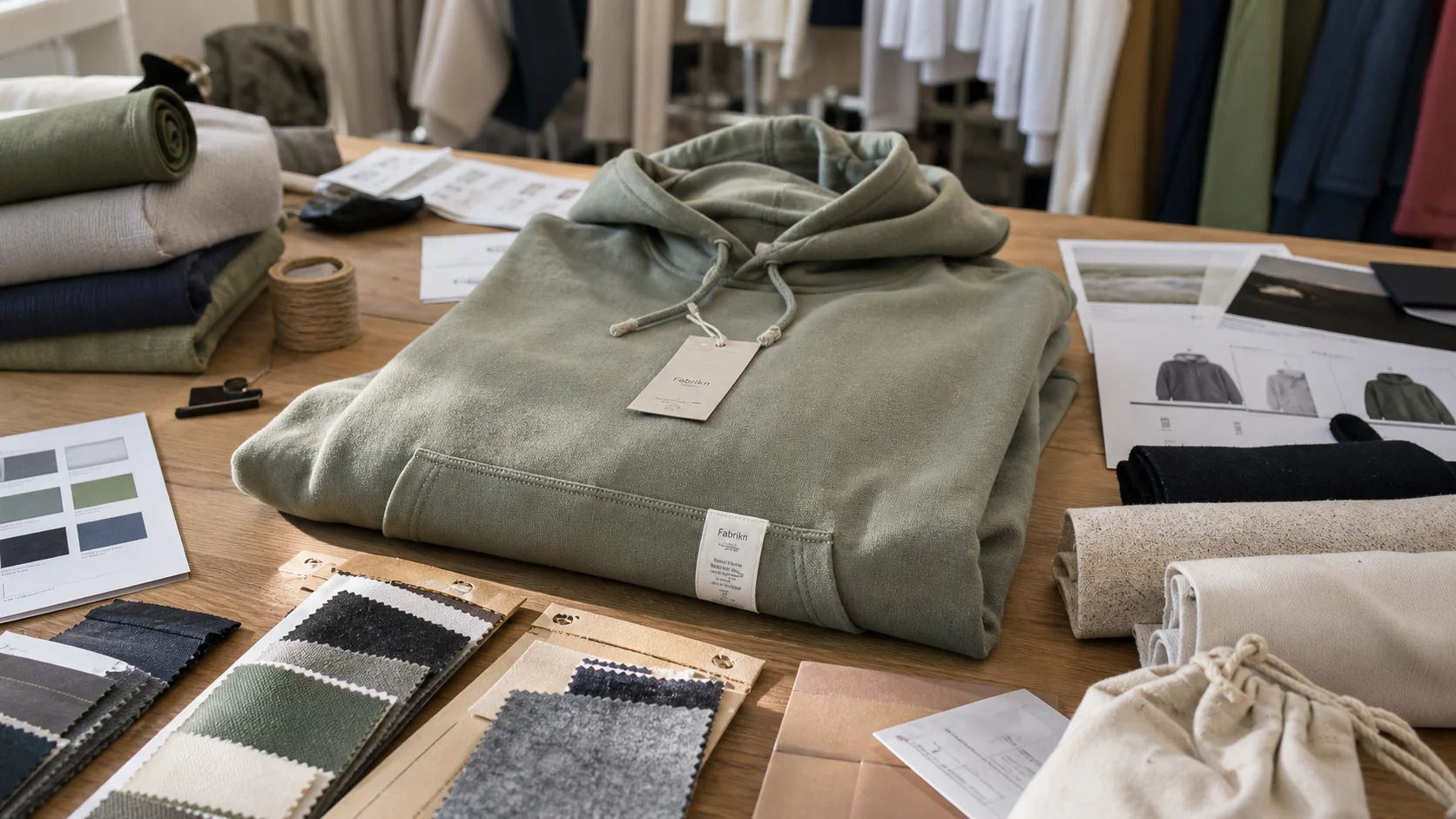
China Apparel Poly Bags with checks for samples, fit, MOQ, QC evidence, pricing terms, and delivery risk.
Fast answer: China Apparel Poly Bags: Film, Print, MOQ, and Sourcing Checks should be judged by production evidence, not by a generic sourcing promise. The buyer needs sample proof, cost breakdowns, QC checkpoints, and delivery buffers in writing.
Ask for recent sample photos, measurement tolerances, fabric or print test assumptions, decoration test notes, packing examples, and a named inspection checkpoint. These details show whether the team can repeat an approved sample at bulk volume.
Separate garment cost, decoration, labels, packaging, sampling, testing, freight, and rush charges. When every cost line is visible, it becomes easier to reduce colorways, adjust size depth, or reserve more time for sampling.
A bag that costs less than a cup of coffee can still wreck a shipment. Packaging often sits under 2% of garment COGS, yet moisture, tearing, and bad sizing still drive more than 10% of inbound rejects. If you're sourcing custom poly bags for apparel shipping china, that tiny line item stops looking tiny the moment a dock worker in Ningbo opens a carton and finds warped film after 36 humid hours.
China stays dominant for a reason sales decks rarely spell out: the supply chain is already stitched together. Resin moves in huge volumes, print shops can run flexo plates on short notice, and converters know how to turn film into finished bags in 7-14 days for repeat items. A basic LDPE bag from China can land 30-50% below a comparable U.S. domestic run at medium volumes, especially around MOQ 5,000-20,000 pieces. The gap narrows for compostable films and high-clarity specs, but not enough to erase China's scale advantage.
When I visited factories in Guangdong, Zhejiang, and Fujian, the cheapest bags were often not the worst. The real problems came from inconsistent gauges, weak seals, and print registration that drifted 2-3 mm across a run of 100,000 pieces. A bag can look perfect in a sample room and still fail after 20 cartons because one extrusion line was set 5 microns thinner than the spec sheet promised. That is how a $0.018 bag turns into a claim, a rework, and a very expensive headache.
The sourcing question is not whether to buy from China. It is how to buy bags that protect garments, satisfy retailers, and avoid hidden freight and compliance costs. That is where a brand’s margin gets guarded or quietly leaked. If your team also needs garment development support, I often point them to private label clothing services and broader apparel production planning before packaging is finalized.
Factory catalogs make plastic look simple. It isn't. LDPE, LLDPE, CPP, recycled-content blends, and mixed resins all behave differently once they meet a shipping lane, a heat seal, and a warehouse worker who loads 40 cartons before lunch.
LDPE is the workhorse. Softer handfeel, lower cost, usually right for value apparel where the bag is just a protective shell. LLDPE brings better puncture resistance, which matters for denim, hoodies, and garments with hard trims. CPP is clearer and stiffer, so premium basics look sharper on shelf, but it bruises less gracefully under abuse. Recycled-content film helps with sustainability claims, though the color can shift and the odor can be noticeable in white or high-clarity bags. On a 25-micron spec, that difference can jump out at a retailer within 30 seconds.
Customization goes far beyond logo printing. I’ve specified size, gauge, gusset, vent holes, hang-hole punch, resealable adhesive, warning text, barcode panels, and opaque versus clear film for the same brand across 3 product tiers. A 30 x 40 cm bag for tees is not the same as a 40 x 50 cm bag for sweaters, and a gusset of 4 cm can be the difference between a neat fold and a crushed collar. Value-fashion shipments usually chase cost-per-thousand units. Premium labels pay more for tactile clarity, cleaner print, and a bag that opens flat without static cling.
Aesthetics and shipping durability are always pulling against each other. Higher clarity often means less abuse tolerance unless thickness rises by 5-10 microns. MOQ also shifts by process: flexo printing is usually the best economics for 10,000 pieces and up, while digital or short-run printing is more practical for 1,000-3,000-piece test launches. If your packaging sits alongside sewn product development, it can help to browse our product catalog only after your garment sizing and folding method are fixed, because bag specs follow the product, not the other way around.
Start with line items, not the headline quote. I break every proposal into material cost, printing plates or setup, inner cartons, export packing, freight, duties, and inspection fees. A quote at $0.021 per bag can become $0.031 landed once you add 8 cartons per pallet, reinforced outer boxes, and a missed sailing that pushes freight into a pricier week.
Lead time depends on the amount of change. Plain stock-like custom bags can move in 7-14 days. Printed repeat orders usually need 15-25 days. New designs with approvals, color correction, and packaging QA often need 25-40 days, especially if the factory is waiting on plate making or a recycled film trial. For volume buyers, per-unit pricing can drop 20-35% once an order shifts from pilot quantities to full container-level commitments of 100,000 pieces or more.
Here’s what most people miss: the lowest ex-works quote often becomes the highest landed cost after overpacking, rework, and delayed sailing. I saw one factory in Jiangsu quote 18% below competitors, then charge back for oversized cartons, manual bagging, and a “minor” print correction that added 9 days. By the time the shipment cleared, the buyer had paid more than the higher quote from a cleaner operation. Not rare. It happens because some suppliers price the bag and forget the process.
Put all three bids into the same spreadsheet using identical assumptions: same gauge, print coverage, seal style, carton count, and quantity per carton. A 25-micron bag with 1-color print is not comparable to a 30-micron bag with 2-sided print and barcode panel. Data from U.S. trade and export guidance and trade filings also shows how freight swings by lane and season can wipe out a paper-thin unit cost advantage if you do not lock terms early.
The cleanest sustainability claims are the ones you can measure. Recycled content percentage, resin certification, and recyclability guidance tied to local collection systems are easier to defend than vague language about being “eco-friendly.” A 30-micron bag with verified recycled content can be more defensible than a thicker virgin bag with prettier marketing copy, because the math is visible and the claim is narrow.
Thin-film reduction often beats material substitution on both carbon and cost. If a brand drops from 35 microns to 28 microns and keeps the same failure rate under drop testing, material use falls by roughly 15-25% depending on size and fold pattern. For returns-heavy categories like e-commerce basics, reusable mailers can make sense, but they usually need better closures and more careful QA. For straight-to-retail transport, lighter poly bags still do the job well when the garment is already protected in the carton.
Factory reality is rougher than the marketing copy. Some suppliers can source PCR film, but color consistency is harder to control, and odor is a real problem in white or high-clarity bags. One batch I inspected smelled faintly of recycled warehouse film. A freight team may shrug; a retailer doing a first-impression audit will not. I ask for resin certificates, recycled-content declarations, and sometimes lab verification against OEKO-TEX standards and testing guidance or retailer-specific packaging rules when the brand is selling into stricter channels.
Compliance questions usually include REACH, RoHS, Prop 65 text placement, and whether the warning panel is readable once the bag is folded. For U.S. shipments, the placement of California warnings matters. For EU accounts, recyclability language must align with actual local recovery systems. Sustainable packaging is not just thinner plastic. It is honest documentation, decent conversion quality, and fewer rejected cartons. You can also benchmark broader materials expectations through Textile Exchange sustainability resources when your packaging strategy is part of a larger fiber and materials program.
A glossy brochure tells you almost nothing. I look for film extrusion control, print calibration, seal testing, defect rate reporting, and traceable raw material lots. If a factory cannot show me batch records for a 30-micron run, I assume the process is looser than the samples suggest. That assumption has saved me from at least 4 bad buys.
Ask for real production photos, not sample-room images with perfect lighting and one bag held at eye level. Then ask whether the supplier owns extrusion or only converts bought-in film. A converter can be excellent, but the quality chain is shorter when the same plant manages extrusion, printing, and sealing. Trading companies can work for small orders of 3,000-5,000 pieces, yet the buyer should still know exactly who controls the process and who answers if the gauge is off by 2 microns.
Sample evaluation needs a ruler and some abuse. Measure thickness in multiple points, test tear strength, inspect print alignment, and simulate packing, drop, and humidity exposure. I also want to know how many bags they pack per carton, because inconsistent counts can turn into receiving disputes later. A carton marked 500 that contains 472 is not a minor issue. It is a trust issue, and it signals loose counting or weak QA.
Red flags are usually small and repetitive. Vague lead times. Refusal to share test reports. Prices that exclude plates, cartons, palletization, or inland trucking. If the offer sounds too clean, it probably left out at least one cost. For teams that need to coordinate packaging with garment production, I often suggest a quote cycle that includes get a free quote before any deposit, so packaging and apparel schedules do not drift apart by 2-3 weeks.
Start with a spec sheet that leaves little room for improvisation. I want bag dimensions, gauge, resin type, recycled content, print colors, closure, hole type, carton specs, labeling, and required compliance text. If the garment is a 320 GSM French terry hoodie, say that. If the folding method leaves a 6 cm collar bulge, say that too. Packaging that ignores product reality creates rework, and rework costs money.
Approval should move in three steps. First, request a die-line or layout proof. Second, approve color proof. Third, sign off on a pre-production sample before the mass run starts. I insist on the sequence because a pretty sample can hide a bad barcode placement or a logo that sits 8 mm too low. The garments may fit. The bag may not.
Quality checks belong at three moments: incoming film, in-line printing, and finished carton inspection. Film defects often show up as haze, weak gauge spots, or inconsistent slip. Printing defects reveal themselves as registration drift or low ink density. Finished cartons catch count errors and seal failures before the freight booking gets expensive. If you are consolidating bags with apparel, make sure the cartons are palletized or protected with a moisture barrier, especially on lanes with 65-85% humidity.
For logistics, EXW can save money on paper, but FOB usually gives buyers better control once the order value reaches $5,000-$15,000. Consolidation with garment shipments reduces handling, yet it also means the packaging must be ready on the same 3-4 week schedule as the clothing. My practical advice is simple: place one pilot run, set defect thresholds at 1-2% max, and lock a revision schedule before you scale. For teams planning a broader sourcing program, it helps to browse our product catalog only after you have locked the bag spec, because the wrong spec is more expensive than the right one in small quantities.
Most factories quote MOQ 5,000-10,000 pieces for simple printed bags and 1,000-3,000 pieces for digital or short-run jobs. Flexo printing usually becomes economical at 10,000 pieces and above because plate costs get spread across more units.
At medium volumes, basic LDPE bags often land around $0.018-$0.035 per piece, depending on size, thickness, and print coverage. Recycled-content, high-clarity, or compostable specs can move higher by 20-60%, especially when freight and cartons are included.
Plain custom bags can ship in 7-14 days, printed repeat orders usually need 15-25 days, and new designs with proof approval often take 25-40 days. Add another 3-7 days if you need recycled film sourcing or a third-party inspection.
Yes. Ask for recycled content declarations, resin certificates, and any retailer-required statements before paying a deposit. For U.S. and EU shipments, also confirm REACH, RoHS, and Prop 65 text placement if those rules apply to your account.
The biggest risks are inconsistent thickness, weak seals, misregistered printing, and cartons that do not contain the stated count. I also watch for hidden charges on plates, packing, palletization, and inland trucking, because those can add 10-25% to landed cost.