
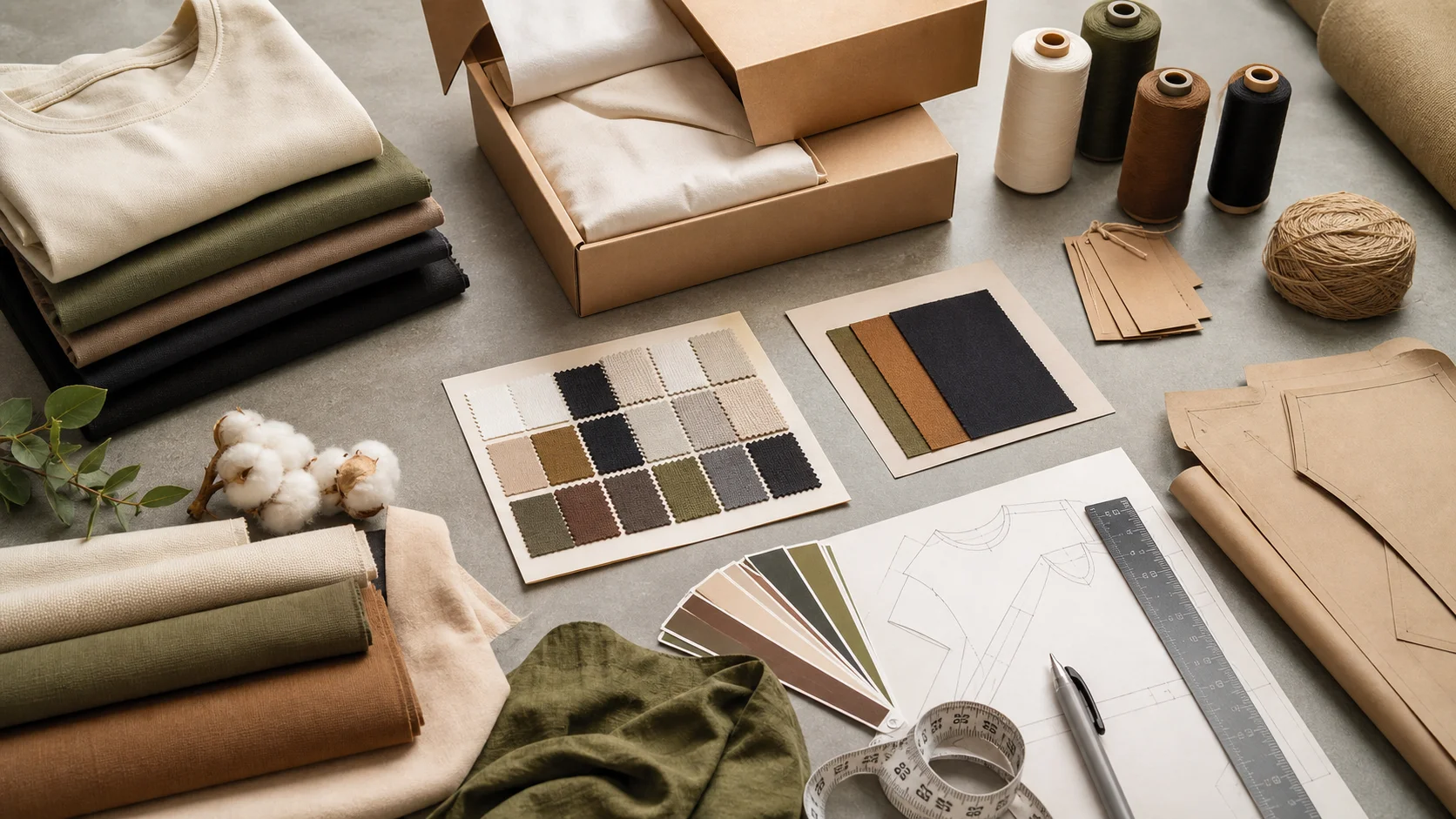
Low-MOQ Jogger Manufacturer with checks for samples, fit, MOQ, QC evidence, pricing terms, and delivery risk.
Fast answer: Low-MOQ Jogger Manufacturer: Size Runs, Fabric, Sampling, and Cost should be judged by production evidence, not by a generic sourcing promise. The buyer needs sample proof, cost breakdowns, QC checkpoints, and delivery buffers in writing.
Ask for recent sample photos, measurement tolerances, fabric or print test assumptions, decoration test notes, packing examples, and a named inspection checkpoint. These details show whether the team can repeat an approved sample at bulk volume.
Separate garment cost, decoration, labels, packaging, sampling, testing, freight, and rush charges. When every cost line is visible, it becomes easier to reduce colorways, adjust size depth, or reserve more time for sampling.
Small-batch joggers are having a moment because brands want margin without betting the farm. Nearly 7 in 10 emerging apparel brands I’ve interviewed start with just 100 to 300 pieces per style, and that scale changes everything about sourcing. A low moq jogger manufacturer overseas becomes attractive because a 200-piece run can absorb setup costs better than a domestic plant built for 2,000-piece orders. Cash flow matters. So does sample speed. When I visited factories in Dhaka, Ho Chi Minh City, and Bucharest, founders kept picking joggers before tees because joggers can carry a higher ticket, often $42 to $78 retail, which leaves room for a $9.50 to $16.00 FOB.
Overseas factories often quote lower MOQs because they run larger sewing floors and spread machine time, maintenance, and supervision across more lines. In South Asia, I’ve seen cut-and-sew plants accept 150 to 250 pieces per color on fleece joggers, especially if the fabric is stock-supported. Southeast Asia tends to be similar on knit programs, though some factories hold firmer on fabric minimums of 400 to 600 meters. Parts of Eastern Europe can be even more flexible for premium buyers, sometimes taking 100 to 150 pieces if the pattern is simple and payment is clean. That flexibility does not come from charity. It comes from capacity planning.
During slow seasons, some overseas factories actually prefer low MOQ jogger work because it fills idle lines without crowding out larger orders. I’ve seen this in January in Cambodia and in late summer in Poland. A factory that was reluctant at 500 pieces in April suddenly welcomed 180 pieces in August because its operator roster had empty hours and its knitting partners had stock yarn on hand. The same plant may quote aggressively on French terry 320 GSM, yet push back hard on custom-dyed fleece with a 6-week lab dip cycle.
The real question is not whether a cheap minimum exists. It is whether the factory can repeat the result. I care about pattern control, communication speed, and proof of export discipline. If a supplier can only talk about price and never about shrinkage, seam recovery, or pack-out accuracy, that quote is a trap dressed as savings. For brands building private label clothing services around joggers, the offshore option works best when the first order is treated like a test, not a victory lap. For broader development support, some teams also pair sourcing with private label clothing services to keep the first run focused and clean.
MOQ means minimum order quantity, but apparel buyers use it loosely, which causes expensive confusion. A factory may quote 200 pieces per style, yet still require 500 meters of fabric, 2,000 meters of drawcord, or 300 sets of branded hangtags. Those are separate gates. A jogger that looks low-MOQ on paper can become a 400-piece economic commitment once color minimums and trim purchase rules show up. That is why I separate garment MOQ from fabric MOQ, trim MOQ, and color minimums before I approve a sample.
The construction of joggers raises or lowers the threshold fast. Elastic waistbands are common, but a self-fabric waistband with internal drawcord, double-needle topstitching, rib cuffs, and slash pockets requires more machine time than a plain straight-leg lounge pant. Add a back patch pocket, coverstitching at the hem, or bartacks at stress points, and the setup grows again. Heavyweight fleece at 380 to 450 GSM usually needs more careful cutting and pressing than a 260 GSM French terry, so the factory price rises and the minimum often follows.
Garment washing also changes the math. Enzyme wash can soften a garment without the aggressive abrasion of stone wash, but both create extra handling, testing, and shrinkage risk. Custom dyeing is another lever. If a mill must produce 500 meters in a special shade of olive or mineral black, the true minimum is governed by the dyehouse, not the sewing line. I’ve seen buyers assume a 200-piece quote meant freedom to order any color; then they discover the factory only had stock yarn in 3 shades and wanted a 4-week lab dip for anything else.
A true low MOQ factory owns or tightly controls production. A trading company bundles small orders by passing them to different workshops, which can work, but it is not the same thing. One is accountable for line output and QC. The other is a coordinator with variable control. If you want fabric development, cutting, and finishing under one roof, ask directly about cut and sew manufacturing capability, then verify where each step happens. If the answer shifts three times, the supplier is selling convenience, not manufacturing discipline.
I start with documents, then I move to the floor. Business registration, export license, audit reports, and client references should be easy for a legitimate supplier to produce within 24 hours. If they cannot send a certificate, a tax record, or a third-party compliance summary, I move on. According to Global Organic Textile Standard guidance and audit practice, traceability is only meaningful when each processing step can be documented, so I want a paper trail before I ever talk about embellishment.
Factory photos are not enough. I ask for live video from cutting tables, sewing lines, QC checkpoints, and the packing area. If the footage shows 8 operators but the factory claims 120 workers, I ask why. I also want to see the storage space for fabric rolls, because poor roll identification causes shade variation later. A credible supplier should be able to show sample room discipline, finished-goods cages, and a numbered workstation map. A factory that hesitates to walk you through its own floor usually has something to hide.
Sampling tells you more than sales language ever will. I measure waistband width, inseam, rise, pocket opening, and cuff recovery after a 5-minute stretch test. I also check stitch density, which should stay consistent across seams, and I wash the sample to test shrinkage. For joggers, I want shrinkage within 3 to 5 percent, not 8 percent. Color consistency matters too. If black fabric shows visible tone shift across panels under daylight, that is a rejection, not a minor variance.
Warning signs are usually blunt. Evasive answers about fabric sourcing. Refusal to quote Incoterms. Lead times that sound too good, such as 7 days for new sample development and 10 days for a 1,000-piece run. I have never seen those promises survive real production pressure. The cheapest quote often hides the most expensive mistakes in rework, freight, and lost weeks. A factory that underquotes by $1.20 a piece and then pushes defect corrections onto you can erase your margin faster than a 10 percent tariff change. If you want a supplier list with clearer filters, you can get a free quote and compare the structure, not just the headline number.
Jogger pricing is not one number. It is fabric, labor, trims, finishing, compliance, and freight stacked into one line item. A 320 GSM French terry jogger in cotton-poly blend may land at $7.80 to $10.50 FOB at 300 pieces, while a 420 GSM brushed fleece style with custom dye and embroidery can move to $11.90 to $16.80. Fiber content matters. A 100 percent cotton body usually costs more than a cotton-poly blend because it absorbs more shrinkage risk and often requires tighter quality control in bulk cutting.
Regional labor costs vary sharply. South Asia still offers some of the lowest sewing rates I’ve seen, especially for simple joggers with one color and no wash. Southeast Asia often sits slightly higher on labor but can reduce freight time to major ports by 7 to 14 days depending on destination. Eastern Europe can be pricier on direct labor, yet it can outperform on speed for EU-bound orders, which lowers financing costs and reduces the chance of missing a seasonal launch. Price is only half the story when you are working with a low moq jogger manufacturer overseas.
At 100 pieces, unit cost can be 20 to 35 percent higher than at 500 pieces because pattern setup and marker making are spread across fewer units. At 300 pieces, the curve softens. At 500 pieces, many factories reach a workable margin. At 1,000 pieces, you may see another 8 to 12 percent drop if fabric is booked efficiently. But that drop is not automatic. If a factory must buy new yarn lots, pay for re-dyeing, or run separate color batches, savings disappear fast.
Hidden charges matter more than founders expect. Sampling can run $40 to $120 per round. Pattern making may be $60 to $180. Embroidery digitizing is often $25 to $75 per logo. Testing for shrinkage, colorfastness, and pilling can add $90 to $250 per style. Cartons, polybags, hangtags, and port fees can add another $0.35 to $1.10 per piece. Some suppliers quote FOB but exclude all the small pieces that eat profit. I always compare landed cost, not just factory price. In one case, a factory in Sri Lanka quoted $0.60 more per unit than a rival in another region, but its defect rate was under 2 percent versus 7 percent, and the lower freight delays made the total cost cheaper by nearly $1.30 a unit.
Sampling usually takes 7 to 14 days if the pattern is clean and fabric is available. Bulk production for a low MOQ jogger program commonly runs 21 to 45 days, depending on whether the factory has open line time. Export packing adds another 2 to 4 days. If you need custom fabric development, add 3 to 6 weeks for lab dips, strike-offs, and mill booking. That delay is not a nuisance. It is the cost of controlling color and handfeel.
Country by country, the window changes. South Asian suppliers can move fast on stock fabric programs, sometimes producing 300 to 500 pieces in 25 to 30 days after approval. Southeast Asian factories often sit in the 30 to 40 day range, especially when multiple trims must be imported. Eastern European production may be 20 to 35 days for EU clients because transit is shorter and communication is tighter, though peak seasons can still stretch schedules. I have seen one 250-piece order in Turkey ship in 18 days from PO to export-ready because the fabric was already in house.
Sea freight is cheaper, but it is slow. Air freight can land in 3 to 7 days, while sea freight from Asia to the US or Europe often takes 18 to 35 days port-to-port, plus customs clearance. If a launch date is fixed, I will pay more for air on the first 200 to 300 units, then move the replenishment order by sea. Brands lose more money missing a campaign window than they do paying an extra $1.80 to $3.40 per kilo on air freight.
Sample time, production time, and transit time should be mapped before you order. South Asia: sample 7 to 12 days, production 25 to 45 days, sea transit 18 to 30 days. Southeast Asia: sample 7 to 14 days, production 30 to 40 days, sea transit 16 to 28 days. Eastern Europe: sample 5 to 10 days, production 20 to 35 days, road or short-sea transit 3 to 12 days. A smart buy starts with the clock, not the color card.
Simple wins. One fabric. One wash. One print method. One or two colorways. That formula gives a factory enough certainty to quote accurately and schedule cutting without guessing. I have watched buyers ask for three fabric weights, two logo placements, and contrast piping on a 150-piece order, then act shocked when the factory pushed back. The spec sheet should be boring in the best possible way. Boring means predictable. Predictable means lower risk for a low moq jogger manufacturer overseas.
Details that raise MOQ fastest are contrast panels, complex appliqué, dense embroidery, special dye effects, and mixed materials on one garment. A jogger with side tape, reflective piping, and a split waistband may look easy on a mood board, but each feature adds setup time and scrap risk. A tonal silicone print is cheaper than a multilayer puff-and-embroider combo. A flat drawcord with metal tips is easier than a braided cord with custom aglets. Small changes can move a style from 150-piece flexibility to 500-piece friction.
Good tech packs include graded specs from XS to XL, stitch types, seam tolerances of 0.5 to 1.0 cm, packaging method, labeling position, and care instructions. I also want fabric composition, GSM, yarn count if available, and wash effect described in plain language. If you plan to reorder, build the jogger so the pattern can repeat across seasons with only a color change. That makes later buying easier and usually drops the MOQ on the second run by 20 to 30 percent.
Region matters here too. Some factories are flexible on pattern tweaks but strict on fabric procurement. Others will source any knit you want but resist revised pocket geometry after sampling. I have seen this difference in Vietnam, where pattern teams were nimble but mill commitments were rigid, and in Romania, where small pattern changes were welcomed as long as the fabric was already approved. Browsing a well-organized browse our product catalog can help you anchor your spec choices before you lock the first order.
Start with five factories, not fifty. Request quotes from each, compare BOMs line by line, and sample the top two. Then place a pilot order of 100 to 300 pieces in one style and one size range. I would not add multiple colorways on the first run unless the factory has already proven fabric consistency. Small-batch buying only works when the variables are controlled.
Ask for a written production calendar with milestone dates for fabric booking, cutting, sewing, finishing, QC, and packing. Build penalty language for delays, even if it is modest, such as a credit against future orders or a freight contribution. A factory that refuses timeline accountability is asking you to carry all the risk. Your contract should also state acceptable shrinkage, measurement tolerances, and defect thresholds before goods leave the floor.
Your QC plan should include pre-production confirmation of fabric and trims, inline inspection at 20 to 30 percent completion, and final inspection before shipment. I also insist on photo evidence of packed cartons and carton counts matched to the PO. Payment terms should protect cash flow: 30 percent deposit, 40 percent after bulk approval, 30 percent after final inspection is a practical starting point, though some suppliers will ask for 50/50 on a first order. Negotiate against milestones, not hope.
Test one style, one size range, one factory, then scale only after you see repeatable results twice. That is the fastest route to reliable sourcing, and it keeps a low moq jogger manufacturer overseas from turning into an expensive guessing exercise. If the first run hits your fit, price, and delivery targets, expand. If it misses any two, reset before you reorder.
For sustainability and compliance checks, it also helps to review independent standards from Textile Exchange, OEKO-TEX, and trade.gov before finalizing a supplier.
Most factories I’ve seen ask for 100 to 300 pieces per style, but the true minimum often includes fabric, trims, and color limits. A supplier may accept 200 garments while still requiring 400 to 600 meters of fabric.
For basic French terry joggers, pricing often falls around $7.80 to $10.50 FOB at 300 pieces. Heavy fleece, custom dyeing, embroidery, and washing can push that to $11.90 to $16.80 per piece.
Sampling usually takes 7 to 14 days, and bulk production often takes 21 to 45 days. Add 3 to 7 days for air freight or 18 to 35 days for sea freight, depending on origin and destination.
Ask for business registration, export license, audit reports, production photos, and client references. Then request live footage of cutting, sewing, QC, and packing, plus a sample review based on measurements, stitch density, and shrinkage.
Yes, many can manage woven labels, printed neck labels, embroidery, hangtags, and custom packaging. Expect digitizing fees of about $25 to $75 and sampling charges of $40 to $120 per round, depending on complexity.