
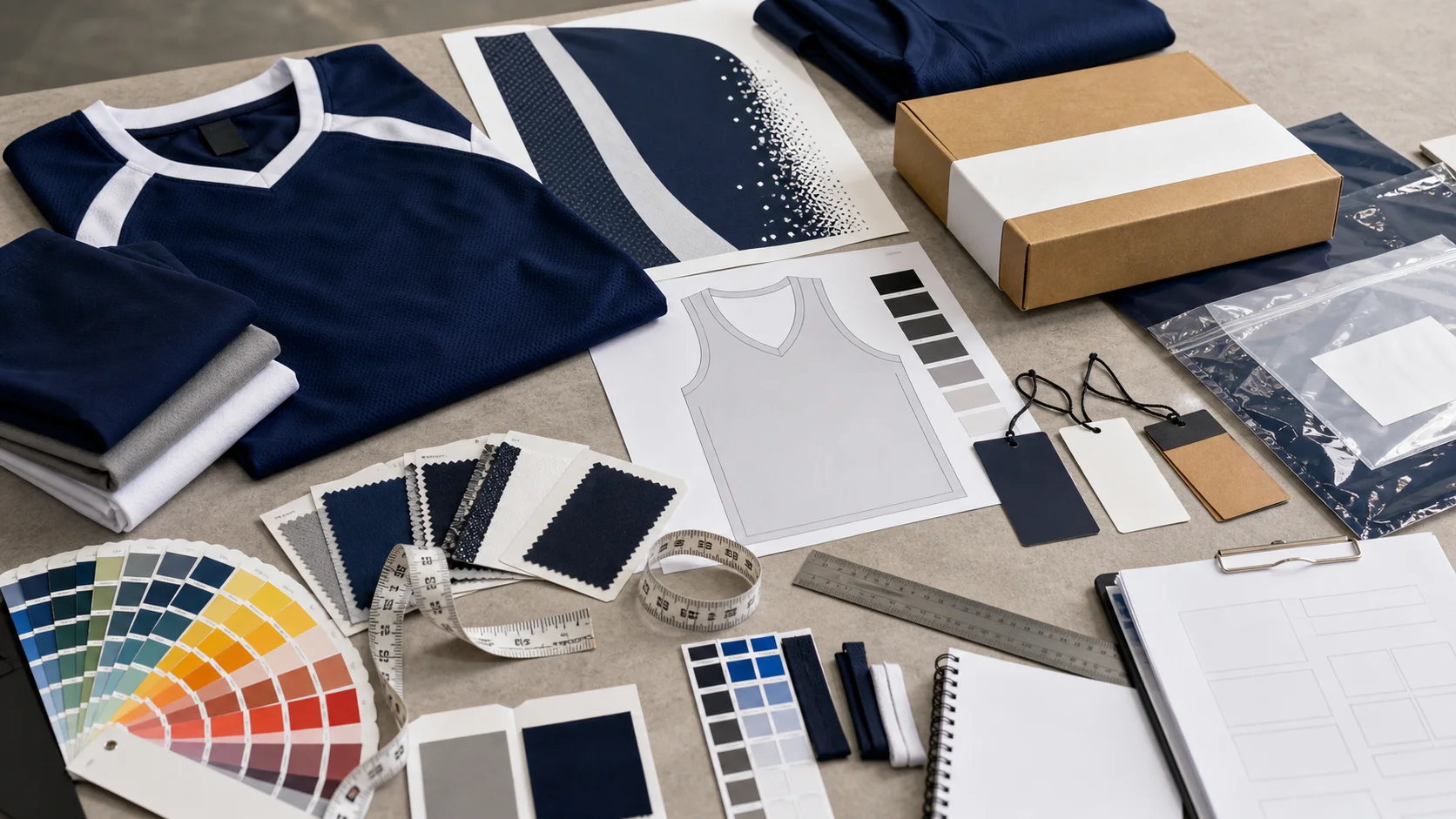
Printed Tissue Paper with Brand Logo with checks for samples, fit, MOQ, QC evidence, pricing terms, and delivery risk.
Fast answer: Printed Tissue Paper with Brand Logo: GSM, Ink, Fold Size, and MOQ should be judged by production evidence, not by a generic sourcing promise. The buyer needs sample proof, cost breakdowns, QC checkpoints, and delivery buffers in writing.
Ask for recent sample photos, measurement tolerances, fabric or print test assumptions, decoration test notes, packing examples, and a named inspection checkpoint. These details show whether the team can repeat an approved sample at bulk volume.
Separate garment cost, decoration, labels, packaging, sampling, testing, freight, and rush charges. When every cost line is visible, it becomes easier to reduce colorways, adjust size depth, or reserve more time for sampling.
A $3 tee can feel like a $30 gift the moment it lands in custom printed tissue paper with brand logo. I have watched a $180 blouse arrive in a plain polybag and lose half its shine before the hanger even touched it. The material cost is tiny. The perception jump is not.
Across factory visits in China, India, Portugal, Vietnam, Turkey, and the U.S., the same pattern kept surfacing: wrapped goods read as more considered, more controlled, and less likely to have been handled carelessly. A bundle of three sheets can cost less than $0.05 a pack at volume, yet the retail signal can be worth many times that when the unboxing video lands on social feeds. For mass-market brands, the uplift is real but limited. For DTC labels, it often helps convert first-time buyers into repeat buyers. For luxury, it is expected hygiene, not a bonus.
The difference is not just price. A $12 accessory brand can use custom printed tissue paper with brand logo to stop looking generic, while a $900 label uses the same touchpoint to protect consistency. Same tissue, different return. On an $18 order, it may be the most visible brand marker after the hangtag. On a $250 order, it supports premium positioning but will not rescue weak product quality. I have seen brands spend on foiled boxes and starve the tissue budget, then wonder why the package still feels incoherent.
What factory visits reveal is blunt: consistency beats drama. A clean one-color repeat on 17 gsm tissue often lands better than a flashy four-color print on a flimsy sheet that tears during packing. In several mills, I saw buyers obsess over substrate claims while ignoring registration drift of 1.5-2 mm, which customers notice faster than paper jargon. Brand memory is built through repetition, not gimmicks.
This is a buying guide, not a branding sermon. I am focusing on what actually changes outcomes: material, print method, MOQ, freight, and the points where a supplier’s promise collapses into rework. If you have ever compared packaging quotes and felt the numbers were telling different stories, that is because they usually are.
Most tissue used for branded wrapping sits in the 14-22 gsm range. At 14-17 gsm, the sheet is airy, soft, and more prone to show-through. At 20-22 gsm, opacity improves, tearing drops, and print edges clean up a bit — but the hand feel can drift from delicate to merely light if the supplier over-calenders the sheet. I have seen buyers ask for “premium tissue” and receive a thicker, whiter sheet that looked less refined in a folding line.
Print method matters just as much. Flexographic printing works well for high-volume runs, often from 5,000 sheets up, with decent speed and controlled unit costs. Offset gives finer detail and sharper small type, but setup can be expensive for small orders and the paper may buckle if the supplier is careless. Digital printing is useful for short runs, test drops, and variable artwork, though the per-sheet cost climbs fast. On small-batch custom printed tissue paper with brand logo, that cost difference can be $0.03 to $0.12 per sheet depending on sheet size and color count.
Ink choice is where some suppliers get slippery. Water-based inks are common, and many mills will describe a product as recyclable or compostable without showing the test basis. Data from ISO standards frameworks and from OEKO-TEX certification programs makes one thing clear: claims need verification, not marketing language. If a vendor cannot tell you whether the ink system affects de-inking, odor, or food-contact suitability, keep asking.
Regional production habits differ. Asia often wins on volume, speed to scale, and aggressive pricing. Europe tends to push tighter compliance norms and steadier color management. In several factories I visited, the first sample looked excellent, but the second production batch exposed the real issue: 2-3% breakage during packing, slight shade drift, and print registration that wandered enough to make the logo feel off-center. That is not a small defect when the entire purpose is consistency.
The same sourcing logic applies elsewhere. The packaging mindset I use for tissue is similar to what I look for in custom bra manufacturing or even private label clothing: material truth, repeatability, and quality control beat glossy promises.
Price tier changes what you can expect. At the budget end, usually tied to orders of 5,000-10,000 sheets, you may see one-color printing, 20-30 day production, and minimal artwork flexibility. Mid-tier buyers, often ordering 20,000-50,000 sheets, can usually ask for cleaner repeats, two-color work, and tighter tolerances on sheet size, maybe ±2 mm instead of ±4 mm. Luxury labels may push for custom sheet sizes, specialty paper, or multi-step finishing, but they also pay for the privilege: setup fees alone can run from $150 to $600 depending on the method.
China remains the most obvious volume player. Unit pricing can be attractive, especially once you pass 20,000 sheets, and factories are often comfortable with repeated orders and fast revisions. India can offer competitive print costs and useful flexibility, though communication chains sometimes add 2-4 extra days per approval round. Europe usually shines in compliance, documentation, and steadier shade control, but the delivered price is higher. North America can be faster for short domestic runs, especially when freight risk is the enemy, yet small-batch pricing is rarely the cheapest.
Hidden costs appear everywhere. Freight on lightweight tissue sounds trivial until a carton count balloons. Color matching can trigger extra proof charges of $50-200. Tooling for a custom repeat may add another $100-300. If you need split shipments, the per-unit cost rises again. I have seen a brand save $280 on the unit quote and lose $1,200 to reprints, customs delays, and emergency air freight. That is the arithmetic suppliers prefer not to lead with.
The cheapest quote can become the most expensive after revisions, rejects, and delays. I learned this the hard way on a holiday accessory line where a low bid from one mill looked irresistible at $0.04 per sheet. Two rounds of color correction, 7% waste from misregistration, and a rushed ship date turned it into the priciest option in the room.
Trade data from International Trade Administration shipping and sourcing guidance consistently shows that freight-sensitive categories swing hard with shipping routes and lead-time buffers, which is why packaging buyers should calculate landed cost, not just factory price. That same habit helped me compare supplier quotes on other categories such as sublimation printing services and cut and sew manufacturing, where setup and revision costs can quietly outrun the unit rate.
Designing for tissue is not the same as designing for a screen. Thin paper drinks ink unevenly, so a logo that looks crisp in a PDF can blur or ghost once it hits a press. I tell buyers to keep the print area generous, leave safe margins of at least 5-8 mm from the cut edge, and avoid tiny marks that disappear after folding. A repeat pattern with a 60-120 mm rhythm usually reads better than a dense, cluttered all-over print.
Color count should stay tight. One or two colors are easier to control, cheaper to run, and less wasteful when the press is calibrated. Three colors can work, but only if the supplier has disciplined registration. Four-color work on tissue often looks clever on screen and muddy on machine. Fine gradients, hairline fonts, and serif microtype are the usual casualties. I have seen a beautiful monochrome crest lose all authority simply because the lettering fell under 4 pt and the ink spread by 0.2-0.4 mm.
Choose PMS references when possible, then ask for a physical strike-off. Digital mockups lie. Paper does not. A blue that looks jewel-like on a monitor may dry flatter and greyer on tissue, especially if the sheet is porous or the ink laydown is heavy. A warm black can become brown-black under certain lamp conditions. That is why proofing under store lighting matters, not just in a studio.
In one run I reviewed, a fashion brand used a gold gradient on custom printed tissue paper with brand logo because it looked expensive in design proofs. On press, the gradient banded badly, the logo lost edge definition, and the final stack looked like three different shades of yellow. A simpler one-color repeat at the same cost would have looked stronger and packed faster.
Keep the design practical, then let the product carry the emotion. Packaging should support the garment, not compete with it.
Here is the cost stack I use when evaluating branded tissue: paper base, printing, plates or digital setup, packaging, sampling, and freight. On a small order of 2,000-3,000 sheets, setup can make up 30-45% of the unit cost. On a bulk order of 50,000 sheets, that setup may fall below 10%. That is why the same sheet can cost $0.10 in one quote and $0.03 in another.
MOQ depends on the method. Digital suppliers may start around 500-1,000 sheets, especially for short-run testing. Flexo often begins closer to 5,000 sheets, sometimes 10,000 if the factory wants a cleaner production block. Offset can sit anywhere from 3,000 to 20,000 sheets depending on the paper size and number of colors. Lead time usually runs 3-4 weeks from artwork approval to dispatch, then another 5-30 days for shipping depending on origin and destination.
Small-batch orders are useful for launches, seasonal drops, and market testing. Bulk orders make sense once the design is stable and replenishment is predictable. In my experience, a brand selling 800-1,200 orders per month should be thinking hard about whether to buy 3 months or 6 months of tissue at once. The answer depends on warehouse space, cash flow, and whether the logo might change.
Sampling and freight are the sneaky variables. Samples can take 5-10 days, and a second round adds time fast. A rushed reorder can be cheaper per unit but more expensive overall if the brand pays air freight on a 40-60 kg carton stack. I have seen buyers save on production and lose on logistics every single time.
The simplest buyer framework is this: if your artwork is untested, order a short run first. If your logo is stable and your annual volume is above 30,000 sheets, negotiate for a production price tied to repeat orders. If you need seasonal colorways, lock in a base spec and vary only the ink, not the sheet. That keeps waste down and approvals cleaner.
Start by asking direct questions. Where is the paper sourced? What is the gsm? Which ink system is used? What is the acceptable defect rate? What is the tolerance on sheet size and registration? Can the factory share a production photo and a test report? If a supplier answers in slogans instead of numbers, I move on.
Inspect samples with your hands as well as your eyes. Check opacity by placing the sheet over dark fabric. Rub the print lightly for smear. Smell it. A strong solvent odor can be a warning. Count sheets for consistency, then check whether the cut edges vary. A good sample in a neat envelope proves very little unless the bulk carton looks and behaves the same way.
Factory visits taught me that one beautiful strike-off does not guarantee a stable run. I have stood beside machines where the first 200 sheets were perfect and the next 2,000 drifted because humidity rose, tension changed, or the operator switched rolls too quickly. That is why I ask for batch photos from the middle of production, not just the start.
Watch for red flags: vague specs, loose terms like “premium quality” with no gsm, refusal to share color references, or a quote that excludes packing but includes “free” corrections. These are the signs of a supplier who is pricing optimism, not production. Comparing two similar quotes means checking line items, not just the grand total. One may include sampling, export cartons, and duty paperwork; the other may not.
That same discipline applies when sourcing other apparel inputs, including a private label clothing program or a custom bra manufacturing order, where tolerance, compliance, and repeatability affect margin just as much as aesthetics.
Build the brief before you ask for quotes. Include sheet size, gsm, number of colors, PMS references, repeat pattern, annual quantity, destination country, target delivery date, and whether you need folded sheets or loose pack. The cleaner the brief, the fewer surprises. A good supplier can quote fast when the data is specific.
Then ask for a sample test. I suggest 2-3 internal reviewers: one merchandising lead, one operations contact, and one store or fulfillment user who handles packing daily. Give them 20-30 sheets and judge the result under normal store lighting, not studio light. If the tissue tears too easily, prints too dark, or smells off, fix it before you approve volume.
Set approval checkpoints: first artwork proof, then material strike-off, then production pre-shipment photo. For larger orders, request cartons from the middle of the run, not only the beginning. That is how you catch drift before it becomes expensive. A 3-step approval process can prevent reprint costs of $300-1,000 and a week of delay.
My final buying instruction is practical: choose the version that fits your brand, your unit economics, and your reorder cadence. A pretty sample is not the goal. Repeatable production is. If your custom printed tissue paper with brand logo does not hold color, survive packing, and land inside your margin, it is decoration, not strategy.
Small runs often land around $0.08-$0.20 per sheet, while larger orders can drop closer to $0.03-$0.06 per sheet depending on size, color count, and shipping route. Setup, sampling, and freight can add $150-$600 or more to the order. The landed cost matters more than the factory quote.
Digital print suppliers may start at 500-1,000 sheets, while flexographic production often begins around 5,000 sheets. Offset runs can sit higher, especially if the artwork uses multiple colors. MOQ depends on paper size, repeat pattern, and whether the factory is set up for short runs.
Most orders take 3-4 weeks from artwork approval to dispatch, then shipping adds 5-30 days depending on origin and destination. A second proof round can add 5-10 days. If the supplier needs new plates or a special paper spec, build in extra time.
Check opacity, rub resistance, line sharpness, odor, and sheet consistency. Hold the sheet over dark fabric to test see-through, then rub the print lightly to see if it smears. Ask for photos from mid-run if you want to judge repeatability, not just the first sample.
China often offers the best unit pricing for larger volumes, India can be flexible on print work, Europe is stronger on compliance and consistency, and North America can suit short domestic runs. The best value depends on freight, revisions, and whether the supplier can hold color across the full order.