
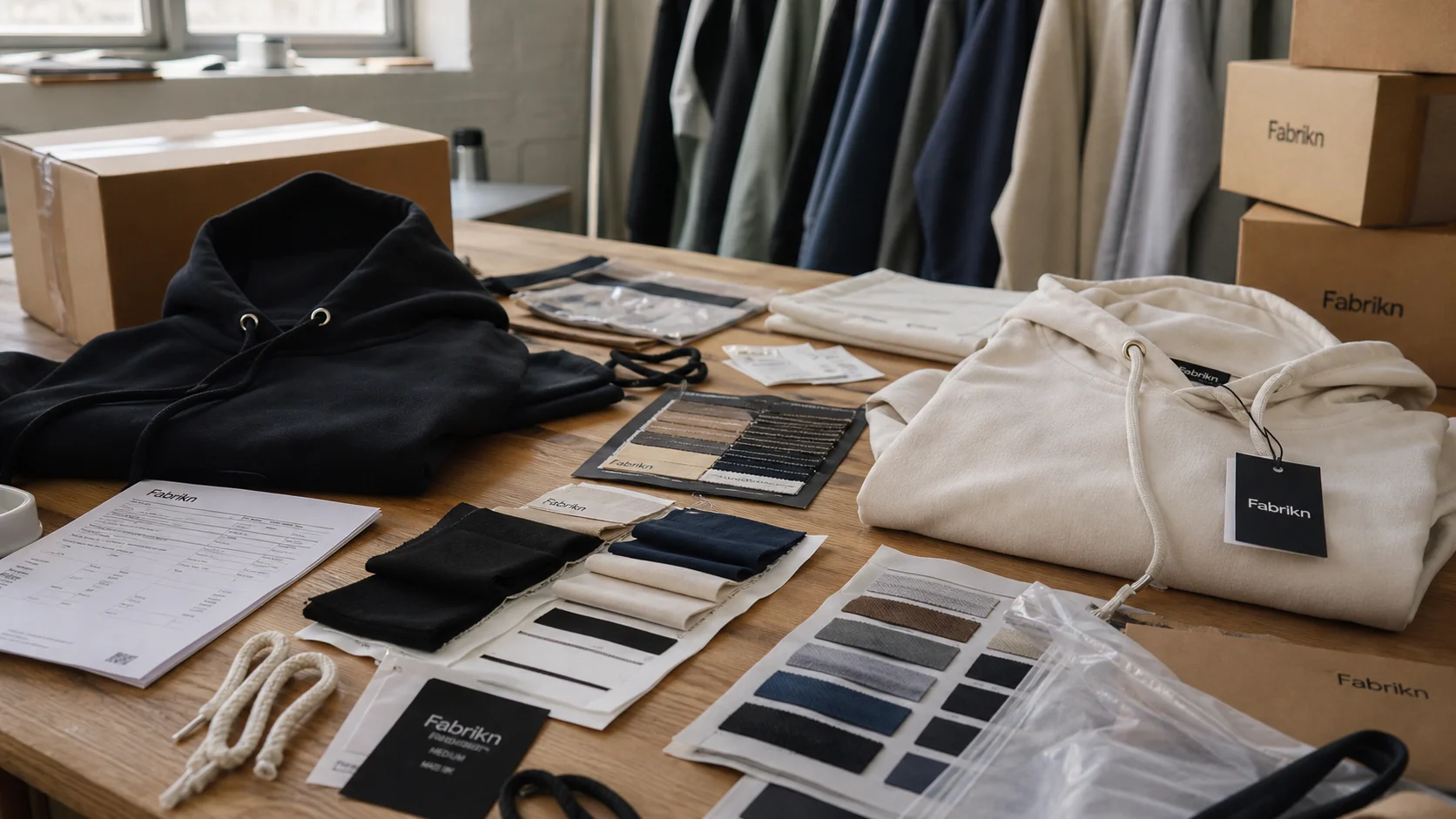
Custom Recycled Kraft Boxes for Clothing Brands compared by sample evidence, fabric or trim specs, MOQ, AQL terms, cost lines, delivery timing, and rework...
Fast answer: Custom Recycled Kraft Boxes for Clothing Brands: Tech Pack, Sample Gate, MOQ, and QC Terms should be judged by production evidence, not by a generic sourcing promise. The buyer needs sample proof, cost breakdowns, QC checkpoints, and delivery buffers in writing.
Ask for recent sample photos, measurement tolerances, fabric or print test assumptions, decoration test notes, packing examples, and a named inspection checkpoint. These details show whether the team can repeat an approved sample at bulk volume.
Separate garment cost, decoration, labels, packaging, sampling, testing, freight, and rush charges. Clear cost lines make it easier to reduce colorways, adjust size depth, or reserve more time for sampling.
The packaging on the table is often the first clue that a brand has grown up. Recycled fiber packaging can be made with 70% to 90% recycled content depending on board grade, and that is one reason custom recycled kraft boxes for clothing brands have moved from niche to mainstream. The first time most teams compare material weight, freight cost, and customer perception side by side, the box stops being “just packaging” and starts acting like a business decision.
Plastic mailers and laminated rigid boxes are getting left behind for practical and financial reasons. Recycled kraft is lighter in material intensity, easier to recycle in most municipal systems, and it delivers a tactile, matte feel that reads as considered rather than flashy. When I visited factories in Vietnam and Portugal, the pattern was the same in different accents: fewer layers, fewer coatings, fewer headaches.
Rigid boxes often cost 25% to 60% more per unit than a simple kraft mailer at the same decoration level, especially once you add inserts, magnetic closures, or soft-touch film. Poly mailers may look cheaper at $0.12-$0.22 per piece, but they rarely support premium presentation for a $90 shirt or a $240 jacket. Brands paying $2.50-$4.50 per box for a recycled kraft structure usually accept that premium because it protects margin elsewhere: fewer returns, better unboxing, stronger repeat purchase intent.
Region matters. In Asia, I’ve seen large runs priced aggressively at MOQ 1,000 to 3,000 units, with better economics when freight is consolidated in 20-foot or 40-foot containers. European suppliers usually quote higher unit costs, yet they often provide tighter compliance documentation, faster sample cycles, and shorter freight routes with less carbon-heavy ocean transit. The decision is rarely only about price. It is about lead time, proof, and the risk tolerance of the brand.
A simpler recycled kraft box often survives transit better than a glossy, heavier alternative because it resists scuffing and stacks more efficiently. I’ve seen cartons with a 2.2 mm board and clean die-cuts outperform ornate boxes that looked luxurious on a desk but failed under compression after 800 to 1,000 kilometers of trucking. Less surface drama. Better logistics.
That matters for brands using private label clothing, where packaging must reinforce consistency across 12 SKUs or 40 SKUs without creating a separate cost center for every capsule drop. It also matters for factories producing cut and sew manufacturing orders, because box specifications often need to match garment folding patterns, polybag sizes, and warehouse shelf dimensions. Packaging is not afterthought work. It touches damage rates, branding, and sustainability claims at the same time.
Most buyers use “kraft” as a catchall, but the material stack is more specific than that. Custom recycled kraft boxes for clothing brands may use kraft paperboard, corrugated kraft, or paper wraps over recycled board, with recycled content ranging from 30% in some coated applications to 100% in certain unprinted structures. The board choice should follow the garment, not the mood board. A 180 GSM folded tee box has different needs from a 1.8 kg outerwear carton.
In my experience, the best supplier teams can explain GSM, caliper, and flute profile without blinking. That matters. A 350 GSM paperboard works well for lightweight apparel and flat-fold tops. Corrugated E-flute or B-flute boards protect denim, knitwear, and heavier accessories better because they absorb shock and resist crush. For shipping cartons, 1.5 mm to 3.0 mm board thickness is common, depending on the garment weight and the distance the box will travel.
Recycled kraft is not a single thing. Uncoated kraft gives the cleanest recycling path, while aqueous coatings add moisture resistance without the plastic film penalty of lamination. Water-based inks and soy inks are popular because they reduce solvent load and print well on brown substrates when the artwork is restrained. Glossy laminates can still be used, but they complicate recycling and often hide the natural texture that makes kraft attractive in the first place.
According to Textile Exchange, fiber and material choices now sit under much closer scrutiny from brands and consumers alike, and packaging is getting pulled into that same conversation. I’ve seen suppliers in India and Turkey present recycled board certificates, but the stronger factories back those claims with recycled content verification, mill declarations, and chain-of-custody records that can survive an auditor’s questions. For broader packaging compliance, the U.S. Trade Administration also remains a useful reference point for import and sourcing considerations.
FSC language is useful only when the documentation is real. A carton can be FSC certified, FSC mix, or made from recycled fiber, and those distinctions should appear exactly as the certificate allows. Vague statements like “eco-friendly” or “green packaging” are weak and risky. Better labels include “made with 80% recycled fiber,” “FSC-certified paperboard,” or “printed with soy-based inks.” That is the level of specificity procurement teams need.
Data from ASTM standards and factory testing protocols shows why structure matters as much as paper source. A board that passes drop tests, compression tests, and rub resistance checks is more valuable than a prettier sample that fails after shipping. I’ve seen brands achieve a premium look without lamination by tightening dielines, reducing print coverage to 20% or 30% of the surface, and using embossing on the logo instead of full-bleed graphics. Simple. Clean. Cheaper to recycle.
Premium packaging is not loud. It is controlled. The best custom recycled kraft boxes for clothing brands I’ve seen use strong typography, disciplined spacing, and one or two structural gestures that make the box feel intentional. A logo, a seam line, a fold reveal. That’s enough. Add too much ink and the kraft substrate starts fighting the design, especially under warm retail lighting where brown can dull pale gradients in seconds.
I once worked with a brand launching 8 SKUs of French terry hoodies at 320 GSM, and the winning box was not the most decorated one. It was the one with a 1-color navy print, a debossed mark, and a fitted insert that reduced garment movement by about 30% in transit simulation. It looked expensive because it was specific, not because it was busy.
Mailer-style folds work well for tees, underwear, and light knitwear. Foldable set-up boxes suit premium drops, gift sets, and collaborations where presentation matters almost as much as protection. Reinforced cartons make more sense for outerwear, denim jackets, and boxed bundles that weigh more than 1.2 kg. For brands shipping wholesale and DTC at the same time, I prefer structures with consistent outer dimensions and internal flexibility.
That way, you can hold SKUs, barcode panels, and returns labels in the same architecture. A retail-ready pack does not need to be a fragile sculpture. It needs to stack on a shelf, survive a warehouse belt, and still look composed when the customer opens it at home. This is where custom baby clothing manufacturing buyers taught me something useful: small, consistent garments benefit from disciplined fold geometry, and that lesson transfers directly to adult apparel packaging.
Inserts and tissue paper should be treated as part of the packaging system, not as decorative extras. A 2-piece pack, meaning a box plus a fitted insert, can reduce garment shift and crease damage by measurable margins in transit tests. I’ve seen that lower the return-linked complaint rate by 3% to 5% in smaller DTC brands. The effect is boring in the best way. Fewer surprises. Less wrinkling. Better first impression.
Fewer colors often print cleaner on kraft. Brown substrates can muddy thin gradients and pale tones, so restraint usually looks more expensive than complexity.
That counterintuitive rule saves money too. A 2-color print can cut plate and setup costs by $120 to $300 per design run, while making the box feel sharper. Brands in premium basics, especially those using custom bra manufacturing or intimate apparel lines, often discover that quiet packaging sells elegance better than illustration-heavy boxes ever could.
Packaging budgets live or die on order size. For custom recycled kraft boxes for clothing brands, small runs can be 25% to 60% more expensive per box than mid-sized orders because tooling, setup, and inspection costs are spread over fewer units. I’ve seen 500-unit orders quoted at $1.90-$3.40 per box, while 5,000-unit orders drop closer to $0.72-$1.40, depending on structure and finish. Price compression is real, but only if the specification is stable.
The biggest cost drivers are predictable. Board weight, custom inserts, print coverage, specialty coatings, foil, embossing, and domestic versus overseas freight all move the number. A 300 GSM mailer printed on one side will not price like a rigid two-piece box with matte lamination and a custom die-cut insert. The brand that understands this stops arguing with the quote and starts shaping the brief.
Simple printed kraft mailers are the cheapest path. Foldable set-up boxes come next, then rigid-style constructions and reinforced cartons. If you want a 1-color logo, a 250 GSM uncoated board, and a standard die-line, many suppliers can quote fast. Add a custom insert, 4-color art, and full inner printing, and the price may jump 15% to 35% immediately. That is before freight.
For brands pricing packaging against garment margins, I advise dividing costs by channel. A $1.10 box may be acceptable for a $140 knitwear set sold DTC, but too high for a $28 tee sold through wholesale. In Europe, documentation is often stronger and freight shorter, yet unit cost can run 10% to 20% above comparable Asian production. In China, the reverse is common: lower factory price, higher exposure to long transit and possible rework. Working with a China-based factory or supplier can make sense when production is stable and quality controls are clearly documented.
Sample lead time usually takes 5 to 10 days for standard structures and 10 to 15 days for custom tooling. Pre-press and approval can add 2 to 4 days if artwork is tight. Simple printed kraft mailers may be ready 10 to 20 days after approval. Complex boxes with inserts, certification checks, and mixed-finish surfaces often need 25 to 45 days. Ocean freight adds 14 to 35 days on top of production, while air freight compresses transit but inflates cost sharply.
Here is the sequence I use when brands ask for a realistic schedule:
Rush orders feel efficient until the hidden costs show up. Expedited shipping can add 12% to 28% to landed cost, while shortening testing time and increasing reorder risk. Last year I worked with a brand that saved 9 days by rushing a shipment, then lost 3 weeks correcting a crush issue that would have been caught with a proper sample review. Patience is not romantic. It is cheaper.
The supplier search should begin with questions that sound almost boring. Recycled content percentage. MOQ. Print method. Drop-test results. Moisture performance. If a vendor cannot answer those without hesitation, move on. I’ve sat across from factory managers in Guangzhou, Braga, and Ho Chi Minh City, and the best ones answer in numbers, not adjectives.
Local sourcing gives faster communication, easier site visits, and lower freight exposure, which is useful for launches with 300 to 800 units. Offshore sourcing often wins on scale, especially once the order reaches 2,000 to 10,000 boxes and the artwork is stable. The trade-off is consistency. Print can vary more across batches if the supplier lacks tight color control or if the board source changes without warning.
Ask these exact questions before paying a deposit:
Sample quality tells you more than a brochure ever will. Check board stiffness, fold accuracy, ink rub resistance, glue lines, and corner crush. I also ask brands to compare two identical samples after 24 hours in retail lighting and after a simulated ship cycle. A supplier may send a perfect-looking box that warps under pressure. That is not premium. That is a problem waiting to be invoiced.
Request ISO certifications, FSC chain-of-custody documents, material declarations, carton testing reports, and where relevant, moisture or compression certificates. If the supplier produces for private label clothing or technical apparel, ask for repeat-order tolerance data too. The cleanest sustainability story is weak if the vendor cannot hold dimensions within 1 to 2 mm across reorders of 5,000 units.
Factory visits taught me one blunt lesson. A box with spotless eco-claims but sloppy tolerances creates more waste than a modest spec with tight execution. The packaging that behaves predictably is the one brands can trust, year after year.
Waste reduction starts with size, not sentiment. A box that is 5 mm too wide can force in extra void fill, extra adhesive, and extra board, then repeat that mistake across 10,000 orders. That small gap may look harmless on a CAD file. At scale, it turns into wasted cubic volume, higher freight costs, and more corrugated scrap. Tight sizing is one of the easiest margin wins in packaging.
Flat-pack or foldable designs can cut inbound shipping volume sharply compared with pre-assembled boxes. I’ve seen brands reduce pallet count by 30% to 50% simply by switching from rigid-form packaging to flat sheets that the warehouse assembles on demand. That saves space, lowers freight weight, and reduces storage pressure during seasonal peaks.
Modular artwork helps too. Leave room for seasonal stickers, variable data, and one reusable base layout across multiple drops. That avoids reprints when a campaign changes late or a colorway underperforms. Uncoated recycled kraft is easier to recycle than glossy, plastic-laminated cartons, which means the end-of-life path is cleaner for customers and less messy for municipal systems.
Waste cuts show up in the ledger. Less fill material, fewer damaged returns, less warehouse labor, and lower reorder frequency all improve per-order economics. For brands producing cut and sew manufacturing collections with variable garment weights, a packaging spec that can stretch across product types saves both money and time. Sustainability and margin are not separate stories here. They are the same spreadsheet.
Start with the product, not the packaging mood board. Define garment weights, fold dimensions, shipping channel, and target price per box. Then choose the box style. Then ask for quotes. I prefer a short list of 2 to 3 suppliers, because more than that usually creates noise, not clarity. The brands that move fastest are the ones that reduce the brief to numbers before they start comparing visuals.
A pilot order of 500 to 1,000 units is enough to test assembly speed, print quality, customer feedback, and transit performance. I want brands to watch how long it takes a warehouse team to build each box, how much tape is needed, and how often corners arrive crushed after shipping. If the sample works under retail lighting and still looks clean after delivery, you have something usable. If it only works in a presentation deck, it is not ready.
Compare the samples after shipping, not only when they are fresh from the factory. Scuffing, color drift, and corner crush tell you more than polished photos do. I look for a box that balances cost, durability, and claim support in one decision. That is the standard. Not cheapest. Not prettiest. Usable, verified, and repeatable—so custom recycled kraft boxes for clothing brands can earn their place from the first shipment onward.
Most runs land between $0.72 and $3.40 per box, depending on size, print coverage, board weight, and MOQ. Small orders of 500 units usually cost 25% to 60% more per piece than runs of 5,000.
Simple printed mailers may take 10 to 20 days after approval. Boxes with inserts, certification checks, or specialty finishes often need 25 to 45 days, plus freight time of 3 to 35 days depending on air or ocean shipping.
Suppliers typically use kraft paperboard, corrugated kraft, or paper wraps over recycled board. Recycled content can range from 30% to 100%, and many brands choose 250 GSM to 350 GSM board for folded apparel.
Many factories set MOQs at 500, 1,000, or 3,000 units per size. Custom print, inserts, and certification requirements can push the MOQ higher, especially for offshore production.
Yes, but only if the claim matches your documents. Use precise wording such as “made with 80% recycled fiber” or “FSC-certified paperboard,” and keep chain-of-custody and material declarations on file.
Compare manufacturer capability, factory quality controls, wholesale pricing, bulk order support, and production lead times. Ask for samples, testing reports, and documentation before you place an order.
Yes. Many brands source from China because the factory network, custom options, and bulk production capacity are strong. Just verify recycled content claims, MOQ, and quality documentation before confirming the order.