
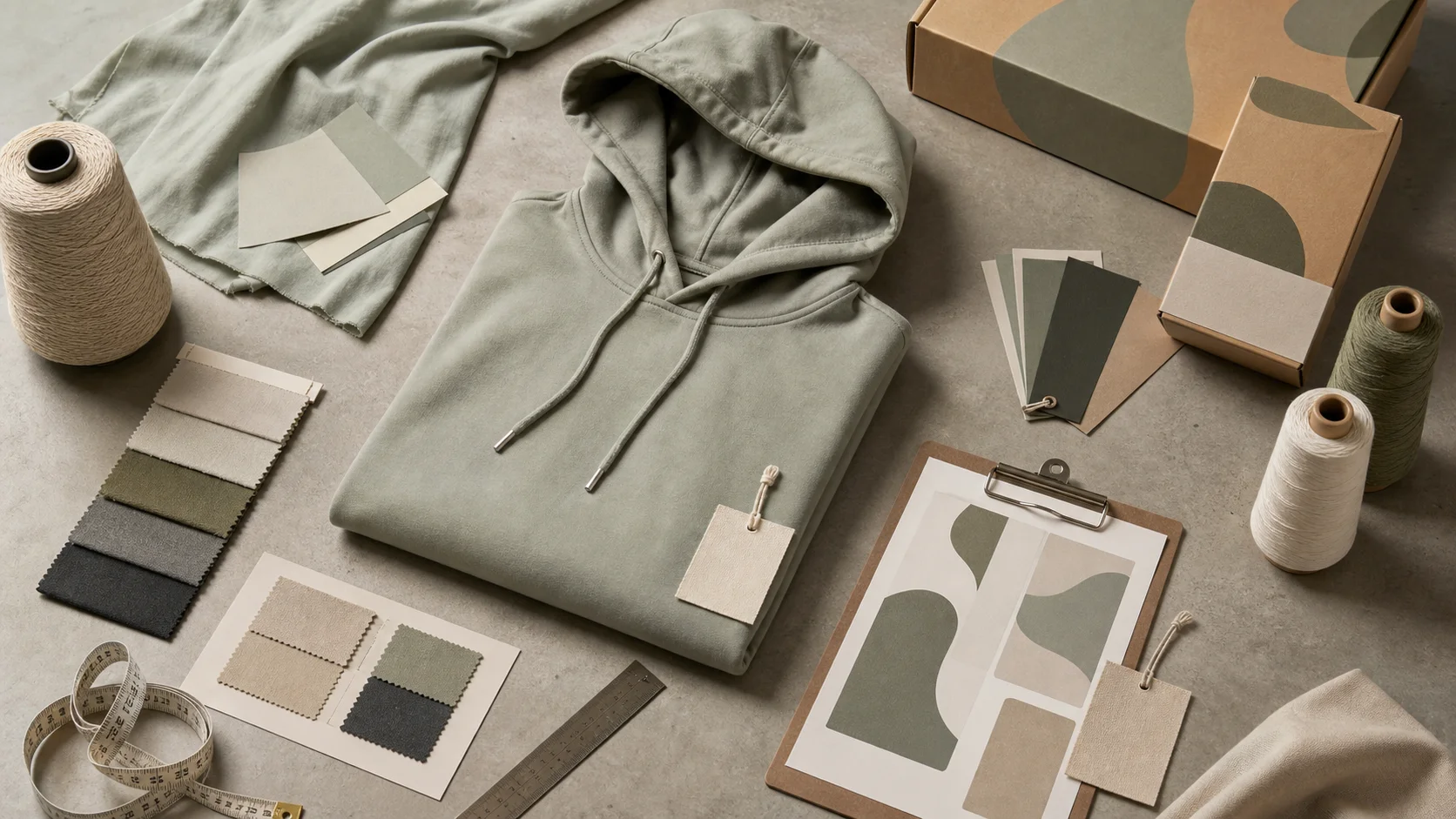
Printed Apparel Boxes with checks for samples, fit, MOQ, QC evidence, pricing terms, and delivery risk.
Fast answer: Printed Apparel Boxes: Board Grade, Print, Inserts, and Damage Control should be judged by production evidence, not by a generic sourcing promise. The buyer needs sample proof, cost breakdowns, QC checkpoints, and delivery buffers in writing.
Ask for recent sample photos, measurement tolerances, fabric or print test assumptions, decoration test notes, packing examples, and a named inspection checkpoint. These details show whether the team can repeat an approved sample at bulk volume.
Separate garment cost, decoration, labels, packaging, sampling, testing, freight, and rush charges. When every cost line is visible, it becomes easier to reduce colorways, adjust size depth, or reserve more time for sampling.
The box that saves the shipment is usually the one nobody notices. Custom recycled kraft boxes for clothing delivery moved from niche to default after 2020, when brands started measuring damage, returns, and warehouse waste with less mercy than before. I first saw the change on a 12,000-shirt shipment headed to three DCs: a 2.8% corner-crush rate turned into 336 damaged units and a returns bill that made the packaging suddenly look very cheap indeed.
Walking factories in Guangzhou, Ho Chi Minh City, and southern Poland, the same pattern kept surfacing. Recycled kraft board held up better than many buyers expected in humid warehouses and on long sea routes, provided the spec was honest about weight and stacking. A 350 gsm recycled board with a snug lid survived three to four weeks of transit far better than a glossy sample that looked expensive on the table and folded under pallet pressure. In tropical storage, a 28% moisture swing could warp weak board within 48 hours.
Adoption rates vary by region. Europe moved early because packaging rules and retailer scorecards made the choice visible, and several markets already treat curbside recovery as a selling point. North America moved more unevenly, with larger e-commerce brands adopting faster than department-store programs. Asia is split: export-focused factories often build to the tighter WRAP and BSCI specs demanded by EU and US clients, while domestic packaging standards can be looser and price pressure stronger. In Dhaka I saw facilities layering GRS-certified fiber over a double-wall structure to meet Western retailers' GOTS and OEKO-TEX Standard 100 textile certifications, even though the local market only asked for basic strength metrics. Data from the WTO and trade filings shows why cross-border compliance keeps tightening the spec sheet.
The surprise is that higher-end labels often adopt recycled kraft faster than mass-market labels because the costs are easier to measure. A premium knitwear brand selling at $120-$220 per piece can trace a 1.5% freight damage drop to real dollars, while a low-margin basics brand often treats packaging as a tiny line item and waits too long. I have seen that calculus inside brands that also invest in custom baby clothing manufacturing, where presentation and safety both matter, and the packaging spec gets audited with unusual discipline.
On the floor, the winner is rarely the prettiest box. It is the one that keeps a folded oxford shirt flat, keeps moisture out, and still fits a return label without a wrestling match. That sounds dull. It saves money.
Recycled kraft board is paperboard made from recovered fiber, usually with a brown unbleached look and a working balance of stiffness, tear resistance, and printability. In the factories I’ve toured, recycled content commonly ranges from 60% to 100%, with many clothing boxes landing around 70%-85% post-consumer or mixed recycled fiber. Typical weights run from 250 gsm to 500 gsm for folding cartons, while heavier corrugated builds can move higher depending on the product load and the shipping route.
For clothing delivery, the construction matters as much as the material. Single-wall board is lighter and cheaper, often enough for a folded T-shirt, a camisole, or one knit dress packed in tissue. Double-wall builds add crush resistance and are better for heavier denim, knitwear, or multi-item orders that can hit 1.5 kg to 3 kg once folded and bagged. I’ve seen a 320 gsm single-wall box perform well for one sweatshirt, then fail when the same design was used for two hoodies and a belt pouch. In Ho Chi Minh City a supplier switched to a 350 gsm E-flute double wall for a denim launch and cut transit claims by 62%, even though the board only added 35 grams per box.
Coatings and inks decide whether the box still recycles cleanly. Water-based coatings resist scuffs without turning the carton into a plastic shell, and soy or vegetable-based inks keep print systems more paper-friendly than heavy solvent work. Embossing and debossing add texture without contaminating the fiber stream. Minimal lamination can work if it is paper-based, but film lamination usually turns a recycling-friendly box into a sorting headache. According to ASTM packaging test guidance, compression and burst behavior should be checked before you approve finish-heavy designs.
Factories will often offer kraft liners, white topsheets, or clay-coated surfaces. White liners print beautifully, but they can add cost and make the box feel less obviously recycled. A brown kraft outside with a clean one-color logo is usually the easiest way to keep the material story intact. That is especially true for brands that already work through private label clothing services and need packaging that supports margin without looking cheap.
Most buyers miss this: the finish that looks most luxurious in a sample room is often the one that slows recycling later. A matte water-based coating with restrained print beats a plastic-feel gloss every time for curbside friendliness and post-sale trust. On lines equipped with Bobst ExpertFold 110 folder-gluers and Heidelberg Speedmaster flexo presses, operators run 600 meters a minute to keep the stack smooth while water-based EVA glue cools to maintain the recycled fiber’s integrity.
There is no perfect format. There is only the format that best matches the product mix, shipping method, and margin structure. For soft goods, the real comparison usually comes down to recycled kraft boxes, corrugated mailers, and poly mailers. I’ve reviewed enough rate cards to know the tradeoff is never just material cost. It includes weight, brand signal, damage recovery, and the time your team spends repacking returns.
Here is the practical comparison buyers should build into a quote sheet. Think in four columns: unit cost, protection, shipping weight, and recycling ease. A simple poly mailer for a T-shirt can land around $0.05-$0.18 per piece, with almost no crush protection and excellent lightweight shipping economics. Custom recycled kraft boxes for clothing delivery may run $0.35-$1.10 depending on print and quantity, but they give much stronger presentation and far better stack performance. Corrugated mailers often sit in the middle, around $0.20-$0.70, with moderate protection and easier flat-pack storage.
For folded denim, the box usually wins. A pair of jeans can puncture thin mailers at the fold corner, especially if a rivet or hangtag is left in place. For premium knitwear, the box also wins because the unboxing effect supports perceived value. For multi-item orders, boxes make returns easier; the customer can refold, reseal, and send back without improvising with tape. For ultra-low-cost basics, the mailer still wins because a $4.99 tee cannot absorb a $0.70 pack-out the way a $98 cardigan can.
Factories in Vietnam and Turkey often tell me the same thing: the cheapest format is not always the cheapest shipped format. A 25 gram mailer may save on carton spend, but if 2% of units arrive crushed or wrinkled, the hidden cost can exceed the box upgrade by a wide margin. In one Istanbul audit, switching from poly to kraft boxes cut customer service complaints by 18% over 90 days, even though packaging spend rose by 11%. That same supplier filmed the load stability on a Kongsberg die cutter and recalibrated the hand-stack to remove voids; freight partners noticed the pallets stacked 12% tighter, which trimmed marine freight by 4%.
The closer the order gets to premium retail, the more the box matters. This is especially true for brands using cut and sew manufacturing, where fabric hand-feel, trim quality, and packaging all signal the same level of care. A thin mailer can work for commodity basics. It struggles to carry a premium story.
Exact-fit sizing is the first design decision that saves money. A box that is 10 mm too tall or 15 mm too wide creates void space, and void space means higher freight weight plus wasted filler. In Guangzhou runs we do a nested size study on the Evolabel 510 cutter, measuring every style (sweaters, blouses, denim) to the nearest 2 mm before we lock the die. That is what keeps the void ratio below 5% and keeps stuffing material (notably, recycled paper chips) from blowing the margin up.
Insert tabs, tuck locks, and magnetic closures must be balanced against run speed. Magnetic closures look nice but add 20 seconds per box and can interfere with metal detectors in Istanbul warehouses. Instead, the best designs use a full tuck lock with a reinforced flap pressed using a Bobst Horizon BHS folder-gluer and sealed with water-based EVA; that glue keeps the broken-down box recyclable in curbside systems. Transparent windows require PET film, but where possible we swap them for kraft cutouts backlighted with a colored liner; this keeps the fiber stream intact and still signals the product inside.
Work with a packaging engineer to define the stacking load (a minimum of 6 layers for retail-bound pallets). In Ho Chi Minh City mills we specify a 1,500 N McKee test result for boxes holding 3 kg bundles, and the corrugator line is tuned accordingly. Hoist the boxes with robotic arms or vacuum lifters at 120 boxes per minute to avoid operator fatigue. These seemingly small choices reduce crush claims in transit, especially when the shipping route includes a 5-week ocean leg from Dhaka to New York.
Certification counts. Recycled content statements should trace back to a mill-certified ledger, not just a "made with recycled fiber" call-out in the spec sheet. Insist on certificates for GRS (Global Recycled Standard) and WRAP (Worldwide Responsible Accredited Production) when the factory is in Guangzhou, Dhaka, or Ho Chi Minh City. The same goes for OEKO-TEX Standard 100 and GOTS if the packaging is bundled with textile orders—keeping the fiber trackable across clothing and box ensures the audit trail stays intact.
If the supplier claims BSCI (Business Social Compliance Initiative) compliance, ask for the latest audit report and look for corrective action plans tied to overtime, safety, and chemical handling. GOTS and OEKO-TEX Standard 100 apply to textiles, but when a packaging line serves those garments, it often falls under the same chemical management regime. WRAP adds a layer for working conditions, and BSCI documents social compliance; together they help avoid surprises in EU member states where customs now ask for documentation at the quay.
Document the process. From fiber receipt to conversion, the path should include paper receivals, moisture readings, ink usage reports, and die-cut records. ISO 9001 is table stakes, but look for the additional traceability that lets you link a printed batch (200,000 boxes) to a specific GRS-certified bale and a particular run on the BHS KAMA ProCut. That is how you prove the recycled claim to an auditor when the shipment hits Rotterdam.
The math starts with MOQ. For a standard 320 gsm single-wall box with a one-color print and no lamination, expect to pay $2.50-4.00 per unit at 500 MOQ when sourced from Ho Chi Minh City or Guangzhou. Add special features such as a window, foil, or embossing and you jump toward the higher end of that range. The same base design runs closer to $2.20 at a 2,000-unit MOQ, and economies kick in as the die-cut fees are amortized over more boxes — the folded dimensions and lengths determine whether a Bobst Mastercut 106 or a local flatbed die-cutter carries the run.
Turnaround matters: once you approve artwork and tooling, most converters in Dhaka and Istanbul quote 18-22 business days to produce, assemble, and palletize the order, assuming you handle shipping labels, sample approvals, and compliance checks on schedule. That timeline keeps the line from bottlenecking and also allows the printer time to run the PET-free inks through the Heidelberg Speedmaster XL 106 without sweating the curing cycle, so the box is ready to stack for ocean freight.
Also budget for sample builds: digital proofs cost $220-$450, and physical samples (usually 2-3 per style) use the same adhesives and liners planned for the full run. The sample window buys you confidence on the compression rating, stacking test (ASTM D642), and board moisture content (target 6%-8%). Skip it and you risk a mass production run that fails the shipper’s drop test.
Start with a detailed brief. Include the garment mix, final packed weight (ideally measured on a postal scale), desired eco claims, and target countries. Request a production flow chart showing how the fiber arrives, how the print is applied (flexo, digital, litho), and where the boxes are glued, folded, and packed. This level of documentation is standard in Guangzhou and Ho Chi Minh City plants that already serve European retailers.
Ask for a stacking study. The supplier should be able to simulate an 8-layer pallet using either Finite Element Analysis or manual load tests. Insist on pictures of the tool in the folder-gluer setup to confirm the die cushion is under the Bobst Expertfold 110 pressure plate correctly — that assures you the curve and lock tab will hold up without retooling mid-run.
Lock in logistics early. If you ship from Dhaka, 18-22 business days sometimes adds in a two-week dedicated truck lag before the unit hits Chittagong port, so build a buffer. Istanbul converters often route boxes through Trieste to serve EU brands, so ask for delivery proofs to ensure the inland leg is part of the quote. Having freight forwarders in the loop prevents last-minute rush fees and keeps your packaging calendar aligned with garment production.
Q: Can recycled kraft boxes match the look of coated luxury packaging? A: Yes, when you combine a 320-400 gsm board with a soft-touch water-based coating, minimal foil, and tactile embossing. The key is matching the finish to the brand story without sacrificing recyclability by adding PET or foil-backed materials.
Q: How do I ensure the recycled content claim is real? A: Require a GRS certificate for the fiber and audit reports for WRAP, BSCI, or OEKO-TEX Standard 100 if the box is part of a textile shipment. Ask for a traceability sheet linking the batch of boxes to a certified bale and keep the documentation in your CSR file.
Q: What lead time should I expect? A: Plan for 18-22 business days once tooling is approved, especially if you are sourcing from Guangzhou, Dhaka, Ho Chi Minh City, or Istanbul. Add another 5-7 days for ocean freight booking and customs paperwork if needed.
Q: How do I protect knock-down boxes in transit? A: Use double-wall construction, tuck locks reinforced with a strip of recycled kraft, and strap the pallet with 19 mm composite strapping. Pre-ship the sample and run a drop test in the receiving warehouse to confirm.
Q: What’s the best way to pair packaging with private label apparel? A: Coordinate your packaging spec with the private label clothing manufacturer so the box, garment, and care label all share the same sustainability certifications (GOTS, OEKO-TEX Standard 100, etc.), color palette, and packaging process. That way you avoid last-minute supply chain disconnects.